

Rockstar Games has come under attack from a hacker group that means business: the Shiny Hunters. The studio refused to pay the ransom, so the hackers dropped everything a day earlier than threatened. The result: 78 million records exposed, staggering financial figures on GTA Online, and legitimate questions about the future of GTA 6. Here is what the GTA 6 leak analysis actually reveals.
GTA 6 leak: Shiny Hunters enter the scene
The GTA 6 leak data has been released online and the community is analyzing it right now. Behind the attack: the Shiny Hunters. Rockstar refused to pay the ransom. In response, the hackers dropped everything a day earlier than planned.
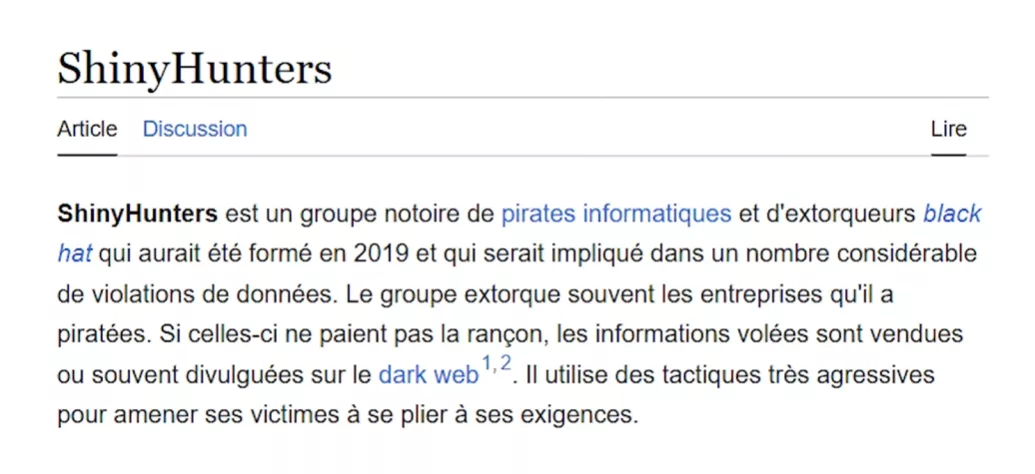
The Shiny Hunters are not amateurs. This group has been active since 2020 and has built a reputation in the cybersecurity world, for all the wrong reasons. Among their previous victims: Microsoft, Ticketmaster, Cisco, as well as Gucci, Louis Vuitton, IKEA, McDonald’s and KFC. These are not hackers who go after small studios.
What makes this group particularly dangerous is their method. They do not attack large companies head-on. They target APIs, identity systems and, above all, third-party integrations — those external services a company trusts to handle its data. A more discreet approach, and far more effective.
Anodot and Snowflake: the vulnerability that opened everything up
To understand how the Shiny Hunters got their hands on Rockstar’s data, you need to look at a tool most players have never heard of: Anodot. It is a cloud cost monitoring platform used by Rockstar to analyze and optimize spending across its infrastructure. This tool is connected to Snowflake, Rockstar’s cloud data warehouse, where internal analytics data is stored.
The group did not attack Snowflake directly. They did not target Rockstar head-on either. They went through Anodot, the third-party service. That was the weak link.
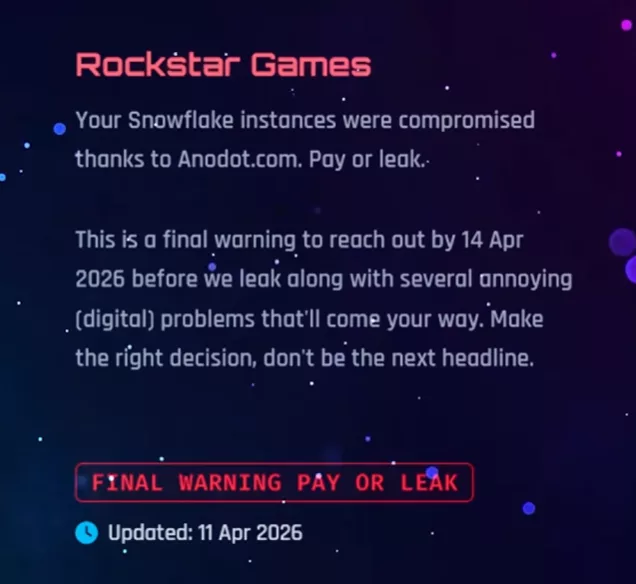
On April 11, the Shiny Hunters published a message on their dark web site. A deadline set for April 14. In their own words: « Rockstar Games, your Snowflake instances have been compromised through anodot.com. Pay up or we release everything. This is our final warning. Make the right decision — don’t become the next big headline. »
Rockstar’s Confirmation and the Emergency Maintenance
Faced with media pressure and the rapid spread of information across social networks, Rockstar Games quickly broke its silence. In a statement issued to several specialist outlets, the studio confirmed the facts without attempting to downplay the existence of the incident: « We confirm that a limited amount of non-essential company information was accessed as a result of a data leak at a third party. This incident has no impact on our organization or our players. » The wording echoes the first message released before the April 14 ultimatum, in which the studio was already minimizing the scope of the incident.
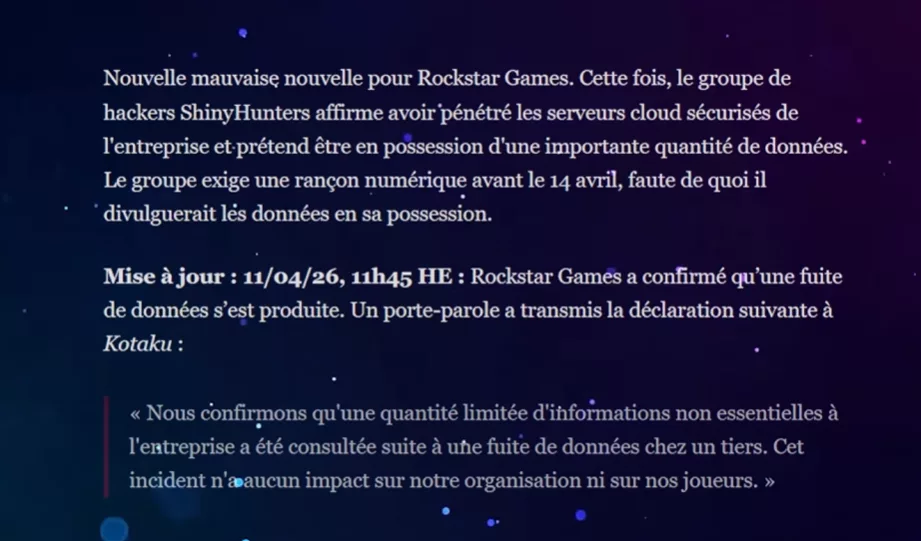
A statement that, read between the lines, says both a great deal and very little. The word « limited » serves as a classic communications shield, and the insistence on the absence of any impact for players seems primarily designed to defuse panic within the community. Behind this carefully managed messaging, actions told a different story.
On April 14, the very day of the deadline set by the hackers, Rockstar triggered emergency maintenance on the GTA Online PC servers. This is not a decision made on the fly: taking servers offline in the middle of the day, without warning, is an admission that something needs to be patched. PC players were disconnected, while consoles were unaffected — a sign that the targeted vulnerability was clearly localized on the PC infrastructure side. This kind of express maintenance looks less like a planned operation than an attempt to limit the damage before files ended up in the wild.
And the damage came sooner than expected. On April 13, a full day before the announced date, the group gave an interview to the BBC to announce that Rockstar had refused to meet their demands. With no agreement, no negotiation, they acted on their threat immediately, releasing all the files twenty-four hours ahead of schedule. A move that looks less like impatience than a message sent to the industry: the deadlines they set are not guarantees.
78 Million Records: The GTA 6 Leak Exposes GTA Online as a Real Cash Machine
The archive contains more than 78 million records, making it potentially one of the most massive leaks in the studio’s history. The data is divided into six broad categories: financial revenue, anti-cheat security, player analytics, in-game economy, customer support metrics, and technical infrastructure. No source code, no GTA 6 data. But the financial figures are absolutely staggering.
For a game released in 2013, GTA Online’s performance is enough to leave you speechless. According to the exposed data, the title generates approximately $1.3 million per day over the past six months. That’s $100 million over a week. That’s nearly $500 million per year, from GTA Online alone, not counting game sales themselves.
What makes this figure even more striking is the extreme concentration of this wealth: only 4% of active players actually spend money in the game. All that money rests on a tiny fraction of the player base. Between 2014 and 2024, Rockstar reportedly raked in more than $5 billion through Shark Cards — this premium currency system that didn’t even exist at the game’s launch.
One detail that generated a lot of discussion: at Christmas 2020, a single player spent more than one million dollars on cars in a single transaction. In gaming parlance, this is called a whale — one of those exceptionally rare profiles whose spending alone keeps an entire live service economy running.
RDO vs GTA Online: A Staggering Revenue Gap
The GTA 6 leak data puts into perspective something many players sensed without being able to quantify: Red Dead Online and GTA Online never really competed in the same league. In terms of gross revenue, the gap is not just significant — it is utterly abyssal. GTA Online generates an average of $9.59 million per week. Red Dead Online, meanwhile, tops out at $507,000 over the same period. That’s a ratio of 1 to 19. Over the year, that translates to roughly $498.8 million for GTA Online versus $26.4 million for RDO. And even then, RDO’s best weeks peak at $868,000, whereas GTA Online can reach $27.9 million in a single week during special events.
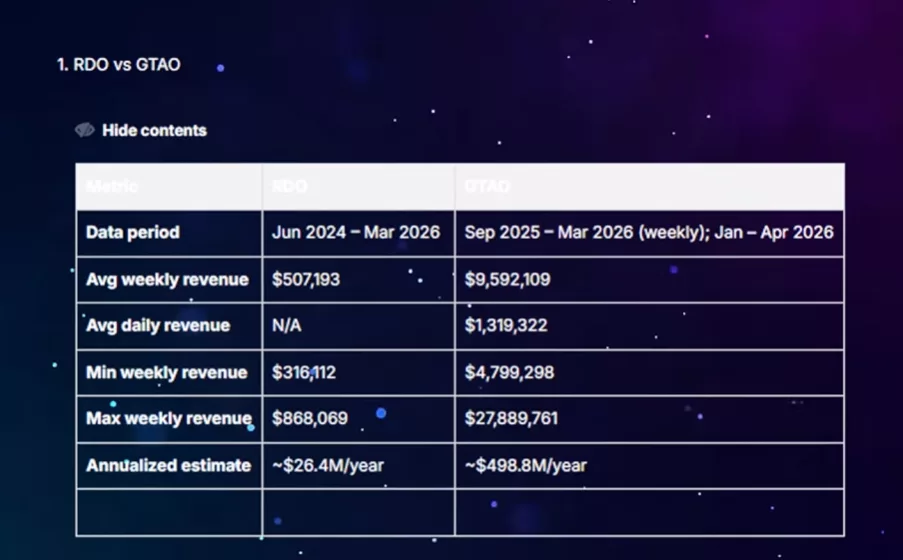
These figures shed a harsh light on a decision Rockstar never officially explained: the gradual abandonment of Red Dead Online. For years, players waited for substantial updates, called for content, hoped for support comparable to what GTA Online received. Rockstar never responded directly. Now, we understand why. When one game earns twenty times less than the other, development teams don’t follow. Resources go where revenue is, and revenue was on the side of Los Santos.
Perhaps the most revealing detail in this picture is GTA Online’s floor: even during its slowest recorded week in the data, the game pulled in $4.79 million. In other words, GTA Online’s worst week is still nearly ten times better than Red Dead Online’s best. Faced with a $3 billion development cost for GTA 6, it becomes clearer why Rockstar is betting everything on the successor.
Platforms and Anti-Cheat: Why PC Always Comes Last
The platform distribution figures are unambiguous. PS5 literally crushes the competition with 53% of GTA Online’s weekly revenue — over $4.4 million every week from that console alone. Behind it, Xbox Series X/S captures 22%, PS4 still 11%, Xbox One 11%, and PC? 3%. Three measly percent. Barely $264,000 per week on a platform that nevertheless hosts millions of players.
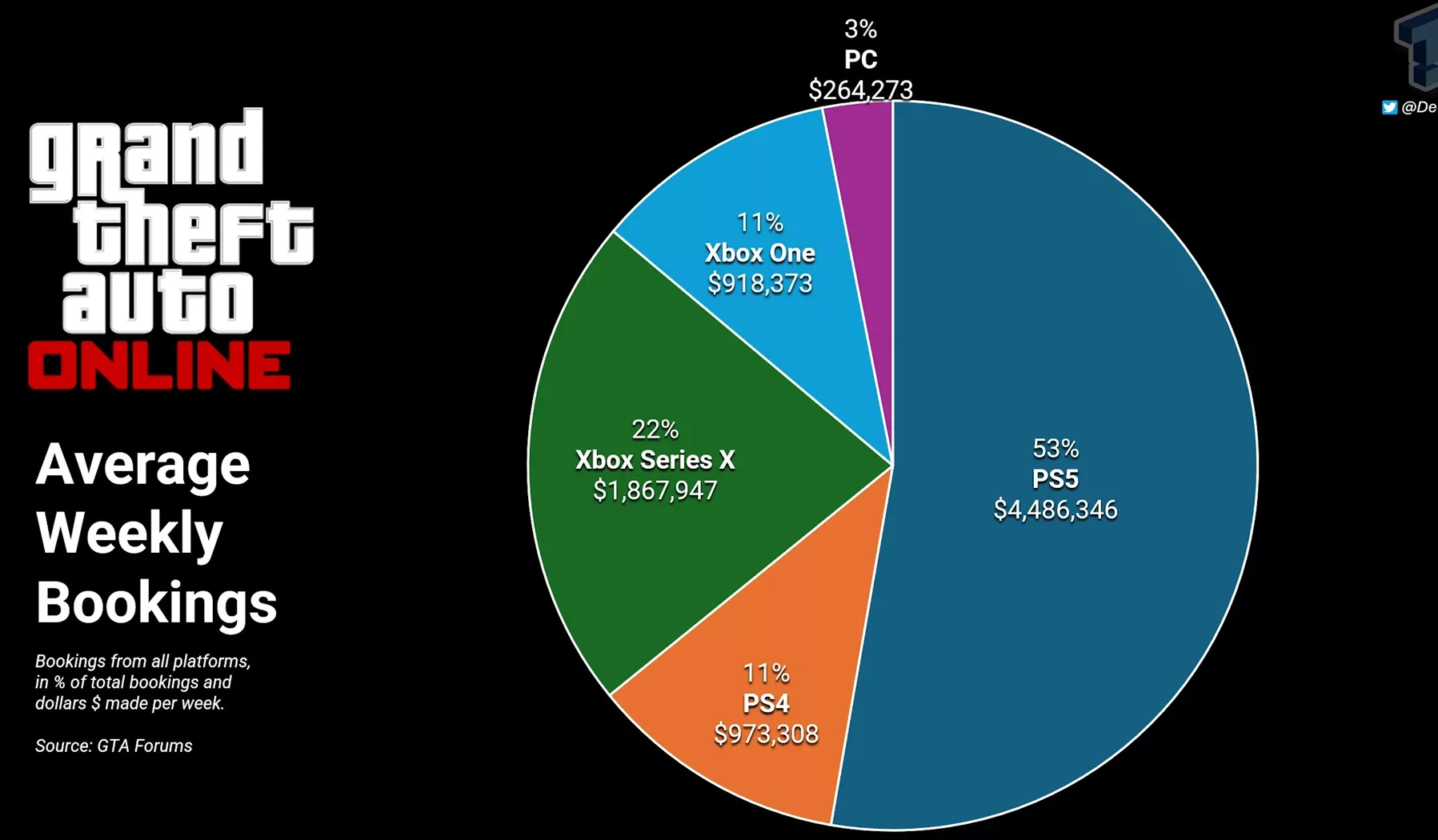
What is even more surprising is that Xbox One, a last-generation console, outperforms PC in both active player numbers and spending. How can an aging machine generate more money than a platform as powerful as PC? The answer comes down to two words: FiveM and RP servers. A huge portion of the PC community plays on alternative servers where Shark Cards are completely useless. These players enjoy the game, build communities, spend hundreds of hours in Los Santos — but Rockstar doesn’t monetize them. Result: PC is a massively active platform that is nearly invisible in terms of revenue.
The real hot-button issue in this GTA 6 leak has nothing to do with percentages. It touches on something far more sensitive: elements of Rockstar’s internal anti-cheat system were found in the exposed data. Detection mechanisms for suspicious transactions, the differences in monitoring between PC and consoles, and fragments of an internal scoring model for identifying cheaters. This type of information could potentially serve as a roadmap for cheat developers looking to calibrate their tools to stay below detection thresholds. This is exactly the kind of time bomb Rockstar absolutely did not need just months before the GTA 6 Online launch. Some revelations from former developers already hinted that the studio was working on a completely redesigned anti-cheat system.
To measure the scale of the challenge ahead for the teams, one final figure: Rockstar handles an average of 9,900 support tickets per day. Almost 10,000 daily requests, for GTA Online alone. With an expanded player base on GTA 6, potentially compromised anti-cheat systems, and a PC community that will likely remain out of reach for microtransactions as long as alternative servers exist, the company’s priorities are easy to predict. PC will not be at the top of the list.
And GTA 6 in All This? What the GTA 6 Leak Really Changes
First thing to clarify: the leak contains no data related to GTA 6. Not a single line of source code, not one asset, not a cutscene, not the slightest marketing information about the game. The 78 million exposed records relate exclusively to GTA Online and Red Dead Online. This is an analytical and financial leak, not a video game leak in the traditional sense of the term. Rockstar has not been compromised on GTA 6.
What it also does not change is the Trailer 3 schedule. The strongest theory currently circulating in the community, supported by fairly reliable historical data, points to a release in early May, around May 5. No element of the GTA 6 leak disrupts this track. Rockstar’s communication plans appear intact, and the release remains officially set for May 26, 2026.
On the ransom, the figures are frankly absurd: Shiny Hunters reportedly demanded around $200,000. For a company generating $500 million per year from GTA Online alone, that is almost insulting. Rockstar was right not to pay. Giving in would have sent a clear message to every active hacker group out there: attack us and we’ll reimburse you. Here, the message is the opposite.
What remains uncomfortable for Rockstar is the exposure of figures they would have preferred to keep confidential. No compromised player data, no passwords, no payment information — but business indicators laid bare for all to see. The embarrassment is real, even if the damage is limited.
And if GTA 6 Online reproduces even half the performance of the current GTA Online, we are talking about one billion dollars per year from the online mode alone.









0 Commentaires
Aucun commentaire pour le moment. Soyez le premier à commenter !