

On June 12, 2026, the US government ordered Anthropic to disable two of its artificial intelligence models, Claude Fable 5 and Mythos 5, for all of its customers worldwide. It is the first time in history that a government has removed an AI model from the market through a direct directive. Here is what we know, and what it concretely changes.
An unprecedented decision: Washington pulls the plug on the most powerful AIs
On Friday, June 12, 2026, at 5:21 PM Eastern time, Anthropic received an official directive from the US government. This export control directive (a government decision that prohibits sharing a technology with foreign nationals) targeted two models directly: Fable 5 and Mythos 5. To comply, Anthropic had no choice but to disable these two models for all of its customers, everywhere in the world.
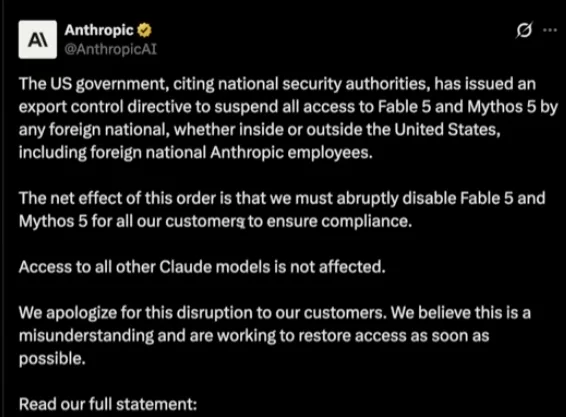
It is the first time in history that an artificial intelligence model has been withdrawn on a government’s orders. The directive applies to all foreign nationals, including non-American employees working at Anthropic themselves. Claude models like Opus 4.8 are not affected and remain normally accessible.
The concrete effects were immediate. In the Claude Code development tool, Fable 5 displayed the message « currently unavailable, please use Opus 4.8 or another model », with an automatic switch to Opus 4.8, known as a fallback (a fallback to a replacement model). Several users also noticed that their weekly request quotas had been reset to zero after the deactivation. The developer of the Devin coding assistant, the company Cognition, also removed access to Fable 5 in its own products shortly after.
Anthropic’s statement: complying while contesting
On the evening of June 12, 2026, Anthropic complied with the directive. The company also published a statement titled « Statement on the US government directive to suspend access to Fable 5 and Mythos 5 » to explain its position. The letter received gave no precise details about the nature of the concern invoked.
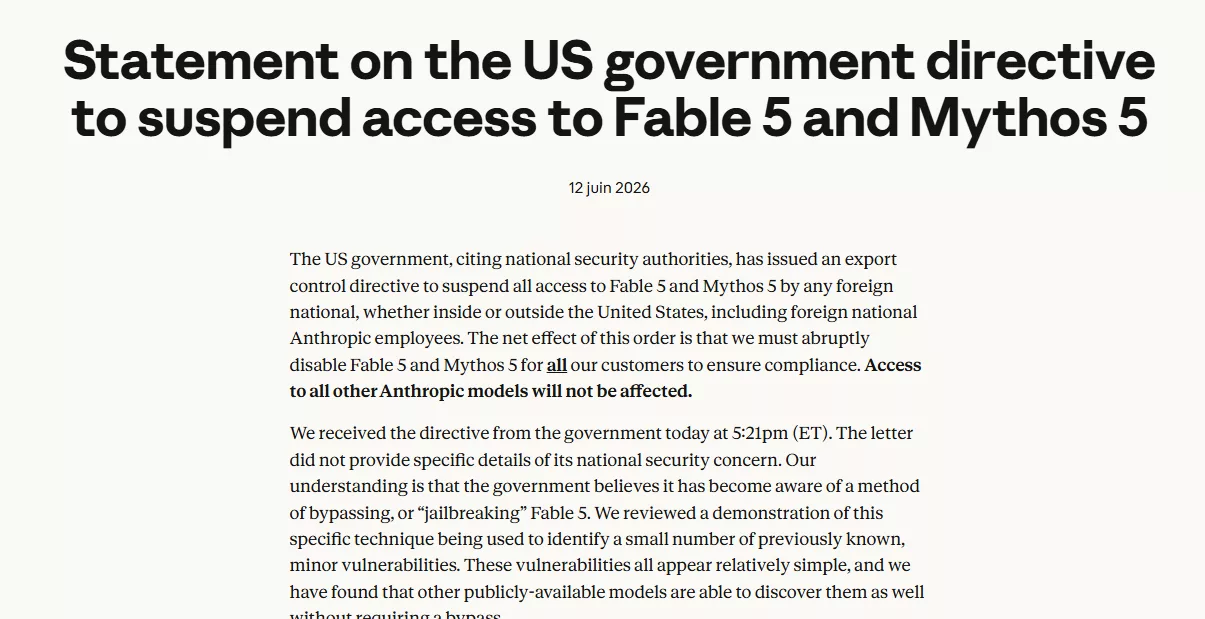
According to Anthropic, the government discovered a technique for bypassing Fable 5’s protections, known as a jailbreak (a manipulation that tricks an AI into ignoring its guardrails). The company says it examined a demonstration of this method. Its verdict: it only exposes a few minor and already-known vulnerabilities that other public models are capable of reproducing. For Anthropic, discovering a narrow jailbreak cannot justify removing a model used by hundreds of millions of people.
The company therefore obeys the legal directive, but openly contests the reasoning. It warns that if this standard were applied across the entire industry, no new cutting-edge model could ever be deployed. Anthropic believes the government should have the right to block models, but only within the framework of a transparent, fair, and technically evidence-based process. This decision does not meet those criteria, according to the company. Access to the models should be restored as soon as possible.
The jailbreak affair: a vulnerability other AIs can already find
The US government only transmitted verbal evidence of a jailbreak (a technique for bypassing a model’s protections) to Anthropic. This jailbreak is described as narrow and non-universal: it only works under precise conditions. Concretely, it involves submitting an entire codebase (the complete source code of a software application) to the model and asking it to identify and fix security vulnerabilities.

Anthropic verified that this capability is already present in other models, notably OpenAI’s GPT 5.5, and that it is used daily by cybersecurity professionals to protect systems. Regarding its safeguards (the protections built into the model), the company points out that its filters trigger alerts so often that users complain about it. Before Fable’s launch, thousands of hours of red teaming were conducted: an exercise where experts actively try to break the system. These tests involved the US government, the UK AI Security Institute (UK AISI), third-party organizations, and internal teams. No tester found a universal jailbreak — that is, a method capable of bypassing protections in a broad and repeatable way.
Anthropic acknowledges that no AI provider can today guarantee perfect resistance to jailbreaks. The company has opted for defense in depth: multiple complementary layers of protection rather than a single barrier. It has also implemented a 30-day customer data retention policy — keeping conversations for one month — in order to study and correct bypass attempts. This choice comes at a cost: some customers, notably developers concerned about the confidentiality of their source code, have left the platform because of this policy.
Mythos 5, the restricted model no one was supposed to touch
Mythos 5 is Anthropic’s most powerful model. Access to it is strictly limited to a select group of American companies and government organizations, under specific agreements. Fable 5 is, according to the developer community, essentially the same engine equipped with guardrails — safety protections compared to a seatbelt. Same architecture, but restricted for the general public. The cost argument often put forward to justify the suspension also doesn’t hold up: users point out that Fable remains less expensive than the older Opus 4 and 4.1 models were at launch.
The Mythos leak had already fueled speculation about its power. To illustrate the capability gap, users report that a previous-generation model, Opus 4.6, would have found 2 exploitable vulnerabilities in Firefox during a security scan, whereas Mythos would have identified 181 in half the time. These figures circulate anecdotally and are not officially confirmed. A hypothesis also circulates in the community: Fable 5 may have been used to help government agencies strengthen their cybersecurity using Mythos’s power, before the guardrails were removed once their security was deemed sufficient. Someone who managed to disable these protections could theoretically identify vulnerabilities in many sensitive systems.

Politics, IPO, or security pretext?
Several theories are circulating to explain the suspension of Fable 5 and Mythos 5, and none have been confirmed at this stage. The first suggests a PR move ahead of Anthropic’s IPO (its initial public offering, meaning its entry onto the financial markets). Most observers consider this reading not very credible. The second, taken more seriously by many, points to a political decision by the Trump administration: Anthropic would have already experienced friction with the government and is not the most cooperative company to deal with. The third hypothesis suggests the models would cost too much to run, but this is widely disputed, with Fable being reputed less expensive than the older Opus 4 and 4.1 models. The fourth, finally, is the most direct: a real security incident would have occurred and justified the government’s intervention.
The timing chosen for the directive is also intriguing. The decision came on a Friday at 5 PM, which leaves two possible interpretations: either to allow financial markets to adjust over the weekend without risk of a mid-week crash, or because Anthropic would not have been able to obtain a judge’s ruling before Monday. A coincidence raises questions: CEO Dario Amodei had publicly stated, the previous Wednesday, that government authorities should have the ability to disable AI models. Less than 32 hours later, that is exactly what happened. Some also wonder why Anthropic is targeted rather than OpenAI, which handles similar government contracts. One explanation put forward: Anthropic would be the most transparent company about its guardrails, and the one that has conceded the least. Occam’s razor (the principle that the simplest explanation is generally the right one) leads some observers toward a less dramatic theory: a jailbreak would indeed have been found, then amplified through the political process until it triggered the suspension.
What now? What changes for those who coded with Fable
From the moment of suspension, calls to Fable 5 are automatically redirected to Opus 4.8, the fallback model (meaning the replacement that takes over when the first is no longer available). Opus 4.8 remains an excellent tool, which many developers consider more than sufficient to complete a project. But Fable 5 represented a rare capability leap: it was able to generate a complete feature in a single request, without iterations — what the community calls « one-shot ». This kind of efficiency concretely changes the way of working.

The blow is particularly felt by Claude Max subscribers, some of whom hold up to three subscriptions to enjoy near-unlimited access to Fable. For them, the suspension disrupts their daily work organization. Financial markets could also react as early as the Monday following the announcement: the idea that governments can block AI models deemed too powerful is a signal that worries the entire sector on the stock market.
Anthropic says it is monitoring the situation closely and wants to restore access to Fable 5 as soon as possible. In the developer community, some are betting on a return as early as the following Monday, the time it takes for a legal proceeding to open a way forward, but this scenario remains a hypothesis. What is concrete, however: if the block were to last, it could accelerate the shift toward open source models (whose source code is freely accessible to everyone) or toward models developed in China — an outcome that US authorities themselves would have every interest in avoiding.









0 Commentaires
Aucun commentaire pour le moment. Soyez le premier à commenter !