
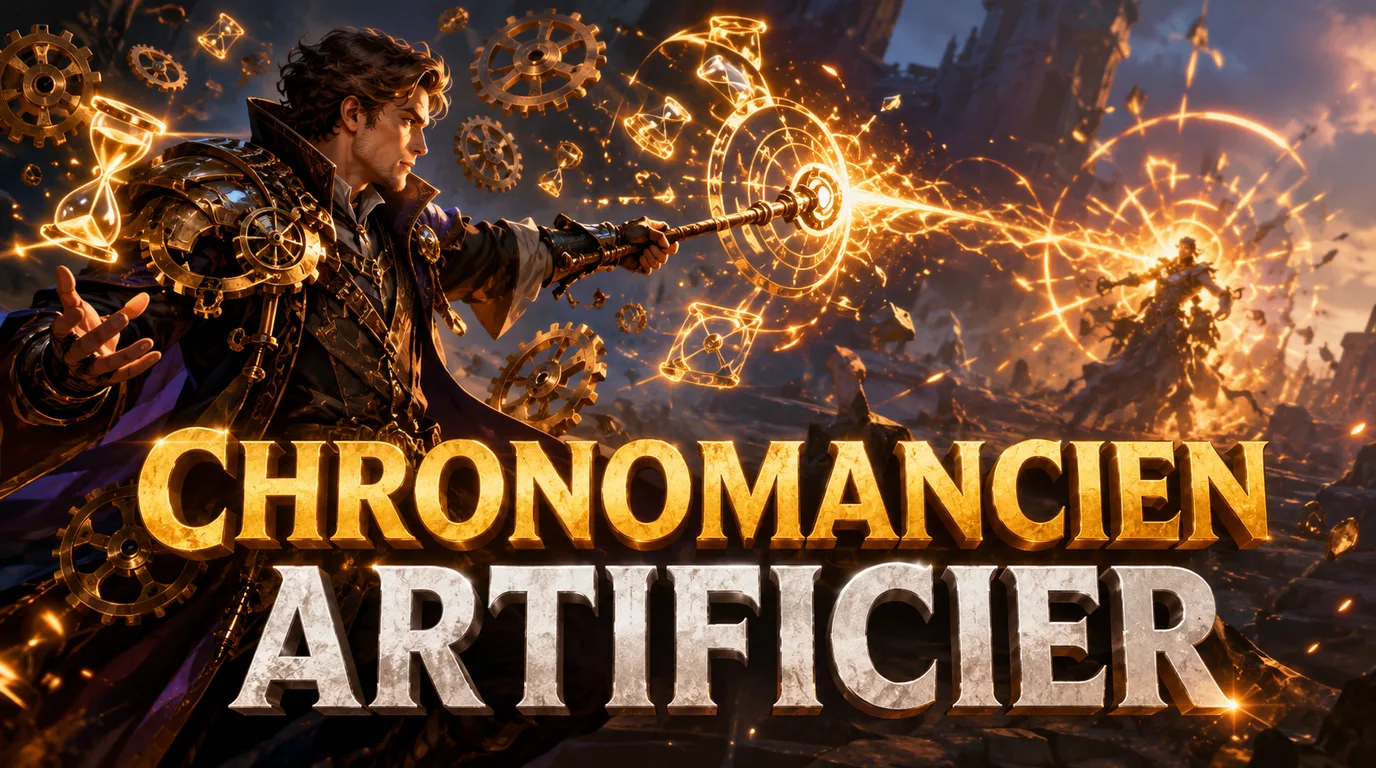
Artificer is a wand-slinging ranged DPS: Artificer's Wand is the filler spell and main Echo Fragment generator, while Wand of Time and Discordance also bank fragments. Those fragments are then spent to trigger Distortion spells — like Shatter Echo — and to fuel and extend Continuum spells (Singularity Core, Flux Emitter, Paradox Cannon).
Self-buffing runs through passives rather than a toggled stance: Artificer's Empowerment raises Spirit, and Wand Expert converts a share of it into ranged attack power — so almost the entire kit scales off one stat. Control is real but situational: Clasp of Infinity roots, Waves of Time knocks back, and Unstable Chronoglass soaks a caster's opening casts.
Wand of Time now generates an Echo Fragment, usable to trigger your Distortion and Continuum spells. Decomposition becomes a Distortion spell, dealing increased damage based on how many Echo Fragments you hold.
Closest to a ranged builder/spender caster, somewhere between a stack-driven Arcane Mage and the Essence loop of an Evoker: you cycle wand casts to build Discovery and bank Echo Fragments, then spend them into Continuum/Distortion windows for burst rather than casting big spells on demand. Unlike a real support there's no teammate amplification or pet here despite the temporal flavor — Artificer is a pure ranged DPS whose whole payoff is stacking one stat (Spirit) and managing the fragment economy well.
How is this number calculated?
Measured scope: Zul'Gurub, Molten Core, Onyxia's Lair, all difficulties — High Priest Venoxis, High Priestess Jeklik, High Priestess Mar'li, Bloodlord Mandokir, High Priest Thekal, High Priestess Arlokk, Jin'do the Hexxer, Hakkar, Gri'lek, Gahz'ranka, Lucifron, Magmadar, Gehennas, Baron Geddon, Garr, Shazzrah, Golemagg the Incinerator, Sulfuron Harbinger, Majordomo Executus, Ragnaros, Basalthane, Onyxia.
These numbers come from Ascension Logs’ public combat logs, not an in-house guess.
The index compares each spec to the median player — the one sitting exactly in the middle of the ranking — on the same boss and the same group format: 1.00 matches that median player, 1.40 means 40% more damage than them. Only each player’s best fight counts, never their average — otherwise a player posting fifty fights would count as much as fifty different players, and averaging would mostly reward beginners still learning the spec rather than those who’ve mastered it. The comparison always happens on the same boss and the same format: a two-minute fight and a seven-minute one aren’t comparable, and a flex raid doesn’t give the same support as a 25-man.
Tiers (S, A, B…) aren’t picked by hand: the cutoffs are calculated from the real spread of every measured spec. A spec under 15 distinct players or 30 fights isn't ranked at all, rather than given a made-up grade.
Ranking updated on August 29, 2026
The tree the best players actually run. Read from the top 10 Artificer Chronomancers in our player rankings for raids, of whom 2 have since switched specialisation and 1 was last recorded in a dungeon, leaving 7. 37 of its 53 talents are identical across all 7, so they agree on the bulk of it and part ways on the rest. This exact tree is run by the 9th ranked player. Recorded on 9 August 2026.
The 58 points are a fixed budget, so no tree can take everything. The most common picks left out of this one: Entropy Reversal 43 %, Entropy Overload 43 %, Gravity Bomb 43 %.
These talents are a PvE configuration. The Arena and Battleground grades shown above rate the specialisation’s PvP potential, not this tree.
Hit is the scarcest, highest-value stat — there are no hit talents in the tree and it's thin on Spirit-itemized gear — so cap it first; Spell Penetration is also worth capping so the Arcane portion (Shatter Echo, Singularity Core, Decomposition) lands on higher-level targets. Spirit remains the throughput backbone (Wand Expert converts it to ranged attack power; Artificer's Empowerment raises it). Spell Power is overrated — only a few abilities scale it, and weakly — treat roughly 100-200 as a floor, not a priority.
See also: all Ascension CoA builds · the talent tree builder
Talent data: ascension.gg
· Spec tiers & analysis: ascensionsidekick.com
Editorial rewrite, interactive talent tree, tooltips and fact-checking: KAMI LABS






0 Commentaires
Aucun commentaire pour le moment. Soyez le premier à commenter !