
Three announcements landed back to back between August 5 and August 11, 2026: Nvidia unveiled a $500 billion financing alliance, Anthropic signed a $9.1 billion power deal spanning twenty years, and Google reshuffled the leadership of its DeepMind lab. These three facts tell the same story. The race for AI infrastructure — that is, the data centers, chips and electricity that power the models — now matters just as much as the race for the models themselves.
Nvidia Gathers $500 Billion for AI Infrastructure
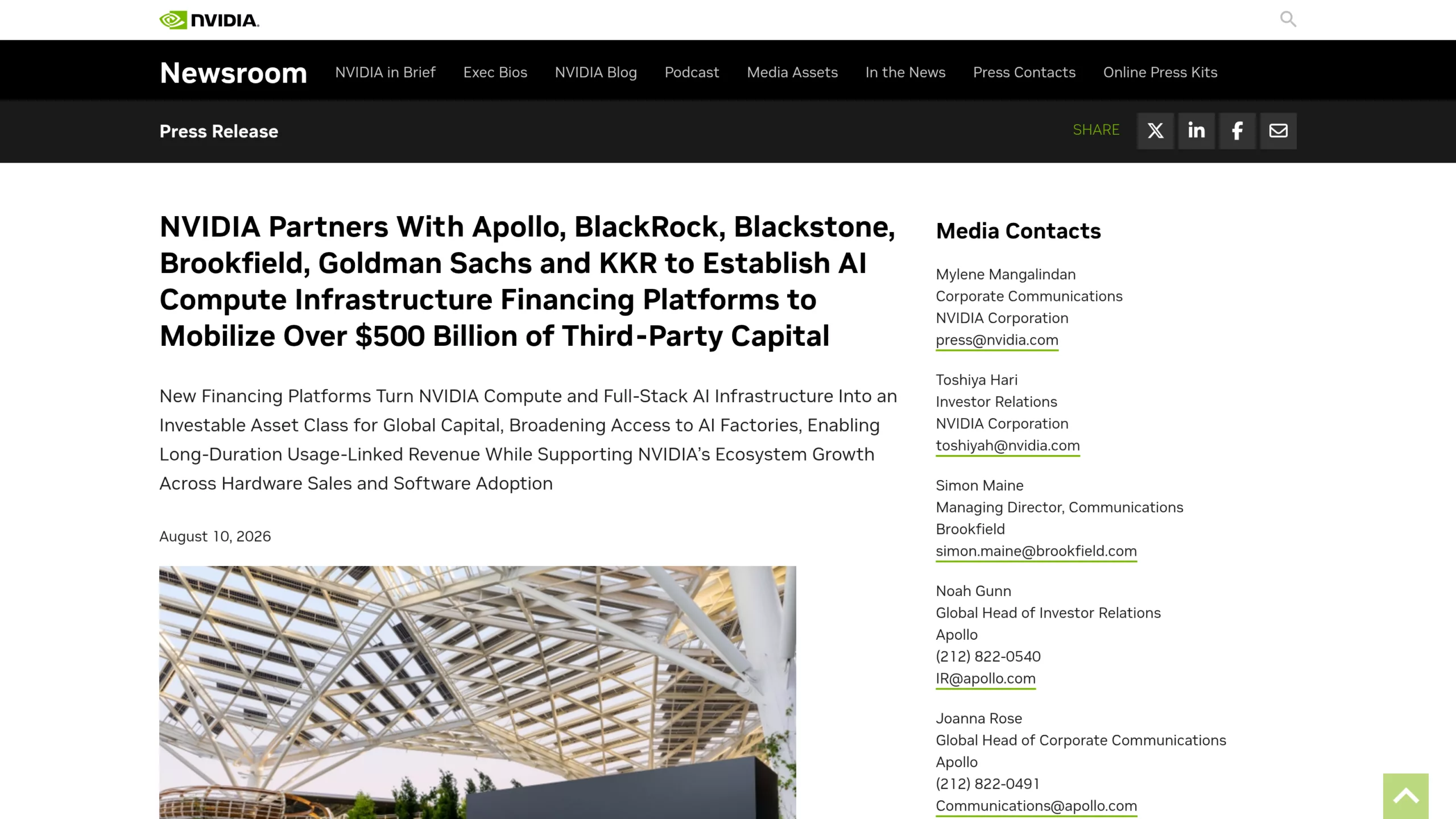
On August 10, 2026, Nvidia announced a deal with six finance giants: Apollo, BlackRock, Blackstone, Brookfield, Goldman Sachs and KKR. Together, these partners aim to mobilize more than $500 billion in third-party capital — that is, money that doesn’t come from Nvidia’s own coffers but from outside investors. The goal is to build data centers (the massive buildings packed with servers that run AI), power plants and electrical grids dedicated to AI infrastructure.
- Apollo
- BlackRock
- Blackstone
- Brookfield
- Goldman Sachs
- KKR
The arrangement is structured through memorandums of understanding — preliminary agreements that set the framework before the final contracts. These platforms are meant to let Nvidia’s customers (AI labs, enterprises, cloud providers) borrow to fund their compute — the processing power needed to train and run an AI model — without Nvidia itself carrying that debt. Jensen Huang, Nvidia’s founder, sums up the ambition this way: the company no longer just sells chips, it helps create a new investable asset class, what he calls AI factories.
An Nvidia chip installed in a data center generates money as long as it’s running. It becomes an asset that can be financed the way a building or a toll highway is financed. That’s the reasoning pushing asset managers like BlackRock, used to financing traditional infrastructure, toward AI infrastructure.
Anthropic Locks in Electricity for Twenty Years
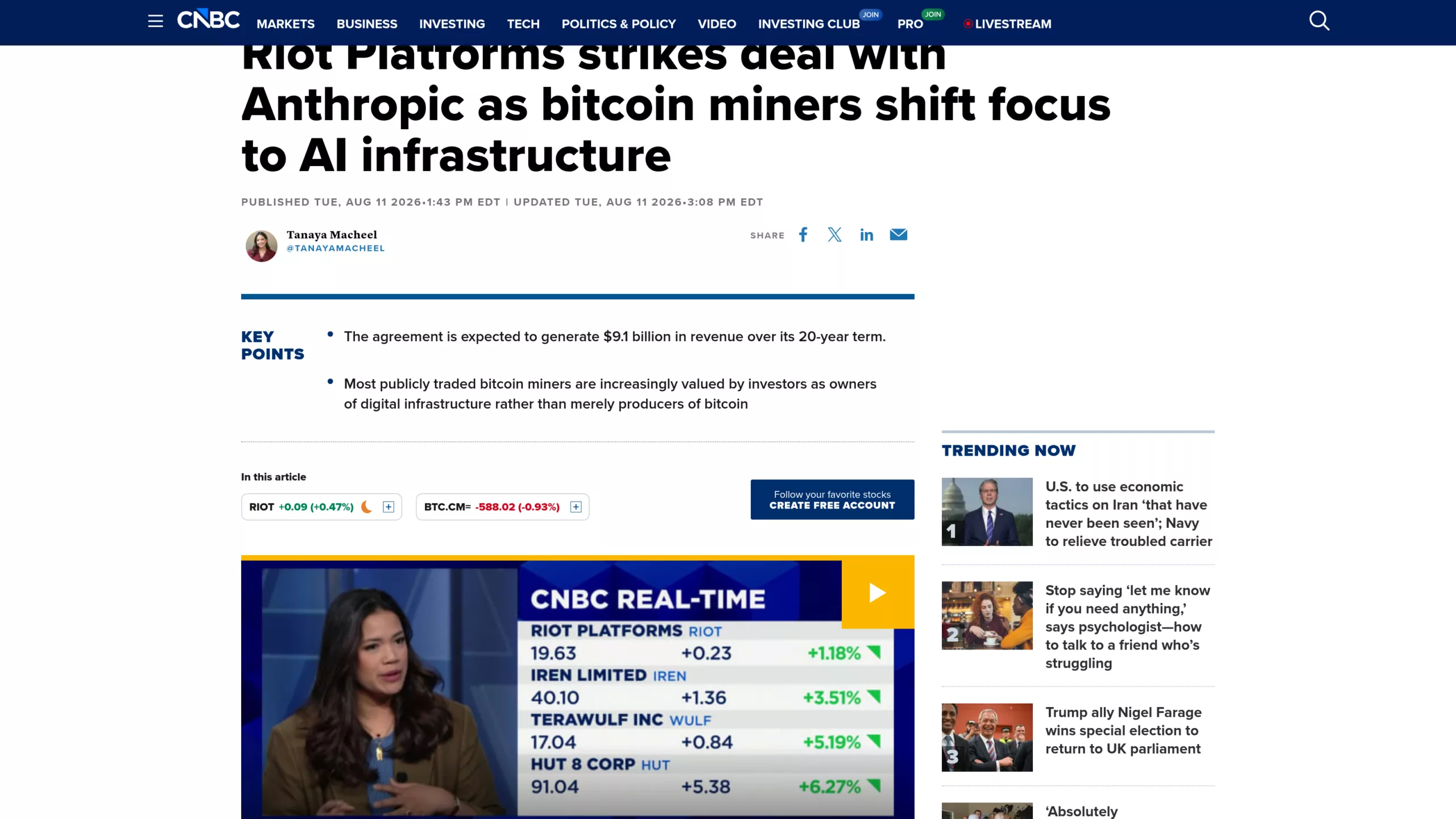
CNBC, August 11, 2026, by Tanaya Macheel: the deal is expected to generate $9.1 billion in revenue over twenty years. It was the press, not Riot Platforms, that identified Anthropic.
On August 11, 2026, Riot Platforms, a Texas-based company best known for bitcoin mining, announced a $9.1 billion deal spanning twenty years with a leading AI lab. The contract covers 191 megawatts, enough to power a city of about 150,000 residents, at Riot’s campus in Rockdale, Texas. Riot is set to deliver 96 megawatts as early as December 2027, then the full capacity by June 2028.
One detail is worth clarifying. Riot Platforms did not name its client in its announcement. It was Bloomberg that identified Anthropic as the partner, information later picked up by several other outlets without denial from either company. The contract also includes two five-year extension options each, which would bring its total value to $16.1 billion.
This shift isn’t isolated. According to several sources close to the matter, Anthropic is reportedly meeting with investors ahead of an IPO — that is, the moment when a company sells shares to the public for the first time, on a market like the Nasdaq. The move is said to be targeting fall 2026, with no official confirmation from Anthropic at this stage. An IPO requires a simple story to tell a future funding round (the operation through which a company brings several investors together around the same financing): rising revenue, and secure AI infrastructure for years to come. Anthropic has also multiplied its product announcements in recent months, from the launch of Claude Managed Agents to this power deal in Texas.
Google Reorganizes DeepMind While Its Models Keep Everyone Waiting
On August 5, 2026, Google announced a leadership change at DeepMind, its AI research lab. Demis Hassabis, who led the unit, becomes chairman of the board and chief scientist at Alphabet, Google’s parent company. Day-to-day management moves to Koray Kavukcuoglu, previously DeepMind’s chief technology officer, who will now report directly to Google CEO Sundar Pichai.
Two longtime figures, Jeff Dean and Sanjay Ghemawat, are leaving the company at the same time to found their own research outfit. This reorganization comes as Google has not unveiled a single frontier model — that is, the most advanced model a company is able to produce at a given moment — since the start of 2026. The flagship version of Gemini, expected in June, still hadn’t shipped by the time of the announcement.
The contrast with Nvidia and Anthropic is stark. While its rivals raise colossal sums to build their AI infrastructure, Google is reorganizing its research in an attempt to catch up on schedule.
Google is nonetheless still moving forward on other fronts, such as integrating Gemini into Google Maps, while its frontier lab reorganizes behind the scenes.
Why Electricity Has Become the Real Bottleneck
For a long time, AI news boiled down to a simple question: which lab shipped the strongest model this month. That ranking still exists, but it’s no longer enough to understand who’s gaining the edge. Our readers already saw this tension play out when tech stocks crashed, with massive layoffs across several companies in the sector.
An AI model is expensive before it even exists. First you need chips, then data centers to house them, then electricity to run and cool them. These three elements make up AI infrastructure in the strict sense. Yet electricity production isn’t scaling up as fast as demand from tech giants. Building a power plant or reinforcing an electrical grid takes years, while a new model ships every few months.
That’s what explains why a lab like Anthropic is turning to a former bitcoin miner for its electricity. Cryptocurrency mining companies already have sites connected to the grid with plenty of compute capacity. They’re becoming AI infrastructure providers almost in spite of themselves, by repurposing their facilities. It’s also what’s pushing Nvidia to team up with asset managers rather than finance data center construction alone: the bill exceeds what a single company, even the world’s most valuable one, can carry on its own balance sheet.
What This Shift Changes Going Forward
This dynamic is reshaping the sector’s hierarchy. Labs without access to abundant capital or megawatts guaranteed over several years risk losing ground, even with good researchers. Anthropic, by contrast, is turning a simple power deal into a selling point for its IPO.
The funding round organized by Nvidia also changes the nature of the risk. The targeted $500 billion won’t come off Nvidia’s own balance sheet: it’s Apollo, BlackRock, Blackstone, Brookfield, Goldman Sachs and KKR who will carry part of the debt tied to AI infrastructure. Nvidia sells chips and, now, also helps finance the walls that house them.
At Google, the pressure is different. DeepMind has the resources and the talent it needs. What it’s missing right now is a schedule it can keep. The shift toward AI infrastructure doesn’t erase the competition over models, then. It adds a second race, slower and more expensive, to run in parallel.









0 Commentaires
Aucun commentaire pour le moment. Soyez le premier à commenter !