

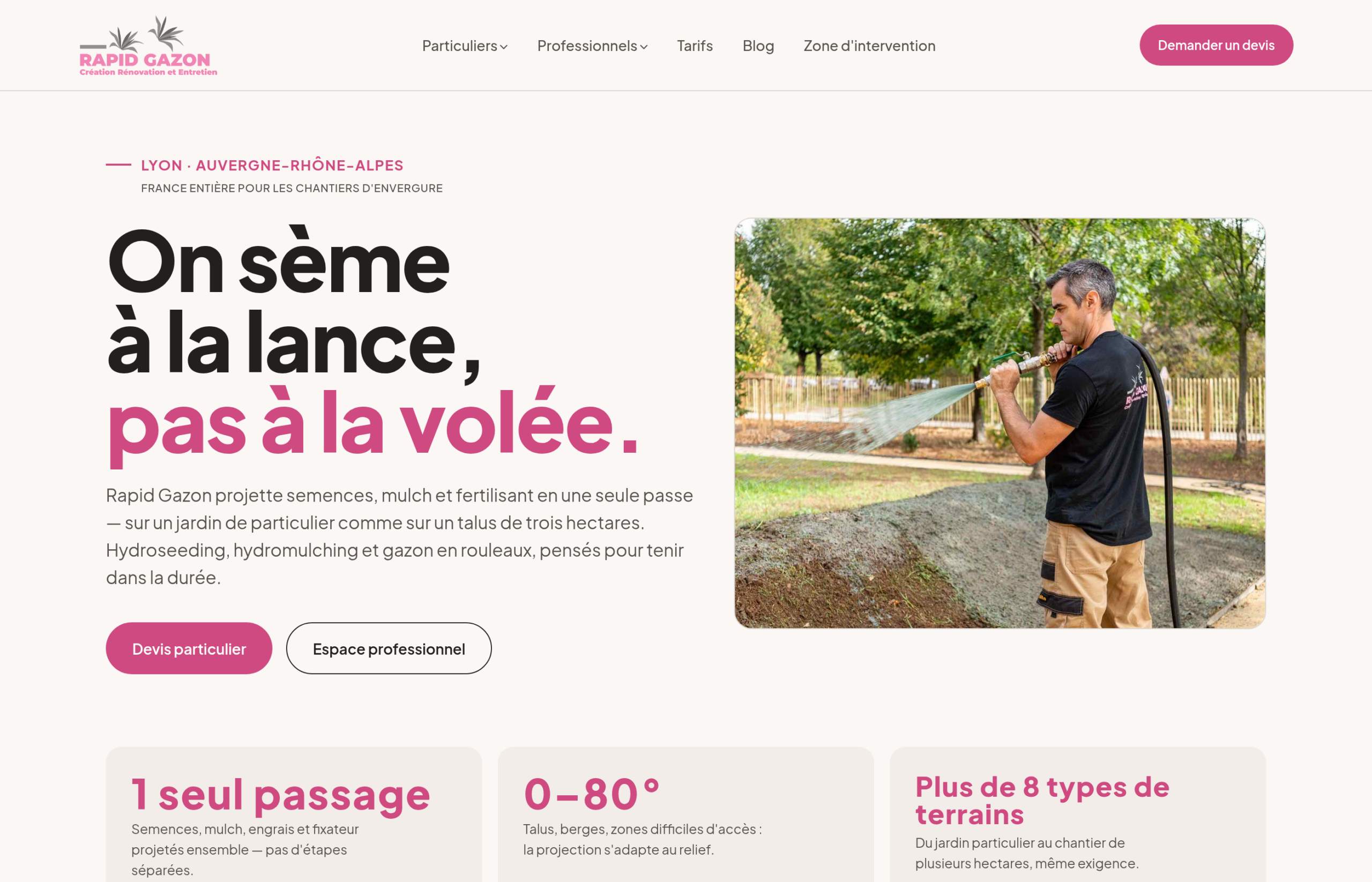
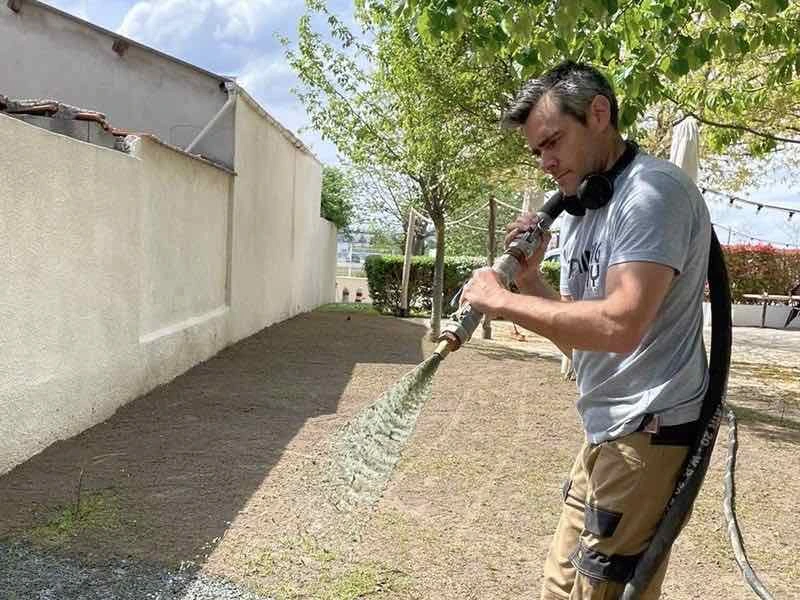
A man with a lance in his hand sprays a bare embankment with a green jet. Three weeks later, the slope is covered in grass. No magic involved: it’s hydraulic seed projection, or hydroseeding for those in the know.
That man is Jérémie Galan, and he’s my cousin. This article covers his company, Rapid Gazon, based in Limonest, near Lyon. His slogan fits on one line: « On sème à la lance, pas à la volée » (« we sow with a hose, not by hand »).
I’m not a gardener, and you probably aren’t either. So I looked for three answers: how the technique works, what it really costs per square metre, and when to sow so you don’t end up watching dry dirt.
Sowing with a hose: what hydroseeding really does
The grey-green liquid sprayed onto this mound of earth is nothing like paint. It’s tomorrow’s lawn, as a slurry. According to Rapid Gazon’s technical page on hydroseeding, the spraying is done with a high-pressure lance: a mix of grass seed, fertiliser, binding agent and water goes straight onto the prepared soil, in a single operation.
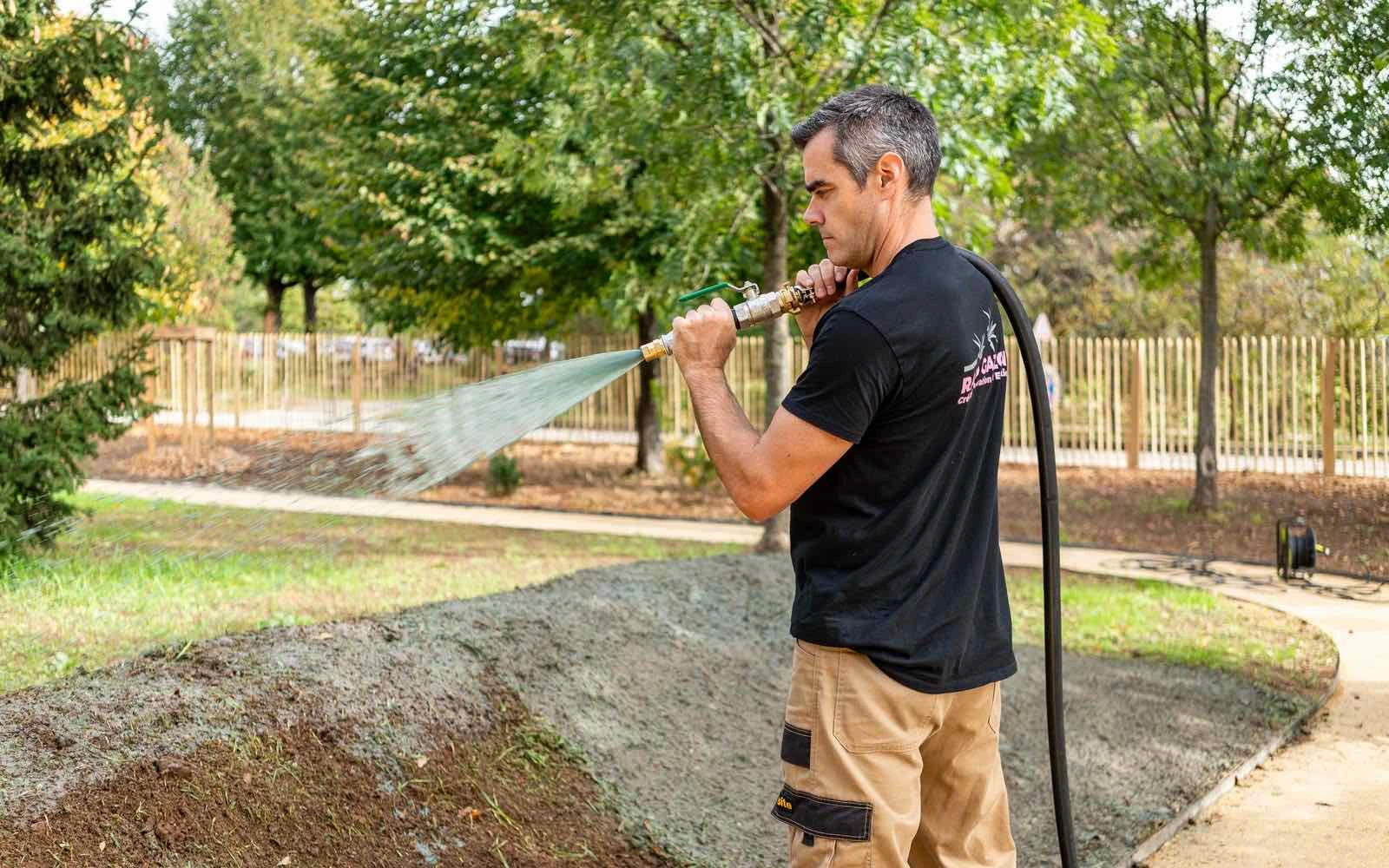
Picture a paint gun loaded with seeds. Sowing by hand depends on the arm doing the throwing. Here, the spread stays even across the whole surface, even on a slope, uneven ground or a hard-to-reach corner.
The binder does the rest. It forms a thin protective crust that keeps the seeds in place and limits how far wind or moderate rain can scatter them while germination kicks in. The fertiliser is advertised as 100% natural.
A job follows four steps:
- Diagnosis: the soil, slope and exposure are checked on site, before any quote.
- Spraying: one even pass.
- Emergence: the mulch holds moisture, and germination is usually visible within 2 to 3 weeks.
- Hold: the roots strengthen over the following months, with no washout from rain.
Lifespan is no different. A lawn established this way lasts as long as one sown the classic way. Only the method of installation changes.
Hydromulching: more mulch to hold on the slope
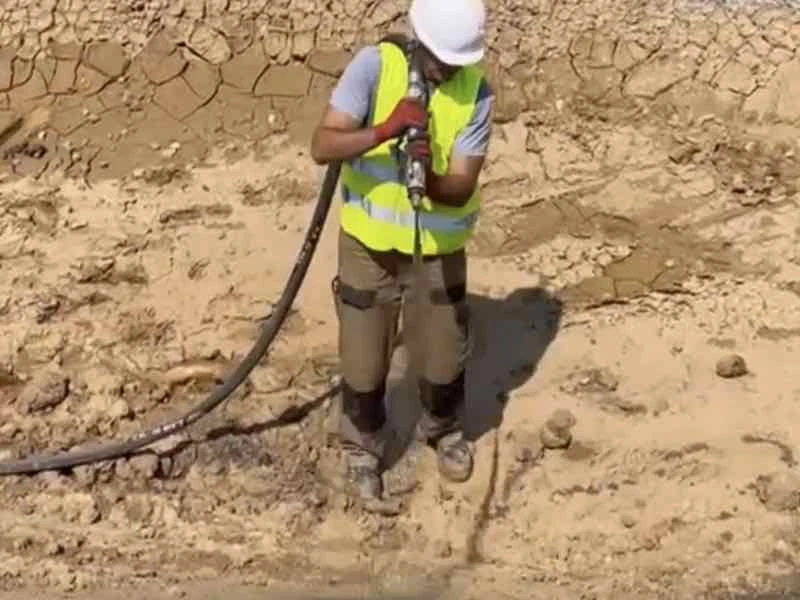
On an embankment, sowing by hand quickly turns into a failure. You can’t run a mower over it, and at the first downpour the rain gullies the soil and washes the seeds downhill. They end up in a pile at the foot of the slope while the top stays bare.
Hydromulching fixes that. Same principle as hydroseeding, with more mulch (plant-based cover made of wood fibre or cellulose) in the mix. This mulch keeps moisture around the seed, which germinates faster and with less risk. It also protects against erosion on embankments, riverbanks and steep slopes, and it helps on poor, compacted soil or ground disturbed by recent earthworks.
Rapid Gazon picks between the two techniques depending on the slope, the soil and the final use. A flat garden doesn’t have the constraints of a quarry embankment or the edges of a retention basin. The spraying adapts to terrain from 0 to 80°, with a « slope hydromulching » offer using reinforced anti-erosion mulch that holds the seeds against runoff. Sod, by contrast, is hard to lay and keep on a steep slope. To see how a job unfolds, check out the embankment revegetation page.
Hydroseeding or rolled turf: speed against price
It’s a real gamer’s choice: pay to go fast, or farm patiently. Rolled turf is the paid shortcut. It has grown for 12 to 18 months in open ground on a turf farm, until it forms a dense root mat. It’s then cut into thin strips, rolled, delivered and laid the same day. That very short delay is deliberate, because it protects the roots.
On your plot, the soil is first loosened and levelled, with topsoil added if needed. The rolls are laid edge to edge, staggered, on slightly damp soil. A pass with a roller drives out the air pockets. Then comes heavy watering for 2 to 3 weeks: every day, even twice a day in summer.
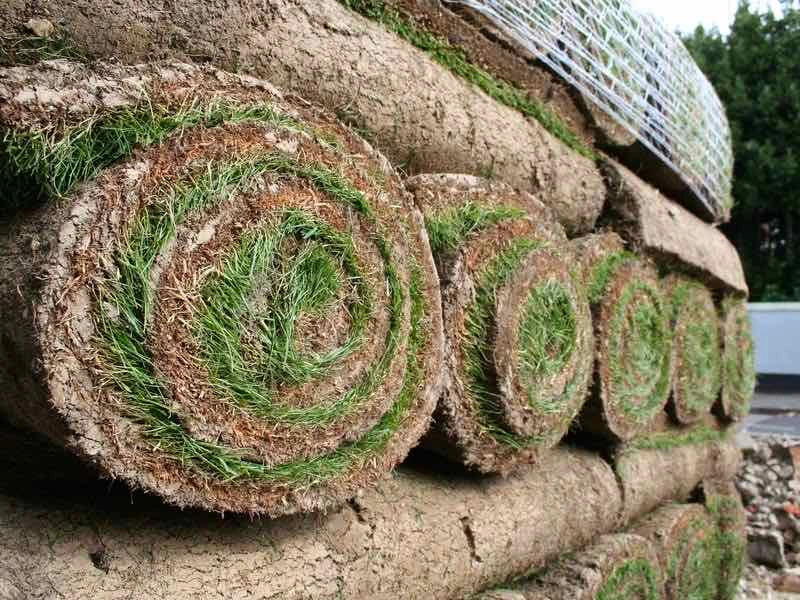
The result is immediate: a dense, green lawn from the moment it’s laid. It handles light use after about 2 weeks and normal use after 3 to 4. Spraying, on the other hand, takes more patience before you can walk on it.
The bill follows. Rolled turf starts at €10 excl. VAT/m² on already prepared soil, against €1.90 excl. VAT/m² for basic hydromulching, seed not included. The gap weighs most on large areas. You also need flat ground or a very gentle slope.
Hosting an event, putting a property up for sale, wanting to enjoy the garden without waiting: rolled turf makes sense. Slope, large area or tight budget: hydromulching remains the patient player’s route.
What it costs, down to the square metre
Here are the prices shown on Rapid Gazon’s pricing page. They are “from” prices, excluding VAT, per square metre.
| Service | From (excl. VAT/m²) | Best for |
|---|---|---|
| Basic hydromulching | €1.90 | Flat ground, new lawn or renovation (soil diagnosis included) |
| Slope hydromulching | €2.90 | Embankments, riverbanks, slopes up to 80°, the most requested option |
| Rolled turf | €10 | Already prepared soil |
| Ground preparation | €4.90 | Close mowing, soil work, soil improvement, levelling |
Take 600 m² of flat ground with basic hydromulching: 600 × €1.90 = €1,140 excl. VAT. Above 500 m², the base price applies as is. On a slope, the same area comes to €1,740 excl. VAT. With rolled turf, count €6,000 excl. VAT, on already prepared soil.
Two caveats. Seed is not included: you choose it, and it’s billed on top depending on the variety. And small areas pay a surcharge: +20% between 300 and 500 m², +30% between 200 and 300 m², +40% between 50 and 200 m². Below 50 m², the company doesn’t take the job.

On my screenshot, 150 m² of basic hydromulching shows €399, which is the base rate plus 40% (150 × 1.90 × 1.40). The final price comes after an on-site diagnosis: soil type, access, terrain. For professionals, there is no price grid, only a quote based on area, terrain, access and deadline. You can redo the maths on the pricing page and its real-time simulator.
October, the right window, and the weeks that follow
It’s mid-October, and it’s now or spring. Habitatpresto puts the ideal sowing window from mid-September to the end of October: the soil is still warm, rain is regular, and weeds compete less.
Germination needs soil at around 10 °C at minimum. In continental zones, it’s better to sow early to beat the frosts. The date isn’t everything, the condition of the soil matters a lot too.
At Rapid Gazon, emergence generally starts between 8 and 15 days after hydroseeding, depending on the season and exposure. The mulch holds moisture, and the fixative prevents washout by rain. Allow 4 to 6 weeks before the lawn is usable.
A review shown on the site’s homepage points the same way. Sophie M., a private customer in Écully, writes: “We were afraid it wouldn’t take on such poor soil, and the result is a nice green lawn in three weeks. Deadline met, no bad surprises.”
To go further, the Rapid Gazon blog has two articles: « Quand semer son gazon : automne ou printemps ? » (When to sow your lawn: autumn or spring?) and « Arroser après un hydroseeding : le bon rythme » (Watering after hydroseeding: the right rhythm).
Embankments, basins, solar panels: the bulk of the business
Gardens are only part of the company’s spraying jobs. Rapid Gazon also works for landscapers, public works companies, solar farm developers and ecological engineering consultancies. The professionals page sums up the promise in one sentence: « a technical contact, not a form ».
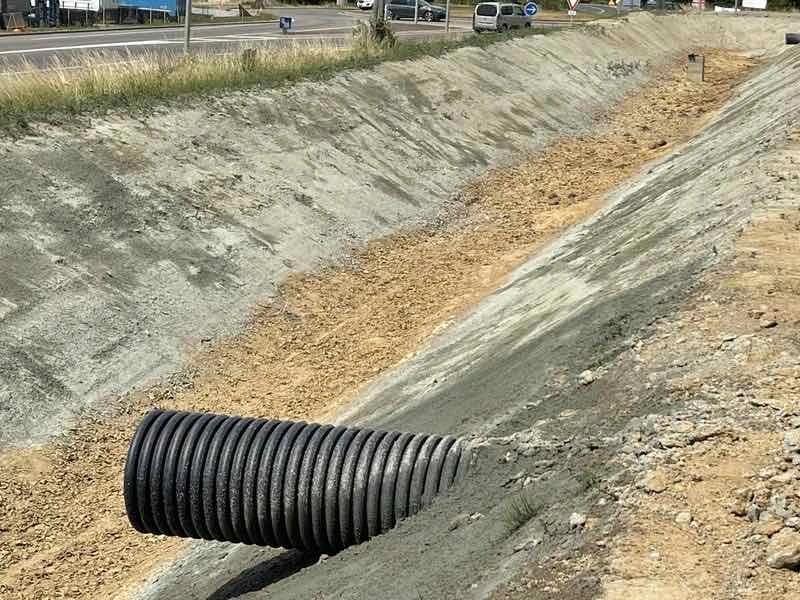
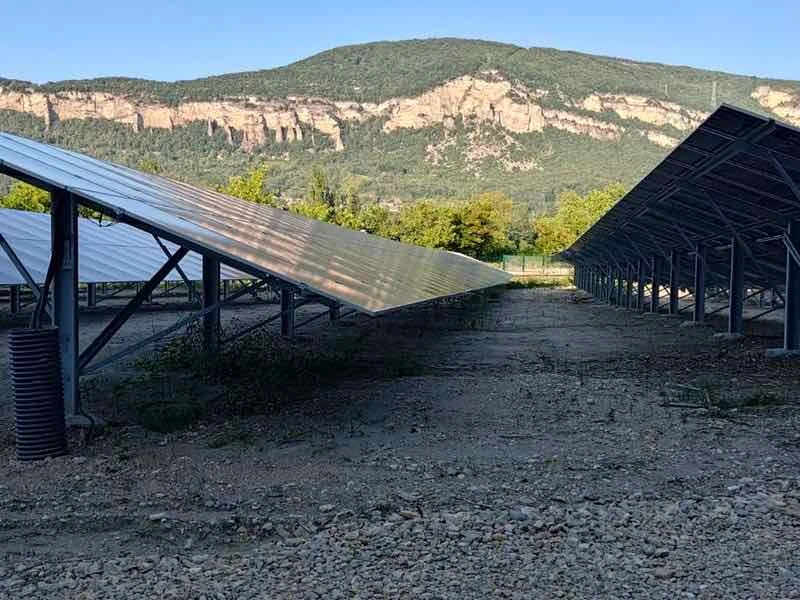
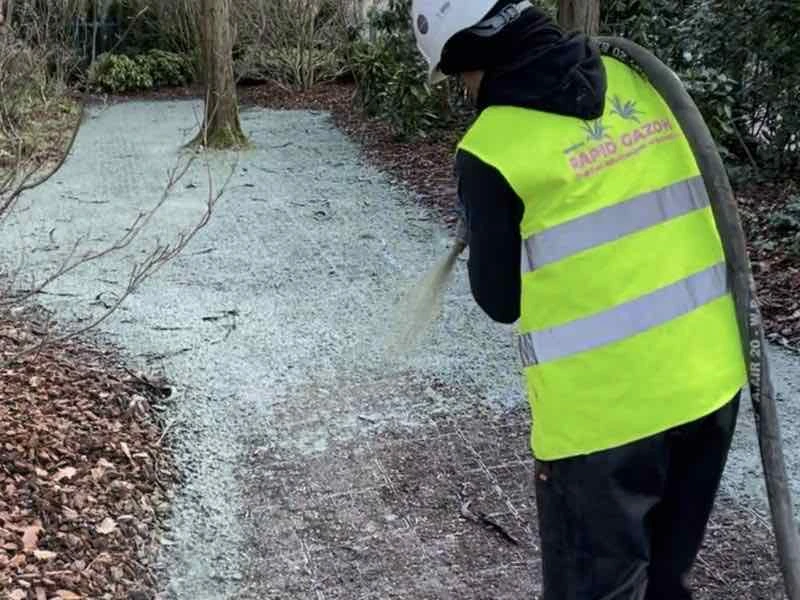
Here, the sites change scale. An embankment or riverbank is stabilised against erosion. A retention basin needs mixes that tolerate moisture swings. Under the panels of a ground-mounted solar farm, the goal is low ground cover that grows little and needs little upkeep, with a wildflower meadow or eco-grazing as options.
- Quarries: poor or disturbed soils.
- End of public works jobs: road verges, housing developments, business parks, with deadlines compatible with handover.
- Cemeteries: grassed paths, reduced upkeep for municipal technical teams.
- Soil bioengineering: alongside fascines, cuttings and geotextiles.
France recorded 70,000 company bankruptcies in 2025. Rapid Gazon, for its part, lives off concrete jobs: embankments to hold, basins to revegetate, work handovers to meet.
Practical info. Based in Limonest, the company works in the Rhône, Loire, Isère, Ain, Savoie, Haute-Savoie and Puy-de-Dôme departments, and anywhere in France for large projects. You describe the site (area, terrain, deadline) by email or phone, then an on-site diagnosis comes before the technical proposal. You request a quote online through the quote request form, with a reply promised within 48 h. Phone: 06 50 56 42 17.





2 Commentaires
Intéressant nous faisons refaire la surface d’un décollage parapente à Samoens et nous n’avions pas de solution pour un ré-engazonnement rapide. Je transmet les coordonnés à celui qui coordonne les travaux.
@Kouette Top ! J’ai grande confiance en jéremie vous serez pas déçu !