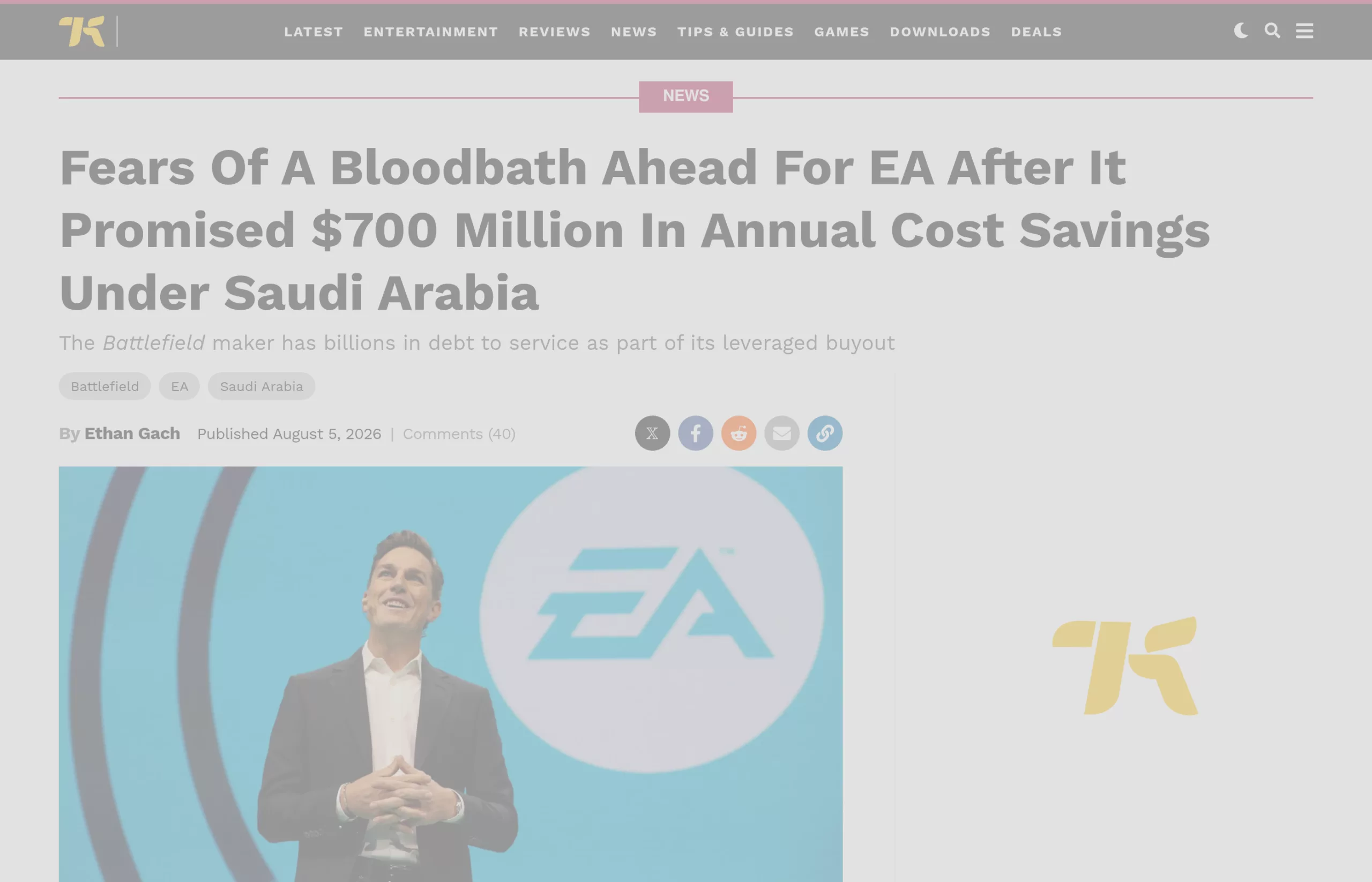
Electronic Arts’ buyout was finalized on August 4, 2026. A consortium led by Saudi investors put up $55 billion to take the publisher private (delisted from the stock exchange). In practical terms, EA stock is no longer publicly tradable, and the company no longer has to disclose its financial results the way it used to.
The next day, August 5, 2026, journalist Jason Schreier (Bloomberg) revealed the document EA sent to its banks and investors. In it, the publisher states it wants to cut $700 million in annual costs. That figure isn’t arbitrary — it comes directly from how the buyout was financed, and that’s the mechanism worth understanding first.
$55 Billion to Buy EA, $18 Billion in Debt for EA
A $55 billion buyout doesn’t mean the buyers pulled $55 billion out of their own pockets. A large chunk of that sum was borrowed. This is what’s called a leveraged buyout, or LBO (borrowing money to buy a company, then having the acquired company itself repay that loan — not the buyers). EA isn’t just changing owners. It’s inheriting a debt taken out to finance its own acquisition.
The deal leaves EA carrying $18 billion in buyout debt. That sum doesn’t vanish into some distant balance sheet belonging to the consortium — it weighs on EA’s own accounts, and EA now has to pay interest on it every year, on top of running its studios, funding its games, and paying its employees.
$1.8 Billion in Interest, $1.5 Billion in Earnings
Here’s the number that shows the scale of the problem. The $18 billion in buyout debt generates about $1.8 billion in interest per year. Meanwhile, EA’s annual EBITDA (earnings before interest, taxes, depreciation and amortization — essentially what the company earns from its core business before those costs) sits at around $1.5 billion.
The interest on the buyout debt exceeds what the company generates from its operations. That’s not a minor accounting detail. It means EA can’t cover the cost of its own buyout with its current earnings.
| Item | Annual amount |
|---|---|
| Buyout debt interest | $1.8 billion |
| EA’s EBITDA (core operating profit) | about $1.5 billion |
That gap is exactly why EA is actively looking to cut spending. Without extra breathing room, the debt bill eats up more than the company brings in.
$700 Million to Find, and a Word That Raises Alarms
In the document leaked by Jason Schreier, EA lays out its target of $700 million in annual cost cuts. Of that sum, $170 million is explicitly filed under the label ‘organizational efficiencies.’
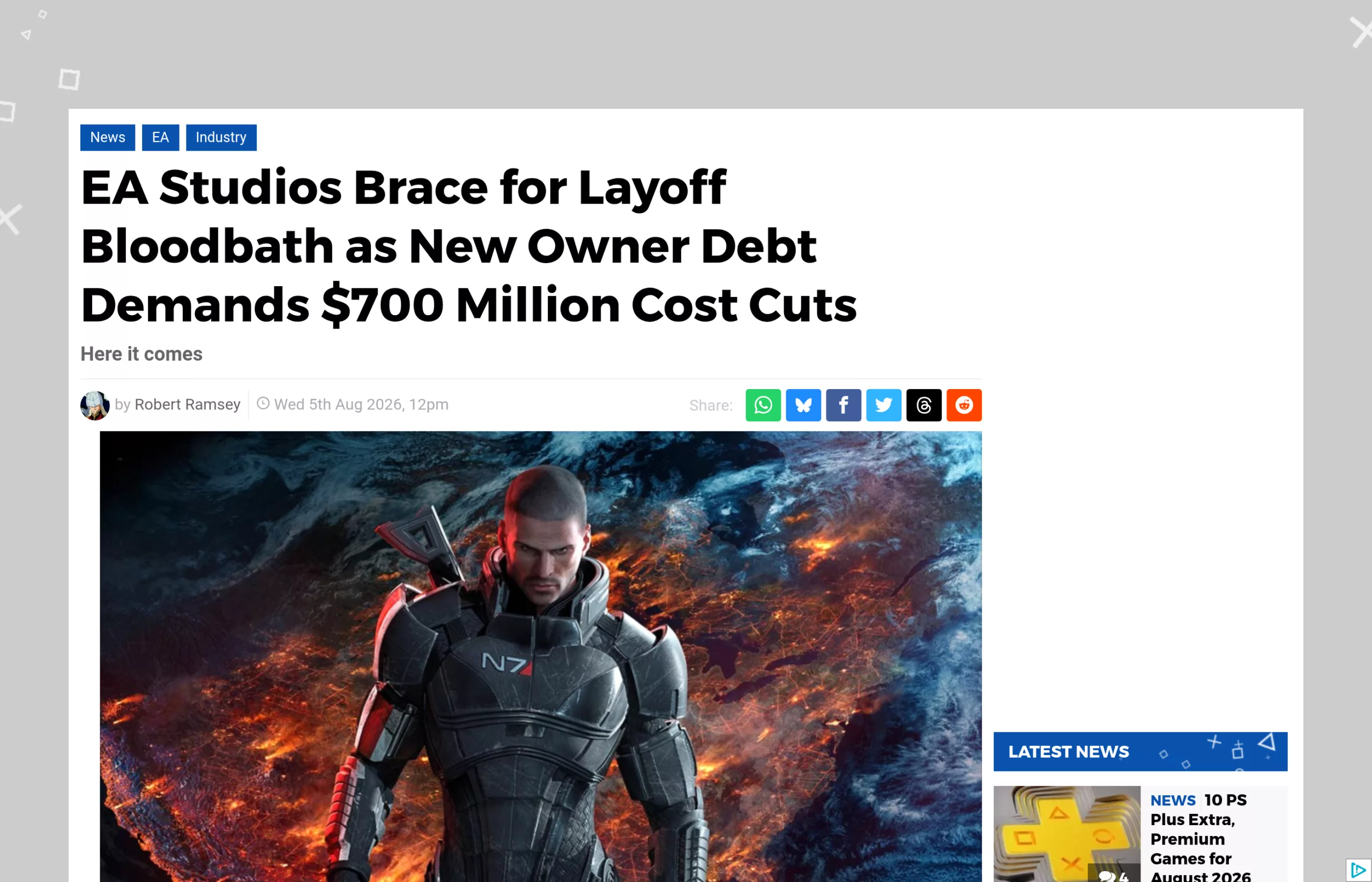
That’s the term companies use when they restructure their teams to shrink payroll. Schreier’s comment on the phrase is blunt: ‘In other words: mass layoffs.’ At this stage, EA hasn’t announced any specific number of job cuts — only the cost-reduction target has been made public.
This isn’t happening in a vacuum. Between 8,000 and 12,000 jobs have already disappeared across the video game industry in the first half of 2026, as detailed in our investigation into the wave of layoffs sweeping the industry. Xbox cut 3,200 jobs, 20% of its division, and shut down four studios. Epic Games wasn’t spared either, with 1,000 employees laid off and $500 million in budget cuts announced despite Fortnite’s continued success.
EA now joins an already long list. The difference is that in its case, the pressure isn’t coming just from the market or game sales. It’s coming from $18 billion in debt, taken out to finance its own acquisition, that the company has to repay with its own earnings.









0 Commentaires
Aucun commentaire pour le moment. Soyez le premier à commenter !