
Claude will soon start discreetly marking the text it generates. Anthropic confirmed this on August 11, 2026, just days after a new European obligation took effect. The marking will be invisible to readers, but detectable by software.
What makes the announcement interesting is its scope. Anthropic isn’t applying this rule only to European users. It’s applying it everywhere, including in the United States. The AI Act, a regulation passed in Brussels, has just changed a product used around the world.
What the EU Has Required Since August 2
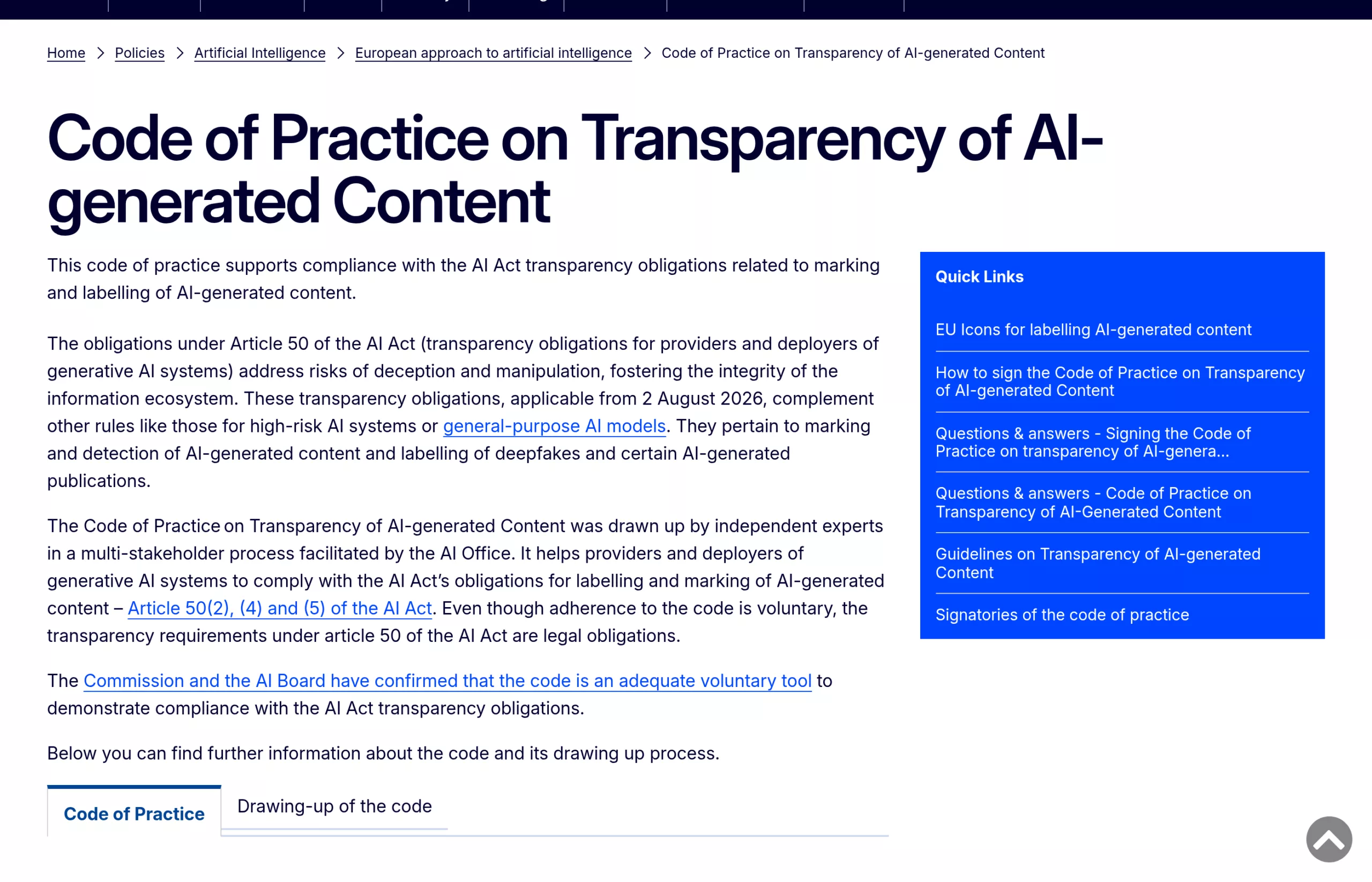
The text behind all this is Article 50 of the European Union’s regulation on artificial intelligence, better known as the AI Act. It took effect on August 2, 2026. It requires companies that build generative AI to mark the content they produce, whether text, image, audio, or video.
This marking must be in a machine-readable format (one that only software can detect, not the human eye). The goal is simple: let anyone check, using a dedicated tool, whether a piece of content was generated by an AI or written by a person.
European regulators aren’t settling for a single technique. They expect a multi-layered approach. First, digitally signed metadata (information attached to the file that describes its origin, without being part of the visible content). Next, an imperceptible watermark (a mark hidden within the content itself, invisible to readers but detectable by software). As a last resort, fingerprinting or logging of the content produced. None of these methods is considered sufficient on its own.
Failing to comply with the AI Act is costly. The fine can reach 15 million euros or 3% of the company’s total worldwide annual turnover, whichever is higher. That’s enough to push any AI provider to fall in line quickly, even outside Europe, as the next section shows.
| Case | Deadline |
|---|---|
| Systems placed on the market from August 2, 2026 | Immediate compliance |
| Systems already on the market before August 2, 2026 | Until December 2, 2026 |
Anthropic Applies the Rule Everywhere, Not Just in Europe
Anthropic could have limited the watermark to users located in the European Union. Technically, nothing stopped it from doing so. The company chose the opposite. The marking applies to all text and files produced by Claude, no matter where the person requesting them is located.
This choice illustrates a mechanism that observers of European regulation call the Brussels Effect (when a European rule ends up applying everywhere, because it’s cheaper to comply globally than to build two versions of the same product). Maintaining two versions of Claude, a watermarked one for Europe and a raw one for the rest of the world, would require constant engineering work. It would mean detecting each user’s location, separating the infrastructure, and monitoring both versions continuously to stay compliant.
A single version, watermarked for everyone, is cheaper to develop and maintain. It also avoids a legal gray area. A European user who travels or uses a VPN could otherwise dodge the marking, which would defeat the purpose of the rule entirely. The result is that a decision made in Brussels reshapes a product used in New York, Tokyo, or Paris. Other tech companies have already followed this same path in the past, notably on privacy and cookie consent, two areas where Europe’s GDPR ended up becoming a de facto standard elsewhere in the world.
The topic of marking AI-generated content is just one facet of a broader battle over artificial intelligence regulation. To understand how companies in the sector navigate between rapid innovation and security requirements, our article on the security flaws revealed around OpenAI’s GPT-5.6 shows that these tensions go beyond regulatory compliance.
Why It’s Not Going Down Well
Public reception hasn’t been kind. Forbes summed up the mood in one blunt line: « The internet is not happy. » The criticism isn’t aimed at the principle of transparency itself, but at how it’s being implemented.
The first point of friction concerns privacy. An invisible watermark in text means a mark persists in the content without the person reading it, or even the person who generated it, being able to see it. Some users are asking what that mark actually encodes: a simple confirmation that the text came from an AI, or more information, such as a session or account identifier.
The second point concerns how reliable the detection actually is. A text watermark relies on statistical choices in how words are arranged, a technique more fragile than watermarking an image. Rephrasing a paragraph, translating it and translating it back, or simply copying excerpts, can be enough to break the mark. It remains an open question whether this technique will hold up under daily use, against users who will try, deliberately or not, to work around it.
Anthropic isn’t the only AI company having to navigate these tensions between regulatory compliance and user expectations. Our article on the shutdown of Claude Fable 5 for US users covers another episode where an Anthropic product decision sparked strong reactions.








0 Commentaires
Aucun commentaire pour le moment. Soyez le premier à commenter !