
« The empty invocation of national security is not a blank check to punish and retaliate against government critics. » The sentence sits on a single line, in the middle of a fifty-nine-page ruling. It was written on Thursday, August 27, by federal judge Rita F. Lin, and it strikes down the Pentagon’s blacklisting of Anthropic.
This is the third act of a story we’ve been following since March. It began with a refusal, moved through a cutoff, and has now reached a courtroom. And it still isn’t over.
What the judge ruled
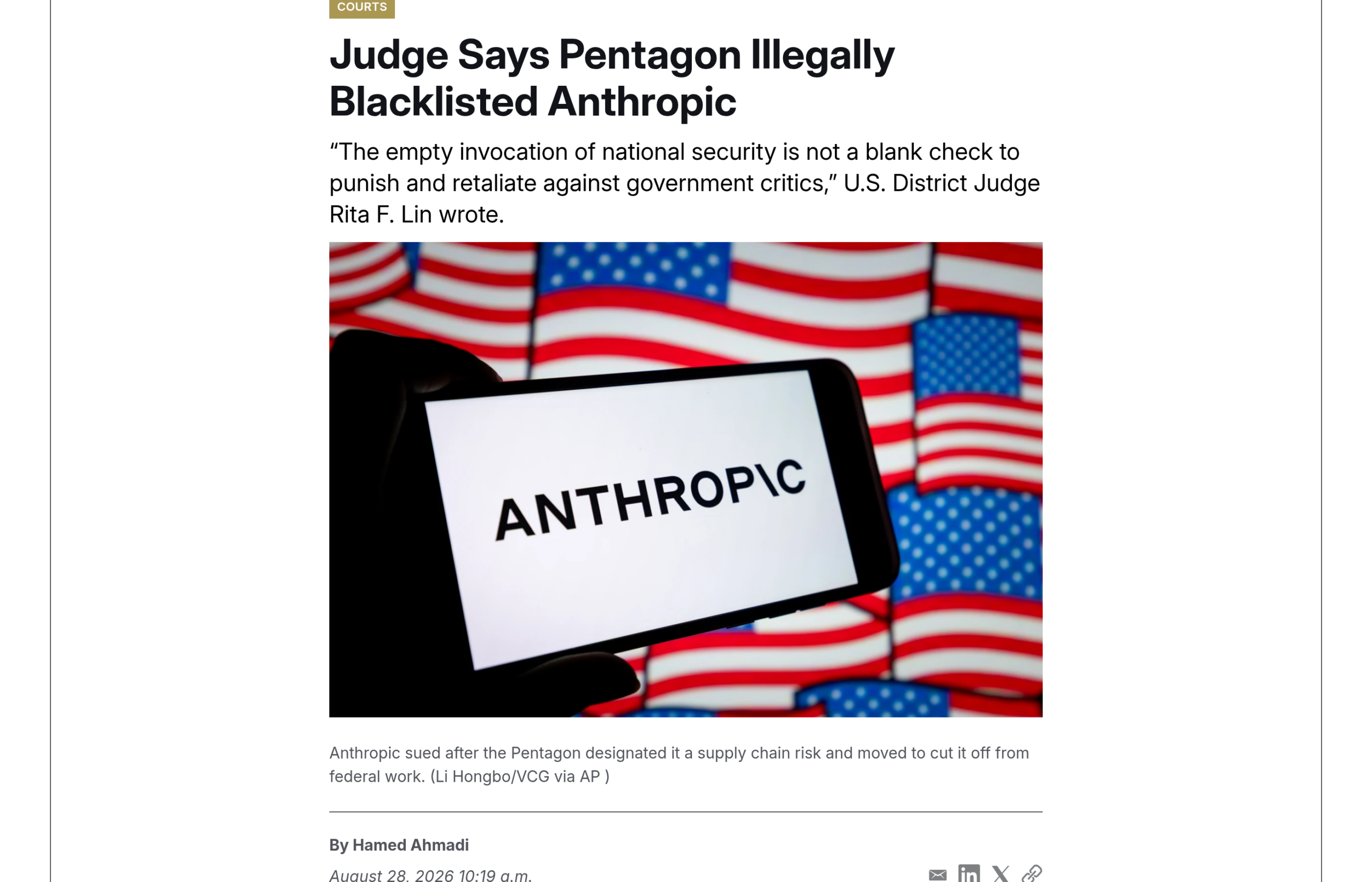
The ruling, reported by NOTUS under Hamed Ahmadi’s byline, strikes down the « supply-chain risk » designation imposed by Defense Secretary Pete Hegseth, and bars the administration from enforcing the contested measures.
Two grounds. The First Amendment, which protects free speech and bars the state from punishing someone for criticizing it. And the Fifth Amendment’s due process clause, which requires notifying a person facing a sanction and giving them a real chance to respond. The judge found that neither was honored.
Two more passages from the ruling are worth quoting, because they show where the judge draws the line. « An IT vendor does not become a potential adversary whenever it asks probing questions or stubbornly insists on particular contracting terms. » And on the security rationale put forward by the department: « None of that is consistent with a genuine fear that Anthropic is a saboteur who would poison its software. »
This isn’t a ruling about the technology. It’s a ruling about how the state went about it.
A sanction normally reserved for foreign entities
The dispute stems from a $200 million contract covering the deployment of Claude models on classified systems. The company wanted two clauses in writing: no use of its models in autonomous lethal weapons systems, and no use in mass surveillance on U.S. soil. The Department of Defense refused, arguing that a vendor has no business setting the military’s rules of engagement.
With negotiations broken off, Hegseth designated Anthropic a « supply-chain risk. » That status is normally used to shut out foreign actors deemed a threat to national security. Applied here, it automatically cut off access for every contractor and supplier working with the Pentagon, far beyond the contract in dispute.
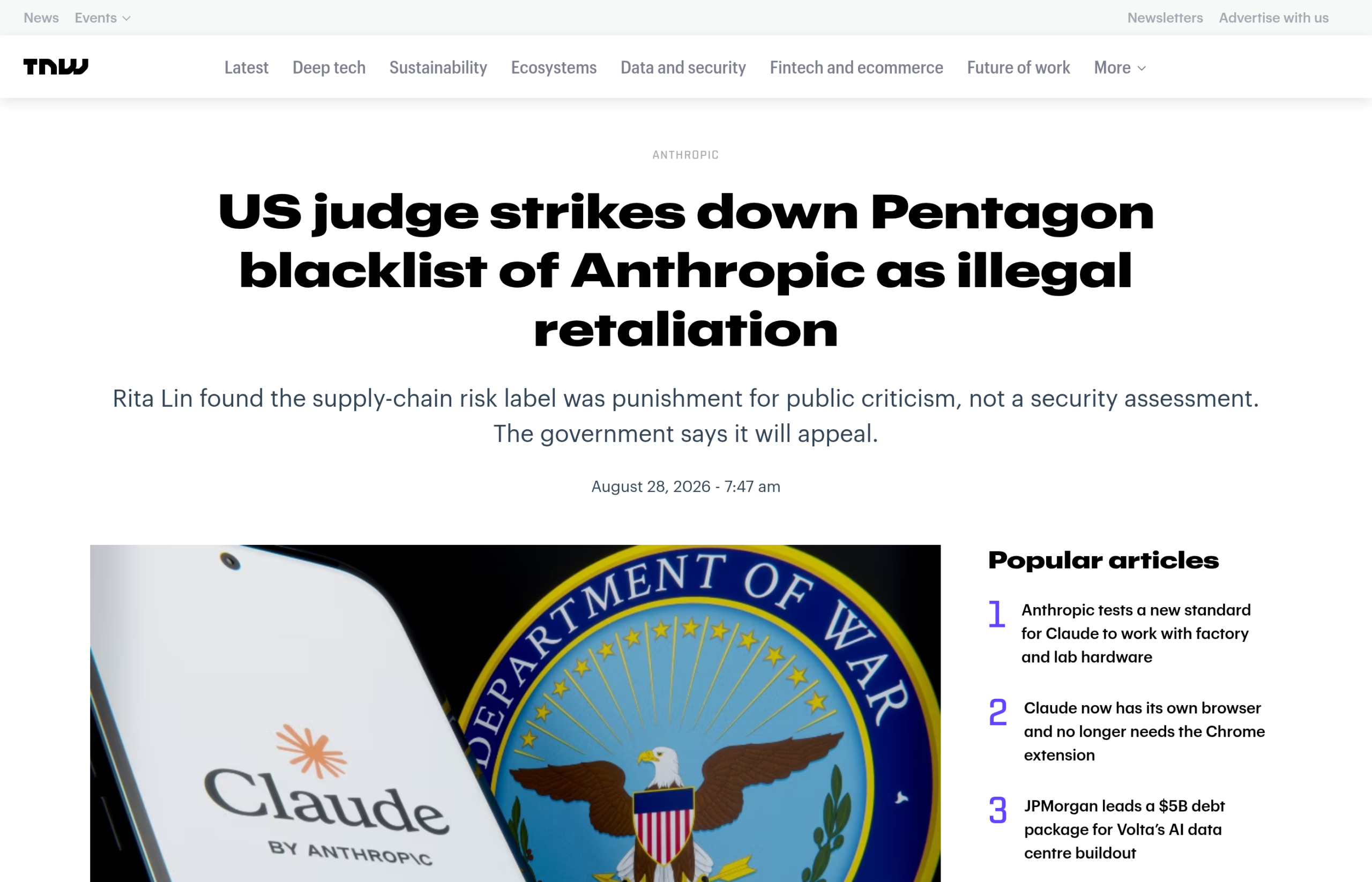
It’s the gap between the stated rationale and the actual effect that the judge penalized. The Next Web‘s subheadline, on August 28, sums it up in one line: the label was punishment for public criticism, not a security assessment.
A detail French coverage often leaves out: Anthropic didn’t wait to be defended. The company sued on its own after the designation.
Six months, three episodes
On March 2, we covered the initial refusal and the two red lines the company drew. Those are exactly the two clauses now back at the center of the court case. Nothing has changed on the substance in six months.
On June 13, second episode: Washington got Claude Fable 5 disabled. At that point the balance of power tilted entirely toward the state, and the open question was how far it could go.
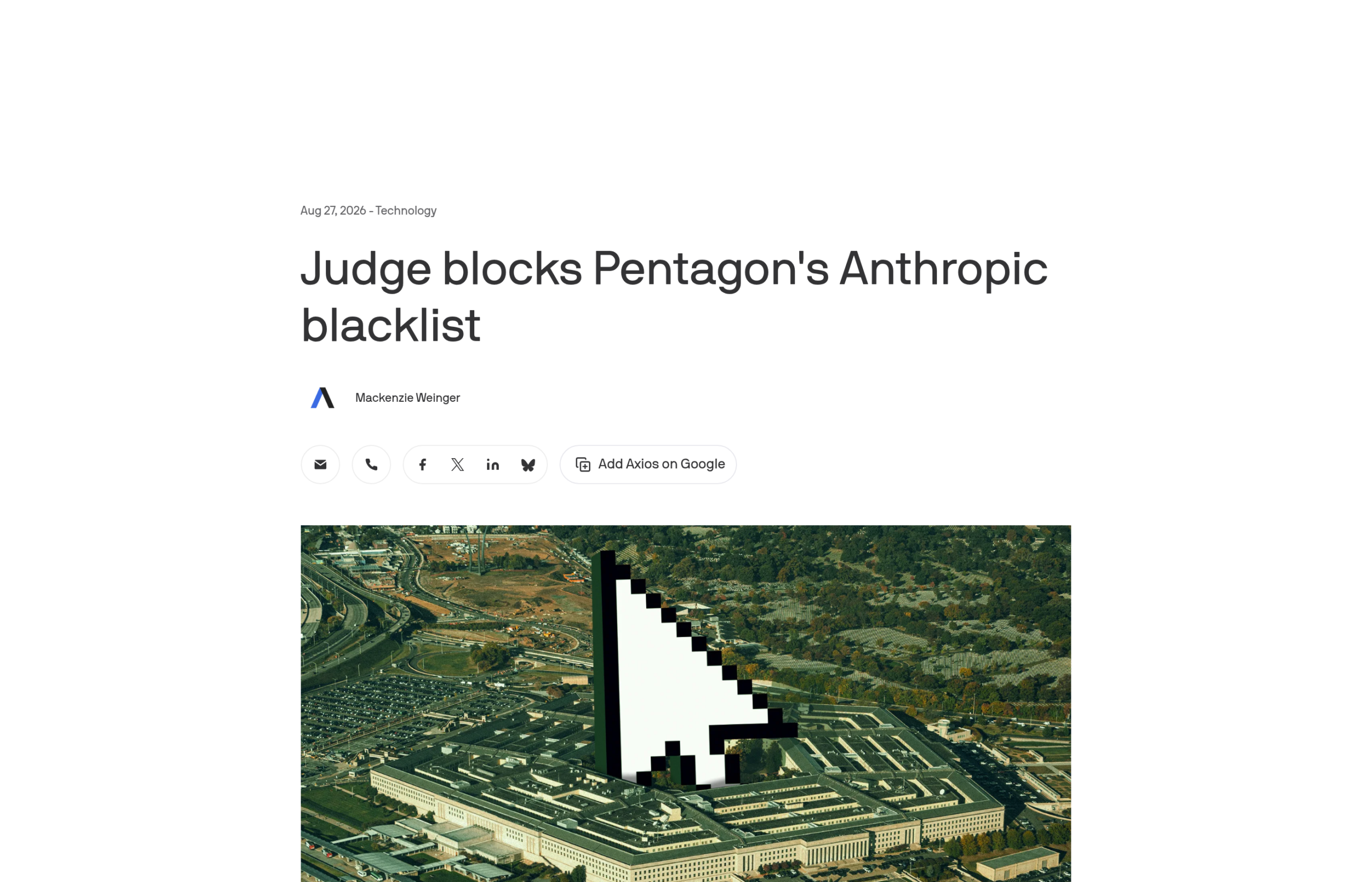
The answer came on August 27, and it came from a court. Axios, under Mackenzie Weinger’s byline, published the story that same day. The rest of the American press picked it up the following morning. The broader controversy over the military use of language models, though, has been running since at least March, and it isn’t limited to this one company.
What the ruling doesn’t settle
The government has announced it will appeal. The case will go to the Ninth Circuit Court of Appeals, which the Northern District of California falls under, and it could climb higher still. A trial-court ruling overturned on appeal leaves nothing behind. Nobody won anything permanently on August 27.
Nothing forces the department to work with Anthropic again, either. The judge struck down a sanction, not reinstated a contract. Letting the $200 million deal lapse without renewing it remains perfectly legal, and far less dramatic than a blacklisting.
Above all, the underlying question remains open. The judge didn’t say who was right about autonomous weapons or surveillance. She didn’t say a vendor can dictate usage limits to a military. She said the state couldn’t punish this vendor this way, without notice and in retaliation for a public stance.
The distinction matters. A vendor that made the same demands tomorrow would land at exactly the same starting point, facing the same refusal. What the ruling changes is the cost to the state of responding with blacklisting instead of simply ending the contract.
For an industry that lives on government contracts, and whose internal leaks regularly make the news, as we noted in April, this is a useful precedent. It is not protection.









0 Commentaires
Aucun commentaire pour le moment. Soyez le premier à commenter !