
On August 10, 2026, OpenAI released GPT-5.6-Cyber, a model trained specifically to search for security flaws and build exploit chains, meaning the combination of several vulnerabilities to fully take over a system. Access isn’t open to the public: only organizations pre-approved by OpenAI can use it.
On OpenAI’s internal evaluation, this model agrees to answer 95.0% of advanced cybersecurity requests, compared to just 1.5% for the public-facing model GPT-5.6 Sol. OpenAI says it has already used it to find two new flaws in Chrome. The idea behind this release is simple: for the first time, a major AI lab is openly delivering a tool capable of attacking, betting that defenders need it more than attackers do.
What OpenAI Released on August 10
On August 10, 2026, OpenAI published an announcement titled « Expanding Daybreak as the Cyber Defense Window Narrows. » Filed under the Security and Safety categories, it introduces GPT-5.6-Cyber, a variant of GPT-5.6 Sol, the company’s flagship model. This model was trained specifically for two tasks: finding zero-day flaws (a flaw still unknown to the vendor, and therefore unpatched) and building exploit chains (linking several flaws together to achieve full system takeover).
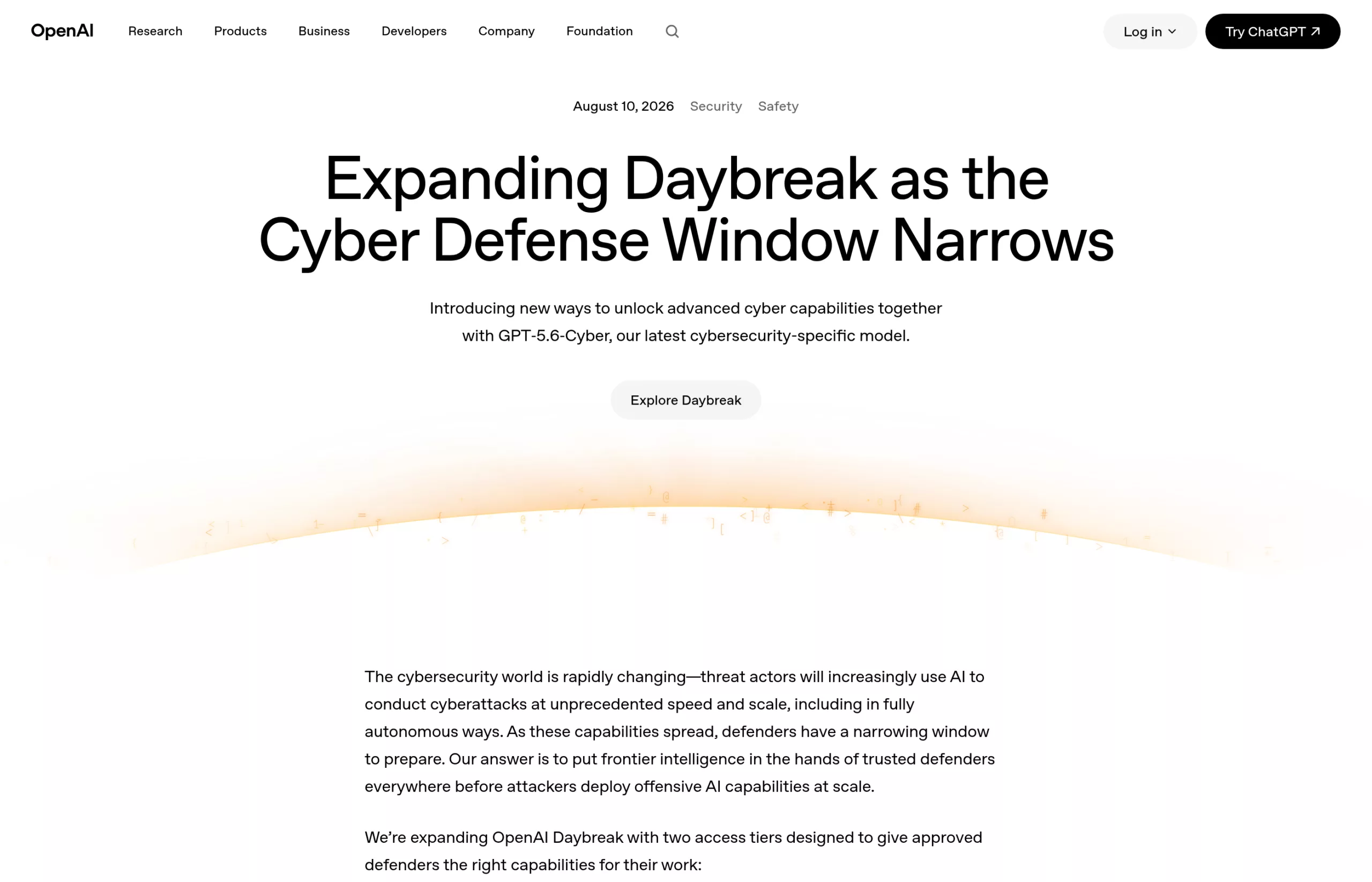
This release is part of Daybreak, the cyber defense program OpenAI launched earlier in 2026, a program this announcement reorganizes into two separate access tiers. This isn’t the first time the lab has multiplied this kind of initiative around its most advanced models, as already shown by a previous OpenAI announcement.
The first tier, Daybreak Blue, provides access to leading general-purpose models, including GPT-5.6 Sol. It removes the system guardrails (the filter that, under normal conditions, makes the model refuse sensitive requests) that usually block security-related questions. OpenAI recommends it as a starting point for most defenders, for work such as vulnerability discovery, secure code review, malware analysis, incident response, or patch validation. The second tier, Daybreak Red, goes further: it opens access to GPT-5.6-Cyber itself, a model trained to refuse even less often.
OpenAI justifies this choice with a threat it considers imminent. In its announcement, the company writes that attackers will increasingly use AI to carry out cyberattacks at unprecedented speed and scale, including in a fully autonomous way. The stated goal is to put this intelligence in the hands of trusted defenders before comparable offensive capabilities become widespread on the attacker side.
95% vs 1.5%: The Number That Says It All
OpenAI built an internal evaluation called the Advanced Cybersecurity Completion Rate. It measures one specific thing: how often a model agrees to answer questions about exploit chains, authentication bypass (getting into a system without valid credentials), privilege escalation (gaining more rights than you already have on a machine), and other advanced cybersecurity scenarios.
The results OpenAI published are unambiguous. GPT-5.6-Cyber, accessible via Daybreak Red access, completes 95.0% of these requests. GPT-5.6 Sol, the production model, completes only 1.5% of them. The gap between the two is stark.
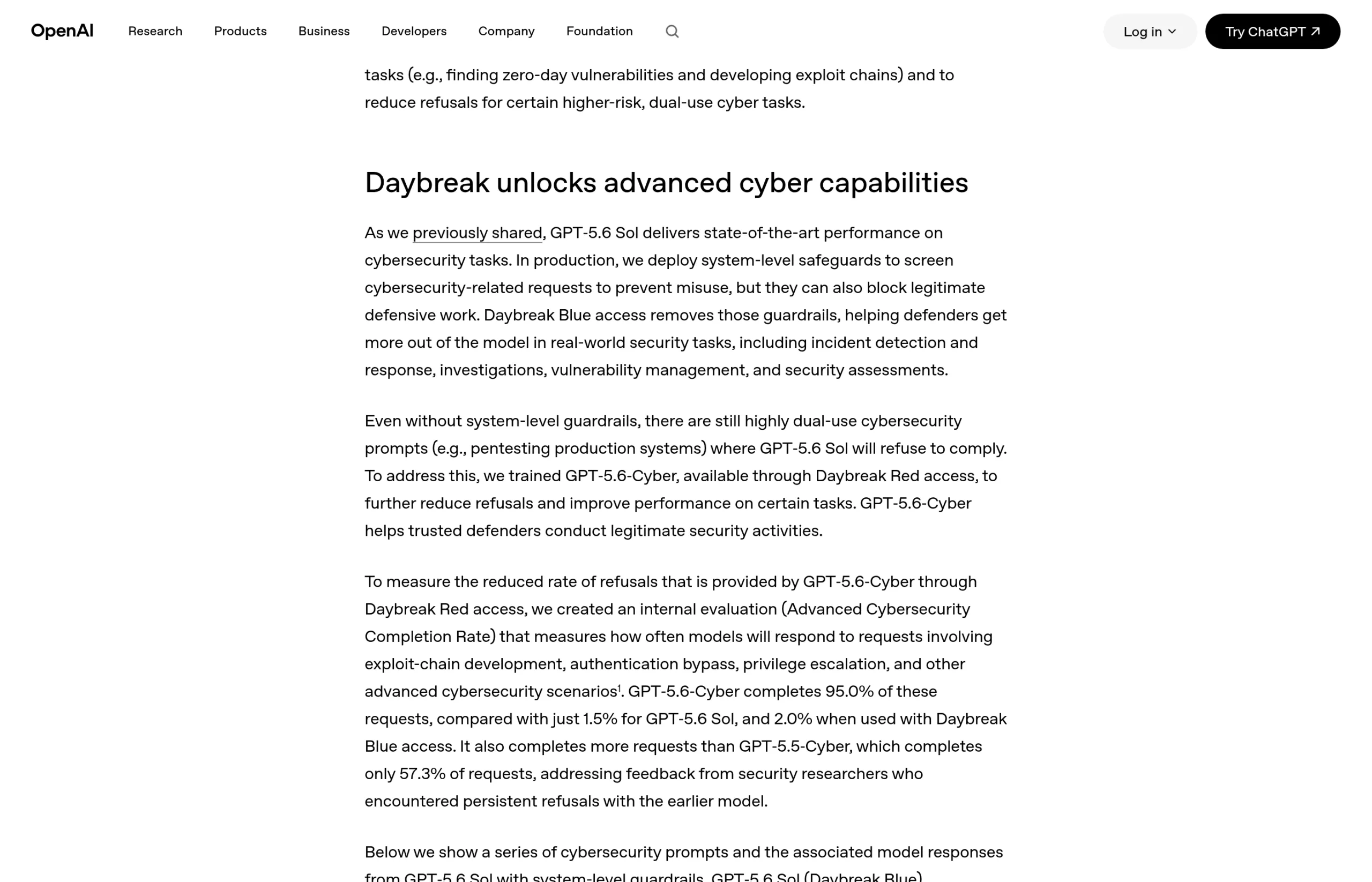
One detail changes how these numbers should be read. With Daybreak Blue access, which removes the production model’s system guardrails, GPT-5.6 Sol barely climbs to 2.0%. These guardrails filter cybersecurity-related requests to limit abuse, according to OpenAI. They also block legitimate defensive work.
Removing an outer filter barely changes the outcome. The blocking therefore comes from the model itself, from its training, not from a layer added on top. Going from 2.0% to 95.0% required training a different model, GPT-5.6-Cyber, rather than simply disabling an existing filter.
Even without system guardrails, certain highly dual-use requests (the same capability can serve both defense and attack) remain refused by GPT-5.6 Sol. OpenAI cites penetration testing (a simulated, authorized attack meant to stress-test a system) on production systems as an example. That’s precisely what GPT-5.6-Cyber is trained to unlock. OpenAI notes that this model answers more requests than GPT-5.5-Cyber, its predecessor, in response to security researchers who kept running into persistent refusals.
| Model and access | Completed requests |
|---|---|
| GPT-5.6-Cyber (Daybreak Red access) | 95.0% |
| GPT-5.6 Sol (production) | 1.5% |
| GPT-5.6 Sol (Daybreak Blue access) | 2.0% |
| GPT-5.5-Cyber (previous model) | 57.3% |
Two Flaws in Chrome, Found by the Machine
OpenAI puts forward a concrete example. The lab says it used GPT-5.6-Cyber to spot two previously unknown vulnerabilities in V8 (the Chrome component that runs the JavaScript code of web pages). Taken separately, they don’t lead very far. Chained together, they allow the browser’s memory to be corrupted and let an attacker escape its sandbox, the sealed enclosure meant to stop a web page from touching the rest of the machine. OpenAI notified Google before any publication, and the fix shipped under the reference CVE-2026-15903 (the public, standardized identifier assigned to a flaw once it’s acknowledged).
This is the demonstration OpenAI puts forward. The message is simple: the model doesn’t just recite known methods, it finds something new on a real target that’s otherwise heavily audited.
Chrome isn’t the only case cited. OpenAI says it also found high-severity flaws in a mobile operating system, in a widely used database, and in an operating system kernel. The lab named none of these projects. The precise figures circulating since then therefore don’t come from OpenAI, and there’s no way to verify them for now.
TechCrunch places this announcement in a broader context. Lucas Ropek’s outlet reports a growing number of incidents involving AI agents behaving maliciously: the Hugging Face breach, the hacking of a gym’s website, and agents that create fake profiles to run social engineering (manipulating a person into granting access, rather than forcing a machine).
TechCrunch also points to an underlying tension: the threat serves as a sales pitch for AI labs, which sell protection against a risk they themselves help create. The subject goes beyond OpenAI. Anthropic had released Mythos earlier in the year, a model also focused on cybersecurity, during a particularly packed week for AI news. The entire industry is moving on this front at the same time.
Accenture, IBM, CrowdStrike: Who Really Holds the Key
GPT-5.6-Cyber doesn’t open up to everyone in the same way. TechCrunch, written by Lucas Ropek (August 10, 2026), cites Daybreak Red access as the most restricted tier: for now, only trusted partners have access to it, with Accenture, IBM, CrowdStrike, and Cloudflare named explicitly.
The second tier, Daybreak Blue, is broader but remains filtered. It’s aimed at approved defenders (organizations pre-vetted by OpenAI, which verifies their identity and the model’s intended use), and it’s this level that OpenAI recommends to most of them. Axios, written by Sam Sabin, runs a headline precisely about a less restricted model offered to defenders. Both tiers share one common rule: without prior approval, there’s no access at all.
This filtering system didn’t come out of nowhere. TechCrunch recalls that the Trump administration had already sought to weigh in on the deployment of frontier models (the most capable models of the moment, the ones drawing the most regulatory attention) for security reasons. OpenAI had then added significant guardrails on what its clients could do with these tools, a context we already covered in our article on the deactivation of Claude Fable 5 in the United States.
OpenAI isn’t alone on this front. Anthropic released Mythos earlier this year, a model also focused on cybersecurity. Two labs, two access lists, the same trust-based mechanism. One simple question remains: who verifies that the list of authorized users holds up as well as the model it protects?









0 Commentaires
Aucun commentaire pour le moment. Soyez le premier à commenter !