
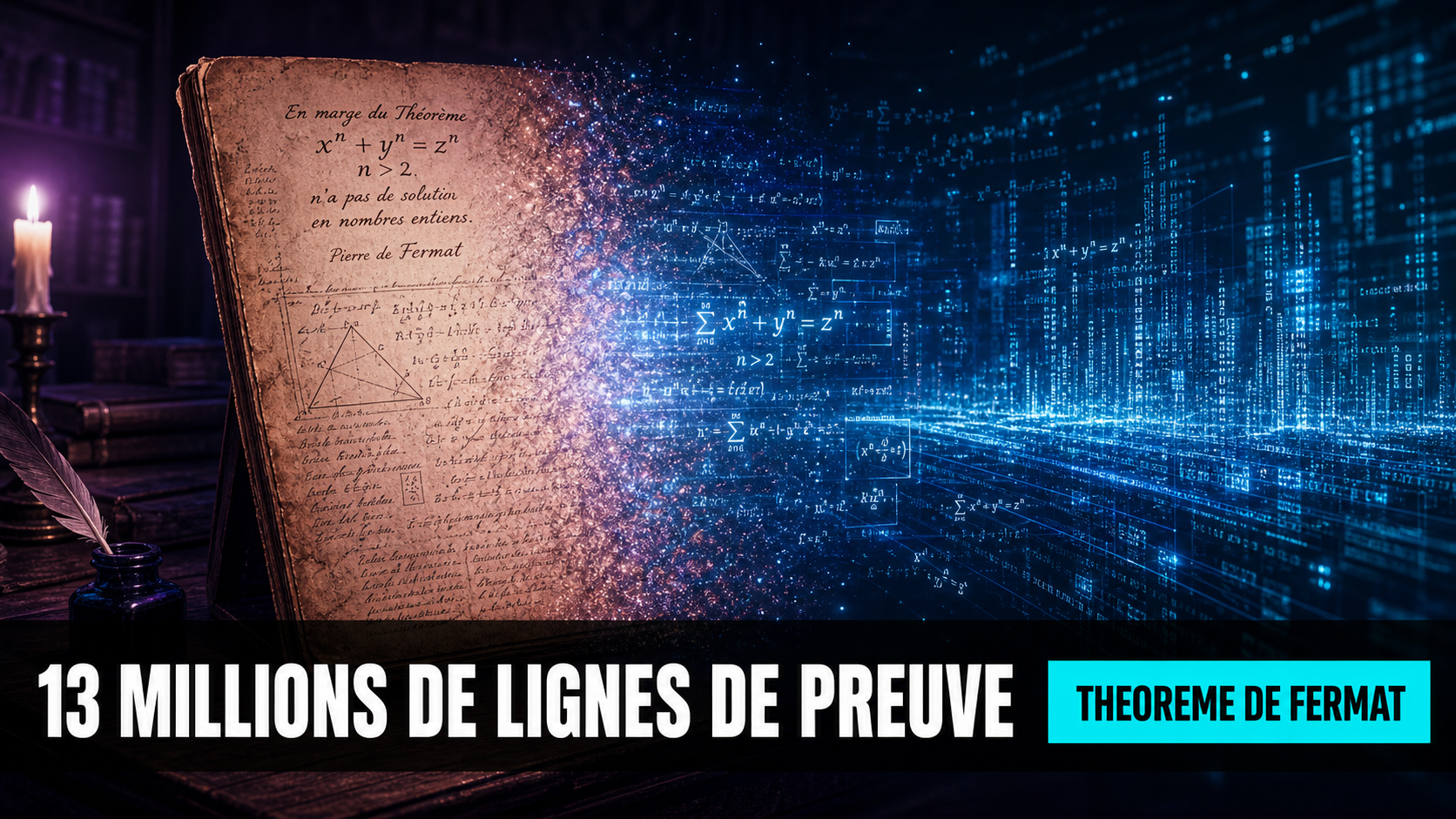
Thirteen million lines of code for a single proof. That’s what an Anthropic model produced in eleven days, translating the proof of Fermat’s Last Theorem into a language the machine can check step by step. The technical feat is real. What it actually guarantees is a little less than the number suggests.
13 million lines, 29,500 theorems
Thirteen million lines. That is the volume occupied, once translated into computer language, by the proof of Fermat’s Last Theorem, a statement formulated in the 17th century and left unproven for over three hundred years, until Andrew Wiles proved it in the 1990s. On September 4, 2026, Anthropic’s publication detailed not a new proof of Fermat’s Last Theorem, but the complete formalization of Wiles’s proof. That is, the rewriting of his proof in a language the computer can verify line by line, without relying on human intuition.
The text was written in Lean, a computer language designed to write and verify mathematical proofs. Along the way, it proves 29,500 intermediate theorems, out of 30,300 produced in total, each one necessary to the final structure. To put that in perspective: this formalization is five times the size of Mathlib, the reference library of mathematics already formalized in Lean, built by the community over the years.
Eleven days of work. Anthropic sums up the duration as « a little under two weeks ». The project consumed roughly six billion output tokens, the units of text a model produces, the rough equivalent of word fragments. The model used is not publicly available: Anthropic describes it as a « general-purpose internal research model roughly comparable to Claude Fable 5.1 ». The company, whose standoff with the Pentagon we had covered, therefore keeps its best tools to itself.
What the machine guarantees, and what it doesn’t
Lean verifies one precise thing. Every line of the proof, every logical step, follows the system’s rules. Nothing is off between the start and the end of the reasoning. There is no gap, no hidden « we assume that » buried in the 13 million lines.
This guarantee rests on just three axioms. An axiom is a statement accepted without proof, on which everything else is built. The fewer a system uses, the stronger it is. The proof of Fermat’s Last Theorem produced by the agents doesn’t use any more than Lean’s own.
Yet verifying that a piece of reasoning is correct says nothing about what it actually proves. A perfectly valid proof can address a statement slightly different from the one you think you’re proving. That’s why an automatic comparator checked the final statement against its reference version in Mathlib. The two match. This step sets the work apart from a mere production of convincing text: it ties the proof to the real problem, not to an approximate rewording. The question of verifiability had already come up in August, when OpenAI Astra cracked ten math problems that anyone could check.
The project didn’t move forward in a straight line. Dozens of agents worked in parallel over eleven days, coordinated through Prove2Me, an open collaborative platform built by Tianyi Peng and his collaborators at Columbia University. It maintains a graph of the statements to be proven, letting each agent choose which sub-part to tackle next, and find a result already proven from a plain-language description. Many attempts failed. Anthropic writes that « failed efforts contributed ~7% of the non-boilerplate lines in the final proof ». Those failures were therefore not wasted.
One limitation remains, which Anthropic itself acknowledges. The company writes that its proof is « likely much longer than it needs to be ». Mathlib owes its conciseness to careful human review, line by line. No one has read the 13 million lines produced by the agents. Compilation, the step where the machine rereads all the code to check that it holds together, validated the structure. No human validated its form.









0 Commentaires
Aucun commentaire pour le moment. Soyez le premier à commenter !