
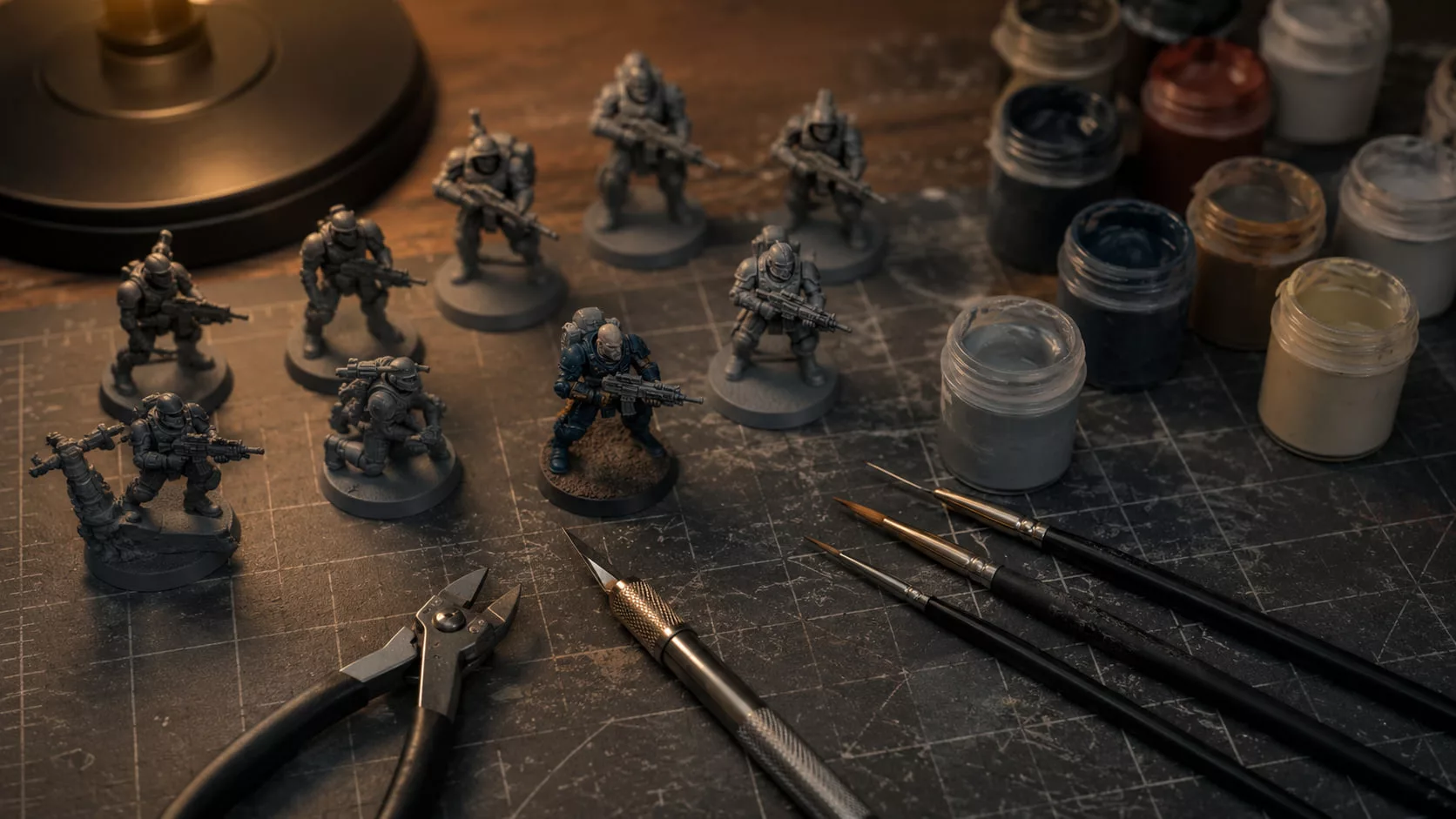
You just finished Space Marine 2 and you’re wondering what the game it’s based on looks like. Moving from the controller to Warhammer 40K miniatures takes no particular skill, but the hobby costs more in time than in money, and nobody tells you that before you buy. Here are the real numbers, as of August 2026.
The video game tells a battle, the tabletop makes you play it
The Ultramarines from Space Marine 2 come from Warhammer 40K miniatures, a tabletop game created in 1987. Every unit you commanded on screen exists in plastic, ready for you to assemble and paint yourself. The difference is pace: where the video game blows through waves of Tyranids in seconds, a tabletop game lasts two to three hours and gets measured out with a tape measure.
Games Workshop released the eleventh edition of the game on June 20, 2026. The core rules were rewritten for the occasion, which works out well if you’re arriving now: you’re learning the same version as players who’ve been at it for twenty years.
What it costs to get into the hobby
The entry budget varies fourfold depending on how far you want to go. Four entry points exist today, from the smallest to the most complete:
- The Discovery Edition: a few miniatures, simplified rules, enough to try a short game with no extra gear.
- The « Start Collecting » sets: a complete patrol-sized army, Space Marines or Orks depending on which faction draws you in.
- The Introductory Set: two armies, a board, terrain, dice and the rulebook. The option that lets two players get a game in on the very first night.
- Armageddon, the eleventh edition’s launch box: 61 miniatures and the new rules.
Add the assembly and painting essentials: one set holds thirteen Citadel paint pots, a pair of clippers, a mould line remover and a brush. Individual unit boxes are sold separately, and the rulebook is available on its own. Prices shift with reprints and sales, so check them with your retailer before deciding.
A starter box works out cheaper than buying piece by piece
An Introductory Set holds the equivalent of three to four unit boxes, a board and the rules. Bought piece by piece, the same contents come to noticeably more. The starter box is therefore the best value for a first purchase, with one catch: it locks you into its two factions. If Orks leave you cold, half the contents will sit in a cupboard, or end up resold secondhand.
Buying piece by piece makes sense once you already know which army you want to play. In that case, start with the rulebook and a single troop box, then build up as you play more games.
The real budget is painting time
A Space Marine miniature takes a beginner between one and three hours: assembly, priming, base coats, wash, highlights. A patrol-sized army has around twenty of them. Expect several weeks at two or three evenings a week before you can put a fully painted army on the table.
Nothing forces you to paint before you play, and plenty of clubs accept grey plastic while you’re still learning. But this is the step most players end up preferring to the game itself, and it’s also what explains why people stick with the hobby for years.
Where to buy in France
Games Workshop stores sell at the recommended retail price. Independent retailers often offer the same product a bit cheaper, with advice that’s worth its weight in plastic when you’re torn between two armies. A store specialising in Warhammer 40K miniatures stocks the full catalogue, from starter boxes to individual paints, which saves you from splitting orders across three different sellers just to finish one army.
Check real stock availability before ordering: releases tied to the eleventh edition sell out fast, and a miniature listed as in stock can end up waiting weeks for restock.
Partner content – this article was published as part of a paid commercial partnership. It does not engage the Kami-Labs editorial team.









0 Commentaires
Aucun commentaire pour le moment. Soyez le premier à commenter !