
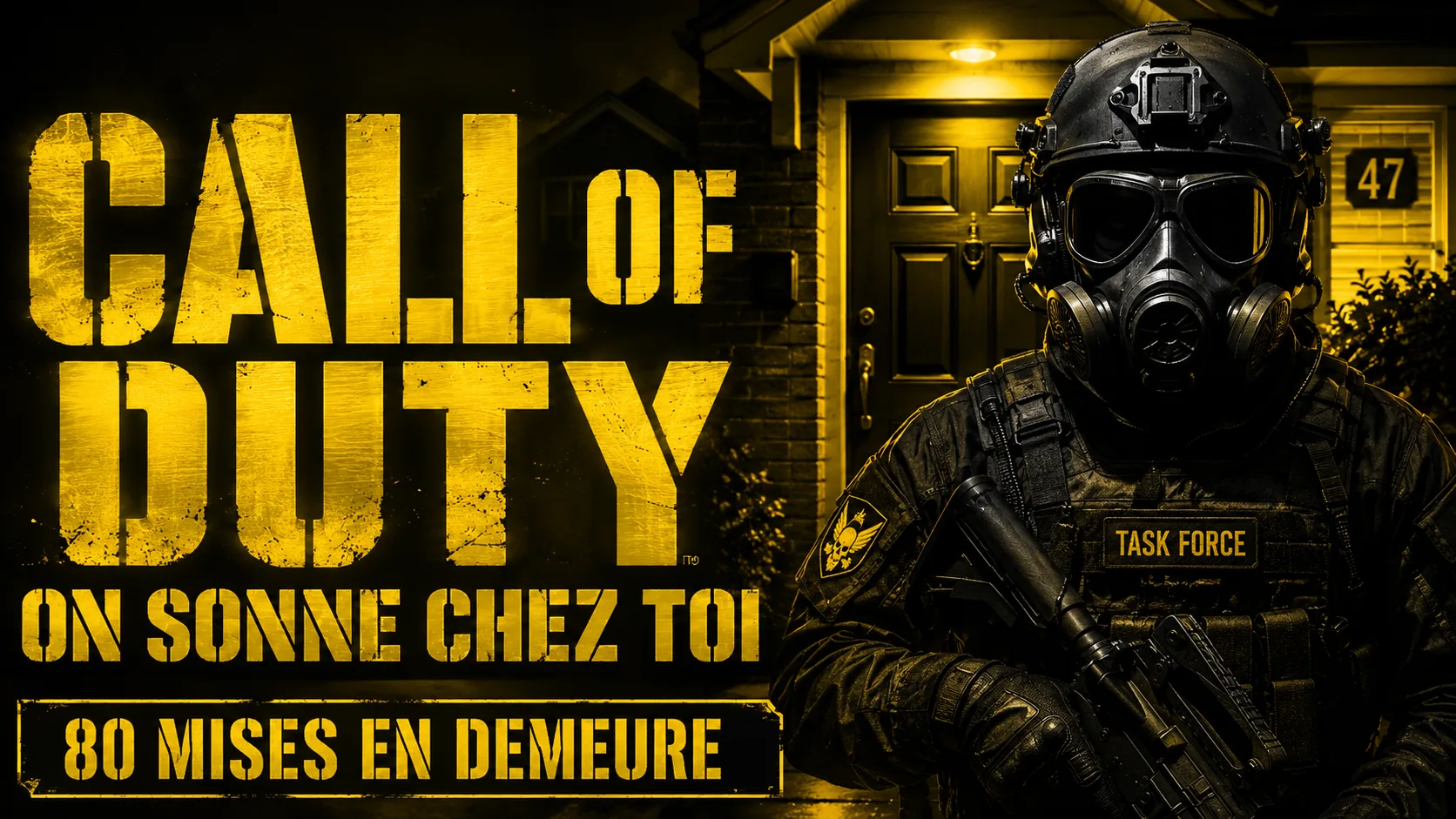
A publisher suing a Call of Duty cheat seller is nothing new. A publisher filming the handoff and posting the video on its own account is. Activision did exactly that on Friday, August 28, 2026, and used the moment to publish its own numbers.
A Process Server, a Camera, and a « What’s That? »
A driveway, a front door, a camera that never cuts. A process server walks up to the home of a cheat software seller, knocks, and hands over an envelope. The exchange lasts a few seconds. Polite, almost mundane.
The document is a cease and desist letter. The person receiving it goes by Elocarry. He sells Call of Duty cheat tools, plus gear for Rust and Apex Legends. Faced with the paper, he has one question: « What’s that? » The process server tells him to call the law firm named in the document.
Kotaku spotted the video on Friday, August 28, 2026, on Call of Duty’s official X account. The publisher isn’t acting behind closed doors: it films, then it broadcasts. Elocarry’s catalog is a reminder that this market reaches well beyond one game, with effects that show up in competitions too, like this hack that disrupted Apex Legends’ North American finals.
The message to other sellers fits in one line: the publisher will sue, and it will let everyone know. Activision has already sued cheat providers for several million dollars. The story was reported by Rick Lane for PC Gamer, on August 30, 2026.
The Numbers Activision Is Citing on Call of Duty Cheating
In the thread posted after the video, the publisher cites three specific numbers about its campaign against Call of Duty cheat sellers.
- 80 cease-and-desist letters sent
- 375 resale operations disrupted
- 30 sellers shut down entirely
Elocarry reacted almost immediately. The Call of Duty account shared a screenshot of his Discord server, where he announced he had « temporarily suspended sales » of his cheats while he « looked into an internal matter. » Nothing more on what that matter actually is.
These three numbers come from Activision, and Activision alone. They land the same day the publisher films itself cracking down, with no third party able to check them. Nobody has verified the count of cease-and-desist letters, or the disrupted operations, or the shuttered sellers. Take it for what it is: the tally the company chose to make public.
Modern Warfare 4 and the Real Timing Behind the Operation
The video isn’t alone. In the same thread, Activision addresses the next phase of its fight against Call of Duty cheating, this time in Modern Warfare 4. The timing isn’t a coincidence: it’s the day a beta opens to every player.

The official Call of Duty blog, August 30, 2026: Modern Warfare 4’s second beta weekend has been open to everyone since August 28.
This second beta weekend kicked off on Friday, August 28. Unlike the first, it’s open to everyone, as announced by the official Call of Duty blog. On the menu: the usual multiplayer test, a campaign mission, and a run through Warzone, the game’s battle royale mode.
An open beta is when a competitive shooter draws the biggest crowd. So it’s also when a publisher most needs to reassure people about its anti-cheat. Activision claims that, during the previous weekend, infection rates were lower. That’s the share of matches where at least one cheater gets detected. Hardware bans, which target the machine itself rather than just the account, were supposedly harder to get around. Response time had reportedly improved.
None of these three claims comes with a number. Lower than what, by how much, improved by how many minutes: these questions have no public answer.
What This Actually Changes When You Load Into a Match
That’s the only question that actually matters to you. Not how many letters got sent, but how many cheaters you run into this month in ranked play. These two questions don’t answer each other.
There’s real logic behind the move. Going after the seller costs the market more than banning accounts one by one. When a piece of software disappears, dozens of resellers lose their source overnight. Activision’s own ratio makes the point: 375 resale operations disrupted for just 30 sellers shut down. And getting filmed on your own doorstep leaves a mark that quietly closing an account never did.
Now look at what Elocarry actually announced. A temporary suspension, while it looks into the matter. Not a shutdown. It’s still selling for Rust and Apex Legends, outside the scope of this cease-and-desist. Its Call of Duty cheat tool still exists somewhere, ready to come back under another name. A precedent like Blizzard’s warning about TurboHUD4 before its ban wave had already shown this: a public announcement and a measurable result are two different things.
Cheating isn’t limited to software bought on some obscure Discord either. Sometimes it comes from the inside, like this Blizzard game master caught favoring a streamer. It reaches every level of fame, up to Elon Musk admitting he cheated in Path of Exile 2.
The one number that would actually settle the debate, Activision hasn’t published: the rate of matches with a cheater, before and after these cease-and-desist letters. Without it, this operation remains a show of force. Not proof it works.









0 Commentaires
Aucun commentaire pour le moment. Soyez le premier à commenter !