On August 13, 2026, Chinese company DeepSeek released a new language model (an artificial intelligence system trained to understand and produce text) named DeepSeek V4 Pro. The next day, Google published a model presented as more powerful and, above all, cheaper. In between, OpenAI wrapped up an employee tender offer worth around $7 billion. Three announcements in a matter of days, one real shared question: who offers the best performance-to-price ratio.
DeepSeek V4 Pro: the power, then the rising bill
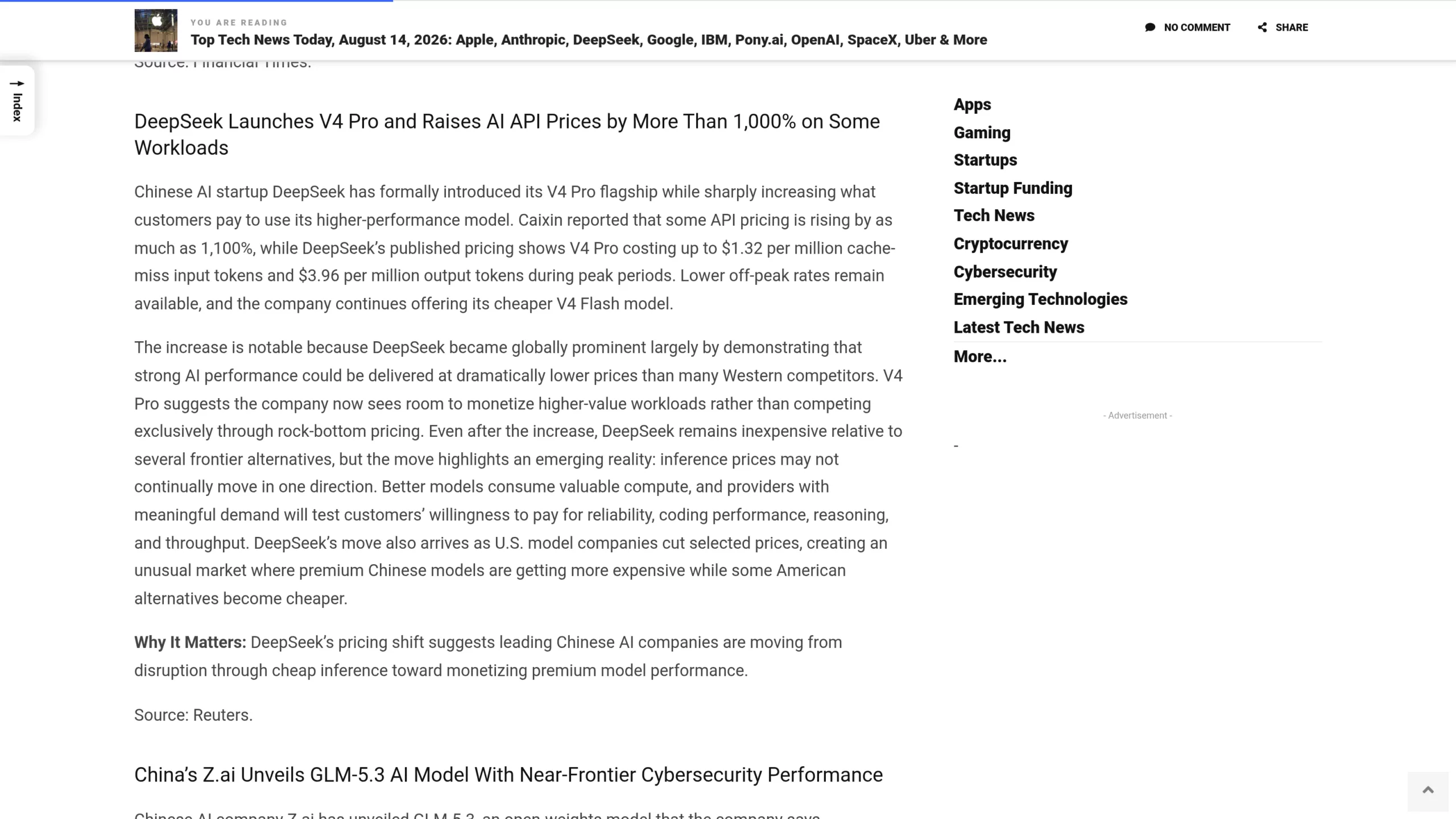
Tech Startups, August 13, 2026, citing Reuters: the V4 Pro launch comes with a price increase for the application programming interface.
DeepSeek took V4 Pro out of testing on August 13, 2026, under the technical name V4-Pro-0813. The model is available on the company’s app, website, and API. DeepSeek describes it as built for agentic tasks, meaning cases where the AI uses tools, writes and runs code, and chains multiple steps without human intervention.
On a technical level, DeepSeek V4 Pro relies on what’s called a mixture of experts architecture. The model is split into specialized sub-networks, and only part of it activates to answer each request, which limits the computation required.
- 1.6 trillion parameters in total (parameters are the internal settings the model learns during training), of which only 49 billion are active to process each token
- A 1 million token context window, with responses reaching up to 384,000 output tokens (a token is the word fragment the model processes as a basic unit)
- Open weights (the model itself, not just API access) released under the MIT license on Hugging Face, which anyone can download and run on their own servers
- Two operating modes, with or without visible reasoning, and three adjustable effort levels depending on task difficulty
DeepSeek claims strong results on several agent-focused benchmarks: 87.9 on Terminal-Bench 2.1, 62.7 on DeepSWE, 61.5 on NL2Repo. These figures come solely from the company itself. No independent lab had confirmed them at the time this article was published.
Two days after launch, DeepSeek announced the opposite of what had built its reputation. Starting August 16, 2026, API pricing rises sharply, up to a 355% increase on DeepSeek V4 Pro’s output price during peak hours, according to figures published by Fortune. The price goes from $0.87 to $3.96 per million tokens generated during the day, with the rate cut in half at night. DeepSeek justifies the change by the need to better distribute the load on its servers. Despite the increase, these prices remain lower than several high-end Western models.
Google fires back with Gemini 3.7 Flash, half the price
Google released Gemini 3.7 Flash on August 13, 2026, made available to developers the next day. The company describes it as its smartest model for coding and agentic tasks, designed for volume rather than raw power records.
The introductory price is $0.75 per million input tokens and $3.75 per million output tokens, valid until December 31, 2026. That’s half the launch price of Gemini 3.6 Flash, its predecessor released just three weeks earlier. The rate is set to rise back to $1.50 and $7.50 on January 1, 2027.
Google claims significant progress over Gemini 3.6 Flash: 43.6% versus 34.4% on the FrontierCode benchmark, 65.3% versus 49% on DeepSWE. Here too, these scores come from the company selling the model, not from an outside body.
The irony of the week fits in one sentence. Google cuts its prices in half the very same day DeepSeek raises its own by more than three times. Even after this increase, the output price of DeepSeek V4 Flash, the lightweight version of V4 Pro, stays below that of Gemini 3.7 Flash during off-peak hours. The price ranking shifts almost every week.
OpenAI: a $7 billion employee tender offer
OpenAI, for its part, finalized an employee tender offer worth around $7 billion around August 10, 2026. An employee tender offer is when a company uses its own cash to buy back shares from current and former employees, rather than turning to new investors. It lets them cash out without waiting for an IPO. The information comes from Bloomberg and was confirmed by CNBC.
The deal values OpenAI at $852 billion, the figure set during the $122 billion funding round closed in March 2026. It’s the third buyback of this kind organized by the company:
- $1.5 billion in 2024
- $6.6 billion in October 2025, for a valuation of $500 billion
- $7 billion in August 2026, for a valuation of $852 billion
OpenAI filed a confidential registration with the SEC (U.S. Securities and Exchange Commission) in June 2026, without announcing an IPO date. A buyback funded from the company’s own cash is often read as a sign that an IPO isn’t imminent. The financial move comes right after two product announcements: GPT-5.6-Cyber, a model built for security vulnerability research, and Astra, introduced in early August.
This buyback isn’t a move on a product’s price. But it’s part of the same battle. Keeping top engineers paid and loyal is expensive, at the very moment two rivals are fighting over customers on price per token.
The real battleground: the performance-to-price ratio
For a long time, the question asked at every model release was simple: which one is most powerful? DeepSeek had already reshuffled the deck in early 2025 by undercutting prices against American models. This week changes the game a second time, in both directions at once.
For someone using these tools daily, coding with an AI assistant, or running an agent that processes documents, the consequence is concrete. The choice no longer comes down to just a benchmark score. It also comes down to the real cost per million tokens processed, at the time of day they’re processed. A lower rate at night, or for large tasks, can weigh more on a company’s bill than a point gained on an academic test.
This price war has a downside you won’t see in a launch press release. Running ever-bigger models at ever-lower prices requires enormous amounts of chips, data centers, and electricity. That’s the other side of the AI race, the one playing out on capital and energy rather than on the price tag per token.
For now, DeepSeek, Google, and OpenAI are each moving their own piece on this chessboard, in this same month of August 2026. The link between tech’s stock market value and the AI race has never been more direct.









0 Commentaires
Aucun commentaire pour le moment. Soyez le premier à commenter !