

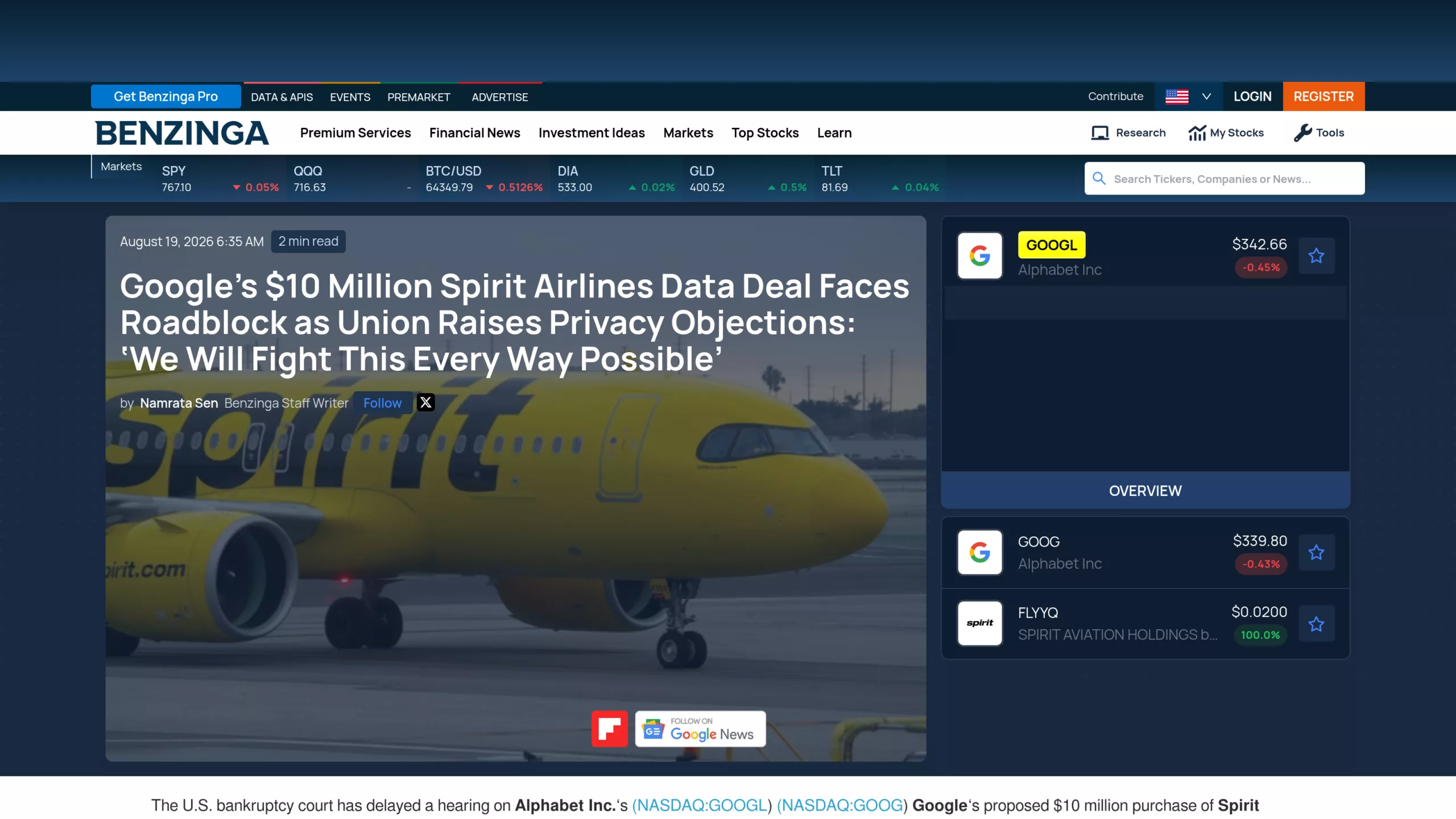
Google won a bankruptcy auction on August 17, 2026. The prize: Spirit Airlines’ internal archives, roughly 100 million emails and 500 million Microsoft Teams conversations, for $10 million. The 5,500 flight attendants whose messages are in this trove were never consulted. Their union filed a court objection, and the hearing has been postponed.
What Google bought, and for how much
Spirit Airlines, the American low-cost airline, filed for bankruptcy. As part of the proceedings, its digital archives went up for auction like any other company asset. Google won with a $10 million bid, beating out Mercor, an AI recruiting company that offered $7.5 million.
The trove is vast. It includes roughly 100 million emails and 500 million Microsoft Teams conversations, the internal messaging platform used by Spirit Airlines. Add to that software code, spreadsheets, calendars, and presentations, plus various administrative archives built up over the years. Financial databases round out the lot, with billions of ticket price records accumulated over the airline’s entire operating history. For anyone looking for training data (the body of text fed to a model so it learns to respond), this is a goldmine.
Google says it won’t receive any personally identifiable information, meaning nothing that could point to a specific person in the documents. The archives will be scrubbed by a third party before delivery, the company states. Passenger profiles and loyalty program data are excluded from the sale. The practice isn’t isolated: Twitch also trains Amazon’s AI with its users’ streams, by default and with no real choice left to creators.
The math tells its own story. Ten million dollars for roughly 600 million messages works out to under two cents per message. At that rate, the emails and chat threads of a bankrupt airline are worth less than a cup of coffee.
Flight attendants are pushing back
The Association of Flight Attendants-CWA (AFA-CWA), the union representing more than 5,500 Spirit Airlines flight attendants, filed an objection with the bankruptcy court, the legal process overseeing the sale of a struggling company’s assets. The statement, published on August 18, 2026, carries a blunt title: « Spirit Bankruptcy: Objection to Sale of Your Data ».
Sara Nelson, AFA-CWA international president, told Forbes: « This is outrageous! We are filing a court objection to Google’s attempt to buy data that has no business being sold. » The union adds that it will fight « every way possible. »
The privacy protections built into the deal cover consumers, meaning passengers. They don’t cover employee data. If the court approves the sale as written, the work records and internal communications of more than 5,500 people would pass to Google without any of them having had a say.
Data in scope runs long: disciplinary records, payroll history and records, internal communications, emails, SharePoint files, Microsoft Teams content, training records, and time cards, meaning logs of hours worked.
Union lawyers are asking the court to reject the sale unless it’s amended to exclude any information about flight attendants, including training records, time cards, and payroll, as well as any Microsoft 365 content concerning them. Google responds that a third party will scrub all personally identifiable information before any transfer.
At Spirit Airlines, anonymized doesn’t mean anonymous
According to the court filings, the purchased data will be turned into « deidentified records », files stripped of any direct personal identifier, before reaching Google’s servers.
Removing a name doesn’t always erase a person, though. Take an anonymized flight schedule, cross-referenced with shift times and two or three internal messages mentioning a specific flight. At a given layover, at a given hour, there are sometimes only three or four crew members on duty. That overlap quickly narrows the field down to a single individual. Researchers call this re-identification: recovering a person’s identity from data that has otherwise been scrubbed of their name.
That’s exactly the technical issue worrying the AFA-CWA. The sale agreement keeps the links between the different data sets intact. The same identifier still connects one person’s emails, time cards, pay stubs, and Teams conversations. With a group of more than 5,500 people at Spirit Airlines, the union believes it remains possible to reconstruct information about identifiable individuals, or identifiable small groups, even without a name attached.
Legal commentators add another angle, separate from the technical question. These employees never consented to having their work communications reused as training material for a third party’s AI. The topic of exposed company data comes up regularly, but it’s usually a leak. Here, the data transfer is written into a contract and approved by a judge.
What this price says about the data market
Ten million dollars for 100 million emails, 500 million Teams conversations, code, spreadsheets, calendars, financial databases, and billions of fare records. Broken down per message, the total falls under two cents. That figure sums up, better than any lengthy argument, what the raw material of a language model is worth per unit.
Two companies fought over this lot. Mercor, which specializes in AI recruiting, had offered $7.5 million before losing the auction. This wasn’t a last-resort sale for lack of a buyer. Two separate bids priced this corpus, which points to real demand rather than an accounting move by a liquidator eager to close the books.
What makes these messages sought-after comes down to their nature. Professional communications written by humans, in a work context, spread across several years. Not published text, not web content already recycled a thousand times by crawlers. This kind of corpus stays rare, precisely because it’s normally private. The billions poured into AI infrastructure are useless without this textual fuel, which trades here for a fraction of a cent.
When a company goes bankrupt, its assets are sold off to repay creditors. Internal data is now part of that, on the same footing as a warehouse or a fleet of planes. The employees whose messages are being handed over have no say in the process, short of union representation filing a formal objection. The proceedings unfold under U.S. bankruptcy law, far from the framework set by European AI regulation for the use of training data.
The hearing that will decide the fate of Spirit Airlines’ emails was originally set for August 19, 2026. It will now take place on September 9.









0 Commentaires
Aucun commentaire pour le moment. Soyez le premier à commenter !