
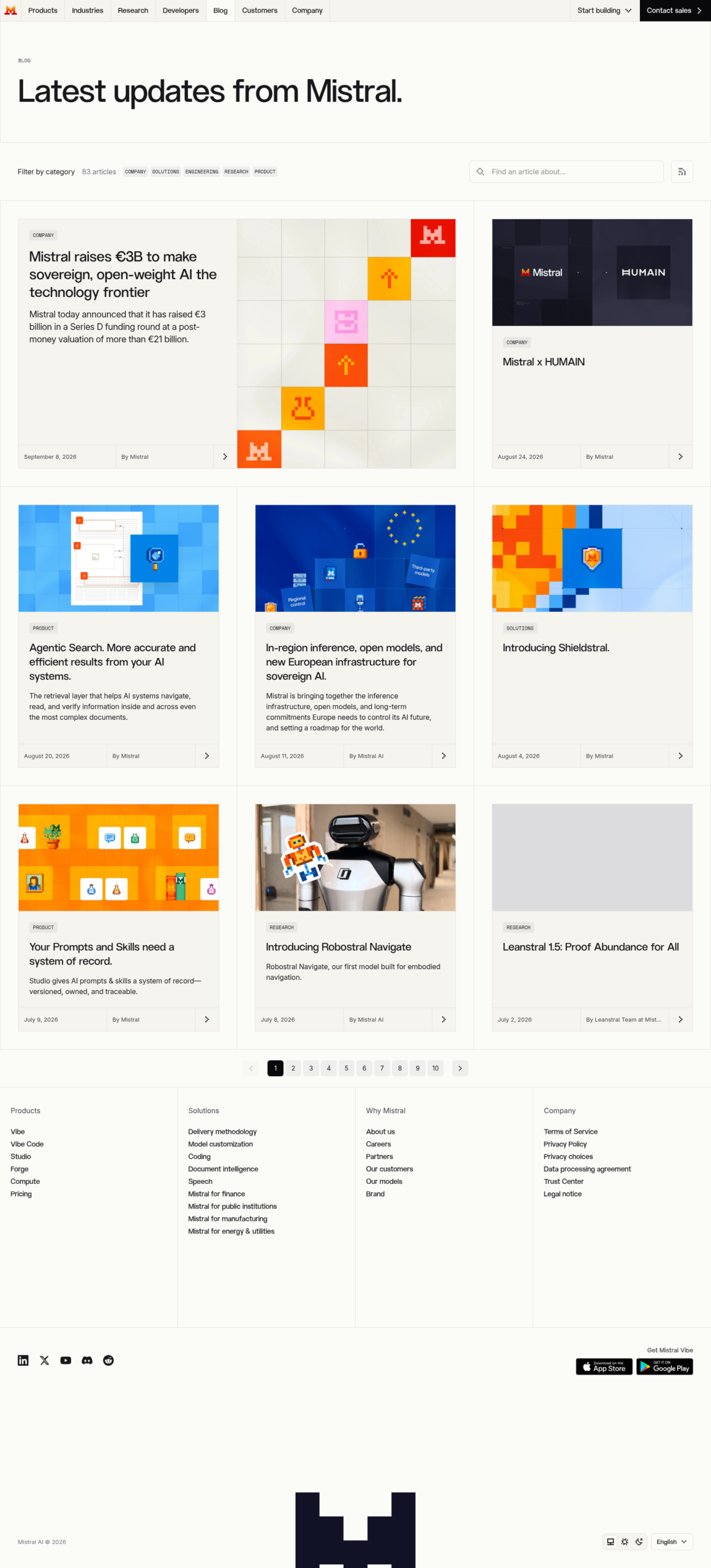
Twenty-one billion euros. That is the valuation investors now give Mistral AI, three years after its founding in Paris. On September 8, the company confirmed a €3 billion Series D, led by South Korean group Samsung Electronics. A Series D is the fourth major funding round for a tech startup, generally reserved for companies already established and ready to scale up. According to the company’s official announcement, it is « the largest equity fundraising round ever completed by a European technology company. »
A €21 Billion Series D for Mistral AI
Mistral AI’s post-money valuation, the figure calculated right after the new money enters the company’s accounts, now exceeds €21 billion. A year earlier, in September 2025, a Series C led by Dutch chip-making equipment maker ASML had valued the company at €11.7 billion, reports Quartz. Tuesday’s round therefore more than doubles that figure in twelve months.
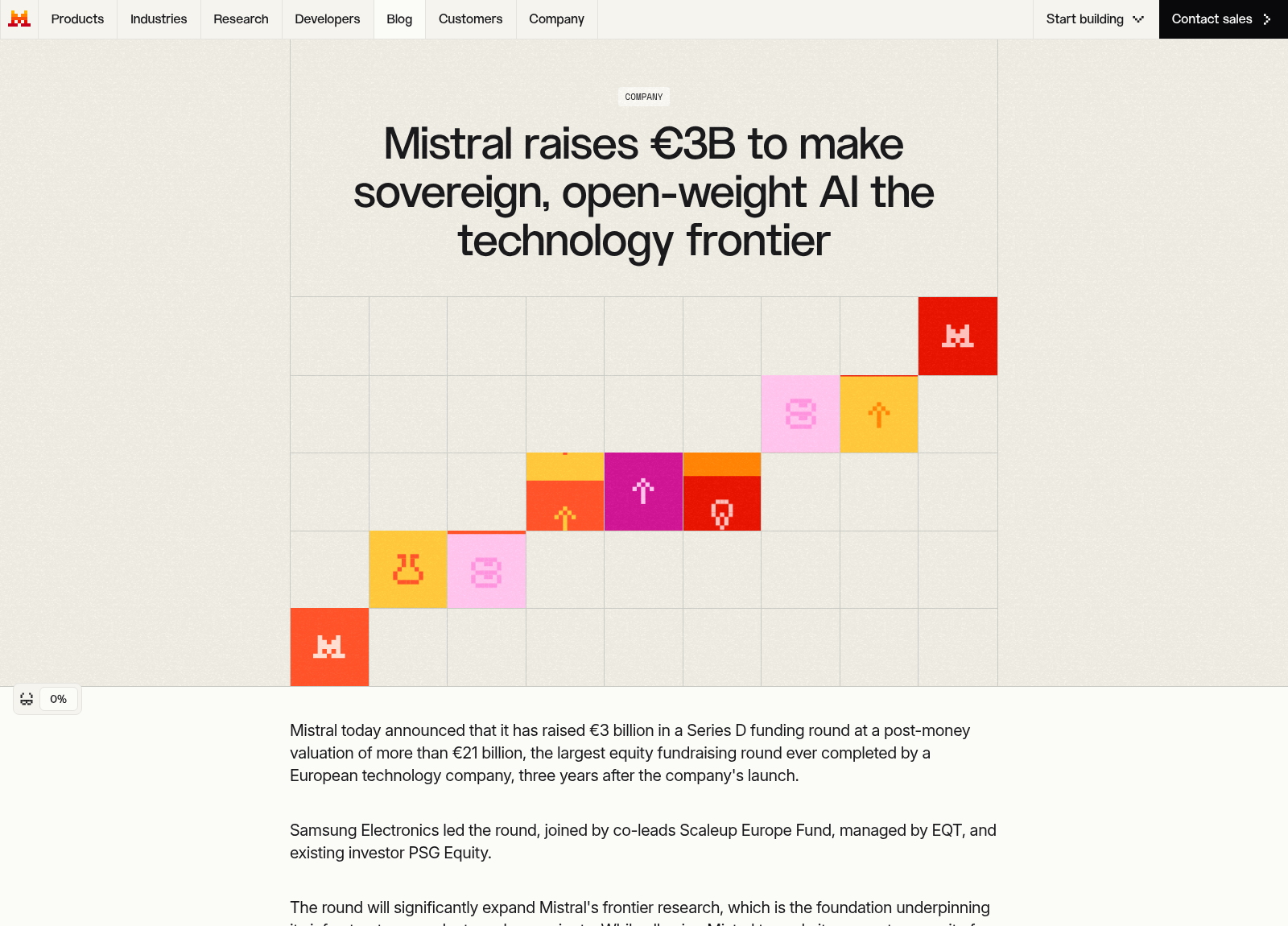
TechCrunch converts the amounts into dollars, about $3.58 billion raised, for a valuation of roughly $24.39 billion. The round pairs lead investor Samsung Electronics with two co-investors, the Scaleup Europe Fund managed by European fund EQT, and PSG Equity, already a shareholder in the company.
Who Put in the Money, From Samsung to Luxembourg
Three new names join the investor table, according to Mistral AI’s press release, picked up by Quartz. Advent, accounts managed by American asset management giant BlackRock, and the Grand Duchy of Luxembourg itself are entering the cap table. Many longtime shareholders also put more money in. Among them, a16z, ASML, Nvidia, Salesforce Ventures, Bpifrance, BNP Paribas CIB, and Belfius, alongside funds such as General Catalyst, Lightspeed, and Index Ventures.
The sequence of these two rounds follows an industrial logic. The 2025 Series C was already led by a player in the semiconductor supply chain, ASML. With Samsung Electronics leading this time, two heavyweights of chip manufacturing have now each taken turns backing the company’s funding rounds.
The Money Is Meant to Fund Compute and Data Centers
The company is targeting a gigawatt of computing power in Europe by 2030, reports TechCrunch. A gigawatt is now the unit used to measure the electrical power of artificial intelligence data centers, the ones that train and run the models.
CEO Arthur Mensch laid out the strategy on CNBC, in remarks relayed by Quartz. He wants to own most of his machines rather than rent capacity from a third party. « Long term, the plan is to fully rely on capacity that we are building ourselves, » he explained, adding that the company’s owned compute should grow by about 100 percent over five years.
On the business side, Mensch announced that the company should top $1 billion in annual recurring revenue before the end of the year. Investors call this figure ARR, the money that already-signed contracts and subscriptions bring in every year, the amount a company can count on from one year to the next. He added that the funding round also accelerates the growth planned for 2027.
This capacity is already taking shape on the ground. An $830 million debt facility financed the Bruyères-le-Châtel data center near Paris, equipped with 13,800 Nvidia GB300 graphics processors, chips specialized in training AI models. A second site, in Sweden, is expected to cost €1.2 billion, targeting a total of 200 megawatts of European capacity by the end of 2027.
This race for computing power is not unique to the French company, as shown by the compute race that American labs are also running. The company also remains a Microsoft partner, under a deal expanded in July, which is set to use its European capacity for cloud customers and integrate its models into Microsoft Foundry and Copilot Studio, Quartz notes.
What Samsung Wants to Do With Mistral
The Korean manufacturer isn’t just writing a check. According to SamMobile, under a byline from Asif Iqbal Shaik, the deal calls for integrating the French company’s technology, including its Mistral Large large language model, into Samsung’s semiconductor operations. A large language model, or LLM, is a program trained on huge amounts of text to understand and generate language.
Samsung’s stated goal is industrial. It wants to detect manufacturing defects on its chips, optimize its equipment, and stabilize the yield of its most advanced plants, across its foundry, memory, and logic divisions. The models would remain hosted on-site, inside Samsung’s secure network, so that sensitive industrial data never leaves the Korean company.
This agreement was unveiled in Paris, at a state summit devoted to cooperation between France and South Korea, SamMobile notes.
Not About Building a European ChatGPT
TechCrunch reports it bluntly. The company’s goal is not to build a European ChatGPT, even though its models lack OpenAI’s mainstream name recognition. The company still sees itself as a research lab, not as a consumer-facing app.
Part of the strategy fits in one word, open-weight. Weights are the millions of numerical parameters that encode what a model learned during training. Making them public lets any organization download the model and run it on its own machines, rather than depending on remote access from a provider.
Since August, the company’s customers have been able to choose the region where their requests are processed. The company now also hosts third-party models, including Chinese ones, positioning itself as an AI services provider, not just a competitor to OpenAI or Anthropic. Anthropic, for its part, is fighting for control of its models against the Pentagon.
The Sovereign Champion’s Paradox
French President Emmanuel Macron praised the round on X, describing the building of a « third way in AI » between France and South Korea, reports TechCrunch. The message shows just how far this funding round extends beyond finance alone.
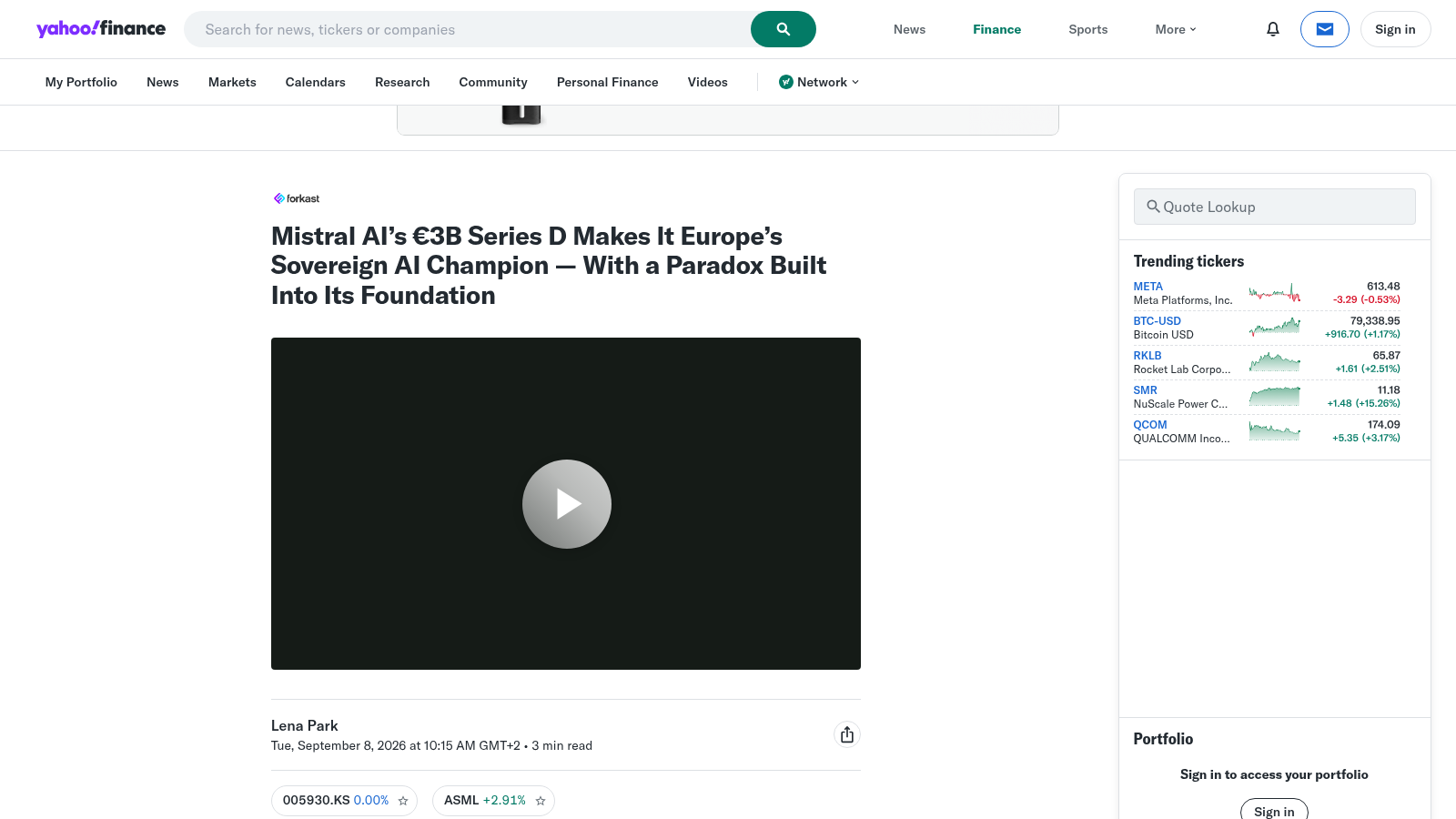
Yahoo Finance covered the story under Lena Park’s byline, in an article titled « Mistral AI’s €3B Series D Makes It Europe’s Sovereign AI Champion, With a Paradox Built Into Its Foundation. »
The paradox fits in one sentence. Mistral AI presents itself as the flagship of sovereign, European AI, yet its shareholder table now brings together a Korean conglomerate, a Dutch chipmaking equipment manufacturer, American funds, and a Benelux state. TechCrunch compares it to the pairing of Germany’s Aleph Alpha and Canada’s Cohere, another multi-country attempt to build an alternative to American labs.
Twenty countries, more than 125 client companies, including Airbus, ASML, and HSBC. Three years after its founding, the company is building its promise of sovereignty with capital coming from Korea, the Netherlands, the United States, and Luxembourg.







0 Commentaires
Aucun commentaire pour le moment. Soyez le premier à commenter !