
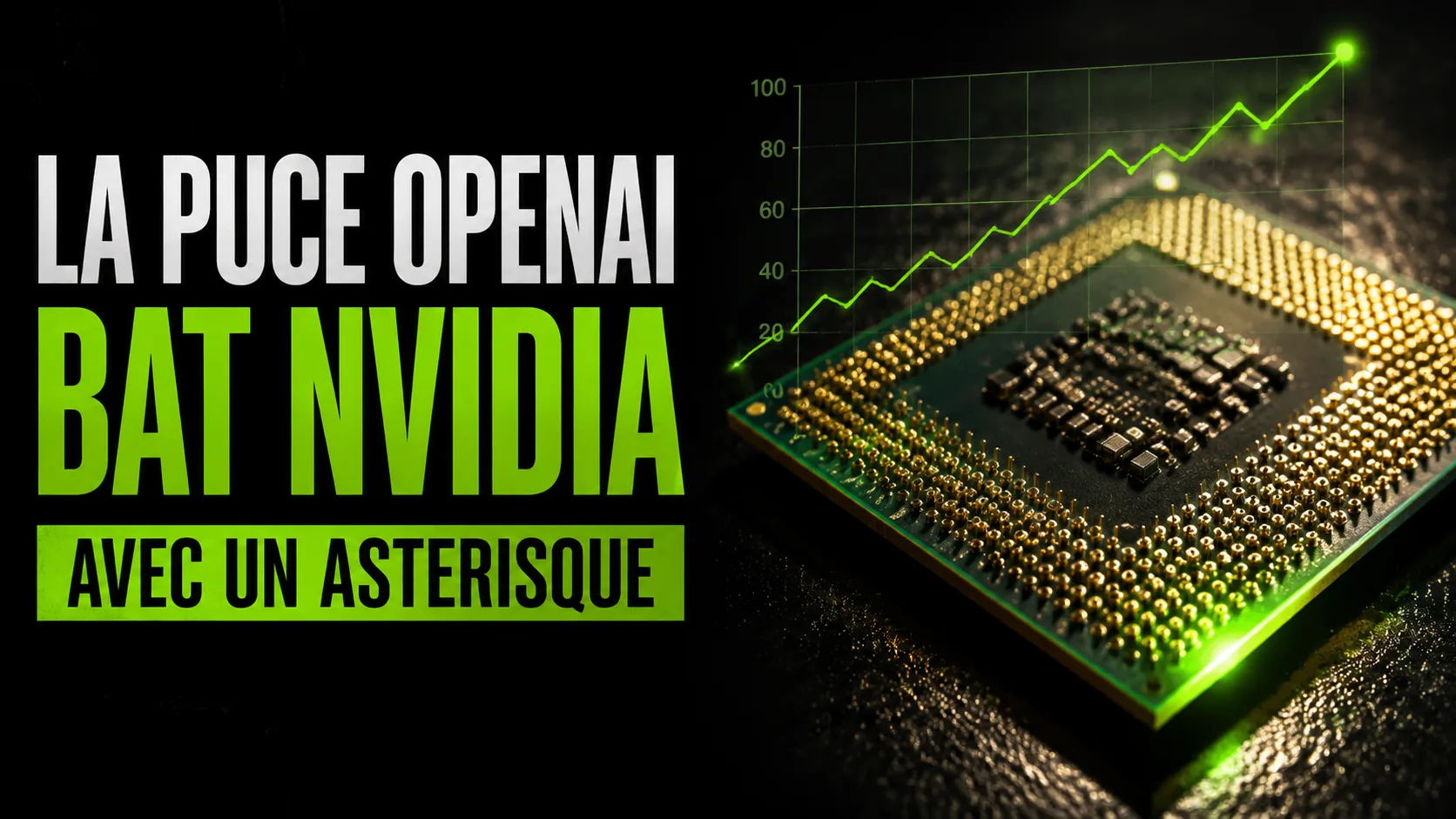
1.9x more work per watt (the metric that matters when comparing two chips: how much computation each watt consumed produces) than Nvidia’s Blackwell systems. The figure concerns the Jalapeño chip, and it dropped on August 25, 2026, at Hot Chips, the conference where semiconductor makers come to show engineers their new chips. It carries a fine-print caveat worth reading before the number itself: it was OpenAI that produced these results, and it was OpenAI that invited the firm tasked with verifying them.
What OpenAI Showed at Hot Chips
The chip is called Jalapeño. It was designed exclusively for inference (running an already-trained model so it can answer a query, as opposed to training, which builds the model). Across three models tested, GPT-OSS 120B, DeepSeek R1 670B, and Kimi K2.5 1T, the Jalapeño chip shows between 1.5x and 1.9x more performance per watt than Blackwell, the generation of accelerator chips Nvidia sells in volume today, at maximum throughput.
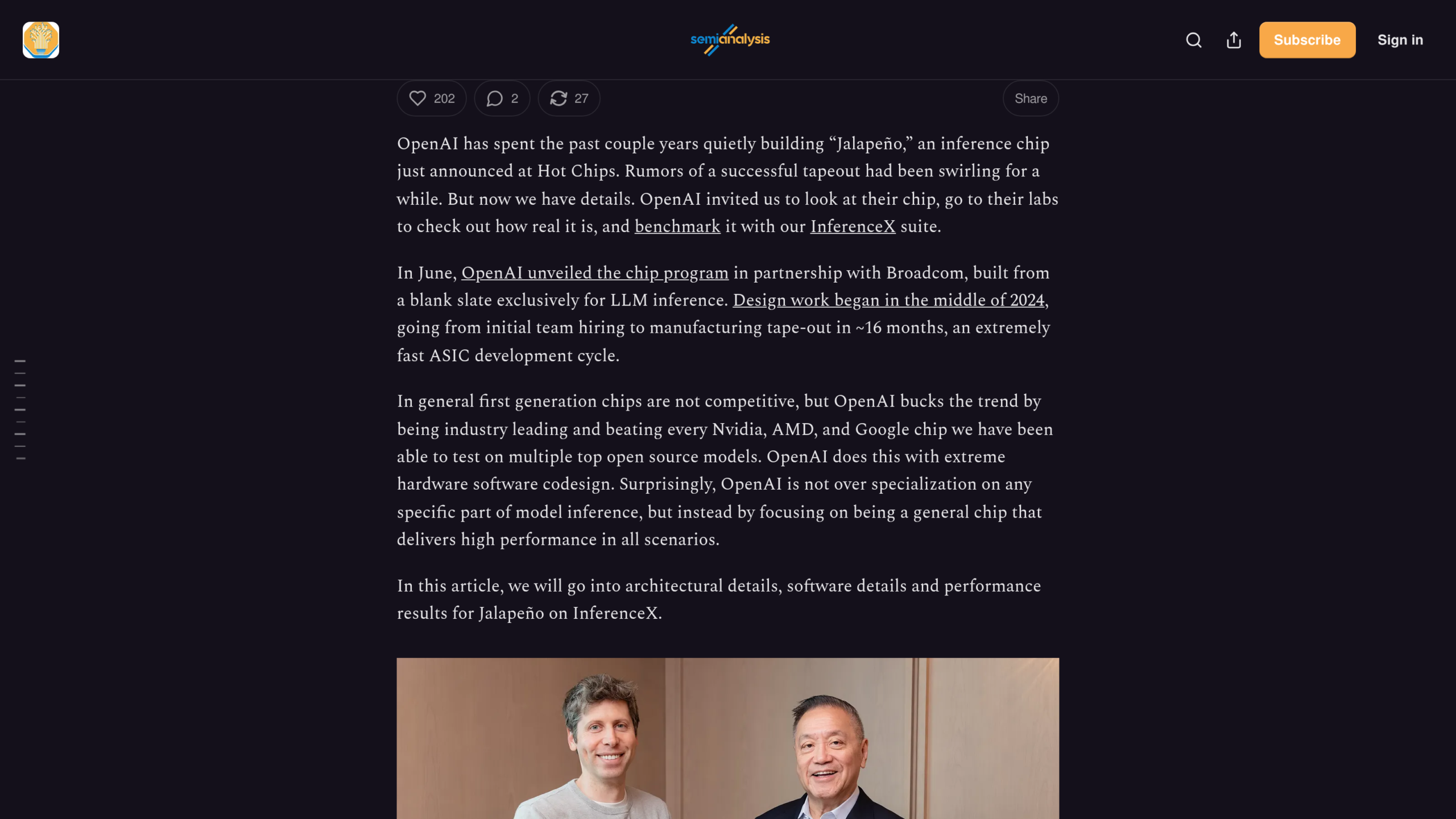
SemiAnalysis, the analysis firm that ran the tests, sums it up in one line: « Jalapeño beats Blackwell on perf/W across almost all scenarios without being tuned for any specific point in the curve. » In other words, it does not win on one cherry-picked front, it dominates across almost the entire measured range.
The measurements were taken with InferenceX, SemiAnalysis’s public test suite. At concurrency 1 (a single user served at a time, without sharing the chip), the Jalapeño chip tops 700 tokens per second per user on DeepSeek R1, and climbs to around 1,400 tokens per second on Kimi-K2.5 and GPT-OSS. A token is the unit of text a model generates at each step, a word or a word fragment. These results were obtained with simple prediction (the model proposes one word at a time), without the speculative decoding that usually speeds up responses by guessing several words ahead.
The Jalapeño Chip Was Built in Sixteen Months, With Broadcom
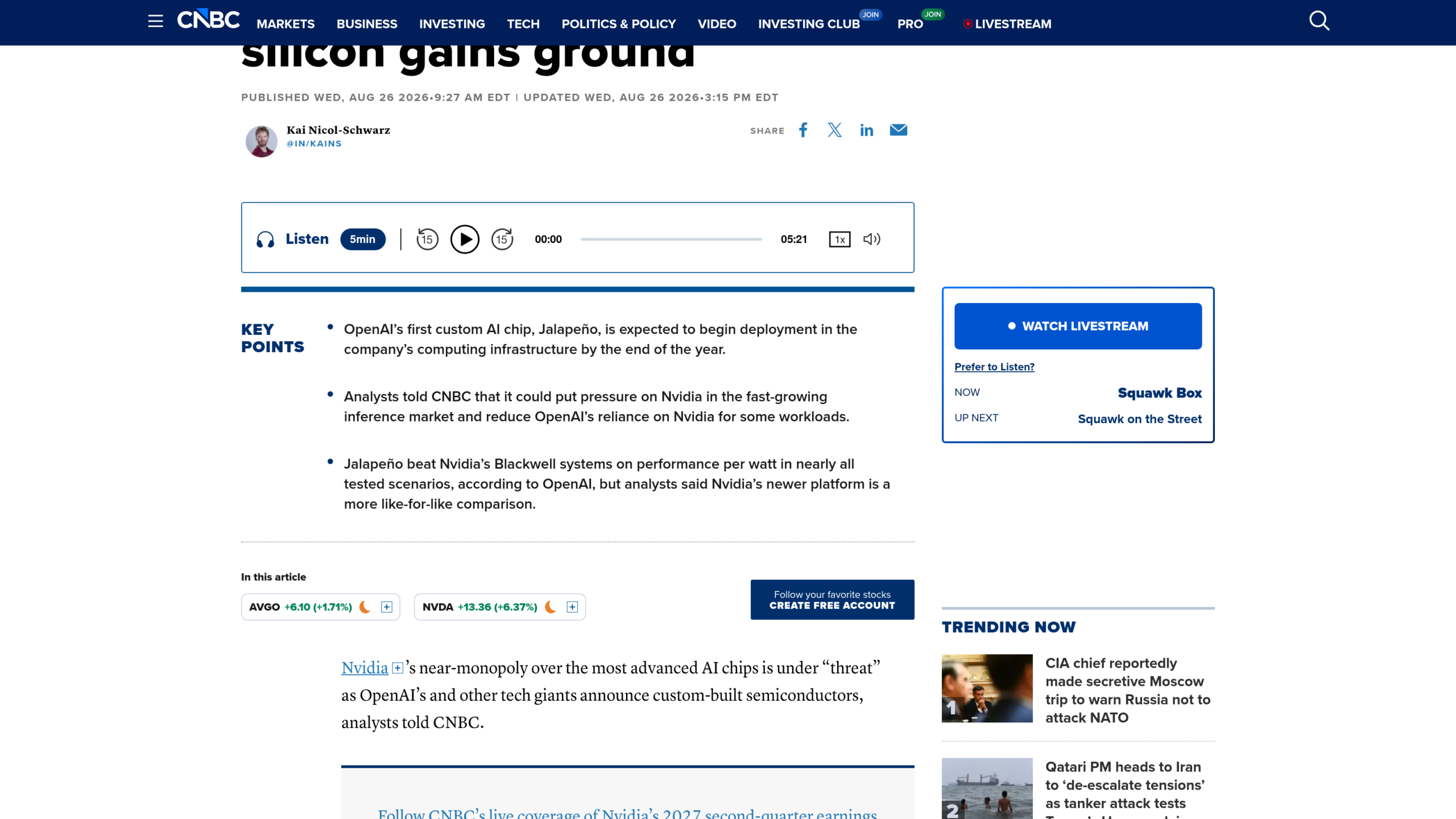
OpenAI had unveiled the program in June 2026, in partnership with Broadcom. Design work started in mid-2024, which puts about sixteen months between the team’s hiring and tape-out (the moment the final design ships to the fab to be etched onto silicon). For a custom chip, that is an extremely short timeline.
OpenAI is not alone on this front. Etched has reached a $21 billion valuation with a chip specialized for transformer architectures, and several labs are chasing the same goal: breaking free of total dependence on a single hardware supplier. The Jalapeño chip fits into this movement, with an argument few others can make: it has already been measured, in a lab, on real models.
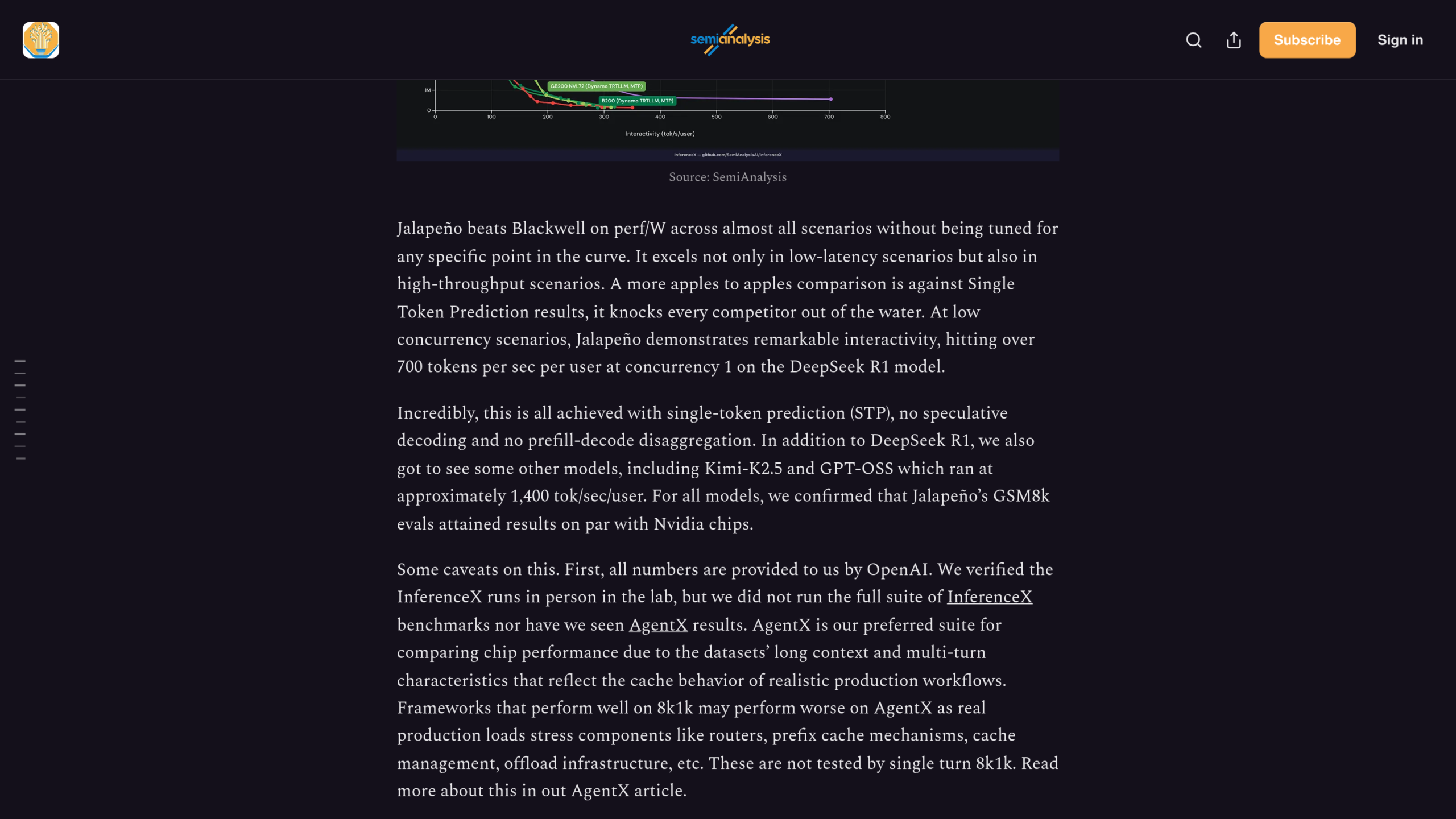
According to CNBC, the Jalapeño chip’s rollout across OpenAI’s infrastructure is expected by the end of the year. Analysts cited by the outlet believe it could weigh on Nvidia’s market share in inference, and reduce OpenAI’s dependence for certain workloads. OpenAI, for its part, says it will keep buying Nvidia hardware.
The Caveats, Written by the Testers Themselves
This is where the analysis is worth reading in full. SemiAnalysis does not hide how the numbers were produced: « OpenAI invited us to look at their chip, go to their labs to check out how real it is, and benchmark it with our InferenceX suite. » The invitation came from OpenAI. The test protocol, InferenceX, comes from SemiAnalysis. The numbers, though, come from OpenAI.
The firm spells out its own limitation with a frankness that stands out against the usual tone of press releases: « all numbers are provided to us by OpenAI. We verified the InferenceX runs in person in the lab, but we did not run the full suite of InferenceX benchmarks nor have we seen AgentX results. » AgentX is the test suite SemiAnalysis prefers for comparing chips against each other, because its long-context, multi-turn scenarios resemble what actually happens in production. A chip that shines on a short test can behave differently on a long one, and SemiAnalysis says so plainly.
Second caveat, this time raised by the analysts cited by CNBC: the Jalapeño chip uses HBM4 memory (the most recent generation of high-bandwidth memory, the kind that feeds the chip’s calculations quickly), while Blackwell carries the previous generation. Memory remains a scarce and expensive resource right now, and the generation installed weighs directly on the raw results. The fairer comparison would not be with Blackwell, but with Vera Rubin, Nvidia’s newer platform, which also carries HBM4.
The Decoder picks up both caveats without downplaying them. None of this cancels out the result Jalapeño achieved. It puts it in its proper scale: a lab measurement, on three models, under conditions chosen by the party with an interest in the result looking good.
Why the Stock Market Proves Nothing Here
On August 26, Nvidia’s stock gained 6.37% and Broadcom’s rose 1.71%. It is tempting to read this as the market’s verdict on the Jalapeño chip. That would be a shortcut: Nvidia was releasing its quarterly earnings in the same window, and CNBC covered both stories in parallel. There is no way to untangle how much of that day’s trading owes to OpenAI’s announcement.
Another number better illustrates the balance of power. According to 24/7 Wall St., Nvidia’s data center revenue grew 92% year-over-year to reach $75 billion, with $119 billion in supply commitments already signed. An in-house chip built for a single customer, however good, does not move a scale like that.
The relationship between the two companies is, in fact, less binary than it looks. Nvidia is reportedly in talks to take stakes in some of its own customers, and keeps expanding its lineup well beyond accelerator chips, all the way to desktop machines built for AI. The Jalapeño chip changes something for OpenAI, for a portion of its compute workloads. It changes nothing, for now, about Nvidia’s place in the market.









0 Commentaires
Aucun commentaire pour le moment. Soyez le premier à commenter !