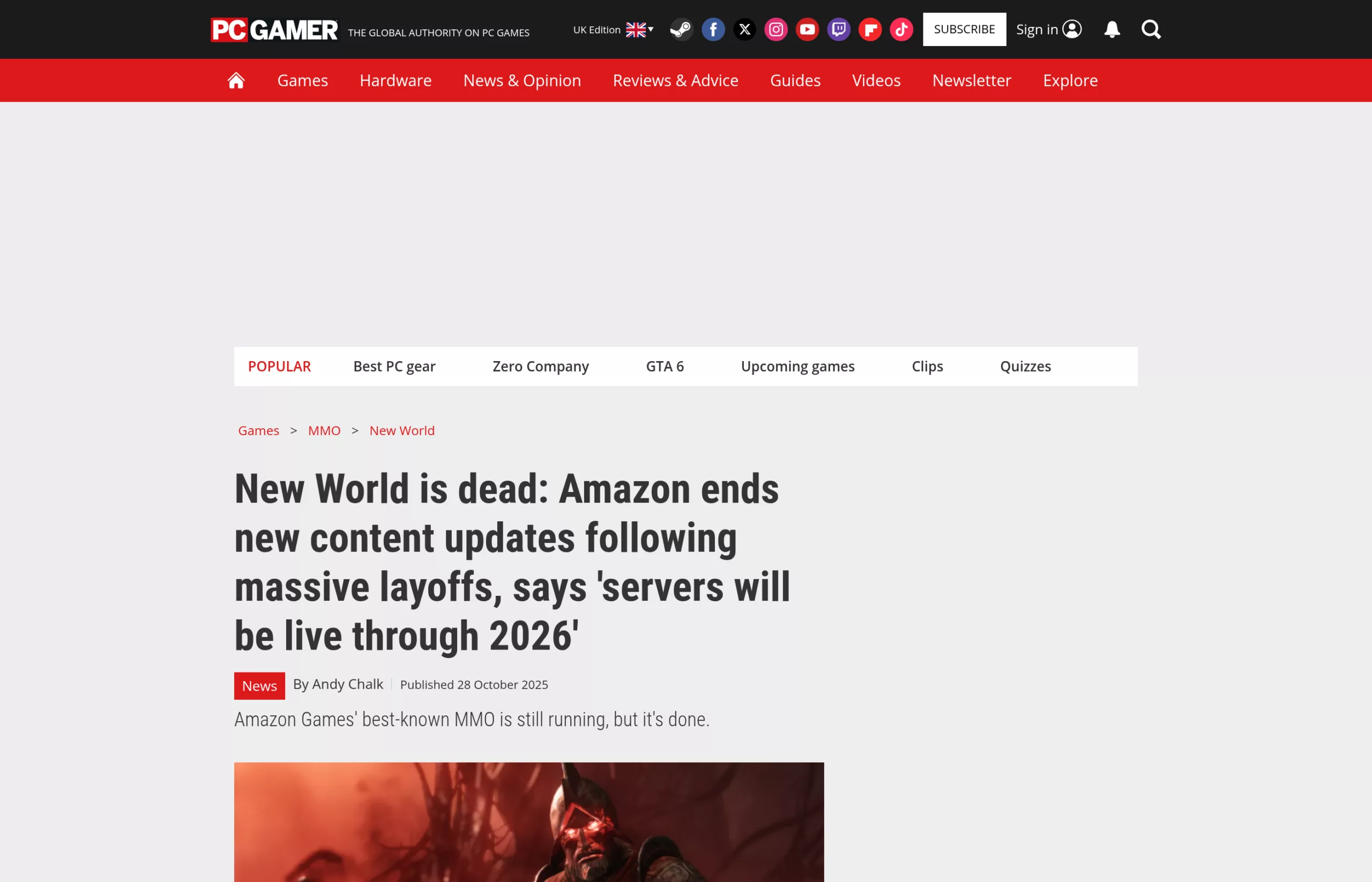
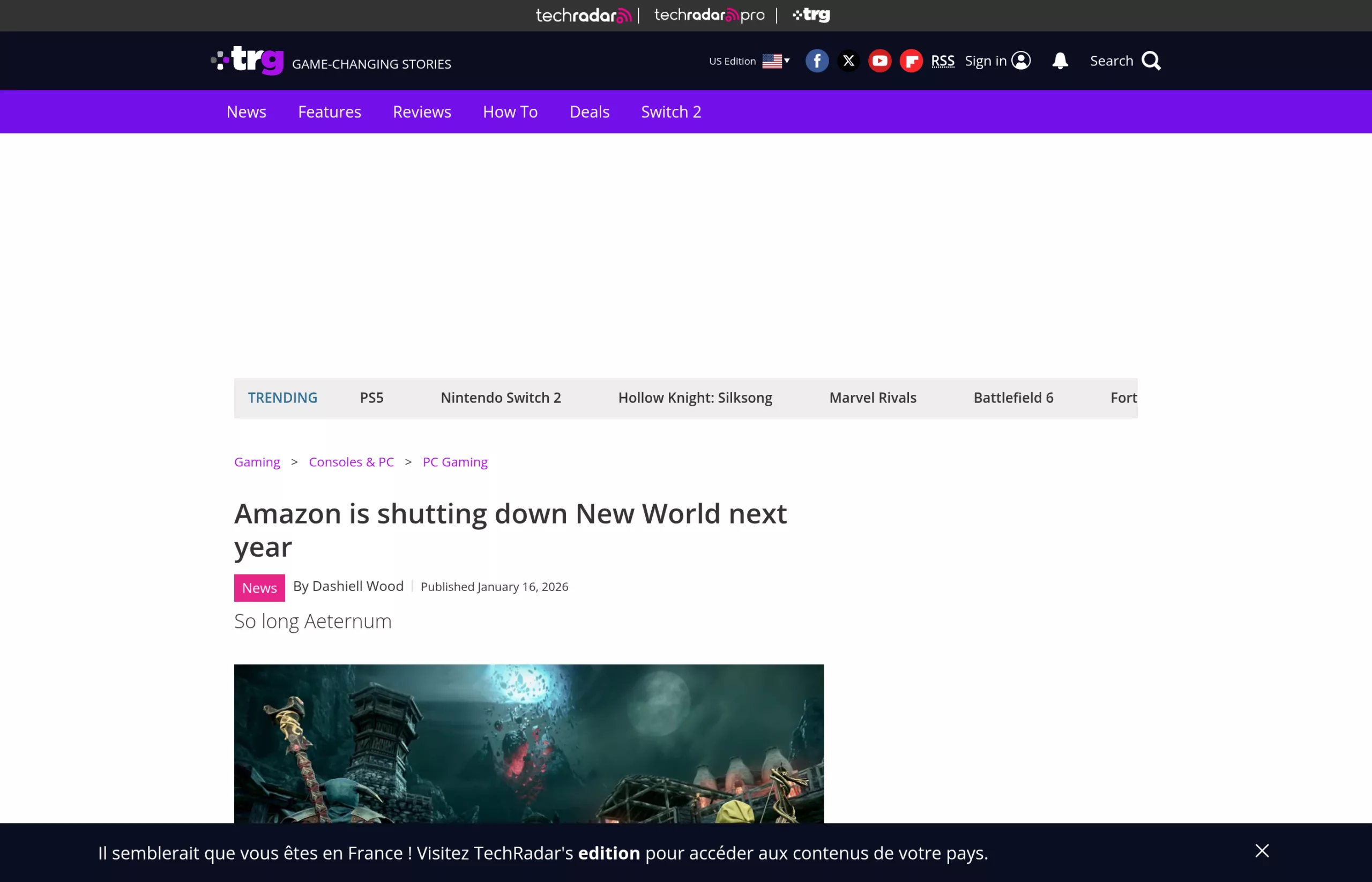
Amazon Games pulled New World from sale on January 15, 2026. The servers will close on January 31, 2027. The game had launched in 2021 with the genre’s attendance record on Steam. Six years later, it is shutting down, the latest link in a chain of failures stretching back to 2004, the year World of Warcraft launched.
Riot Games has been building its own MMO in the Runeterra universe since 2020, the same ground where so many others failed before it. The Runeterra MMO has no commercial name and no release date, but it inherits an asset that no World of Warcraft rival ever had at the start of its own project: years of stories, characters and rivalries already known to millions of players. That asset alone will not be enough, but its absence has always preceded the fall of the others.
New World Closes, and Its Failure Sums Up Twenty Years
In 2021, New World broke the genre’s attendance record on Steam: roughly 913,000 players connected at the same time at the launch of Amazon Games’ title. Five years later, that same game was pulled from sale, on January 15, 2026. The servers will close on January 31, 2027.
The most cited cause is not technical. New World was building a brand new world, with no prior legend to hold onto, a coat of paint rather than a foundation. The launch’s technical problems sped up the fall, but the narrative void made it permanent. Layoffs at Amazon Games in 2025 then scaled back the studio’s MMO projects.
Amazon did not lack resources, though. The group cancelled its Lord of the Rings MMO twice: once in 2021, over a dispute linked to Tencent’s licensing acquisition, then again in 2025, in the same wave of layoffs that slowed New World. Two cancellations on one of the richest licenses in Western fantasy say what Amazon’s revenue figures do not: money was not the problem. What was missing was the ability to turn an established universe into a finished game.
The MMORPG market confirms this fragility. Its share of the global RPG market fell from 78.8% in 2020 to 56.2% in 2024. More than 9,000 jobs were cut in the video game industry in 2025. New World is closing within this context, not despite it. This is the landscape the Runeterra MMO still has to cross, with years of characters already written but no finished game to carry them.
Twenty Years of Contenders, and Only One King
World of Warcraft counted 12 million subscribers in October 2010, a figure Blizzard has never seen again. The game now runs between 3 and 5 million active players, but that ceiling of 12 million remains the genre’s absolute benchmark. For twenty years, no Western MMO has surpassed it, or even approached it for long. The table below only lists the serious attempts, the ones that aimed for the throne rather than a niche off to the side.
| Game | Peak Reached | Where It Stands |
|---|---|---|
| Age of Conan (2008) | ~700,000 subscribers | Niche free-to-play. Funcom lost 23 million dollars in Q4 2008 |
| Warhammer Online (2008) | 800,000 subscribers | Closed in 2013. Lives on through a fan-run private server |
| Star Wars: The Old Republic (2011) | 1.7 million subscribers | Dropped below one million in 5 months, forced into free-to-play. Still online |
| TERA (2012) | Not disclosed | Closed on PC in 2022, the publisher citing the impossibility of delivering « the content it deserved » |
| ArcheAge (2014) | Not disclosed | Western servers closed or handed off after players rejected the pay-to-win model |
| WildStar (2014) | ~450,000 players | Closed in 2018, studio shut down. Never profitable |
| Black Desert Online (2016) | 400,000 sales in the first month in the West | Alive, 200,000 to 300,000 players per day |
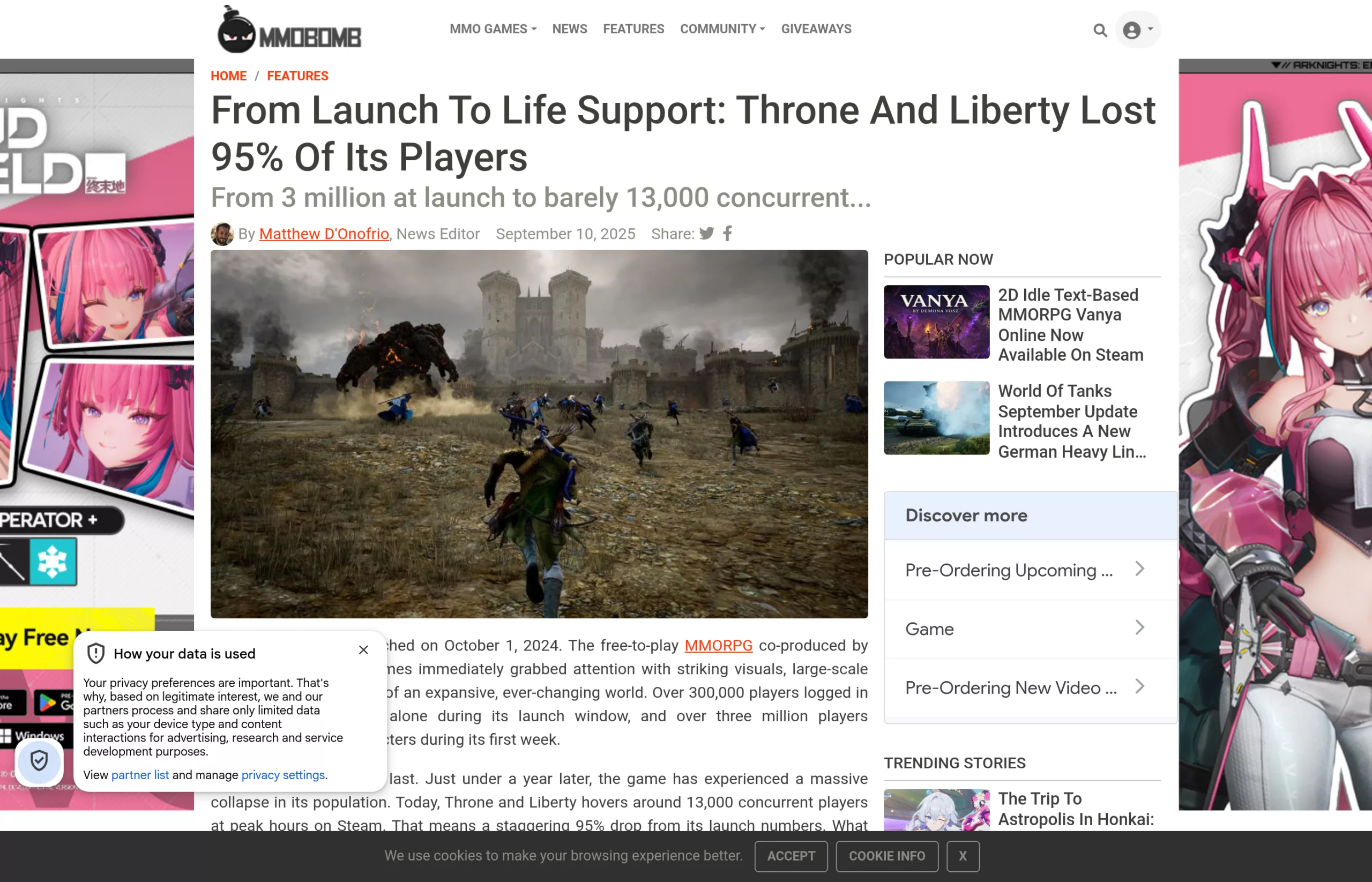
| Throne and Liberty (2024) | 300,000 concurrent players at launch | Down 95% in players, servers merged |
| Pax Dei (2025) | 11,500 concurrent players in early access | About 800 players by mid-2026 |
| Ashes of Creation (early access Dec. 2025) | Not disclosed | Unstable, founder resigned on January 31, 2026 |
The number that sums it all up: SWTOR, the best-equipped contender on paper, with BioWare at the helm, the Star Wars license and a blockbuster budget, peaked at 14% of WoW’s peak before switching to free-to-play five months later. No other contender did better, and most did far worse.
The pattern repeats with mechanical regularity. A massive launch carried by the license or the marketing. A rapid drop once the endgame content runs dry, often too demanding for the casual players who made up the initial peak. Then a publisher reaction that makes things worse: a poorly prepared switch to free-to-play, a drift toward aggressive monetization, or the outright abandonment of content. WildStar, ArcheAge and Throne and Liberty each illustrate a variant of this pattern.
Some never even reached launch. Titan, the MMO Blizzard was developing internally, was cancelled after failing to find, according to its own developers, what made the game fun. The studio’s in-house survival game followed the same path in January 2024, its engine never ready. Amazon’s Lord of the Rings MMO was cancelled twice, in 2021 and then in 2025.
In this landscape, a Runeterra MMO would not be entering untouched ground. It would be entering a well-marked graveyard, where the pattern of failure has been documented for two decades.
The Dividing Line: Inherited Universe Versus Manufactured Universe
Only three MMOs have lasted more than a decade. World of Warcraft peaks at 12 million subscribers in October 2010 and still holds between 3 and 5 million active players today. Final Fantasy XIV botches its 2010 launch, rebuilds itself entirely in 2013, and surpasses 30 million created accounts by 2024, just behind WoW. The Elder Scrolls Online, released in 2014, claims 26 million accounts in 2025 and has kept growing since dropping the mandatory subscription in 2015.
These three games share an identical starting point. The Warcraft universe had existed since 1994, across three strategy games. Final Fantasy’s dates back to 1987. The Elder Scrolls’ universe, also to 1994. In all three cases, the player already loved that world before the MMO existed. The game had nothing to prove on that front, only to bring the player into it.
On the other side, the failures line up universes manufactured for the occasion. New World, launched in 2021 and closed in 2027, invents its setting from scratch, and critics have faulted it since day one for a shallow lore, more a coat of paint than a mythology. Pax Dei hovers around 800 players by mid-2026. Throne and Liberty has lost 95% of its players since its 2024 release. One case resists this simple reading, though: WildStar offered an original universe, carefully written, funny, and it closed in 2018 after four years.
Two counterexamples also keep this observation from becoming a rule. Warhammer Online carried a universe adored since the 1980s and closed in 2013. Star Wars: The Old Republic leaned on the most powerful license in entertainment and collapsed within five months. A beloved world is therefore not enough to keep an MMO alive.
The correct reading fits in one sentence. A universe the player already loves opens the door, it does not do the design work in the studio’s place. No recent MMO has survived without that asset, but several have died while holding it. This is the dividing line to keep in mind when judging a Runeterra MMO: the universe excuses nothing, it simply provides a starting point no studio ever had to invent.
What Riot Spent Fifteen Years and 250 Million Building
Riot produced Arcane across two seasons, eighteen episodes in total, streamed on Netflix and animated by French studio Fortiche. The total budget is estimated at around 250 million dollars: more than 80 million for the first season, around 100 million for the second. Few animated series have mobilized this kind of budget to adapt a video game.
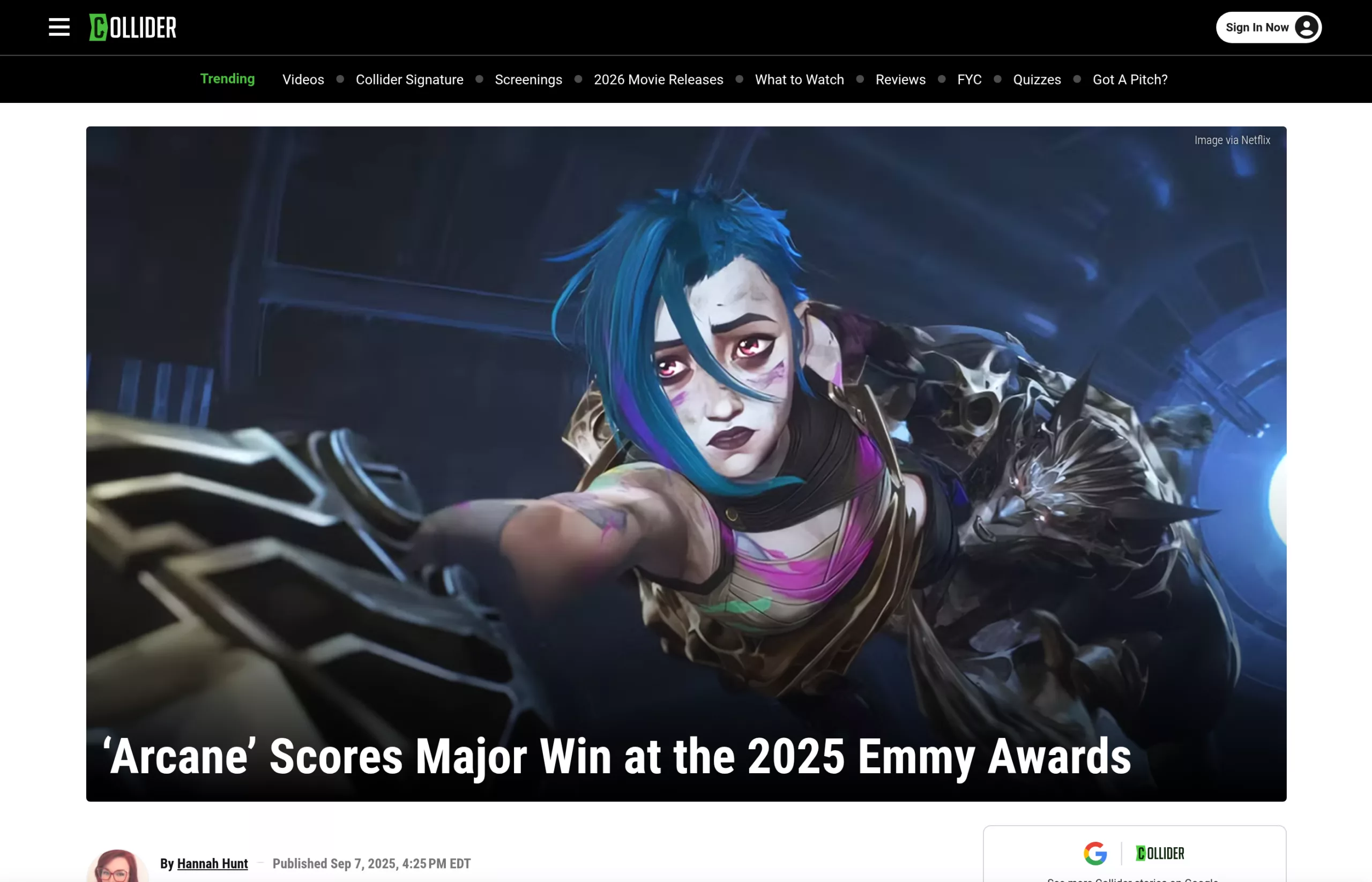
The first season racked up 187.6 million hours viewed and 30.2 million complete views. It took the number one spot in 52 countries. The second did even better: 234 million hours in 28 days, an absolute record for a video game adaptation, number one in 64 countries. Eight Emmy Awards recognize the series, including the award for outstanding animated program twice.
Arcane is not directly profitable. Netflix and Tencent each paid around 3 million dollars per episode, less than half the production cost. Riot owns that: profitability was not the primary goal. The effect on the game was real, but short-lived. Daily logins climbed by about 50% after the first season, without that growth settling in for the long term. New accounts fell back off in the following months.
The Runeterra lore spans thirteen distinct regions: Demacia, Noxus, Ionia, Piltover, Zaun, the Freljord, Shurima, Bilgewater, Targon, Ixtal, the Shadow Isles, Bandle, and the Void as a cosmic force. Riot counts 173 champions in 2026, an official encyclopedia published as early as 2019, and fifteen years of stories published without interruption across every medium: comics, novels, cinematics, spin-off games.
No MMO publisher has ever spent a quarter of a billion dollars knowing it would not be profitable, purely to make its universe desirable. Yet that is the foundation the Runeterra MMO will stand on. Amazon spent money to build a game, not a world. A studio launching an MMO usually has to convince the player to love its world at the same time it teaches them how to play it. For the Runeterra MMO, the first half of that work is already done, and tens of millions of viewers completed it without ever touching a controller.
The Resources No One Else Can Match
Riot has belonged to Tencent since 2008. The Chinese group rose to 92.78% of the capital in February 2011 for 230 million dollars, then bought the rest on December 16, 2015: Riot has since been a wholly owned subsidiary. Tencent reported 751.8 billion yuan in revenue for 2025, around 109.4 billion dollars, of which 35.2 billion came from video games.
According to third-party estimates, since Riot publishes no per-title figures, League of Legends is said to bring in between 1.65 and 1.80 billion dollars a year over 2024-2025, for a cumulative total since 2009 close to 18.9 billion. The game keeps around 130 million monthly active players, against 12 to 25 million for Valorant and 30 to 33 million for Teamfight Tactics.
To grasp the scale, compare it with Star Wars: The Old Republic, the most expensive MMO ever produced at its release: between 150 and 300 million dollars in development, up to 500 million including marketing, for six years and 800 people. League of Legends’ annual revenue alone could fund five to ten SWTORs a year.
Riot has already carried out a long project with no revenue before: League of Legends, developed over three years between 2006 and 2009 by a then-unknown studio. The Runeterra MMO follows a comparable path, only longer: announced in December 2020, it now totals nearly six years with no revenue, including a complete reset in March 2024 that scrapped the work already done.
What that money buys is not quality, it is the right to be wrong. Amazon also had colossal resources for New World, and it failed. The difference lies in the structure: Riot answers to a single shareholder, with no quarterly results to justify on this project, one that has already let six years go by without flinching. We covered this analysis in detail in our article on Riot’s ability to revive the MMORPG genre.
Money saved neither New World, nor SWTOR, nor WildStar. Nothing guarantees it will save the Runeterra MMO. It only guarantees the right to fail several times before getting there.
SWTOR, the Lesson Riot Seems to Have Learned
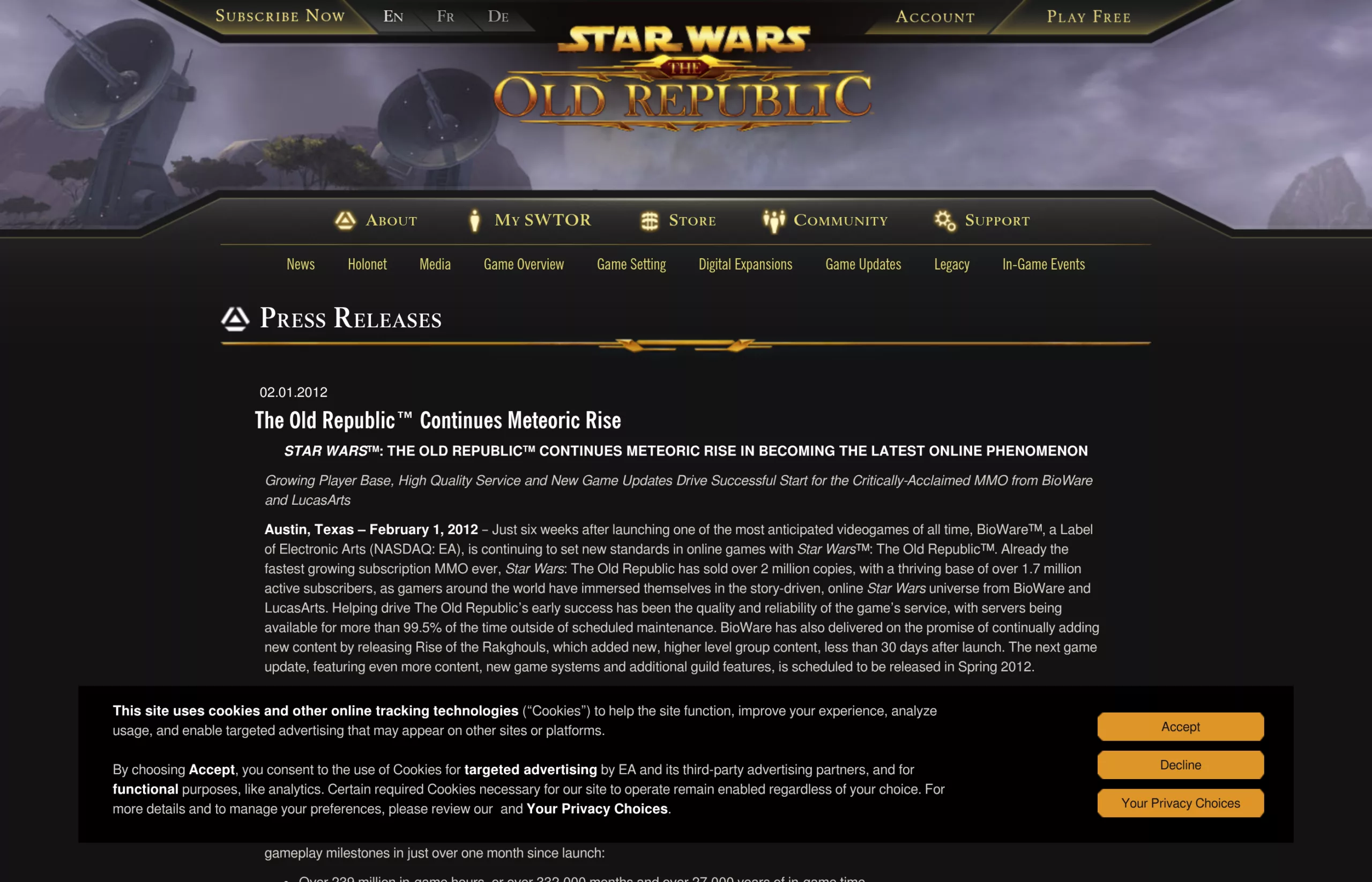
Star Wars: The Old Republic had the fastest start in the genre’s history. Released in December 2011, developed by BioWare for Electronic Arts, the game reached 1.7 million subscribers in six weeks, by February 2012. No MMO had ever taken off that fast, carried by a universe already settled into the collective imagination.
Five months later, the game dropped below one million subscribers. A year after launch, EA switched it to free-to-play. The analyses that followed rarely blamed the universe. They pointed to the game’s design: a solo experience disguised as an MMO, where players barely crossed paths; an economy that lost 97% of its value in thirty days; 217 servers that emptied zones rather than filling them; a subscription poorly matched to how people actually played.
The license opened the door. It did nothing more than that. This is the nuance SWTOR brings to this debate over the Runeterra MMO: a beloved universe draws players in at launch, it does not keep them if the game underneath does not hold up.
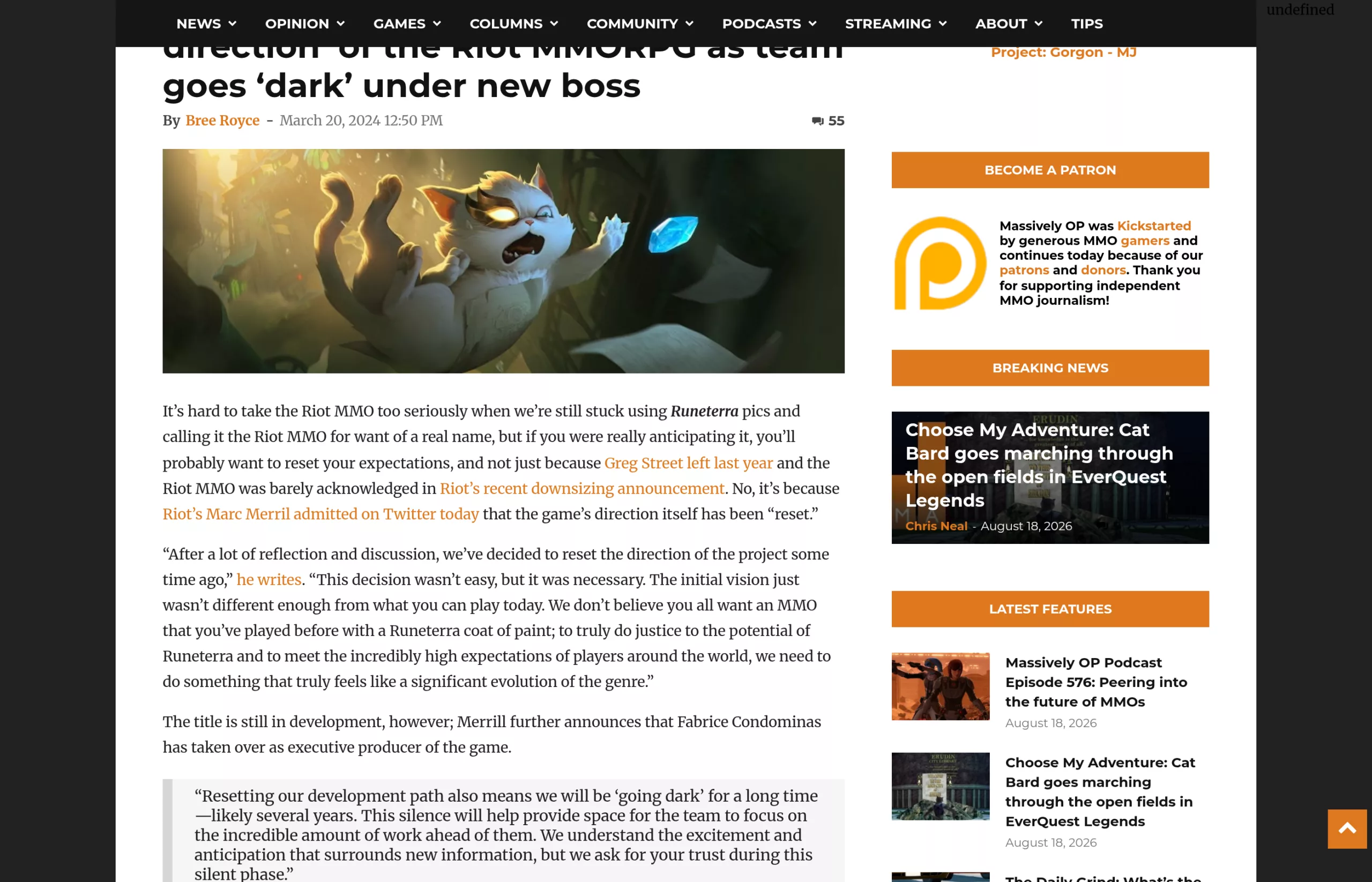
On March 20, 2024, Marc Merrill, co-founder of Riot, announced the complete reset of the project.
« The initial vision just wasn’t different enough from what you can play today. We don’t believe you all want an MMO that you’ve played before with a Runeterra coat of paint. »
Marc Merrill, co-founder of Riot Games, March 20, 2024
No one at Riot cited SWTOR. But Merrill’s statement describes its mistake exactly: bolting a powerful universe onto a game structure already seen elsewhere. Riot chose to throw away several years of work rather than ship that game. Watching a studio identify this trap does not guarantee it will avoid it. It already sets Riot apart from most projects abandoned quietly, without explanation.
This silence is nothing new. Riot has still never given a release date for this MMO, a reserve that has lasted for years.
You Will Not Play Jinx, and That Is Already Decided
In September 2022, Greg Street, known as Ghostcrawler, then director of the project, settled a question no one was publicly asking yet. Champions will never be playable classes. His statement, reported by AltChar, leaves no room for doubt: « We want to treat the champions with a lot of respect… we aren’t just going to turn to them anytime we are short on boss ideas. »
They will remain NPCs, more than a cameo, never a class. 173 champions exist in League of Legends in 2026, each one named, each one loved for precisely what they are. Turning Jinx into a class would multiply her face across thousands of players connected at the same moment, and destroy what makes her unique. Riot has therefore chosen the opposite for its Runeterra MMO: you will create your own character, and Jinx will remain Jinx.
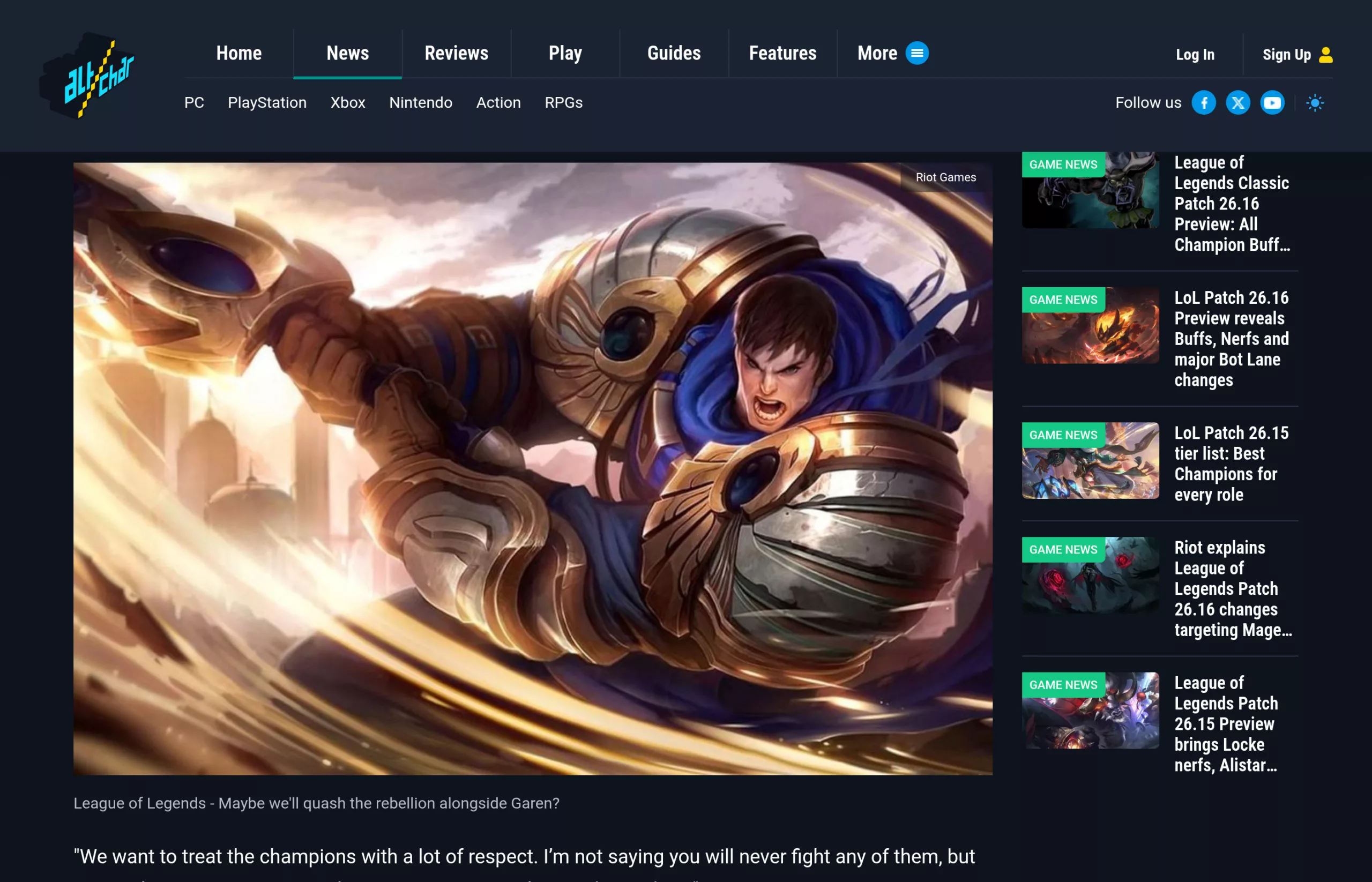
This choice is not neutral, it settles a debate that has already cost other studios dearly. Star Wars Galaxies made the Jedi a rare, hidden class: the game collapsed, a complete overhaul followed in 2005. Marvel Heroes had players directly embody existing heroes: it closed after about four years, in 2017, mostly for financial reasons.
By contrast, games where the player creates their own character tend to last longer. DC Universe Online has been running for more than fourteen years: your hero, with a mentor drawn from familiar figures. Star Wars: The Old Republic lost subscribers and switched to free-to-play, but it is still online fourteen years after launch. The Elder Scrolls Online, which started from a near-blank protagonist, ended up amassing around 2 billion dollars.
| Game | Solution Chosen | Outcome |
|---|---|---|
| Star Wars Galaxies | Jedi as a rare, hidden class | Collapse, complete overhaul in 2005 |
| Marvel Heroes | The player embodied an existing hero | Closed after about four years, in 2017 |
| DC Universe Online | Created character, mentor drawn from familiar heroes | Still active after more than fourteen years |
| Star Wars: The Old Republic | Created character, eight classes each with its own storyline | Subscriber drop then free-to-play, still online |
| The Elder Scrolls Online | Near-blank protagonist, without a strong identity | Rocky launch, around 2 billion dollars cumulated |
| Final Fantasy XIV | Created character, heavily written, central to the plot | The genre’s clearest success, both narratively and commercially |
| Lost Ark | Original classes, with no pre-existing license | Never had this problem |
The closest case to what Riot describes remains Final Fantasy XIV: a created character, but heavily written, central to the plot. It is the genre’s clearest success, both narratively and commercially. No one at Riot has cited this game as a model. That is our reading, not a statement from the studio, but the resemblance to what has been announced is hard to ignore.
One clue, for what it’s worth: Brian Holinka, hired by Riot in June 2026, used to design classes for World of Warcraft. That says nothing about the design that will be chosen, only who is now in the room. What the player will embody in place of the champions remains the real unknown of the Runeterra MMO.
What Is Still Missing From the Runeterra MMO
Riot starts with a universe no rival studio has ever possessed. But the experience is almost entirely missing.
In twenty years, Riot has never shipped a game with character progression spanning hundreds of hours, a persistent economy between players, cooperative raid-style content, or long solo narrative content. League of Legends, Valorant, Teamfight Tactics, Wild Rift: four competitive games in short sessions, and nothing else. This is not one missing checkbox. It is an entire slice of the craft.
The only long narrative content published under Riot’s name did not even come from them. The Riot Forge label handed the storytelling to third-party studios, and it closed on January 23, 2024.
Recent signals outside Riot’s competitive core are no more reassuring. Legends of Runeterra, their card game released in 2020, remains a commercial failure: its player-versus-player mode has been in maintenance since 2024, and its own director admitted the game « struggled to find its place as a business. » Riot Forge closed for lack of traction. And 2XKO, their fighting game, had its team reduced on February 9, 2026, its momentum judged insufficient.
The business model complicates the picture further for a Runeterra MMO. Riot makes money selling skins for champions that every player embodies: an Ahri skin sells to millions of people who all play Ahri. In an MMO, each player owns their own character, customized by their own choices. The same mechanism no longer applies, and no evidence has been found that Riot has ever sold customization on a player-created character.
Greg Street, who led the project, mentioned « a world where it could work. » A hypothesis put forward by the person best placed to judge it, not a certainty. The closest internal precedent, the skins sold in Legends of Runeterra, failed commercially.
What to Watch For
Riot has made no official communication about its MMO in 2026. Everything known comes from personal announcements by new hires on social media and job listings published by the studio.
The project was announced in December 2020, reset in March 2024, and today has no name, no date, and not a single public gameplay image.
Two job listings still give a few hints. The one from October 2025 mentions « a persistent sandbox world. » The one from July 2025 speaks of « an innovative game concept in the early stages of development. » Two cautious phrasings, which say nothing about the actual content.
Marc Merrill warned in March 2024: the silence would probably last « several years. » Nothing indicates that timeline has changed since.
Three signals are worth watching in the months ahead. What Riot shows of the player character, first: its customization, its abilities, what sets it apart from a classic champion. How the studio handles long-term progression next, something it has never designed a system for. And what it does with monetization, untested so far on any player-created character.
The market, meanwhile, is not waiting patiently. The MMORPG share of the global RPG market fell from 78.8% in 2020 to 56.2% in 2024. A Runeterra MMO announced without a date is arriving in a genre that is shrinking.




0 Commentaires
Aucun commentaire pour le moment. Soyez le premier à commenter !