
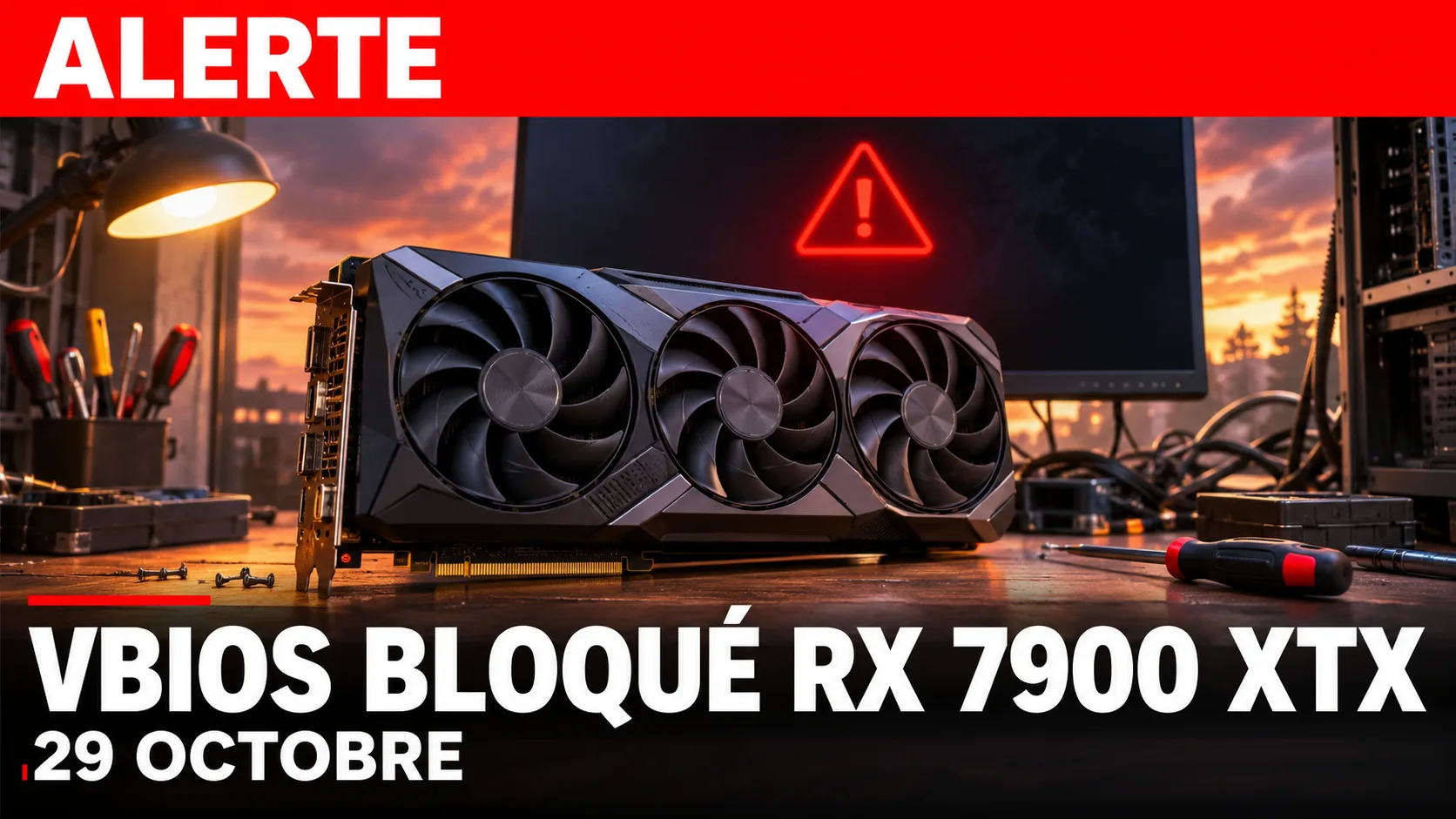
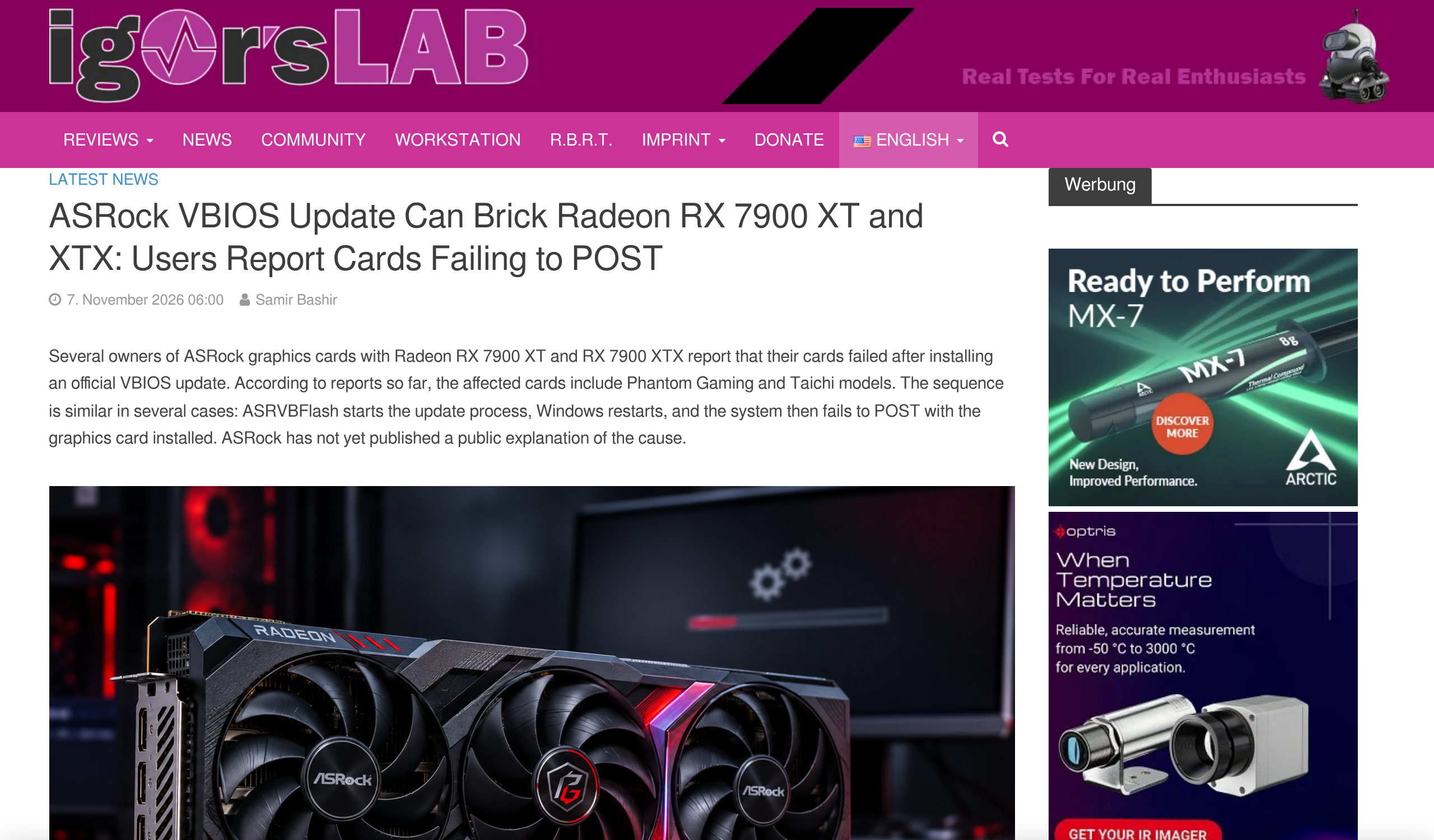
Windows restarts on its own in the middle of an update, both screens stay black, and the PC no longer gets through POST (the machine’s startup self-test) as long as the graphics card is in its slot. Owners of ASRock Radeon RX 7900 XT and XTX cards have described this scene since November 4, 2026. The cause: VBIOS 1.0.5 (the firmware built into the graphics card), released on October 29 to fix a security flaw whose details have not been published.
As of the last check on November 9, 2026, ASRock had published no explanation, no recall and no corrected version. This is an ongoing report: none of the sources read gives the number of affected cards, and no figure is put forward here.
Ten cards covered by the update, five models failing
On October 29, ASRock added VBIOS 1.0.5 for ten RX 7000 cards, from the RX 7600 XT to the RX 7900 XTX, to its support pages, to be installed with the ASRVBFlash 1.0.5 tool. TechPowerUp notes that Sapphire and Gigabyte had released their own versions earlier. On November 4, Overclocking.com reported RX 7900 XTX Phantom Gaming cards that were “bricked”, meaning rendered unusable.
| Cards (VBIOS 1.0.5 of October 29) | Reported failures |
|---|---|
| RX 7600 XT Challenger and Steel Legend, RX 7700 XT Challenger, RX 7800 XT Challenger and Steel Legend | None in the sources read |
| RX 7900 XT Phantom Gaming and Phantom Gaming White | Yes, consistent reports |
| RX 7900 XTX Phantom Gaming, Taichi and Taichi White | Yes, consistent reports |
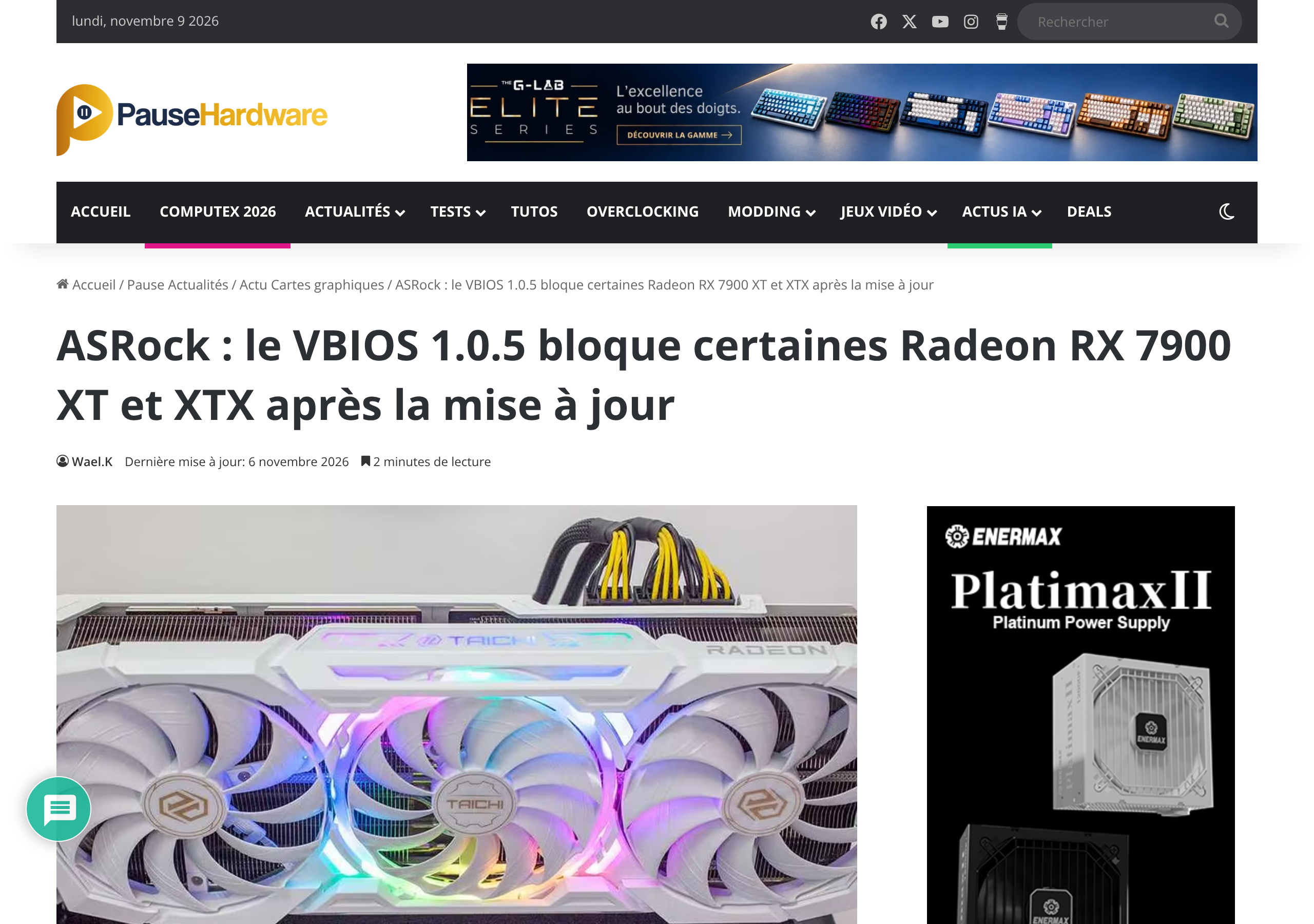
The sequence repeats from one report to the next, according to Igor’s Lab (November 7): the tool checks compatibility, Windows restarts, then the PC no longer gets through POST with the card installed. Once the card is removed, the machine boots normally. Motherboards vary (ASRock and MSI models), and the outlet sees no single guilty platform. It adds that failure is not automatic: not every card and not every installation is affected.
One isolated case, reported by El Chapuzas Informático (November 6), is more worrying: the owner of a Taichi White says the card’s second BIOS (the one on the Dual BIOS switch, meant to serve as a backup) was rendered unusable in turn, with the tool relaunching by itself when Windows restarted. It is a single account, unconfirmed.
An ASRock file half withdrawn, no public explanation
The checks differ on the download. TechPowerUp and The FPS Review describe a file in the process of being withdrawn. Igor’s Lab and PurePC specify that 1.0.5 is still listed in the index under the October 29 date, with 404 errors on some download paths and FTP links that still respond. The site netz-trends, which checked the page on November 8, still sees it listed, with no mention of a withdrawal or a fix.
| Date (2026) | What is established |
|---|---|
| October 29 | VBIOS 1.0.5 online for ten cards |
| November 4 | First reports of locked-up RX 7900 XTX cards (Overclocking.com) |
| November 5 | A thread opens on ASRock’s support forum (netz-trends) |
| November 6 | Picked up by TechPowerUp, The FPS Review and PurePC; 404 links observed |
| November 7 | No public explanation, no recall (Igor’s Lab) |
| November 8 | No reply from staff in the forum thread (netz-trends) |
Help exists, but case by case. According to PurePC, the European subsidiary replied to the author of a Reddit thread: a card that works in the first PCIe slot, a card that stays locked in the second. On a Mini-ITX motherboard, which has only one slot, that is impossible, and the company says it is looking for an individual solution. A Japanese user claims to have obtained warranty coverage. Igor’s Lab sees a one-off case, not a rule for every region.
On the forum, one member suspects leftover graphics drivers that were not properly uninstalled during the flash. No official reply has confirmed it: it is a user’s hypothesis.
AMD recommends flashing, without saying why
AMD has let it be known, via Sapphire and Pause Hardware (October 13), that these firmwares fix potential vulnerabilities, that they should be installed as soon as the card maker releases them, and that no exploitation has been observed. The AMD-SN-6023 identifier, cited by Gigabyte, was not on AMD’s security bulletin page at that date. Nothing has been said about the locked-up cards.
Working card or locked card: what to do
According to Overclocking.com, the manufacturer’s download page advises against installing the update on a card that already works, and does not say what 1.0.5 fixes. That mention comes from the press: ASRock’s page, protected by an anti-bot check, could not be reread directly on November 9. The same outlet suggests that after-sales service might refuse locked cards. That is its own supposition, not an announced position.

| Your situation | What the sources recommend |
|---|---|
| Affected card that works | Do not run ASRVBFlash 1.0.5 until there is an explanation or a corrected version (Igor’s Lab, TechPowerUp) |
| Card locked after the flash | Contact the retailer and the manufacturer’s support before doing anything (Igor’s Lab, The FPS Review) |
| Repairing it yourself | Two users succeeded with a T48 EEPROM programmer (the chip that stores the firmware) and a clip. Igor’s Lab sees a risky method that can make the failure worse, and advises avoiding files from other sources |
Reinstalling an older VBIOS taken from TechPowerUp also worked for some, according to Pause Hardware: a lead, not a guarantee. The FPS Review and netz-trends warn that these workarounds can complicate a warranty return. The precedent of PNY, which had refused the warranty on a melted RTX 5090 (our article of October 1), shows that a manufacturer can fall back on its warranty terms, hence the sources’ advice to go through support first.





0 Commentaires
Aucun commentaire pour le moment. Soyez le premier à commenter !