
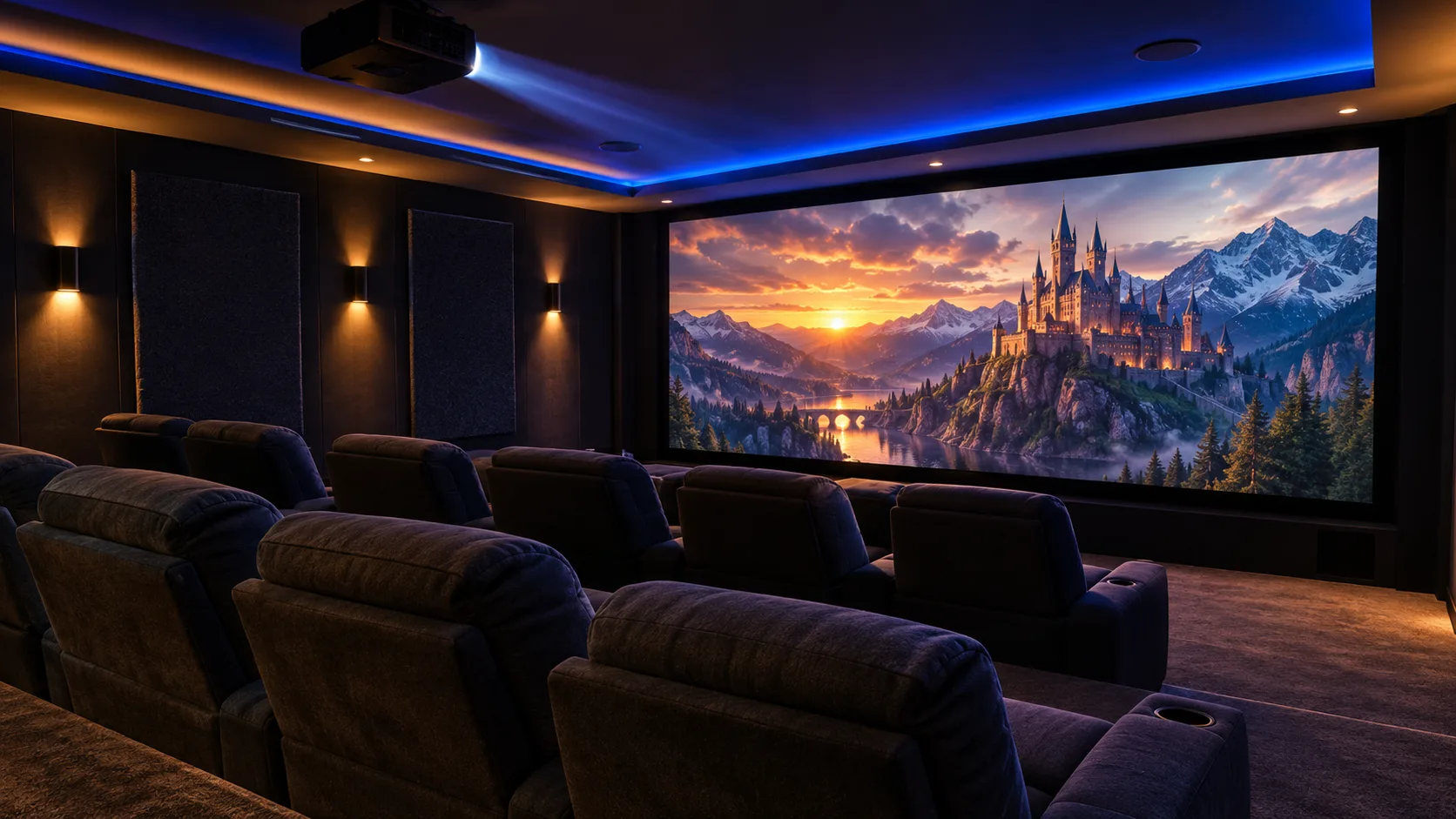
Lights off, door closed, a screen three metres wide and sound that also comes from the ceiling. A private cinema room is built around picture and sound, in a room where nothing gets in from outside. For a gamer, it is also the best place in the house to start a solo campaign or the Tuesday night raid.
A dedicated room that daylight never reaches
The difference between a private cinema room and an equipped living room comes down to the room first. A dedicated room has no windows, or windows that are permanently blacked out, dark matte walls and ceiling, and a door that cuts it off from the rest of the house. For a projector, total darkness counts double: its contrast drops as soon as any light lingers in the room, and every reflection on a light wall washes out the picture.
The choice of room matters as much as the equipment. A basement, a converted garage or a guest room with no one overlooking it often does the job, as long as you can run cables through it and deal with the noise that escapes.
Picture: a projector, a screen and the right distance
Beyond 100 inches diagonal, the projector remains the most common solution. 4K laser models have replaced lamps, which lost brightness over the hours. Opposite, a tensioned screen of 120 to 150 inches is enough in a dark room: the more expensive ambient-light-rejecting screens are designed for lit living rooms.
The size is chosen according to the seating distance. THX recommends a viewing angle of about 40 degrees; the minimum often quoted, inherited from movie theatres, is around 30 degrees. In practice, you sit between 1.4 and 1.9 times the screen width away. For a screen 3 metres wide, or about 135 inches, the front row therefore goes between 4.1 and 5.6 metres.
Sound: Dolby Atmos and ceiling speakers
The reference sound format is called Dolby Atmos. An installation is written as three numbers, for example 7.1.4: seven speakers around the seats, one subwoofer, and four height speakers set into the ceiling. These last ones make a helicopter pass over your head, not beside it.
4K Blu-rays and a good part of the streaming catalogues use it, including on devices like the Apple TV 4K. For bass, two subwoofers placed in different spots work better than a single, larger one: they smooth out the dips and peaks that a single subwoofer creates depending on where you sit.
Acoustics, the part people underestimate
A bare room bounces sound off its walls. Dialogue gets muddy, bass booms in some corners and vanishes in others. You correct it with absorbing panels at the first reflection points on the side walls, bass traps in the corners and a floor covered with carpet or a thick rug.
Soundproofing is a different matter: it keeps sound from leaving the room, which soon matters during an action film at 11 p.m. with children asleep upstairs. It has to be planned at the building stage, because it runs through the walls, the ceiling and the door.
Gaming on a big screen: HDMI 2.1 and latency
A PS5 or an Xbox Series X can send up to 4K at 120 frames per second through an HDMI 2.1 port, a standard that allows up to 48 Gbit/s of bandwidth. The projector and the amplifier must follow the same standard, otherwise the console drops back to 60 frames per second.
The criterion to check before anything else remains display latency, the delay between pressing a button on the controller and the image on screen. Gaming-oriented projectors have a dedicated mode that reduces it sharply, and this figure is often what separates two similar models. For a competitive shooter, a fast gaming monitor on a desk keeps the advantage. For an adventure game, a racing game or a World of Warcraft raid, a three-metre image and sound coming from every side give the scenery and the fights a different scale.
Doing it yourself or hiring an installer
A patient amateur can build their room in stages: the screen and projector first, the sound next, the acoustics over the following months. The result then depends on two steps that are rarely mastered alone, measuring the room and calibrating the equipment, which require a measurement microphone, software and experience.
An installer takes care of everything: room study, 3D plan, choice of equipment, acoustic treatment, installation and final calibration. Specialists such as AV Concept Products design a turnkey private cinema room this way, with several ranges depending on the size of the room and the budget. For a complete room, the budget runs to tens of thousands of euros, and it is decided before construction starts: soundproofing and cable runs cannot be fixed once the walls are closed.
Partner article – this content was published as part of a paid commercial partnership. It does not commit the Kami-Labs editorial team.






0 Commentaires
Aucun commentaire pour le moment. Soyez le premier à commenter !