
On the shared screen of the WoW Forever podcast released on October 29, a curve collapses and then stays flat. It counts the forced world changes during the beta, and it is what the developers point to when they say what awaits you on November 4. Frank Williams, Principal Software Engineer, puts it another way later in the episode: « the state at the end of the beta is what you can expect for launch ».
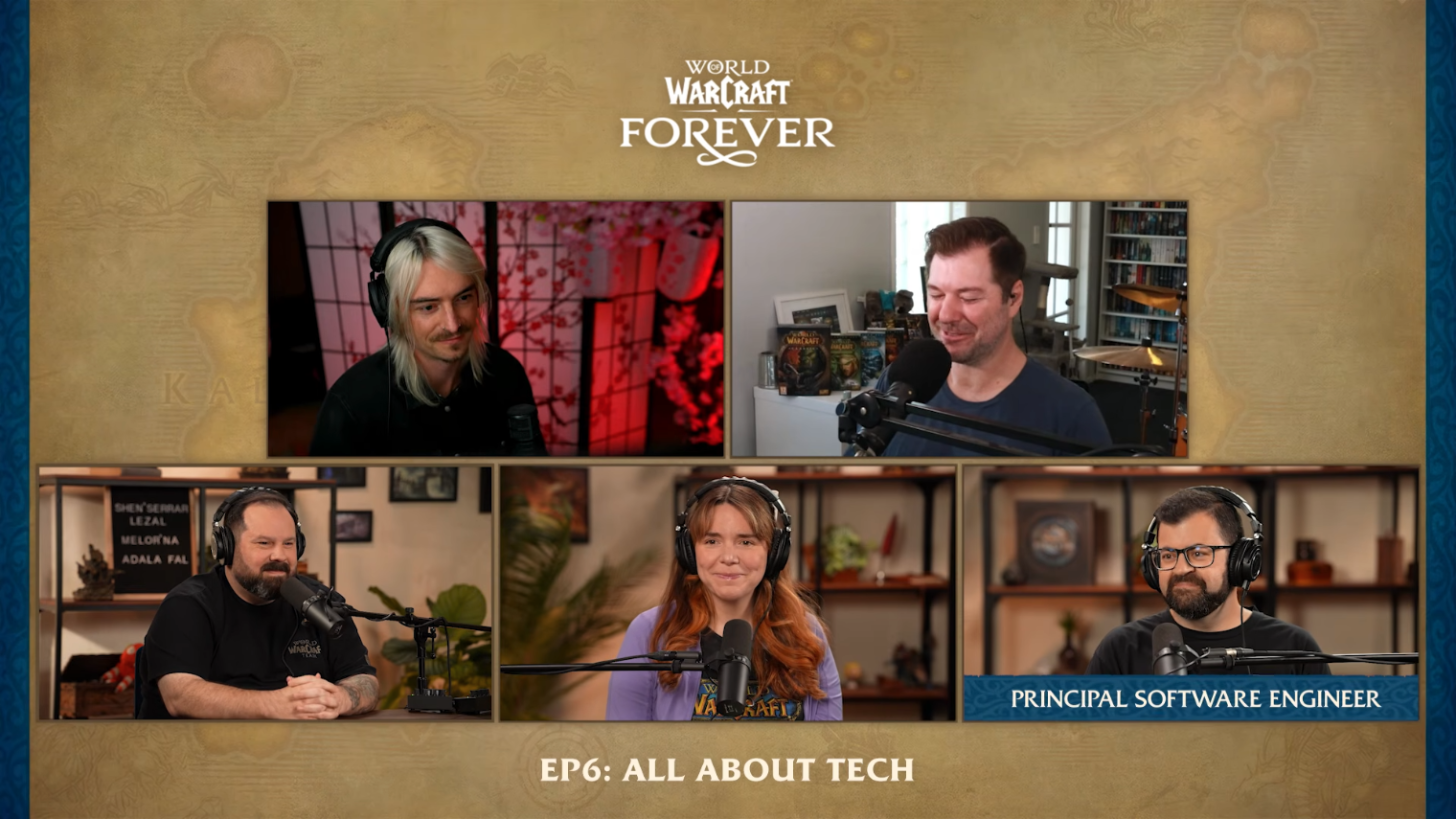
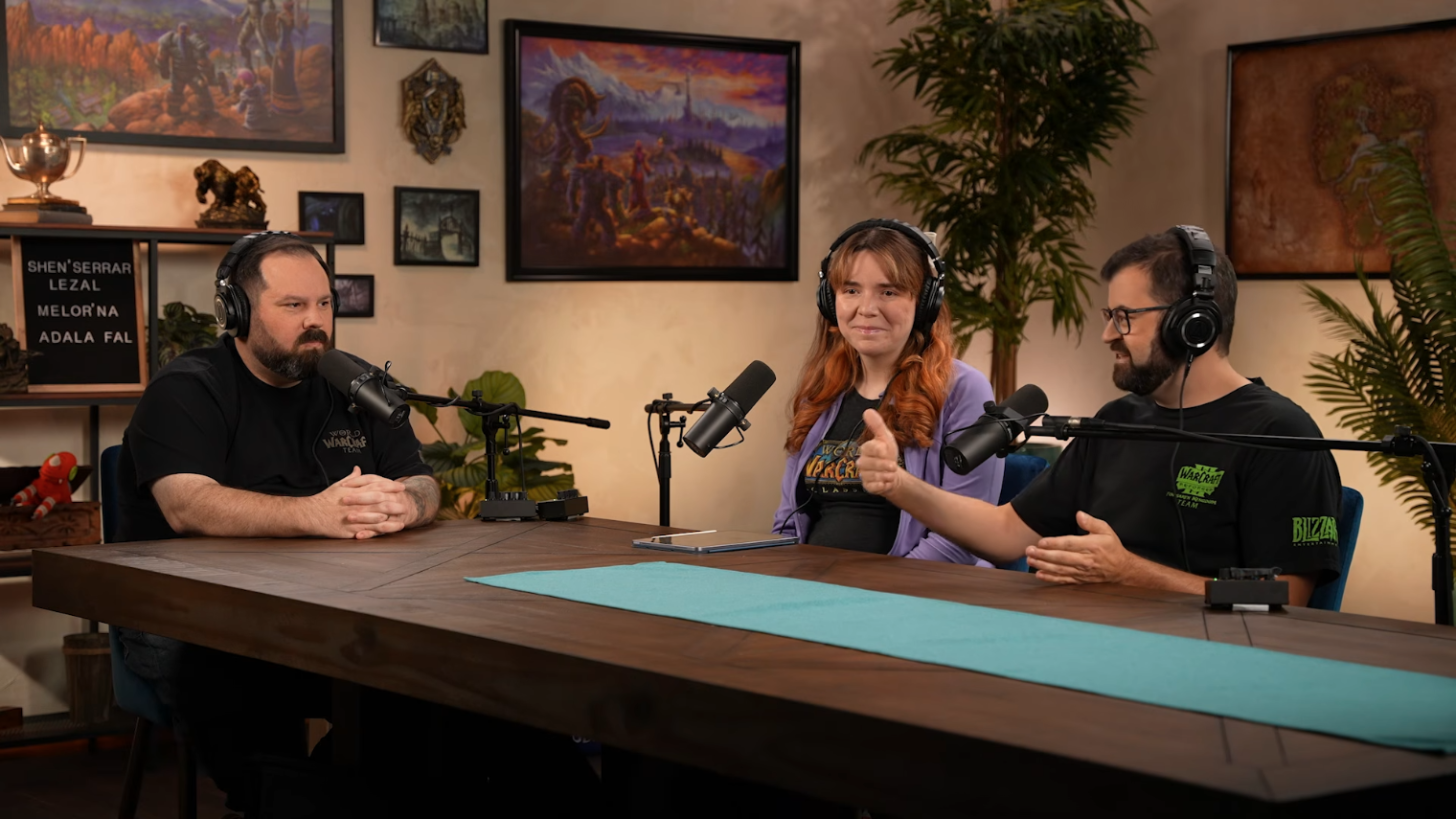
Episode 6, titled « All About Tech », is the last one before the November 4 launch, announced on the official WoW Forever page. Around the microphone of Josh Corbett, a.k.a. Countdown to Classic, you will find Josh « Aggrend » Greenfield (Senior Game Designer), Ana Resendez (Lead Software Engineer), Frank Williams and creator Shobek, an RP-PvP guild leader. They cover what changes for you in practice, then why, then what is still just an idea.
What changes on November 4 when you join a group
The sharpest change in the WoW Forever podcast concerns groups. Frank Williams announces it: joining a group no longer moves you. A window appears, with a delay to move when you decide to. He cites Hardcore mode, where nobody wants to be switched to another world while standing in a cave next to an elite.
During the beta, the situation was very different. World refresh windows (which switch you to another copy of the world) were frequent, and Frank calls the early algorithm far too aggressive. He then shows the graph that appears on screen around 40:06. Programmers, he jokes, cannot name things: this one is called the « eviction graph », and the lower it is, the better.
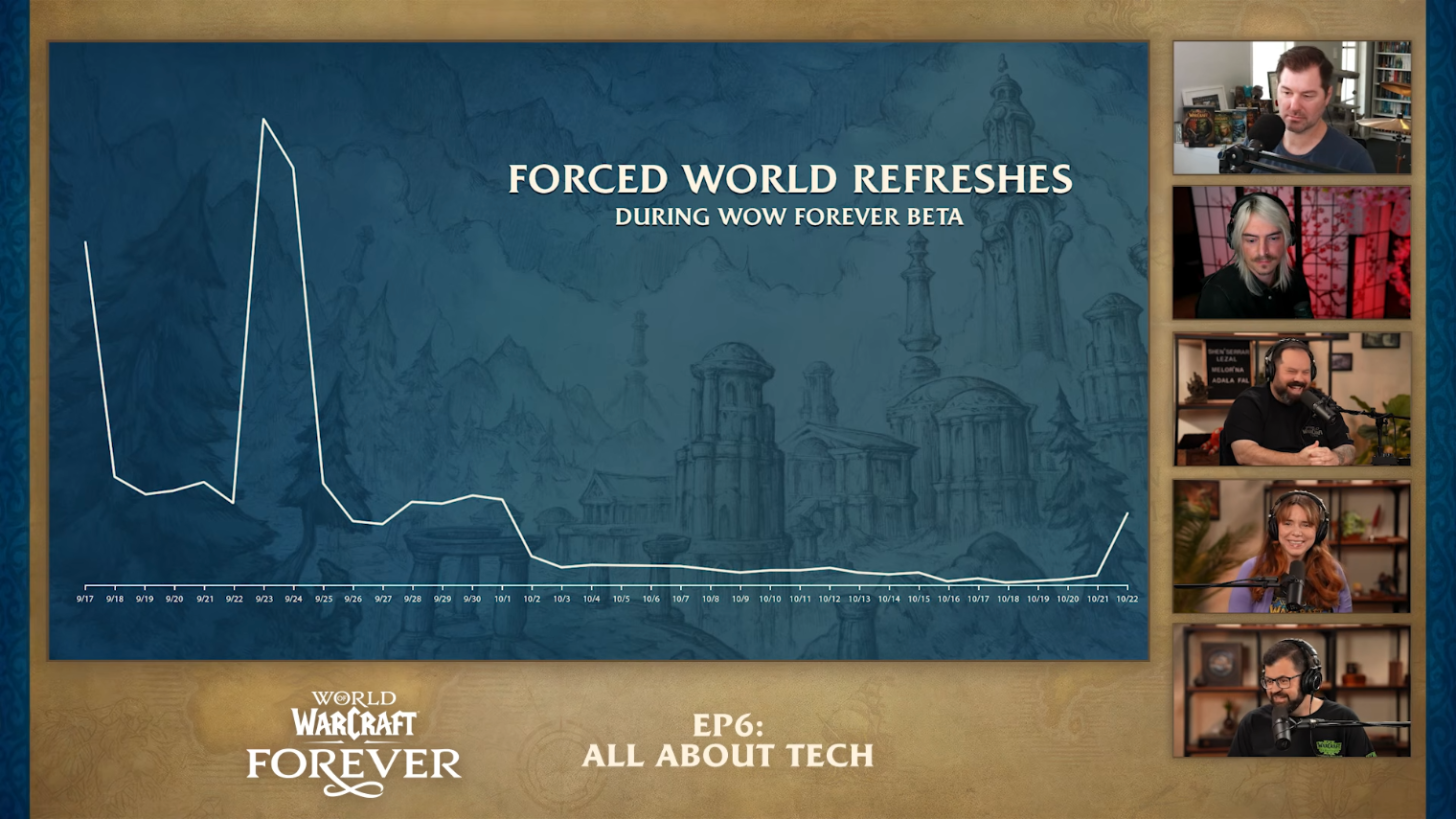
The peak matches the first week of the beta, not the move to level 30, with « 17 different systems » moving everyone around. The curve drops with each fix. Today, he says, you are no longer moved by default, and the window that remains is more limited and friendlier.
Outside a group, you play in the worlds of your guild’s community. Without a guild, your repeated interactions count: if you run into the same person at level 10 and again at level 20, they become a potential friend, a dungeon partner, maybe a guild member. Frank also mentions a bug: being moved just because you receive an invitation was not intended, and it is fixed.
Ana Resendez adds a language detail. During a test in Spanish, she saw Hispanic names appear around her. The system looks at the client language first, and a setting will let you change it.
The start of the episode revisits name reservation. Aggrend admits a few hiccups on the opening Tuesday, fixed since, and sees this period as a way to spot the unexpected before launch day. The guests reserved their own characters: a Windshaper Druid and a Forsaken Paladin for Aggrend, an Undead Priest for Ana, a first run on the Alliance side for Frank, usually Horde. Shobek did not get the name he wanted.
Players who vanish at zone borders
Countdown asks the question many players are asking: why do characters vanish when changing zones, or mid-fight? Ana Resendez points out that the system is entirely new. Frank led its design, and a few weeks before the beta, nobody knew whether it would work. The end of the beta looks nothing like the start. Complaints like standing in Orgrimmar, looking at the Barrens, and watching people disappear led to better technology and adjusted borders.
On the WoW Forever podcast, Aggrend explains the principle: each zone, or small group of zones, forms a layer (a copy of the world shared by a limited number of players), and the team tunes which zones are connected. At launch, Durotar will be packed with character creations and Orgrimmar calmer. A month later it will be the reverse, with battles in front of the capitals. How zones are grouped for layering may therefore differ between those two moments. For the details of how it works, our article on the layering fixes covers what had been announced before the episode.
Frank Williams talks about a real leap for those who logged in during the last days of the beta or at the « server slam » (the load test). The improvements have all but erased the clip of the Orgrimmar exit where everyone pops in and out. By his account, you will not see that at launch, and more fixes are coming.
The WoW Forever podcast states the limits plainly. Aggrend warns: « it’s not going to be a perfect contiguous world at all times ». Borders and world refresh windows remain. He also stays vague on purpose, so as not to hand ammunition to exploits.
On the WoW Forever podcast, Ana Resendez explains why partitions are needed. The original WoW had realms under 10,000 players, and Countdown recalls queues of 3,500. Putting hundreds of thousands of players, even millions, in one continuous world exceeds hardware limits. Aggrend recalls the 2019 flaw: a full Orgrimmar created several copies of the world while the rest sat empty. Smaller partitions aim for zones of the right size.
Early in the beta, Westfall or the Barrens overflowed and tagging a mob became hard. A player cap per zone can now be tuned, and a zone splits in two if needed. The adjustment took a day or two, and it will remain possible after launch. Shobek, who had argued for a single realm, admits he is convinced: every lively zone, from Goldshire to Arathi, proves to him that it works.
Realmless, but with rulesets: why PvE and PvP stay separate
In the WoW Forever podcast, Frank Williams traces the path: it all started with Hardcore mode, where per-realm capacity gains took the realm count from about 200 to 2. For Forever, you pick a ruleset: Normal (PvE), PvP, RP or RP-PvP, and you play. Region restriction remains, but a friend in Chicago and another in Los Angeles can play together. Ana says that at BlizzCon, a friend told her he was playing WoW on the wrong realm.
Aggrend sums up the goal: « we don’t ever want to create a situation again where you can pick the wrong server ». Shobek sees the end of the list of Classic, Hardcore, Season of Discovery, Retail, Anniversary: everyone ends up in the same place.
One point surprises Countdown: PvE and PvP still do not play together. Ana answers with the economy and the flavor specific to each ruleset. Aggrend says the team was divided and considered letting the two groups join up in an instance. The deciding argument is farming, easier on a PvE server, with economies and Auction Houses that diverge. So the two stay separate at launch, even though the technology would allow it. He asks, laughing, not to be harassed on social media.
For RP and RP-PvP, the fear is splitting an already small community, a subject our article on the RP-PvP launch also covers. Aggrend names two levers without announcing either: linking the Auction Houses or allowing grouping in instances, and only if the population demands it.
Another community worry: one ruleset becoming entirely Horde and another entirely Alliance. Ana replies that faction balancing is done per ruleset and aims for 50/50 in each. Creating a Horde character in PvP therefore does not guarantee you can create one in RP-PvP. If a ruleset tilts too far, Aggrend explains that the majority faction gets locked, which does not worry him.
Over time, Frank describes a community that is dynamic but « temporally static »: it is computed from your logins over the past months (he cites four as an example) and evolves slowly. Someone arriving in two or three years should find people to quest with, like on a fresh server. The numbers will be tuned. The ignore list, however, does not remove anyone from your play circle: Aggrend cites Overwatch, where the thumbs-down was removed, and says he wants to prevent people from gaming the system.
Oceania: what the WoW Forever podcast says about the permanent night
Players from Oceania (OCE) fall under the Americas region and complain of playing in perpetual night. Ana Resendez explains that the game is realmless for you, but it runs on machines. Physical servers exist in Australia, with better ping, and you can play there with friends from North America. In a group, the server keeps the world of one of the members.
The team could therefore set an Australian time on those servers. The cost shows up right away: joining a North American friend, you would go from night to day in a few seconds. Aggrend asks Australian players for their opinion, on a Reddit thread and on the forum. He also mentions seasonal festivals, with their start times and the possibility of finishing a festival on another server, and notes that the hardest part for a designer is the « what ifs ».
Why Blizzard started over from modern code
In this WoW Forever podcast, Frank Williams goes back to 2019. Classic was « a snapshot of World of Warcraft » turned into the original game, but on a moving train: modern WoW changes constantly, and security, graphics and other pieces had to be pulled back in again and again. In the Burning Crusade Classic era, the team ran an effort called « the merge », the code merge. Not everything got merged, and the team suffered for it for a long time.
For Forever, the goal is to build something that lasts and ship faster, without content being delayed by invisible work. Ana Resendez points out that Classic was « #nochanges », so its tools could be weaker. Back to the drawing board, with a clean slate on modern code, championed notably by Kevin and by her. The principle is « data-driven »: data decides whether the modern logic or the Forever logic runs. Aggrend adds that security and compliance updates arrive for free this way.
Aggrend gives a telling example, talents. The old talent editor of Classic Era no longer existed, so changing a talent stayed a hard exercise for years, a real problem in Season of Discovery. He now changes the order and placement of talents in the trees very easily. Players do not see it, but the gain in speed and flexibility is huge. Frank clarifies that the team does not import the design of modern systems, only how they are built.
Shobek asks whether the team has tools to bring together more than 40 players, after living through the battles at Orgrimmar and Ashenvale on the beta. Frank answers that the recent codebase brings years of performance improvements, with a « huge thank you » to the housing team. Aggrend hastens to add, laughing, that this does not mean housing is coming to Forever. Every improvement now benefits all of WoW.
Speaking on the WoW Forever podcast, Ana Resendez describes the work on the ground. The team reads « flame graphs » (charts that show where the server spends its time) of function calls and watches response times between server and client. It looks for which events do not need to be sent all the time, and which can go out in batches. In a battle, she says, you want to see the enemies you want to fight.
What remains under study, and what nobody has announced
On the idea side, Shobek asks in the WoW Forever podcast whether the 40-player limit is final and suggests groups of 80 to 120. Aggrend answers that Tim hinted at this in an earlier episode. The team is thinking about « making an army » of 80 to 120 players or an alliance of several groups, but nothing is announced. In his view, it will be looked at once the game has matured, after leveling and pre-raid gear, when emergent behaviors appear. The team is watching what addons do.
Frank Williams runs with the joke: « there might be a whiteboard on campus with the word mega raid scrawled on it ». He adds that you never say never. The team is also thinking about detecting PvP battles automatically and letting servers « stretch slightly » so the battle stays continuous. He repeats, though, that the state at the end of the beta is what you will have at launch.
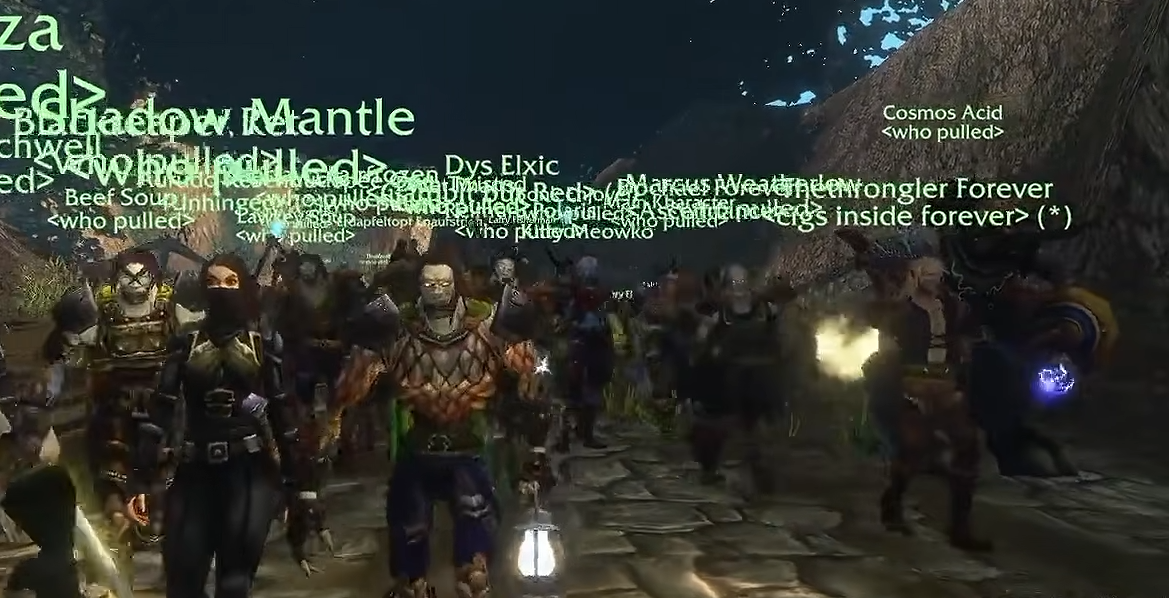
Frank shared Shobek’s Ashenvale clip in their Slack, a sea of red pouring down the hill, in which you can hear Shobek yell « Oh my god, this is World of Warcraft ». Shobek adds that big gatherings are not only PvP: guild meetings, duel raids in front of Durotar, visible even in the group finder.
On communication, Shobek asks for proximity chat or a mic that activates when you enter a group, as an option. Aggrend confirms the team has thought about it a lot, but he demands a safe system, « the internet is big », and there is no solid plan. Frank has also thought a lot about it, and audio features with Discord were added during the beta.
For events, Frank promises almost nothing different at launch. Some were rebuilt: in Season of Discovery, the Ashenvale PvP events suffered from the interaction between layers and the world state system, and everything was redone. Tools for designers exist, and Frank mentions, without promising anything, big PvP events and festivals like a fishing tournament. He also rules out a major AQ-style event at launch, because those gates do have to open someday.
Aggrend repeats that anything is possible, but not everything at launch. The Maka’kar arena, spotted in game, could become a one-off event on the model of the Darkmoon Faire, and the team is thinking about how world bosses would work in a partitioned world. He describes a whiteboard full of ideas, and a time tradeoff: the team no longer wants to sacrifice a class quest because only a ninth of players will see it. Shobek, for his part, wants the Blood Moon, a Season of Discovery event, to come back bug-free if it is redone.
Ana Resendez closes the WoW Forever podcast by thanking the operations, quality assurance and production teams. It takes a village, she says. The podcast takes a break the week of launch: the next episode will come in two weeks and will cover lore.

0 Commentaires
Aucun commentaire pour le moment. Soyez le premier à commenter !