
On the Season 15 PTR, wudijo stumbles on a lightning resistance value far too high to be normal. Not a display bug: Blizzard quietly raised single-element resistance values, without a single line in the patch notes.
Once the change was confirmed, he measures the actual effect on his own character: a single physical resistance affix earns him a 51% toughness gain against that damage type. Enough to reshuffle defensive gearing priorities and put Diablo 4 resistances back at the center of build choices, from Horadric Jewelry charms to the most overlooked tempers.
A Change the Patch Notes Never Mention
Season 15 brings a change to Diablo 4 resistances that nobody announced publicly. wudijo spotted it while testing the PTR (the Public Test Realm), even before the patch's official release. On an ancestral chest piece in his inventory, he notices a lightning resistance value far too high to look real. No display error: that value really was running on the test server.
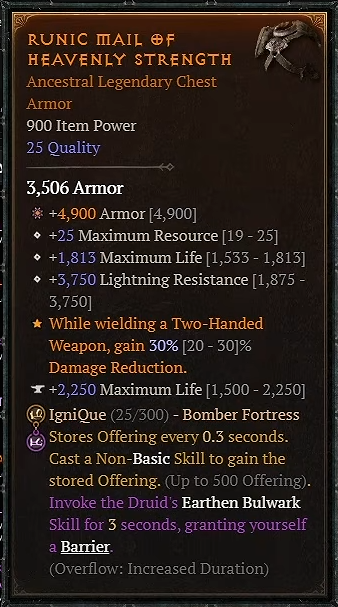
Blizzard has clearly raised single resistance values, the ones that protect against just one element instead of all of them at once. He compares the usual ranges to those on his test items, and the gap is obvious. These Diablo 4 resistances now carry as much weight as armor or Maximum Life in a defensive build. None of it appears in the official patch notes.
The increase isn't limited to the affixes visible on gear. It also touches individual resistance tempers and Horadric Jewelry charms, wudijo notes in his video. That silence is exactly what pushed him to film the demonstration: he wanted to stop players from finding an unfamiliar lightning resistance line on their build planner without understanding where it came from. To check what Blizzard actually communicated before the season, the PTR 3.2.0 notes remain the most complete reference.
Diablo 4 Resistances: Why "All Elements" Used to Dominate

Before Season 15, the math was simple. Take an item with 473 All Resistance. Swap that affix for a single resistance, and you get between 500 and 600 points. With a bit of Masterworking, the high end climbs to 600, or even 800.
The gap didn't justify the trade-off. A single resistance affix only protects against one damage type. The All Resistance affix covers all six at once for almost the same number. The choice was obvious.
Same logic for tempers. A Fire Resistance temper offering 490 points weighs nothing against 2,000 armor or 1,500 life. Nobody picked it.
| Defensive affix | Value observed before Season 15 |
|---|---|
| All Resistance (one affix) | 473 |
| Single resistance (one affix, with Masterworking) | 600 to 800 |
| Fire Resistance temper | 490, versus 2,000 armor or 1,500 life |
The factor that changes everything is simple to state. There are six resistance types in Diablo 4: fire, lightning, cold, poison, shadow, physical. To compare an All Resistance affix to a single resistance affix, you have to multiply the "all elements" value by six.
Take the 473 from the example. Round it to 500, add Masterworking: the total comes to around 3,000 points of equivalent single resistance across the six bars combined. But gear built from six individual affixes, one per element, beats that total by 20 to 25%. That gap is what puts Diablo 4 resistances back at the top of gearing priorities.
Charms Become Free Defensive Space
Before Season 15, a charm only mattered for two things: the right set piece and skill ranks, plus three tied to the ability used. Everything else counted for nothing: a few secondary stats, like crafting drops or gold find, sometimes a bit of resistance. wudijo cites an example straight from the live game: 570 Shadow Resistance on a charm. A value so small it's basically invisible, a few points of damage reduction, nothing worth thinking about.
What changes is the slot. On a charm, the resistance line occupies a slot separate from skill ranks. You keep your ranks and gain the resistance, without sacrificing anything. On the rest of your gear, that choice always has a cost: every point of resistance takes the place of another stat. Not on charms. It's empty space that becomes free.

The reasoning goes further. A charm with two skill ranks but 3,000 resistance beats a charm with three ranks and nothing else. Multiply that across all six charm slots, spread your Diablo 4 resistances across the different types, and you get a toughness gain (toughness, meaning effective hit points) of around 10 to 20% across all damage types.
According to wudijo, this gain amounts to a defensive bonus handed out for free by charms. The trade-off: the affix hunt everyone chases gets harder. A perfect charm now has to balance skill ranks and resistance, where just one of the two used to be enough.
One Single Affix, 51% More Toughness

wudijo didn't want to just announce the buff. He measured the real effect of Diablo 4 resistances on a live-server character, the one he plays every day, not a lab simulation.
His Horadric skull gives 3,500 Physical Resistance. That's roughly what a single affix provides in Season 15 under the new rules. Before equipping it, he sits at 4,500 Physical Resistance, for 73.2% damage reduction, so 26.8% damage taken. Once the skull is added, he climbs to 11,000 Physical Resistance with his Paragon bonuses, for 82.3% reduction and 17.7% damage taken.
The math fits in one sentence: you divide the old damage-taken percentage by the new one. Here, 26.8 divided by 17.7. The result is the toughness gain, the number of effective hit points it now takes to kill you.
| Physical Resistance | Damage Reduction | Damage Taken | Toughness Gain |
|---|---|---|---|
| 4,500 | 73.2% | 26.8% | starting point |
| 11,000 (+1 Horadric skull, 3,500) | 82.3% | 17.7% | +51% |
| 13,600 (+1 Grand Skull, 2,600) | not disclosed | 15.5% | +14.2% |
A single resistance affix earned wudijo a 51% toughness gain, proof that Diablo 4 resistances are no longer a secondary stat. That's half of an entire defensive aspect, for a line everybody skips right over.
But the curve flattens fast. Adding a second skull, a Grand Skull this time, smaller (2,600 Physical Resistance), drops the gain to 14.2%. With a skull of the same quality as the first, it would likely have landed around 20%. The principle stays the same: every extra point gives back a little less than the one before it.
The useful threshold sits between 10,000 and 15,000 resistance per type. Beyond that, the curve tapers off gently. Pushing to 20,000, 30,000, or even 40,000 on a single element is still possible, but the payoff collapses. Unless one specific mechanic keeps killing you over and over, falling swords, or fire explosions. There, going past the threshold can be worth it.
Life, Armor, or Resistance: What to Sacrifice
This buff changes one concrete thing: you can now specialize against a specific damage type. wudijo uses Mephisto as an example, where shadow damage dominates the fight. In his Mephisto guide, he recommends double Amethyst and a skull in the jewelry sockets to maximize toughness against that specific boss.
Outside of specific fights, his usual setup stays skull, Topaz, and Ruby, because fire, lightning, and physical are the three most dangerous monster damage types. Cold, poison, and shadow matter less, without being ignored entirely.

- High priority: fire
- High priority: lightning
- High priority: physical
- Low priority: cold
- Low priority: poison
- Low priority: shadow
The question of what to sacrifice comes up next. On a fully geared endgame character, with Masterworking on weapons and a few life affixes on a ring or gloves, Maximum Life sits around 30,000 to 40,000 points. Barbarians often go past that number. In that case, one extra life affix is only worth 5 to 10% toughness across the whole character. Conversely, if one of your Diablo 4 resistances is close to zero, a single affix on that type can be worth up to 50%.
The same reasoning applies to armor. Chest and pants naturally carry the biggest values, thanks to Masterworking. An extra armor affix on a ring or boots adds roughly 5 to 8% toughness, a comparable order of magnitude to life. Once that average level is reached on life or armor, trading an affix for the resistance you're missing becomes worthwhile.
Boots are the ideal spot for this trade: they offer neither a big life affix nor a big armor affix, but they accept the same resistance affix. That's the math behind wudijo's Warlock Searing Cry Pit 150 build, built for the Pit in Season 15.
Soul Splinters Choose Your Resistances for You

Season 15 adds another layer to the problem. Soul Splinters each arrive with an imposed resistance. You don't choose that value, you choose the splinter for its main bonus, and the resistance comes along whether it's useful to you or not. A good chunk of your Diablo 4 resistances is no longer a choice then, it comes from whatever else you have equipped.
Some splinters show up in almost every build for their offensive bonus, the resistance that comes with them is just a side effect. Others stay marginal, sometimes useless. wudijo breaks down each one.
| Soul Splinter | Resistance provided | Who runs it |
|---|---|---|
| Splinter of Anguish | Fire | almost every build, for critical strike chance and attack speed |
| Splinter of Sin | Lightning | few builds, by wudijo's own admission |
| Splinter of Pain | Poison | almost every build, for damage reduction |
| Black Soulstone | All stats | lots of builds, but the defensive slot is dead |
| Splinter of Hellfire | All Resistance | damage-over-time builds and guaranteed critical strike builds |
The Black Soulstone illustrates the problem on its own. It gives a little of everything, so almost nothing of each. wudijo calls it a dead defensive slot, while waiting for Blizzard to adjust it. The Splinter of Hellfire fares better: damage-over-time builds adopt it without hesitation, like some Barbarians with the  Ring of Red Furor or Spiritborns around the
  Rod of Kepeleke, because it has no downside and adds raw damage.
Once these splinters are locked in, you're usually left covering three to five of your Diablo 4 resistances yourself, through charms, a handful of tempers and affixes. That's where Stone of Jordan comes in. This unique item matches all your resistances to the highest one. A fire build stacking 40,000 Fire Resistance ends up with 40,000 everywhere else too. In Season 15, the effect loses a bit of strength: the random splinter distribution stops you from stacking every Ruby on a single type. But since a resistance's return already diminishes once it climbs on its own, the difference stays small. wudijo sees it as half an offensive aspect with a free defensive aspect built in, especially useful on a fragile Necromancer whose defensive slots are already packed with unique items.









0 Commentaires
Aucun commentaire pour le moment. Soyez le premier à commenter !