
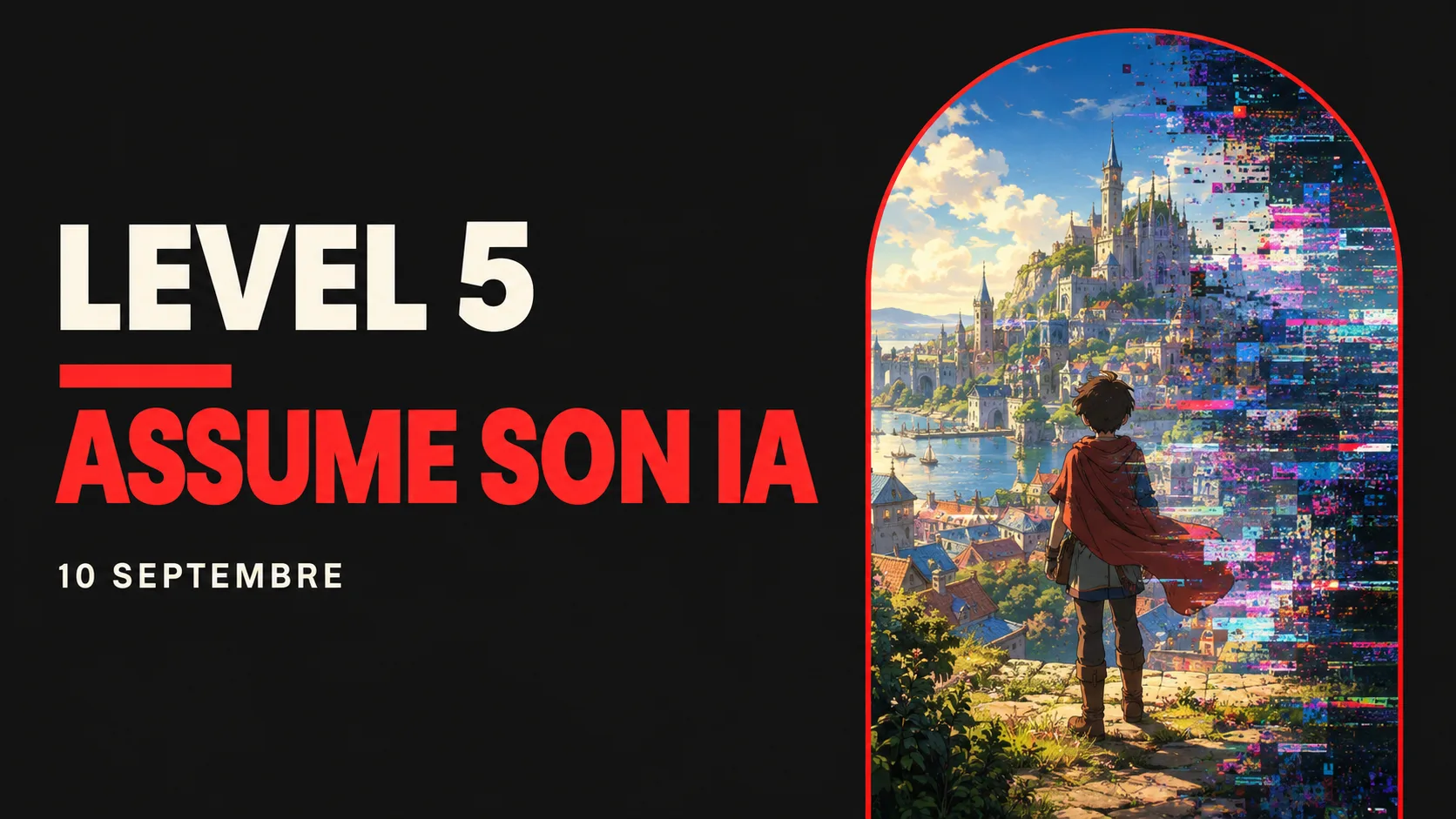
Players had spotted the tells over the weekend. Textures too smooth, rubbery movement, visual inconsistencies from one scene to the next. Japanese studio Level 5 has now confirmed what the internet suspected: the Level-5 Vision 2026 II presentation, held on September 10, 2026, leaned heavily on generative AI.
Akihiro Hino, Level 5’s president and CEO, posted his apology on X on September 12. In the same message, he defends the use of AI as a deliberate industrial choice. After the Crazy Taxi and GTA 6 stories, this is the third generative AI story of the week in gaming, and each studio is handling it its own way.
A Showcase Packed With Announcements, and AI
The list of announcements out of Level-5 Vision 2026 II is dense. A remake of Professor Layton and the Curious Village, planned for PS5, Switch 2, Switch and PC. Holy Horror Mansion, a new title announced for 2027 on PS5, Switch 2 and PC. DECAPOLICE, pushed back to 2027 after several delays already absorbed. Muramasa: Revenant Blades, dated for February 4, 2027. And new entries coming in the Yo-Kai Watch franchise.
Japanese outlet Gematsu compiled the full list of announcements that same day. It was while digging into the presentation’s visuals that players started comparing images to one another, then posting their conclusions online: most of the content shown relied on generative AI, not on standard game rendering.

Once publicly picked apart, the footage quickly put Level 5 in an uncomfortable spot. VGC was one of the first Western outlets to report the studio’s admission about Professor Layton and Yo-Kai Watch.
An Apology Aimed at the Form, Not the Substance
Akihiro Hino’s message on his X (@AkihiroHino) account, posted on September 12 at 5:51 AM, quickly gained traction. At the time of our check, it showed 13.9 million views, 63,000 likes, 9,700 reposts and 1,900 replies.
In this message, Hino writes: « It was entirely due to the desire to make the presentation more spectacular that we incorporated processing that also served as an experiment using the latest AI. It appears that some people felt uncomfortable about this, so I deeply apologize. »
He adds: « We will take this as a lesson and carry it forward to the next one, so please look forward to Level Five’s next presentation. » The apology targets the presentation itself, its execution. Nothing in this passage calls into question the use of AI in game production.
A Line That Doesn’t Move
The same message spells out the studio’s doctrine. Hino writes: « At our company, the parts that relate to the charm and individuality of the released works, such as scenarios, character designs, and basic settings, are all created by human hands. »
On AI’s exact role, he specifies: « What we’re aiming for in terms of efficiency through AI is mainly the digitization of creative work made by people, for example, accurately converting original artwork into polygons and such. » He concludes: « Thanks to the time created by AI efficiency, creators are now able to dedicate more time to the essence of creation. »
The stated target shows the scale of the ambition. Level 5 aims to cut development cycles from five years down to two thanks to AI. For a studio built on narrative games like Ni no Kuni or Professor Layton, the math stays industrial: produce more, faster, with teams refocused on the essence of creation, according to Hino.
A Position Held for Over a Year
This statement is no isolated slip. Nintendo Life has tracked and documented Hino’s position on AI three times over a little more than a year. In June 2025, a first article was headlined « Level-5 CEO Sees AI As ‘Tool For Communication And Efficiency’ ». On December 27, 2025, a second one picked up one of his lines: « A Knife Can Be Used For Cooking Or As A Weapon ». On September 12, 2026, Damien McFerran wrote « We Will Take This As A Lesson – Level-5 CEO Doubles Down On GenAI Despite Backlash », about these same apologies.

Under these three articles, the reactions look alike. One player calls out « blatant genAI ». Another sums it up more bluntly: « the LEVEL5 we knew is long gone ». These criticisms, raised by players and not verified by our editorial team, cover models trained on artists’ work without a license, the environmental impact of these tools, and fears of job cuts in creative roles.
The week saw three distinct stances toward generative AI. Crazy Taxi quietly rewrote an awkward mention. GTA 6 issued a flat refusal, on both generative AI and microtransactions. Level 5, for its part, picks a third path: apologize for the form, and hold the line on the substance. Whether the apology will be enough to defuse the pressure before the next presentation remains to be seen.









0 Commentaires
Aucun commentaire pour le moment. Soyez le premier à commenter !