The Information reported overnight between August 26 and 27, 2026 that Nvidia has agreed to buy Hugging Face for $12.9 billion, citing a person familiar with the deal. No contract has been signed as of now, and the deal could still fall through before it closes. Keep that caveat in mind from start to finish: everything below rests on unofficial sources.
That caution matters twice as much in this particular case. Nvidia had already tried to buy into Hugging Face for $500 million, a sum that would have valued the company at around $7 billion. The founders said no. The reported reason: they didn’t want a single chipmaker (the companies that build the components running AI models) to carry too much weight over a platform that presents itself as « the Switzerland of AI ». That refusal is what gives the current buyout talk its full weight: the neutrality the platform had defended would, this time, be bought out.
A report picked up everywhere, confirmed by no one involved
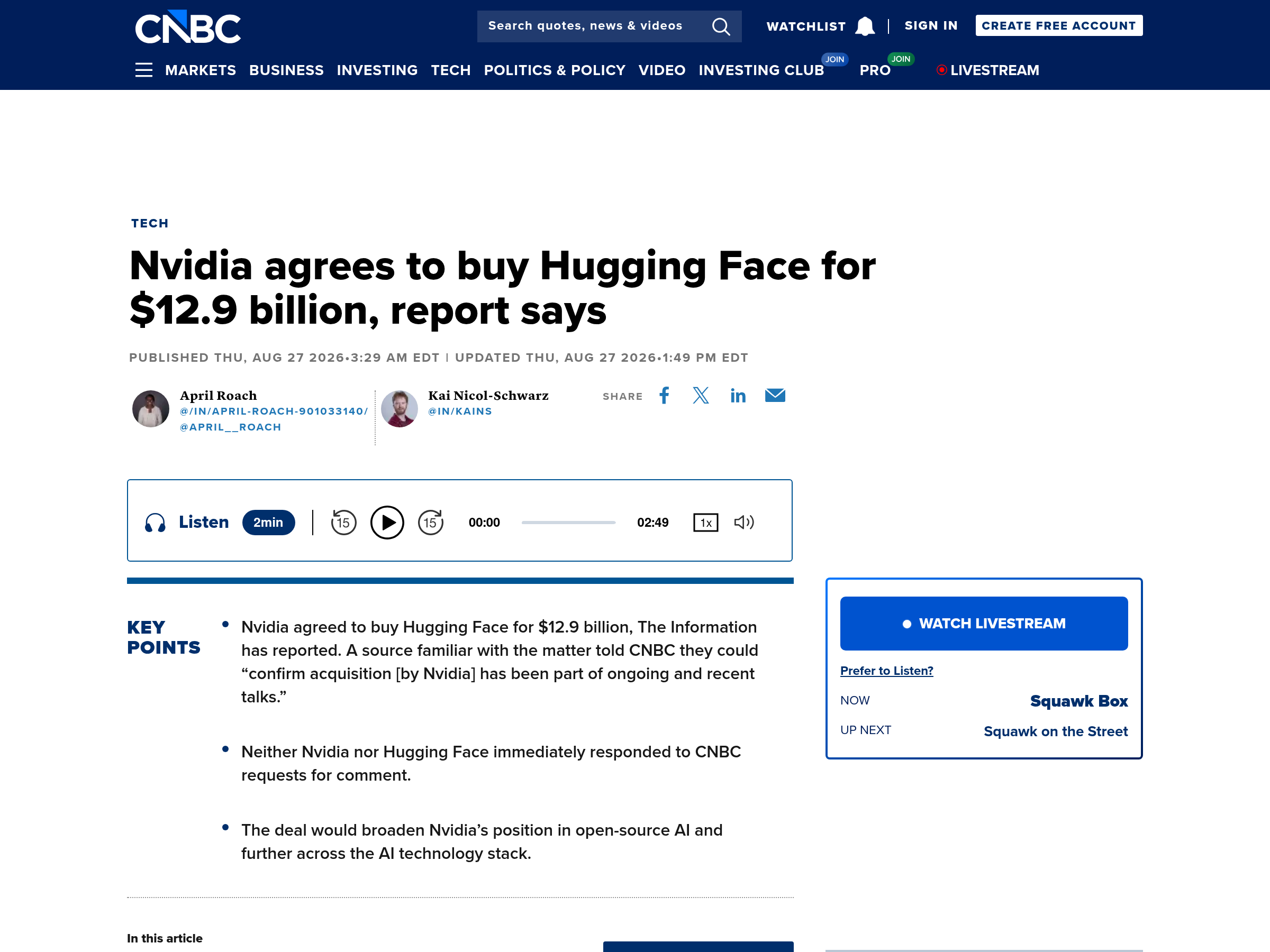
CNBC published its own version on August 27 at 3:29 a.m. Eastern, updated at 1:49 p.m., bylined by April Roach and Kai Nicol-Schwarz. The outlet says it has its own source, separate from The Information’s. That source told CNBC it could « confirm acquisition [by Nvidia] has been part of ongoing and recent talks ». That’s a careful phrasing: it confirms talks took place, not that a deal was signed. Neither Nvidia nor Hugging Face responded to CNBC‘s requests for comment. The whole story rests entirely on anonymous sources.
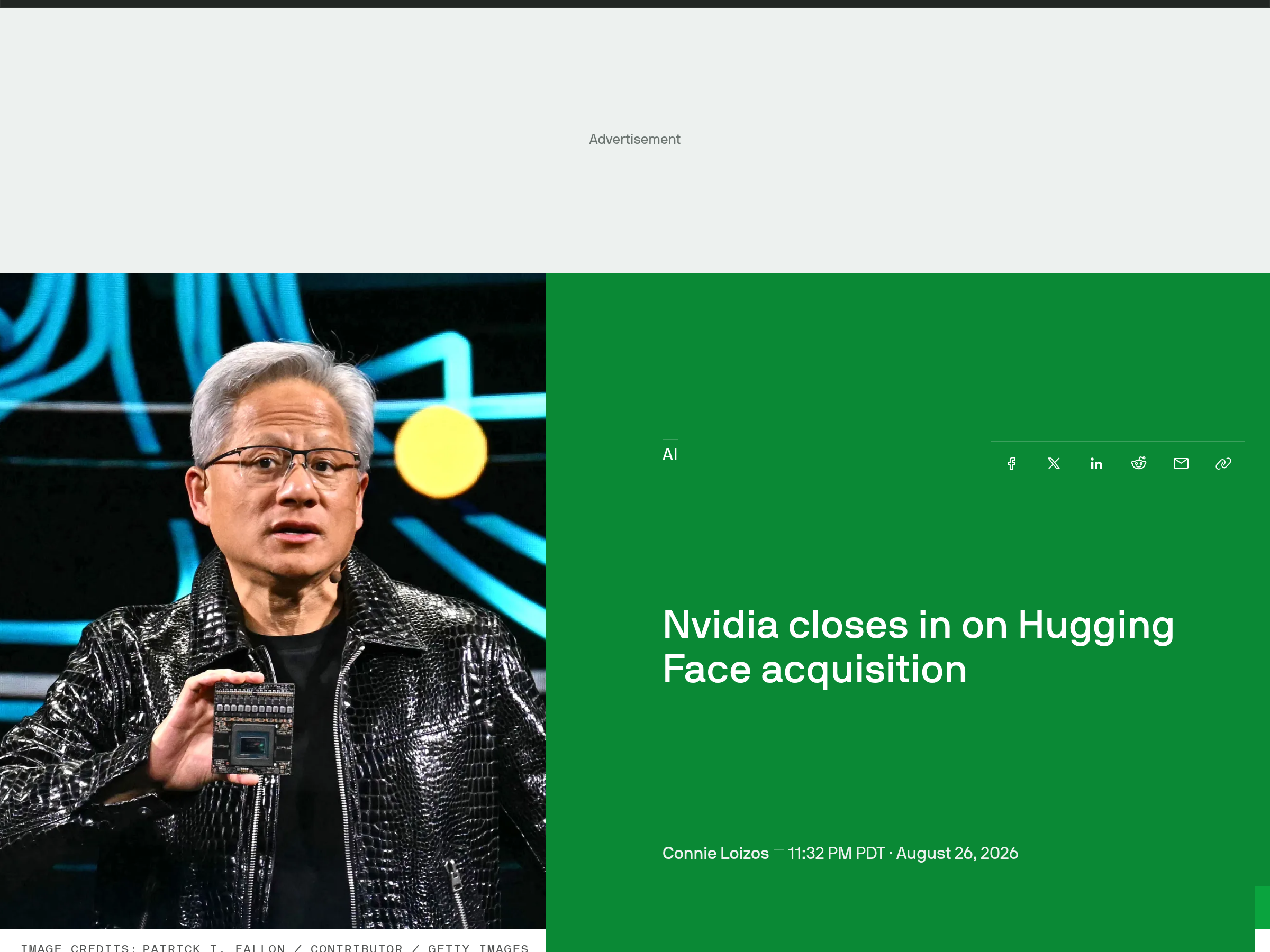
The evening before, on August 26 at 11:32 p.m. Pacific, TechCrunch published its own piece, bylined by Connie Loizos. Blunt headline: « Nvidia closes in on Hugging Face acquisition ». Both articles trace back to the same origin, The Information. Only CNBC says it questioned a source of its own, and that source talks about discussions, not a signature. The cascade of coverage doesn’t multiply the evidence, then: it multiplies the outlets repeating a single piece of information.
Hugging Face, the store where the industry gets its models
Hugging Face was founded in 2016 in New York by three French entrepreneurs, Clément Delangue, Julien Chaumond and Thomas Wolf. The company started as a chat app aimed at teenagers, a project quite far from what it later became. A few years later it pivoted to what it is today: the reference platform for machine learning (the methods that let software learn from data instead of being programmed rule by rule). Models, datasets and apps get published and pulled from there.

At the time of writing, its homepage showed more than 2,555,000 models and 1.5 million datasets, used by over 15,000 organizations. It hosts open models (models whose parameters are published, so anyone can download and run them locally) from Meta, the Llama family, Mistral’s models, plus thousands of contributions from independent researchers. That catalog is where most of the tools now producing images, text and the music platforms are starting to label come from. Nvidia already publishes its own models there: this week the page listed a model named nvidia/personaplex-7b-v1 among the trending items, a sign the company already uses the platform it would reportedly be buying.
A price tag worth 86 times annual revenue
The platform’s annualized revenue is estimated at around $150 million. Against the reported $12.9 billion, that puts the multiple at roughly 86 times revenue, a multiple no current revenue figure can explain on its own. What’s being bought at that price isn’t the platform’s revenue: it’s its position. Nvidia already knows the company well: it was among its investors long before any talk of a full buyout. In August 2023, the platform raised $235 million at a $4.5 billion valuation. The round included Salesforce Ventures, Google, Amazon, Nvidia, Intel, AMD, Qualcomm, IBM and Sound Ventures. Quite a few of the big names in semiconductors and cloud computing, then, gathered around the same table.
The refusal that gives the deal its full meaning
That refusal is what puts the scale of today’s move into perspective. Nvidia had offered to invest $500 million, a far more modest sum than the $12.9 billion now on the table. The founders said no, citing the risk that a single chip supplier would carry disproportionate weight over a platform that hosts models from every player in the field without distinction, including Nvidia’s direct rivals. A full buyout would erase the line « the Switzerland of AI » had carefully kept in place until now, turning one minority investor among many into a single owner.
What Nvidia would gain from it, according to analysts
According to Tom’s Hardware, written by Anton Shilov, the deal would strengthen Nvidia’s open-model strategy and shore up its position against rivals. We already described this trajectory yesterday, about its stakes in open-weight models. For several months now, Nvidia has been investing in freely accessible models instead of betting solely on its partners’ closed systems.
Buying Hugging Face would mean owning the place where these models are hosted, downloaded and discovered, not just publishing its own contributions there as Nvidia does today. The same logic shows up elsewhere in the industry. We noted it about Etched, valued at $21 billion: hardware makers also want to control the software layers that run their components.
What’s still unconfirmed
None of this is settled. The $12.9 billion figure, the signing date, the exact terms of the deal: for now, everything comes from anonymous sources cited by two American outlets, with no official confirmation from either Nvidia or Hugging Face. Should the deal close, the platform’s status would change. Independent, and keen to stay that way, it would become the property of the very company whose money it had once turned down. The coming days will tell whether Nvidia and the platform confirm, deny, or simply let the silence drag on.








0 Commentaires
Aucun commentaire pour le moment. Soyez le premier à commenter !