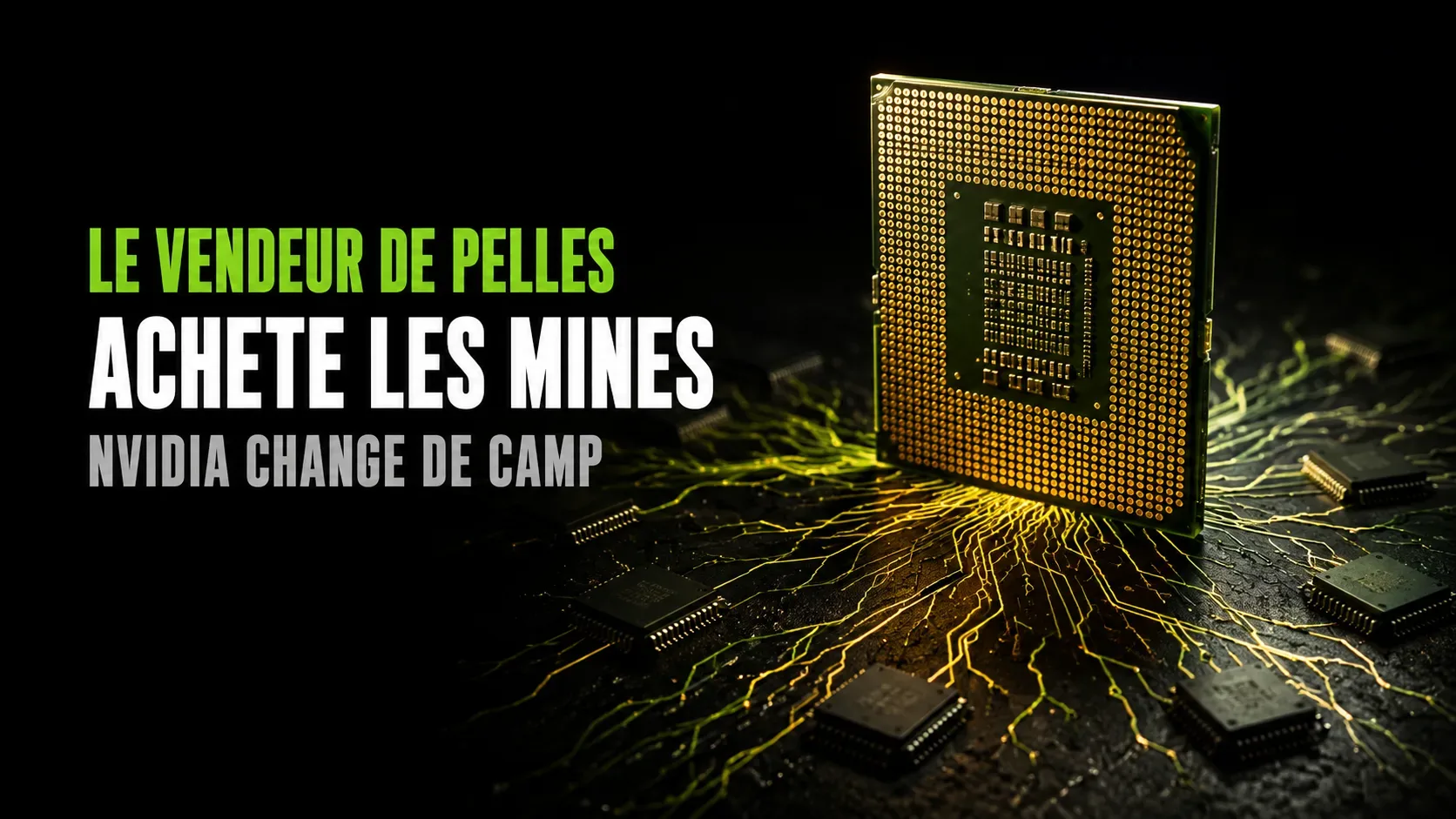
NVIDIA sells the chips that power nearly all of today’s artificial intelligence. But over the past few months, Jensen Huang’s company has stopped merely supplying the hardware. It is investing directly in the companies that buy its processors, and building its own language models. The NVIDIA Perplexity story, revealed on August 23, 2026, illustrates this shift.
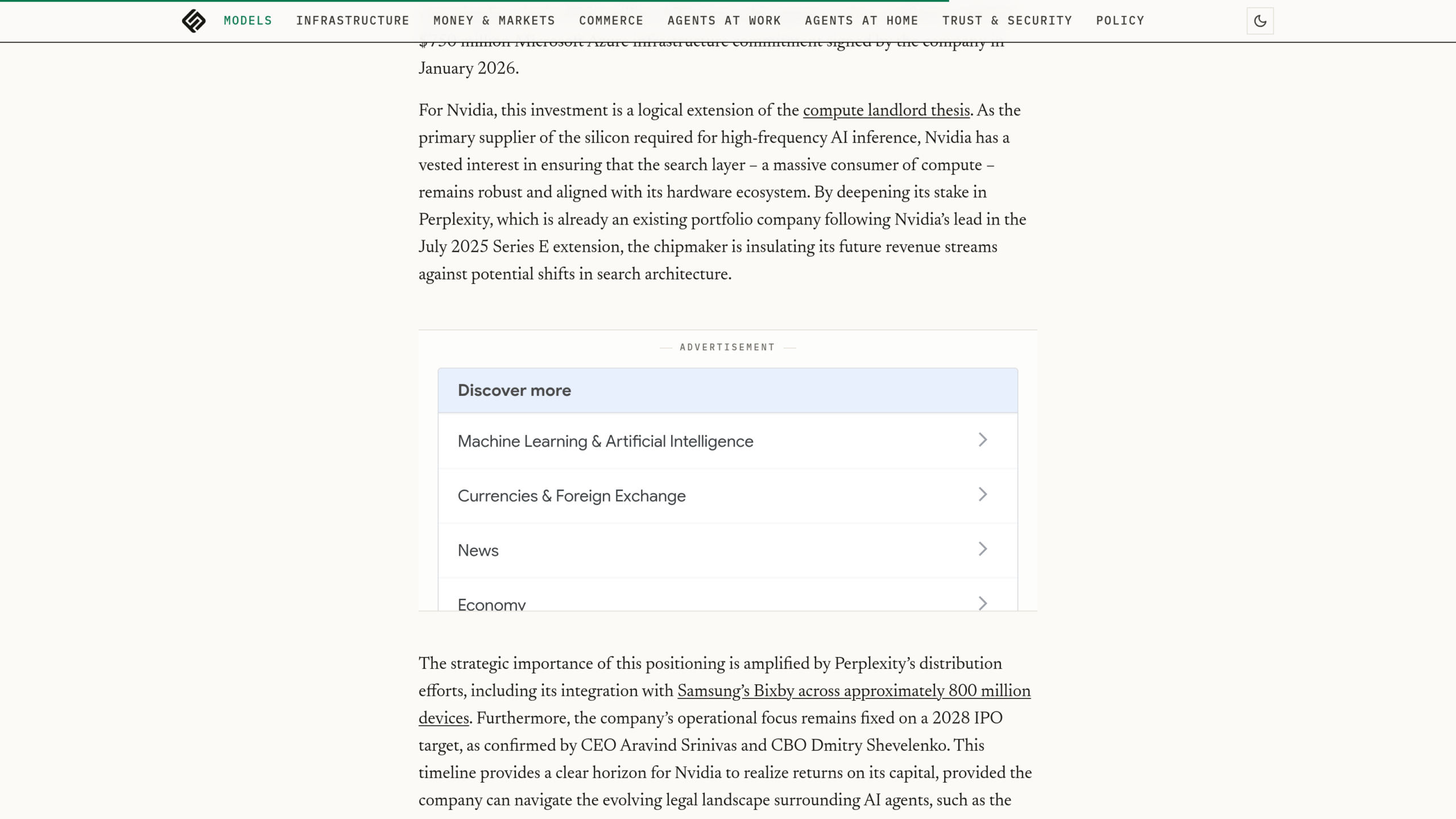
That day, the American outlet The Information reported that NVIDIA is discussing an investment in Perplexity, the AI-powered search engine, at a valuation above $30 billion. Nothing is signed. Neither NVIDIA nor Perplexity has confirmed any discussion, and the NVIDIA Perplexity story remains, at this stage, information reported by a single source.
It fits, however, into a broader movement that is well documented: a $6 billion deal with the startup Poolside, a global coalition of labs called Nemotron, and a lobbying campaign led personally by Jensen Huang in Washington. Together, these three stories point to the same logic behind the NVIDIA Perplexity affair: keep control of open-weight models (AI models whose internal settings are published freely, so anyone can download and run them on their own machines), so that compute demand keeps flowing to NVIDIA regardless of who wins the AI race.
The NVIDIA Perplexity discussions, still unconfirmed
According to an analysis published by Forkast (bylined Lena Park, August 24, 2026, and explicitly labeled as analysis rather than straight news), NVIDIA reportedly first explored a licensing deal with Perplexity before shifting toward a direct equity stake. Forkast sums up this pivot in one line: « the same playbook it ran with Poolside and Groq », the same script already applied to Poolside and to Groq, another AI compute provider.

If this reading holds, it would place the NVIDIA Perplexity story in the inference layer, meaning the stage where an already-trained model actually answers user queries, as opposed to training, the costly phase where the model learns. Inference is where AI’s long-term profitability plays out: every search, every generated answer consumes compute, over and over, long after the model has finished learning. Perplexity, which handles millions of daily queries, is a telling example. But until either company confirms anything, this part of the NVIDIA Perplexity story remains a working hypothesis, not an established fact.
Poolside, the confirmed deal strengthening the Nemotron team
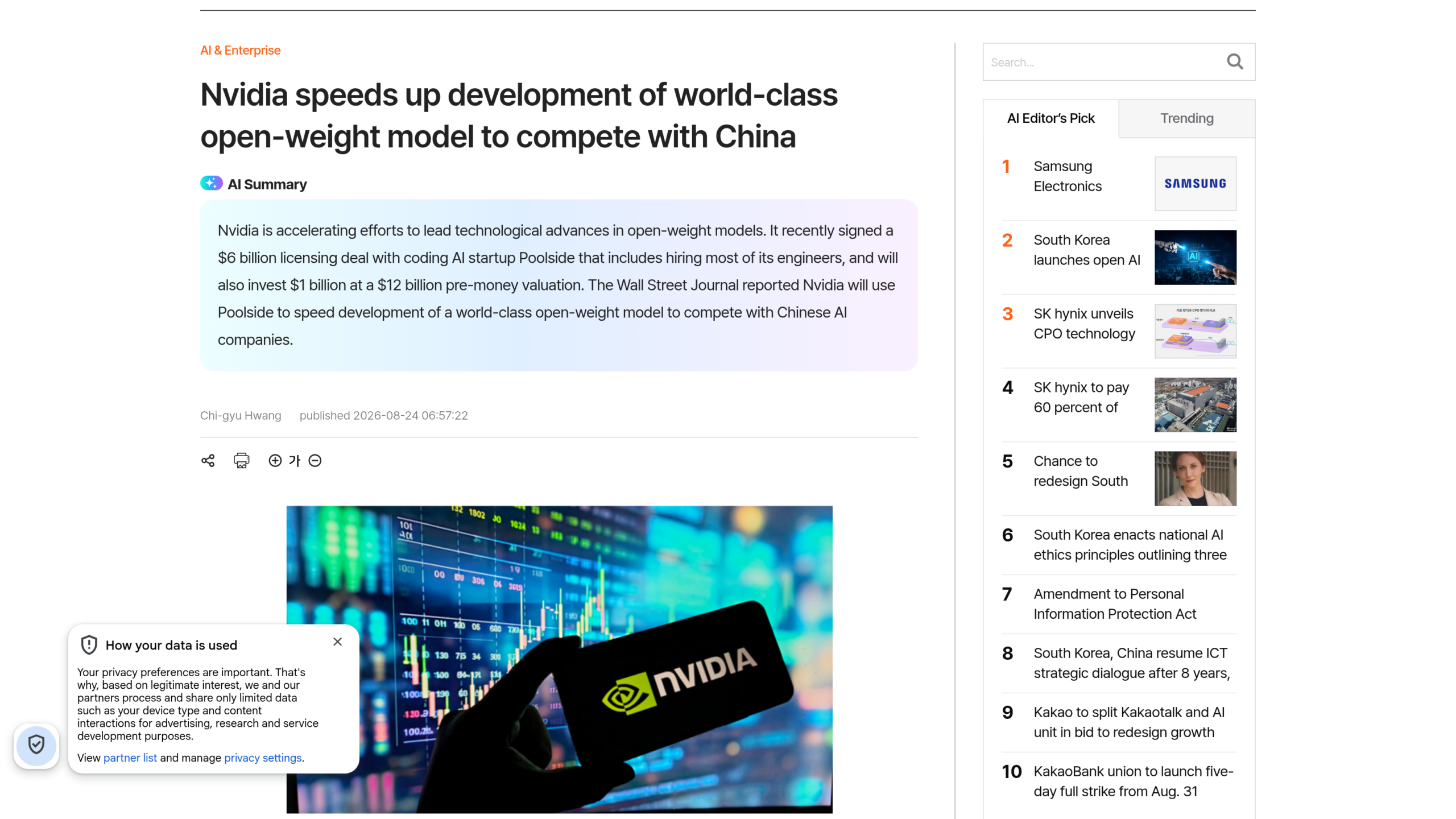
Where the Perplexity angle remains reported, not confirmed, the Poolside deal is documented in black and white. According to the Wall Street Journal, picked up on August 24, 2026 by Digital Today (Chi-gyu Hwang), NVIDIA is spending $6 billion to license Poolside’s technology, a startup specialized in coding AI, and to hire about a hundred of its engineers. Among them, the team behind Laguna S, one of the most widely used open-weight models in the West.
NVIDIA is also investing $1 billion directly in Poolside, at a pre-money valuation of $12 billion (the value assigned to the company before the fresh cash comes in). The engineers hired join the Nemotron team, the one building NVIDIA’s own open-weight models. The stated goal is to speed up development of a leading open model, able to compete with the Chinese models DeepSeek and Kimi K3, as well as with OpenAI’s and Anthropic’s closed models.
| Deal | Amount | Status |
|---|---|---|
| Poolside (license + hiring) | $6 billion | Confirmed (Wall Street Journal) |
| Poolside (equity stake) | $1 billion (pre-money valuation: $12 billion) | Confirmed (Wall Street Journal) |
| Perplexity | Valuation mentioned: over $30 billion | Reported (The Information), not confirmed by either party |
| Nemotron coalition | Amount undisclosed | Confirmed, launched by NVIDIA |
The Nemotron coalition, and Mistral AI’s French presence
Beyond Poolside, NVIDIA has launched the Nemotron coalition, presented by the company as the first global collaboration of its kind between model builders and AI labs, pooling expertise, data, and compute power. The announced founding members are Black Forest Labs, Cursor, LangChain, Mistral AI, Perplexity, Reflection AI, Sarvam, and Thinking Machines Lab, the lab founded by Mira Murati.
One name will catch French readers’ attention: Mistral AI, the Paris-based company that has become one of Europe’s few AI heavyweights, is among the coalition’s founding members. It’s also a reminder that Perplexity already sits within the Nemotron fold as a partner, separate from the investment discussions reported by The Information. The coalition doesn’t replace a potential equity deal between the two companies, but it does set the scene: NVIDIA is building ties with nearly every serious player in open models, even before knowing which ones will end up dominant.
Why a chipmaker benefits from free models
In recent months, Jensen Huang has made himself one of the most visible defenders of open-weight models. He organized a letter to Washington opposing planned restrictions on this type of model, signed by dozens of companies including OpenAI, Alphabet, Microsoft, Meta, Dell, Palantir, and IBM. The logic fits in one sentence: the more open models exist, freely usable by developers worldwide, the more compute demand rises, whatever model each user ultimately picks. NVIDIA sells that compute, both on the data-center side and on the consumer side, where its RTX Spark lineup illustrates the same logic on a smaller scale.
This strategy isn’t an isolated case. Other chipmakers are also placing targeted bets rather than relying solely on component sales, like the specialized chip Etched, valued at $21 billion just twenty-six days after launch. Still, the NVIDIA Perplexity story, even if unconfirmed, marks a further step: a compute supplier that would become a shareholder in one of its biggest customers, in a sector where regulation is also advancing, as shown by the watermarking requirement imposed by the European AI Act on AI-generated content.
One question remains that neither Forkast nor the parties involved settle: when a chip supplier holds stakes in its own customers, on what basis does it allocate processors that remain, despite record production in recent years, insufficient to meet global demand?









0 Commentaires
Aucun commentaire pour le moment. Soyez le premier à commenter !