
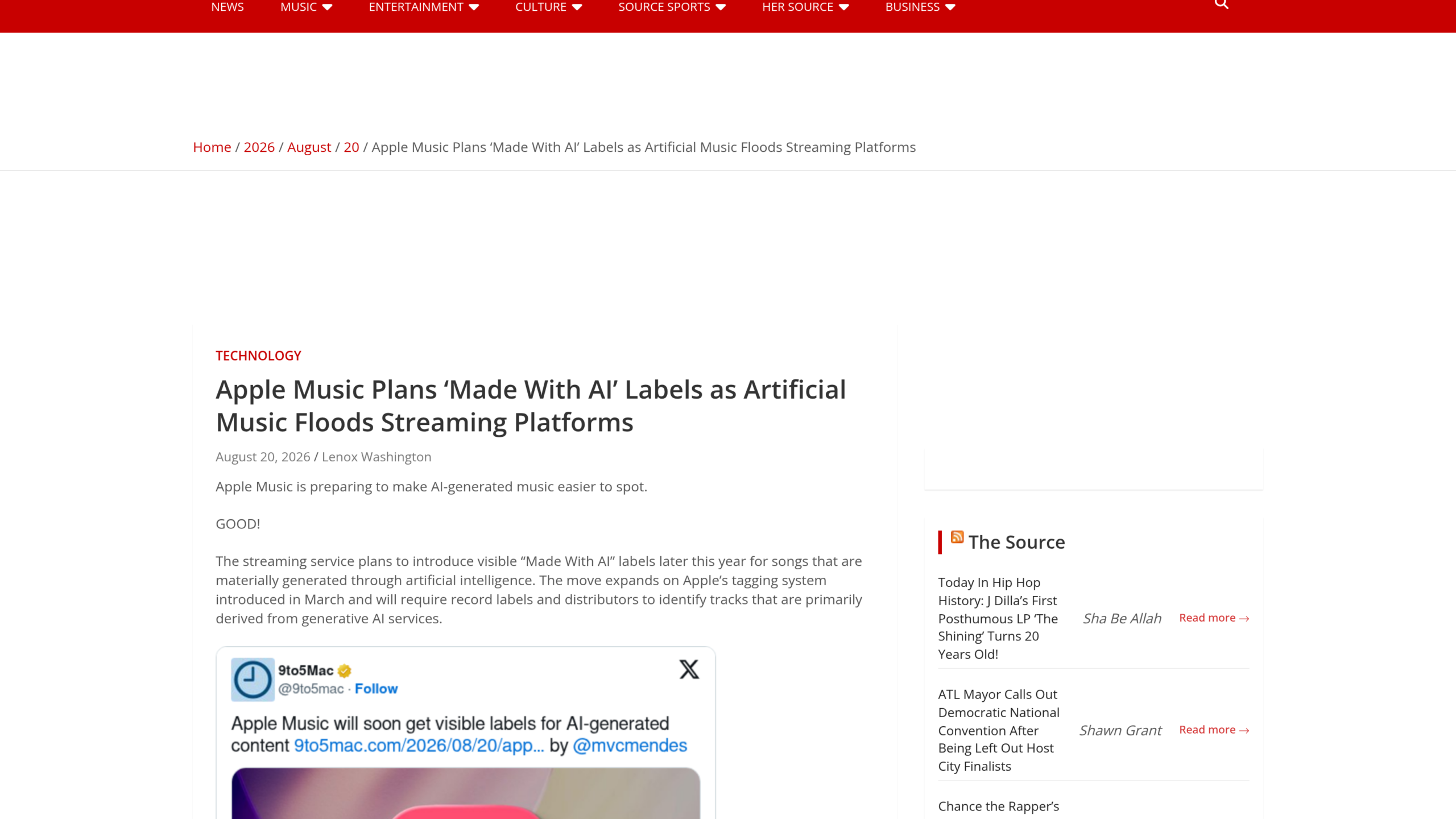
Apple Music will soon display visible « Made With AI » labels on tracks flagged as generated by artificial intelligence. The announcement reached labels and distributors by email on Thursday, August 20, 2026, with no precise launch date. Apple only mentions « later this year ».
The mechanism chosen by Apple Music relies on disclosure, not detection. Content providers, labels, distributors and independent artists, will have to check « AI Transparency Tags » as soon as artificial intelligence has produced a material portion of a track. This includes tracks entirely composed by a generative platform, from lyrics to melody.
These tags are not new. Apple Music built them into its ingestion pipeline, the technical process through which a track enters the catalog, back in March 2026. What changes this year is their visibility: a metadata field until now reserved for internal systems will display directly in front of the listener, on the track’s page.
Apple Music Has Known Since March
This is not Apple’s first transparency project around artificial intelligence. The company, for instance, trained an AI dedicated to the Chinese market hand in hand with Alibaba, a partnership that gives a sense of the resources mobilized internally on the topic. On Apple Music, the stakes are narrower but just as sensitive: giving listeners back information the record industry has already held for months.
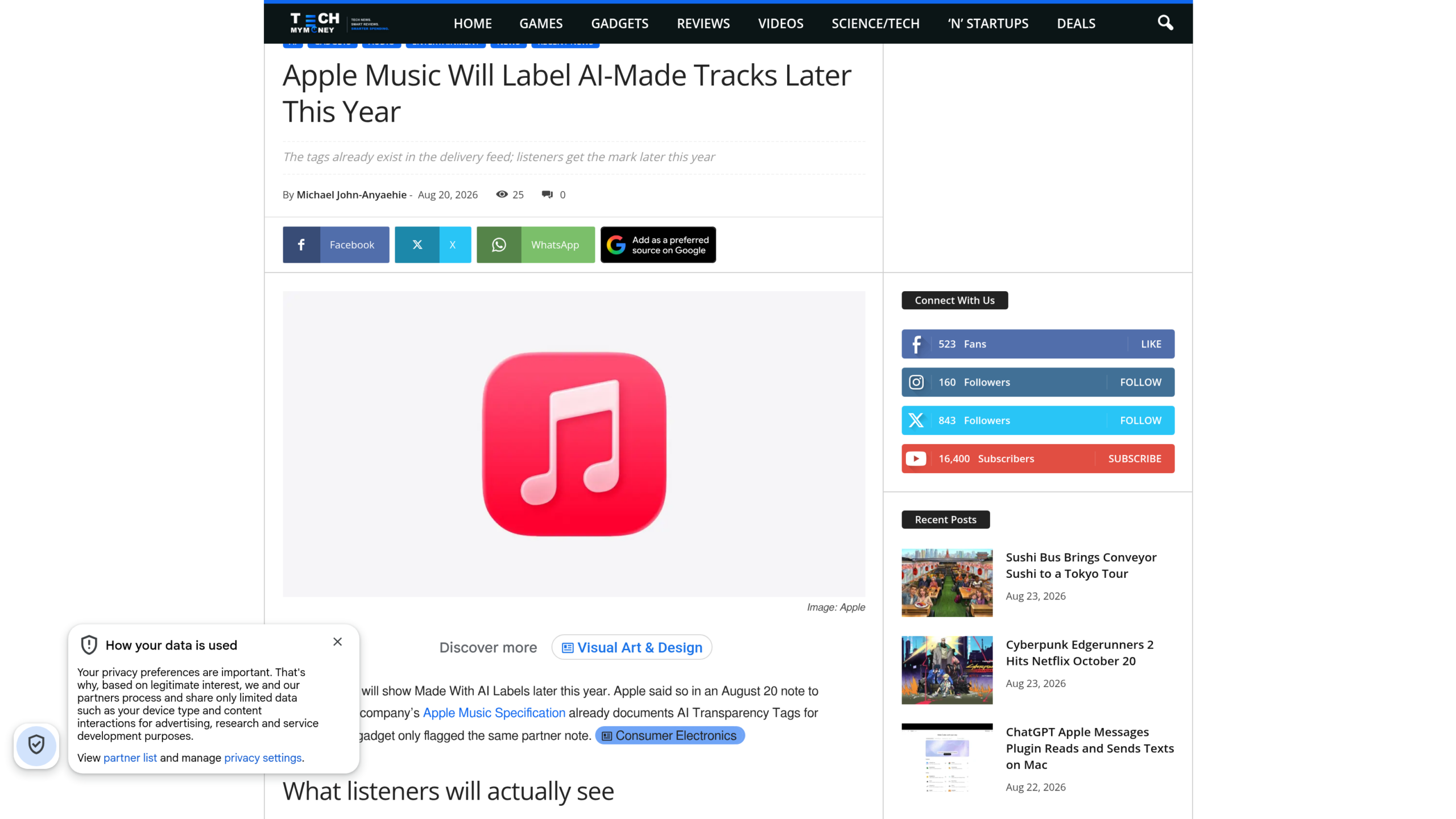
Tech My Money sums up the mechanism in one sentence: the tags already exist in the delivery pipeline, listeners will only see the mark later this year. In practice, a label that submits a track to Apple Music today fills in a mandatory field. That field has existed silently for five months. It will simply become visible, without the submission process changing by a single byte.
The ingestion pipeline is the name given to the process an audio file and its metadata go through before landing in the public catalog. A track passes through it with its cover art, its credits, its ISRC codes, and now its AI transparency tag. None of this was originally designed for the end listener. It was an internal classification tool, useful to curation teams and recommendation algorithms.
Nobody Defines the Material Portion
One question remains that the announcement does not settle. What counts as a material portion of a track? Does an AI-cloned voice laid over a hand-composed melody fall within the scope of the rule? Should a fully generated drum track, slipped under a human vocal, carry the label? Does AI-assisted mixing, a practice already common in studios, count too?
Apple Music has not published any scale for now. The line between a production tool and a content generator remains at the discretion of whoever fills in the disclosure. A composer using an AI-assisted mastering plugin probably has nothing to declare. An artist who has a vocal clone trained on their own voice sing, however, sits in a far blurrier zone.
This choice echoes another transparency effort: Anthropic announced watermarking for texts produced by Claude under pressure from the EU’s AI Act, a measure also built on disclosure rather than automatic detection. In both cases, the precise definition of what must be flagged remains in the hands of whoever produces the content, not the platform that distributes it.
A Third of the Catalog Affected
The scale of the phenomenon gives a sense of the problem. Nearly 40% of music releases in July 2026 reportedly involved artificial intelligence in some form, across all services combined, Apple Music included. At Deezer, the share climbs even higher: around 44% of daily submissions are now AI-generated.
At this scale, the « Made With AI » label stops being an isolated warning on Apple Music. It becomes an ordinary catalog data point, on par with a track’s duration or genre. A title carrying this mark no longer counts as a statistical exception: it joins a share of the flow that approaches, season after season, half of all new releases.
The contrast with Twitch, which enabled Amazon’s AI training on its creators’ streams by default, is striking. Where Twitch chose a silent opt-out, a box checked without the user asking for anything, Apple Music bets on displayed transparency, even if partial and limited to a simple disclosure.
Apple Music Discloses, Nobody Verifies
No automatic detection system accompanies the measure. Apple Music does not scan tracks to spot a synthetic voice or a generated composition. Everything relies on the good faith of whoever submits the file, at a stage where nobody else has access to the track’s raw stems.
What happens if nobody checks the box? The question remains open: Apple has not announced any penalty for an omitted disclosure, nor any third-party reporting mechanism. The system looks less like a control than a trust agreement made with the record industry, in a context where capital keeps flowing into generative AI infrastructure, as shown by Stripe’s 7 billion dollar acquisition of OpenRouter.
The threshold question comes up elsewhere too. kami-labs.fr itself uses locally generated music to dress up certain pages of the site, and the same disclosure question would arise in the same terms for any creator publishing with these tools, whether they sell their tracks or distribute them for free.









0 Commentaires
Aucun commentaire pour le moment. Soyez le premier à commenter !