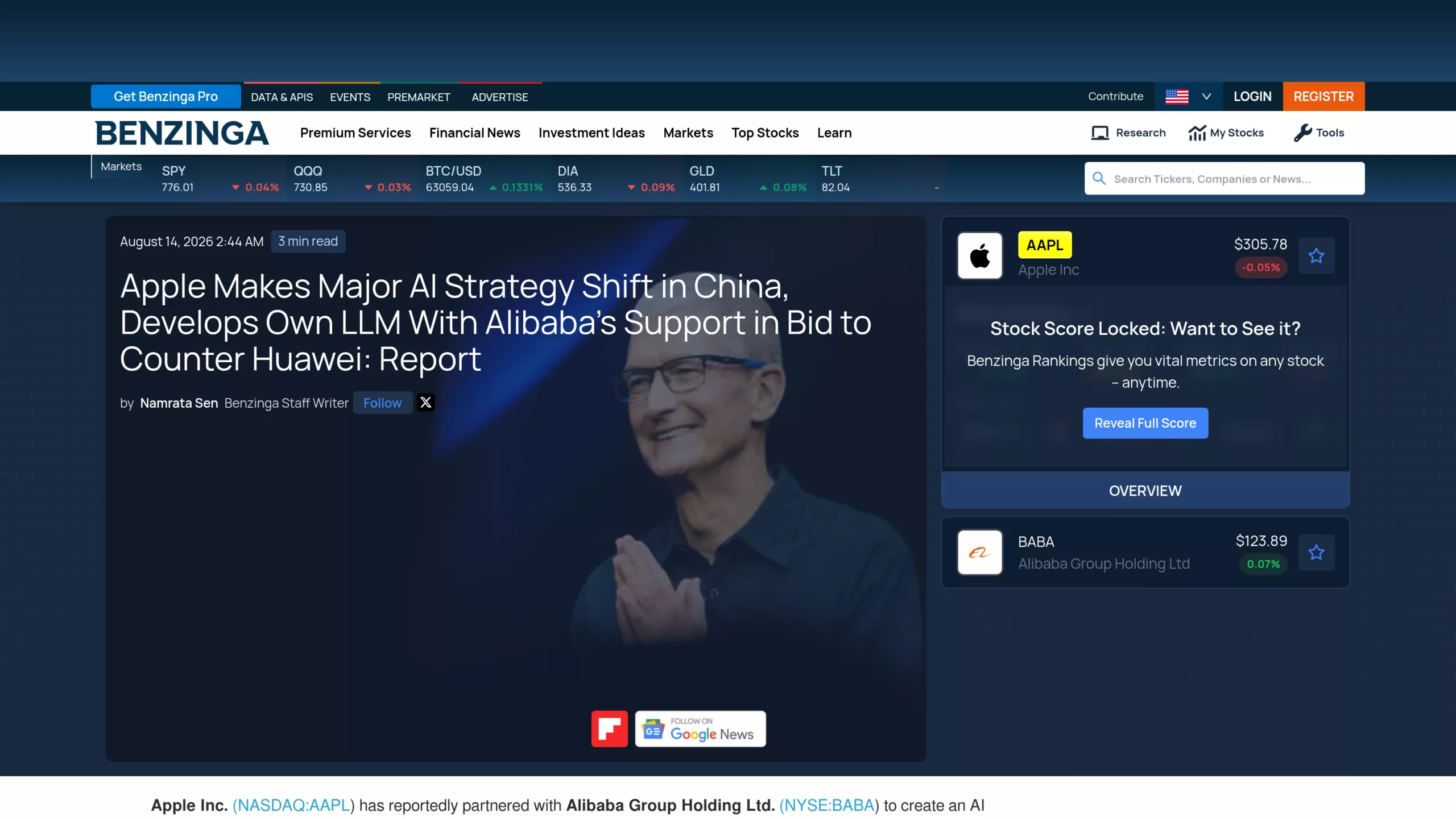
Apple has quietly trained its own Apple Alibaba AI model, built for the Chinese market with help from e-commerce giant Alibaba. The information comes from Reuters, which cites sources close to the matter, not an official announcement from Apple or Alibaba. It answers a simple question: why would Apple — which usually builds all of its technology in-house — need a Chinese partner to run AI on the iPhones it sells in China?
What the Apple Alibaba AI Report Reveals
According to Reuters, citing three anonymous sources, Apple trained a generative Apple Alibaba AI model custom-built for China. A generative AI model is a system capable of producing text or images from a simple prompt, unlike an AI that only classifies or recognizes data. Alibaba provided technical support for this training. The exact nature of its contribution is not known: computing infrastructure, local training data, or both.
Neither Apple nor Alibaba has confirmed this specific part of the deal. That sets it apart from the rest of the story, which has been well documented for a year and a half. The plan known so far had Apple relying on Qwen, Alibaba’s in-house AI model, without building its own version. The new model Apple trained would reportedly sit alongside Qwen rather than replace it, according to the same sources. How the two systems would divide tasks between them remains unclear.
Why Apple Can’t Deploy Its Usual Approach in China
Apple built its reputation on a vertically integrated stack. That means designing the chip, the operating system, and the software in-house, without depending on a third party for essential building blocks. For the AI features it sells outside China, Apple relies on its own models and on a partnership with OpenAI for certain requests. That formula can’t simply be transplanted into China as-is.
China’s law on generative AI has been in force since 2023. It requires any publicly accessible service to go through regulatory approval before launch — that is, a prior administrative sign-off, issued here by the Cyberspace Administration of China (CAC). This regulatory approval checks that the content produced complies with local rules. In practice, it means relying on a local partner already authorized to operate in China, rather than importing a system built elsewhere. Data hosting is also part of the requirements: the model must run on servers located in China, under local oversight.
That’s a constraint other tech companies know well, even though the rules differ from one region to another. In Europe, the AI Act coming into force recently pushed Anthropic to change how Claude works. For Apple, the Chinese constraint goes further. It makes the in-house solution unusable as-is and requires a local partner to keep selling iPhones with AI features in the country.
What Alibaba and Baidu Have Confirmed About Their Role
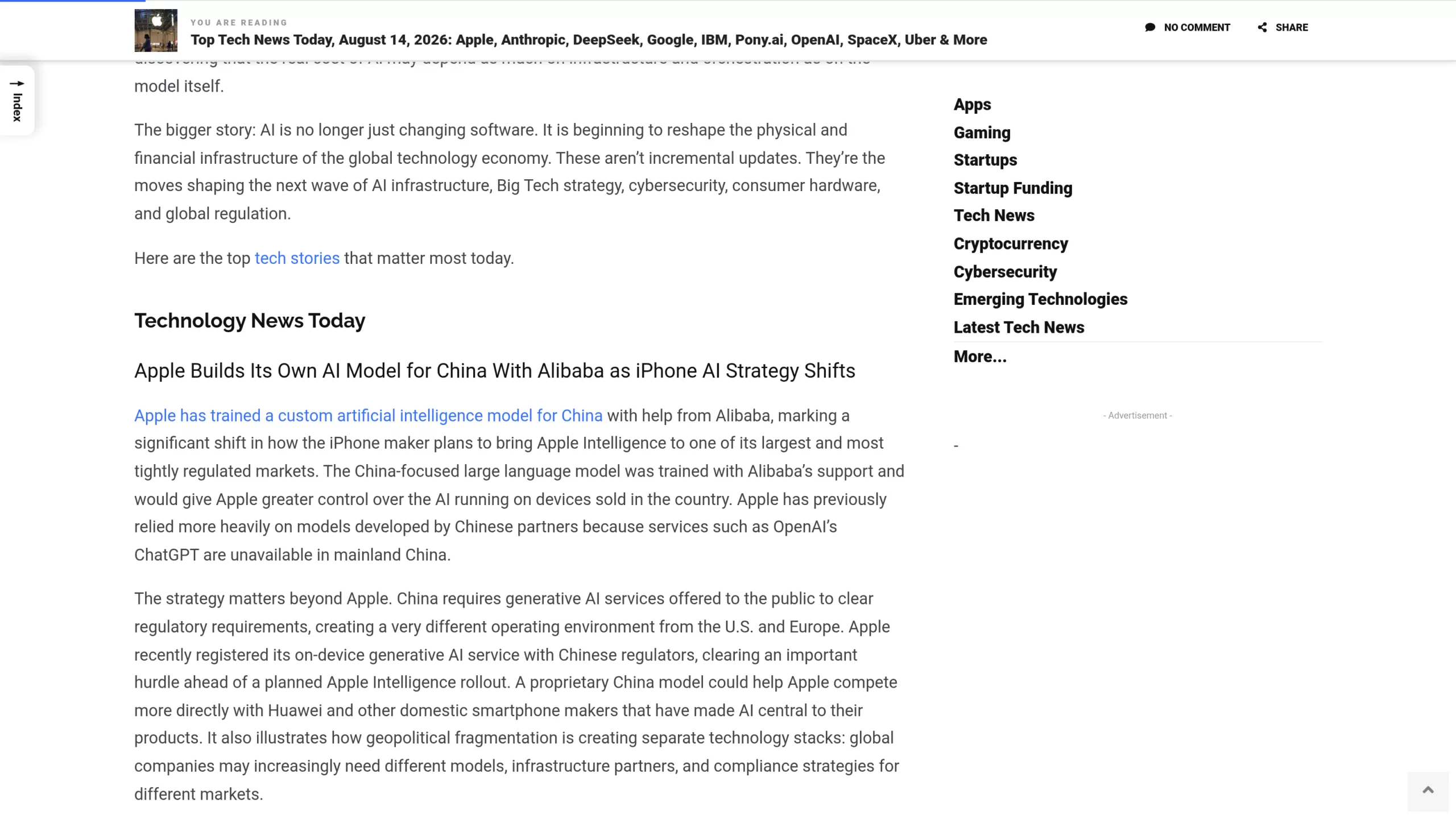
Tech Startups, August 14, 2026: details on the model trained for China with Alibaba’s support, and the service’s registration with Chinese regulators.
Part of the story has been public for a while. In February 2025, Alibaba chairman Joe Tsai announced at a summit in Dubai that iPhones sold in China would integrate his group’s AI technology. On July 15, 2026, the Cyberspace Administration of China (CAC) took a further step by adding Apple’s generative AI service to its list of approved providers, alongside Huawei and Xiaomi. This approval opens the door to launch, but it does not set a date.
In practice, Alibaba’s Qwen model is meant to integrate with Apple’s AI features on iPhone, iPad, Mac, and Vision Pro. It’s expected to cover understanding and generating both text and images. A Baidu spokesperson confirmed a collaboration with Apple on these features. Earlier reports had, however, pointed to difficulties adapting Baidu’s models to Apple’s needs. Relying on two Chinese providers for the same feature, on top of an in-house model, is unusual for Apple, which generally prefers a single partner per technical building block.
This isn’t the first time Apple has handed an AI building block to an outside partner instead of keeping everything in-house. Elsewhere in tech, Google made a similar choice by integrating Gemini into Google Maps rather than building an isolated in-house assistant. The difference, for Apple in China, is that this choice isn’t voluntary: it flows directly from regulation.
A Launch Timeline That’s Still Unclear for Apple
No exact date has been announced. Based on the information available, the rollout is expected in the coming months following the July 2026 regulatory approval. Several observers expect it in the third or fourth quarter of 2026, possibly alongside the launch of the new iPhones in September. This timeline remains an estimate, not a commitment from Apple.
A technical clue points in that direction. Apple had briefly published, then pulled, a developer guide for connecting its Siri assistant to the Qwen model. That quick removal suggests work still in progress rather than an abandoned project. Globally, the new version of Siri is due to arrive with iOS 27 this fall, but nothing guarantees the Chinese version, dependent on local regulatory approval, will follow the same timeline.
Why China Matters So Much to Apple
China remains one of Apple’s most important markets. In the first quarter of its fiscal year 2026, Apple generated $25.5 billion in revenue there, up 38% year over year. The following quarter, that figure came to $20.5 billion, up 28% year over year. Losing ground in this market would have a direct effect on Apple’s overall results.
Huawei adds to the commercial pressure. The Chinese group has closed much of its technology gap since US sanctions and already offers its own built-in AI features on its phones. For Apple, shipping credible Apple Alibaba AI features is therefore not just a marketing bonus. It’s a selling point against Chinese manufacturers who face no regulatory barrier at all in their own market.
The smartphone remains the central product in this battle. Even the most unlikely competitors, like the smartphone Elon Musk dreamed up to challenge Apple, show just how much Apple’s position in this market draws interest. In China, the challenge isn’t an isolated competitor but an entire regulatory framework that even Apple must respect to keep selling iPhones.









0 Commentaires
Aucun commentaire pour le moment. Soyez le premier à commenter !