

Lending your graphics card four hours a day would cost about €6 a month in electricity in France. The Microsoft patent that describes this lending does not say how much the lender would earn in return.
Application US 2026/0349820 A1 was published on November 5, 2026 by the US patent office. It imagines home users’ graphics cards training AI models while their owner is not using them. An application is neither a granted patent nor an announced product. No reaction from Microsoft was found as of November 9, 2026.
Microsoft patent: AI training split into micro-tasks
The document can be read on the US patent office (USPTO) website: application no. 19/195,047, filed on April 30, 2025 by Microsoft Technology Licensing, with Aditya Vasanth Challapally as inventor. Its title: “Opportunistic Micro-training on Edge Devices Using Spare GPU Utilization.” An “edge” device is a device at the user’s home, as opposed to the servers of a data center.
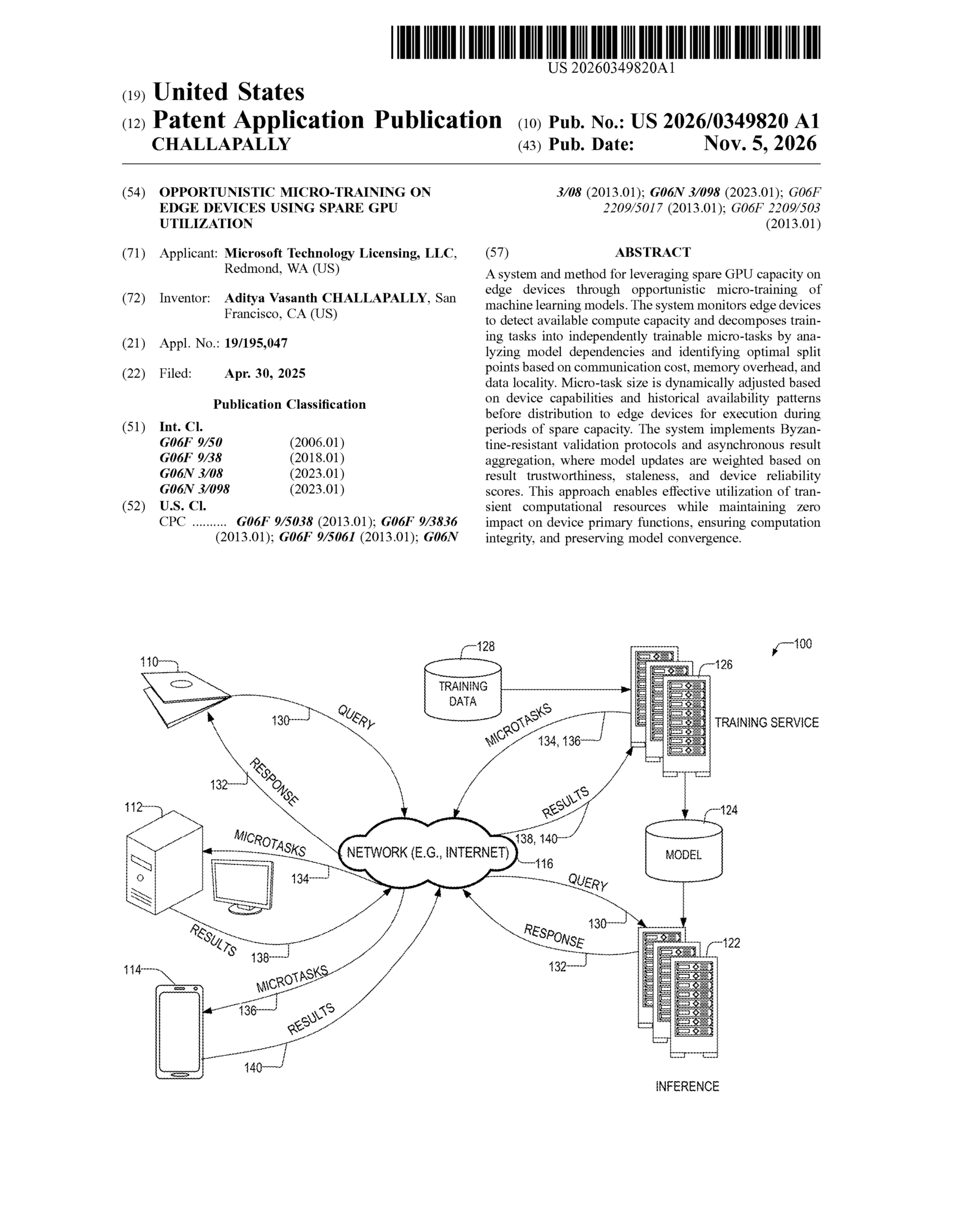
The abstract announces “leveraging spare GPU capacity on edge devices through opportunistic micro-training of machine learning models.” In this Microsoft patent, a central service splits the training of a model into small independent tasks, the micro-tasks, then sends them to devices that have spare time. The results come back, are cross-checked, then merged into the model: paragraph 0145 provides for the same micro-task to be given to several devices, and paragraph 0123 for a suspicious result to be recomputed elsewhere.
To know when a card is free, the system monitors the use of the GPU (the graphics processor) and the CPU, memory, temperature and power draw (paragraphs 0051 to 0055). It checks less often when the card is busy or hot, so as not to get in the way of the “primary functions (like gaming or other user applications),” paragraph 0063. A micro-task can be suspended or cancelled if a threshold is crossed (paragraph 0064). The abstract promises “zero impact on device primary functions”; the description, in paragraph 0015, speaks of an experience that remains “mostly unaffected.” The two phrasings do not say the same thing.
On compensation, paragraph 0019 covers devices owned by third parties who have given their “express authorization,” and says the system “may compensate the owners.” Each calculation could earn a credit on the owner’s account, redeemable for free software, access to the trained model or money. In its November 7 article, Insider Gaming adds that Microsoft would act as the intermediary between third parties who buy computing power and the owners of the cards. The outlet also notes that neither Xbox nor Windows is specified, and that no amount appears.
The math: 250 W, four hours, €0.2001 per kWh
EDF’s regulated Tarif Bleu (Base option) rate is €0.2001 per kWh including all taxes since August 1, 2026, according to EDF’s page on the price of a kWh, which cites decision no. 2026-147 of the French energy regulator (CRE) of July 15, 2026. A kWh is the energy used by a 1,000 W device running for one hour. Only this price matters here: the subscription is fixed whether the card works or not, and market offers vary.

The starting assumption comes from PC Games Hardware (article by Sven Brückner, November 9): 250 W of extra power draw for the whole PC, four hours a day, thirty days, or 30 kWh. At an assumed German rate of 35 cents, the magazine gets €10.50. At EDF’s rate, 30 × 0.2001 gives €6.00. One hour at 250 W comes to 0.25 kW × €0.2001, or €0.05.
| Scenario | Hours per month | Energy (kWh) | Cost at €0.2001 (EDF) | Cost at €0.35 (PCGH assumption) |
|---|---|---|---|---|
| 250 W, 2 h per day | 60 | 15 | €3.00 | €5.25 |
| 250 W, 4 h per day (PCGH) | 120 | 30 | €6.00 | €10.50 |
| 250 W, 8 h per day | 240 | 60 | €12.01 | €21.00 |
| 150 W, 4 h per day | 120 | 18 | €3.60 | €6.30 |
| 350 W, 4 h per day | 120 | 42 | €8.40 | €14.70 |
To cover that €6.00 at 120 hours lent per month, you would need to earn at least €0.05 an hour (6 ÷ 120). The added power depends on the card and the load: the 150 W and 350 W rows bound the range, and an RTX 5090 goes much higher, as shown in our article on the RTX 5090 that holds 900 W on old 8-pin connectors. This calculation leaves out wear, fan noise and heat in the room.
Neither Microsoft nor Salad shows any earnings
Salad already exists: you install software, it rents out your PC’s unused capacity to customers, and you earn a balance redeemable for PayPal money or cryptocurrencies. On its download page, the service recommends “an NVIDIA RTX 3060 or newer” for the best earnings, and states that “eligibility and earnings vary by workload, demand, and region.” The tasks also include mining, meaning cryptocurrency computation. No amount is guaranteed.
| Source | Compensation mentioned | Amount published |
|---|---|---|
| Patent application US 2026/0349820 A1 | Credits redeemable for software, access to the model or money (paragraph 0019) | None |
| Insider Gaming, November 7 | Same principle, with Microsoft as intermediary | None |
| PC Games Hardware, November 9 | Money, software or credits, voluntary participation | None (only the electricity cost is estimated) |
| Salad (existing service) | Balance redeemable for PayPal or cryptocurrencies | None guaranteed: varies with demand |
The cost of lending is therefore the only solid figure in this comparison, and the Microsoft patent changes nothing about that. What lending would earn, nobody publishes.
A patent is not a product
The Microsoft patent describes what the company wants to protect, not what it plans to sell. The company does not say on which device or in which software the service would run, and sets neither a date nor a price. PC Games Hardware notes that Microsoft has announced neither a concrete offer nor a release date. As long as no amount exists, the only benchmark remains the electricity cost: about €0.05 an hour for 250 W at EDF’s rate.





0 Commentaires
Aucun commentaire pour le moment. Soyez le premier à commenter !