

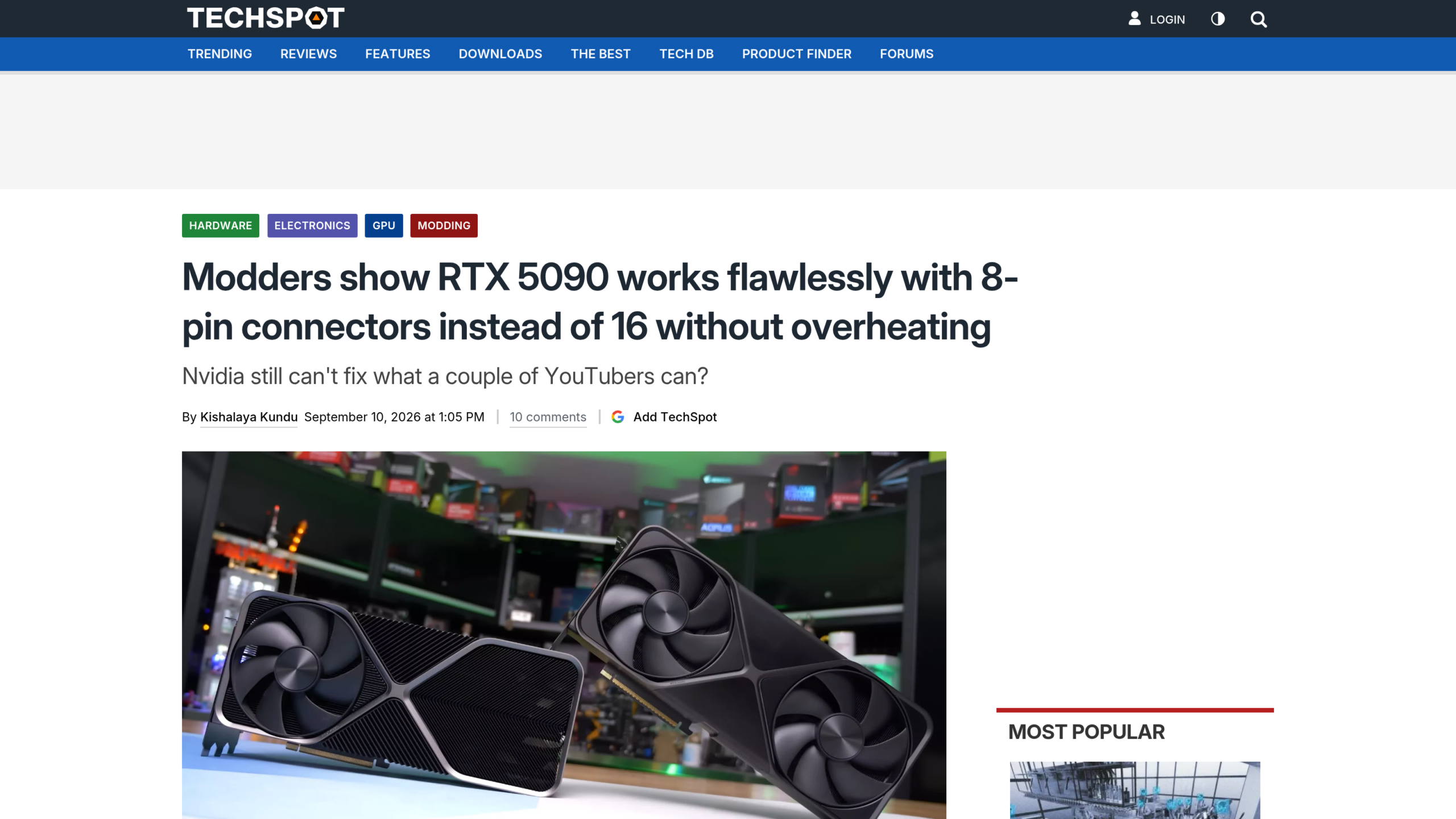
An RTX 5090 pulling 900W for over an hour, with cables staying under 35°C. The card no longer had its original connectors. Brazilian channel TecLab desoldered them and replaced them with three old 8-pin connectors, the ones Nvidia dropped from its flagship cards starting with the RTX 40 generation. The demo comes just days after the melted cable during a DLSS 5 test, at 613W on a connector rated for 600.
Three 8-pin connectors instead of two 16-pin ones

The card is a Galax HOF OC LAB, an overclocking model that ships with two 16-pin connectors. Wccftech details the work: copper plates on the back of the PCB, 24 heavy-gauge cables, and three Mini-Fit Jr connectors, the technical name for the 8-pin PCIe plug. Nine of those cables carry the 12V rail.
Getting the RTX 5090 to accept the setup came next. The 16-pin connector has two sense pins, Sense 0 and Sense 1, which tell the card how much power is available. TecLab bridged them to unlock full power. No modified BIOS, no software: it all comes down to a soldering iron. TecLab’s video is titled « Lançamento da RTX 5090 com conectores de oito pinos! » (launch of the RTX 5090 with eight-pin connectors).
900W for an hour, 35°C on the cables
Nvidia rates the RTX 5090 at 575W. Cooled by a water loop, TecLab’s card was pushed from 400W to 900W, at around 3,400MHz, versus 2,400MHz stock according to TweakTown. Each 12V line carried 8 to 8.5 amps. Nine lines add up to a bit over 75 amps, which lines up with 900W.

The modders then removed connectors. With two 8-pin plugs, 66 amps, and over 3,200MHz, the cables stayed under 25°C. With just one, the card held 65 amps around 3,100MHz without melting anything. The write-ups disagree on the temperature for this test: TweakTown reports 91 to 92°C, Wccftech 45°C under normal load and 65°C at peak. The video has no subtitles, so we couldn’t settle it.
« Call Nvidia, guys »
The line that went viral across sites comes from the moment the team checks the temperature of the cables. TweakTown quotes it directly: « It’s colder than the original connector, guys. Where is NVIDIA? Call NVIDIA, guys. » The team then asks for the raw footage to be posted, « otherwise they’ll think it’s a lie. »

At PC Gamer, Jacob Fox made it the headline as early as September 9. TechSpot picked the pointed question as its subhead: « Nvidia still can’t fix what a couple of YouTubers can? »

Why the old connector handles it better
An 8-pin plug is rated at 150W, or 4.2 amps on each of its three 12V wires. Wccftech points out that this limit is « just an industry specification, and the real limit is higher. » The commonly cited math puts its real capacity at around 1.7 times its rated value.
The 16-pin does the opposite. It concentrates 600W on six wires, 8.3 amps each, inside smaller contacts: a 3mm pitch versus 4.2mm for the Mini-Fit Jr. Its theoretical capacity sits around 684W, a margin of about 1.14. The 613W recorded on the card that melted in early September already used up a good chunk of that margin.
Here is our reading of the numbers, one none of the write-ups make. At 900W, each of TecLab’s wires carried 8 to 8.5 amps, double the 8-pin spec and as much as a 16-pin wire at full load. Same current, bigger contact, direct soldering onto the card: 35°C on one side, melted plastic on the other. The 16-pin’s problem, then, comes down less to current than to contact size and insertion quality.
What this changes for your RTX 5090: nothing, for now
Nobody is redoing this at home. The mod requires desoldering two connectors on a card that was selling for around $4,930 in mid-August, voids the warranty, and has only been validated on this water-cooled Galax model. TweakTown puts it bluntly: this isn’t something most gamers should attempt.
Manufacturers going back to 8-pin plugs looks just as unlikely. Cards, power supplies, and cables were all designed around the 16-pin standard, and three 8-pin connectors take up far more room on a PCB. TecLab’s test doesn’t offer a solution. It removes an argument: the one claiming a 575W card could no longer be powered any other way.
In the meantime, the precautions from our article on the melted cable remain the only useful ones: check the cable’s condition and your power supply’s headroom before turning on DLSS 5, which pushes the RTX 5090’s power draw above its rated value.








0 Commentaires
Aucun commentaire pour le moment. Soyez le premier à commenter !