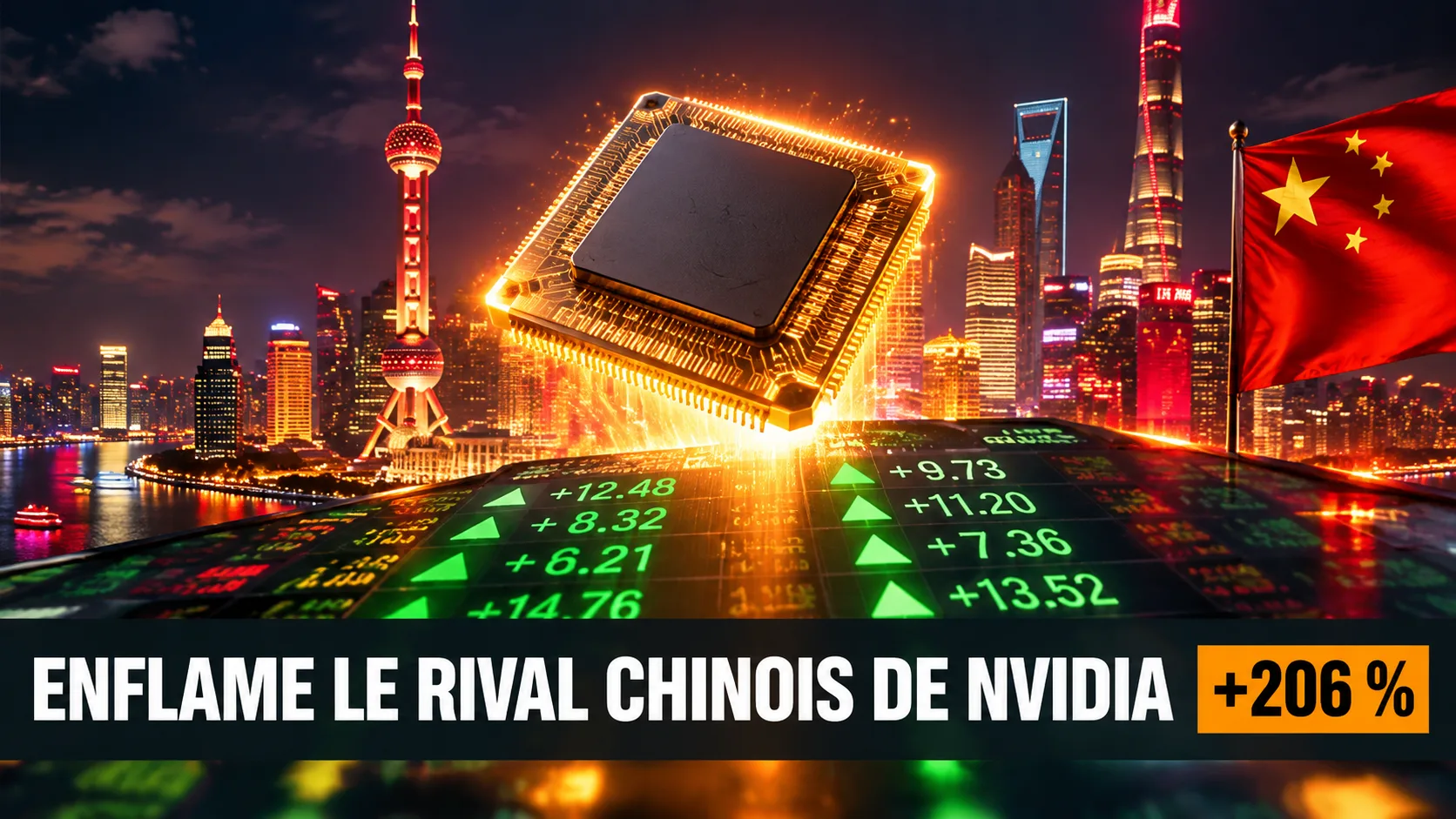
397 yuan. That’s the closing price on Friday, September 11, 2026, for Enflame’s very first trading session, the Tencent-backed Chinese maker of AI chips. A 179% jump in a single day on Shanghai’s STAR Market pushed the company’s market capitalization, the total value the market assigns to it by multiplying the share price by the total number of shares, to around 171 billion yuan, close to $25.5 billion. Enflame becomes the last of China’s « four little dragons » of AI chips to complete its IPO, the process through which a company sells shares to the public for the first time to raise funds.
The September 11 session in three numbers
On Shanghai’s STAR Market, reserved for technology stocks, the shares opened at 410 yuan, 188% above the IPO price of 142.18 yuan. They climbed as high as 475 yuan during the session before pulling back to close at 397 yuan, a 179% gain on the day.
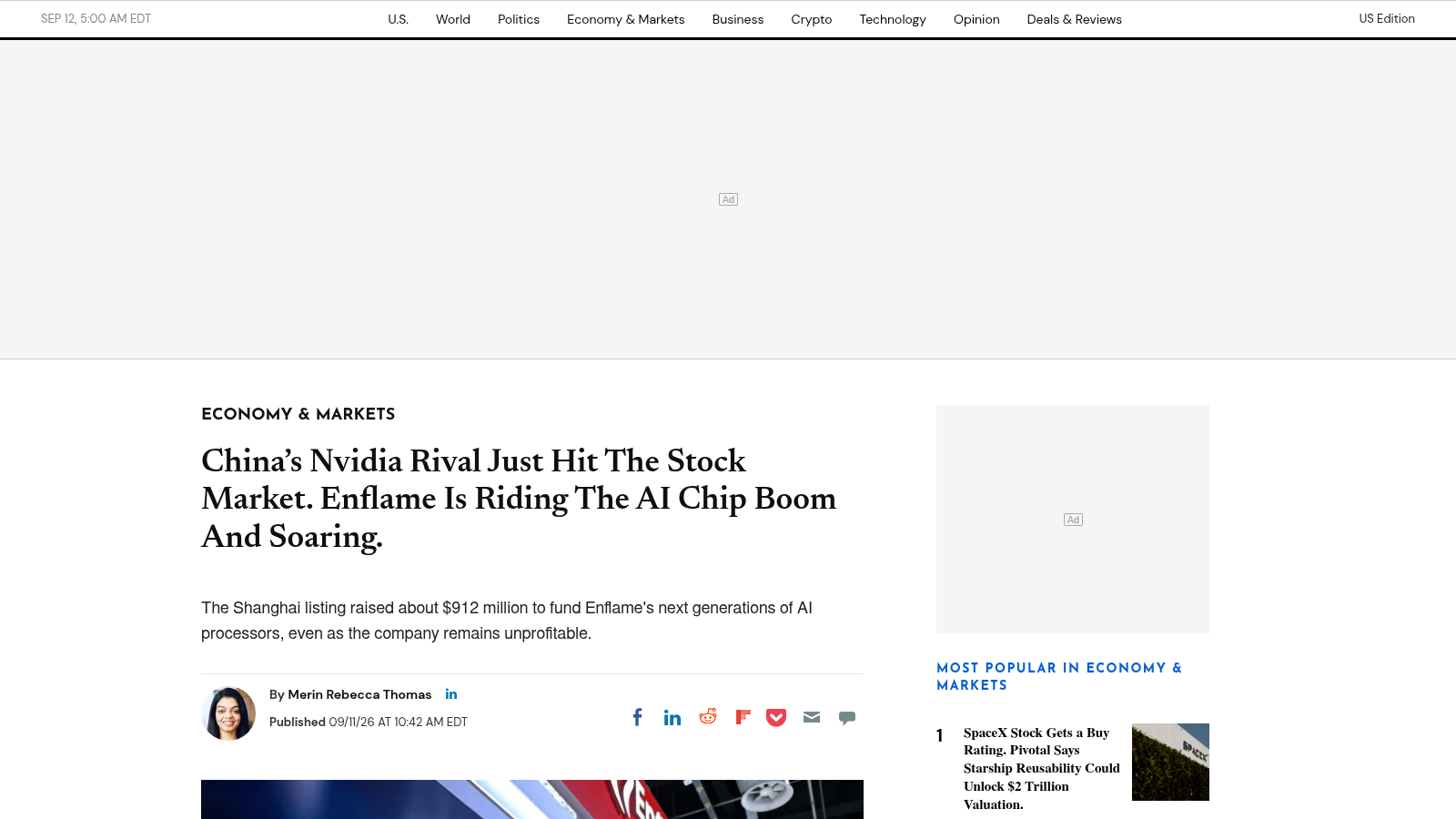
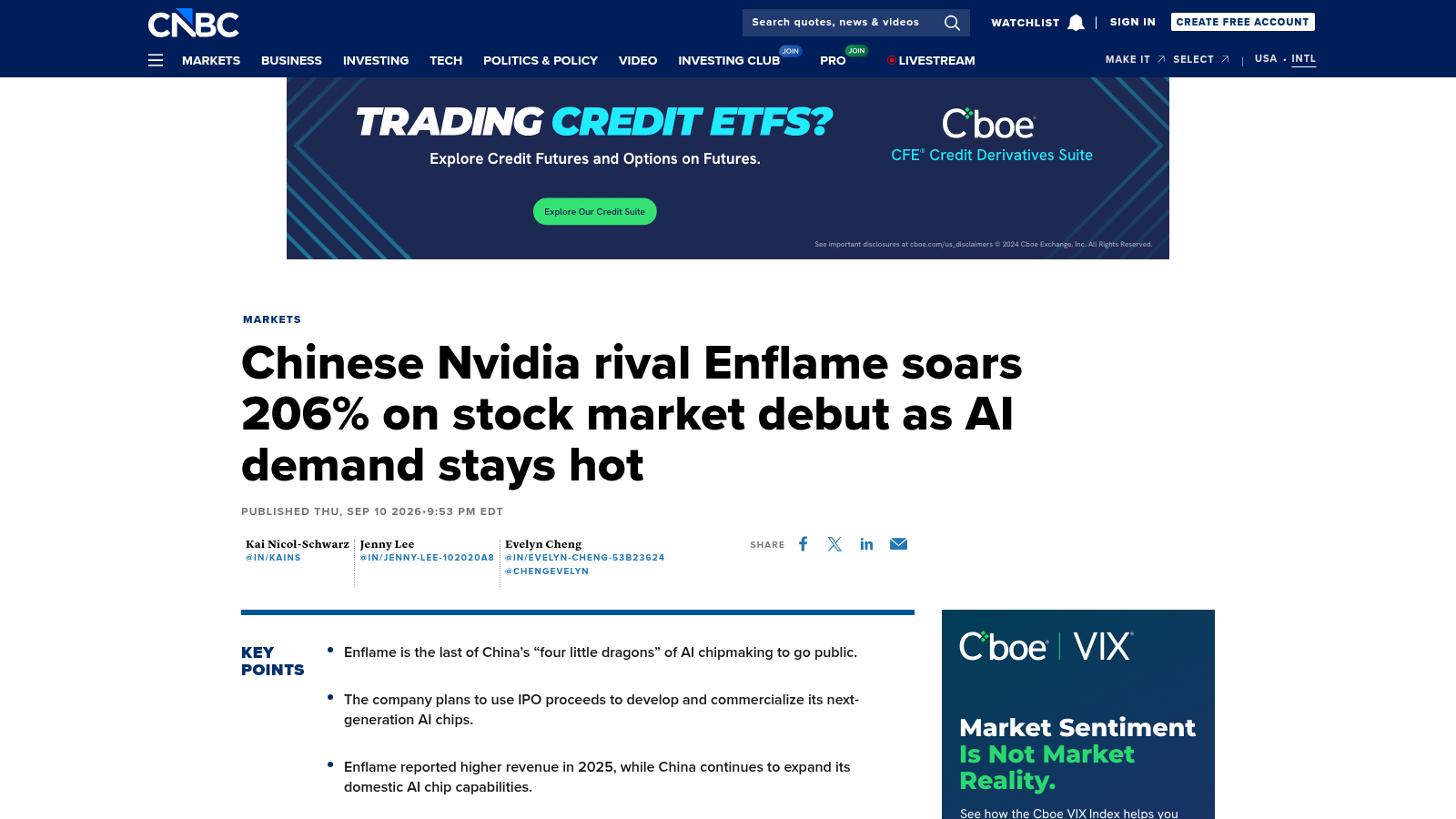
Three outlets, three numbers. Published minutes after the Chinese market opened, CNBC reported a 206% jump. Nikkei Asia first headlined a 188% gain, before revising it to 179% by the close, the same closing figure used by IBTimes. The gap comes from the volatility of a first trading day, not from a disagreement between newsrooms.
The offering allowed the company to raise 6.12 billion yuan, about $912 million, by selling 43.04 million new shares, or 10% of its enlarged capital. Demand was so strong that the retail tranche received orders for 6,109 times the number of shares on offer, according to a stock exchange filing reported by CNBC.
Who Is Enflame, Tencent’s Protégé
Founded in 2018, Enflame designs chips for both training, the phase where an AI model learns by processing huge amounts of data, and inference, the moment when that same trained model actually answers user requests. The company plans to use the IPO proceeds to develop and sell its fifth and sixth generation chips, along with the software and large scale computing systems that go with them.
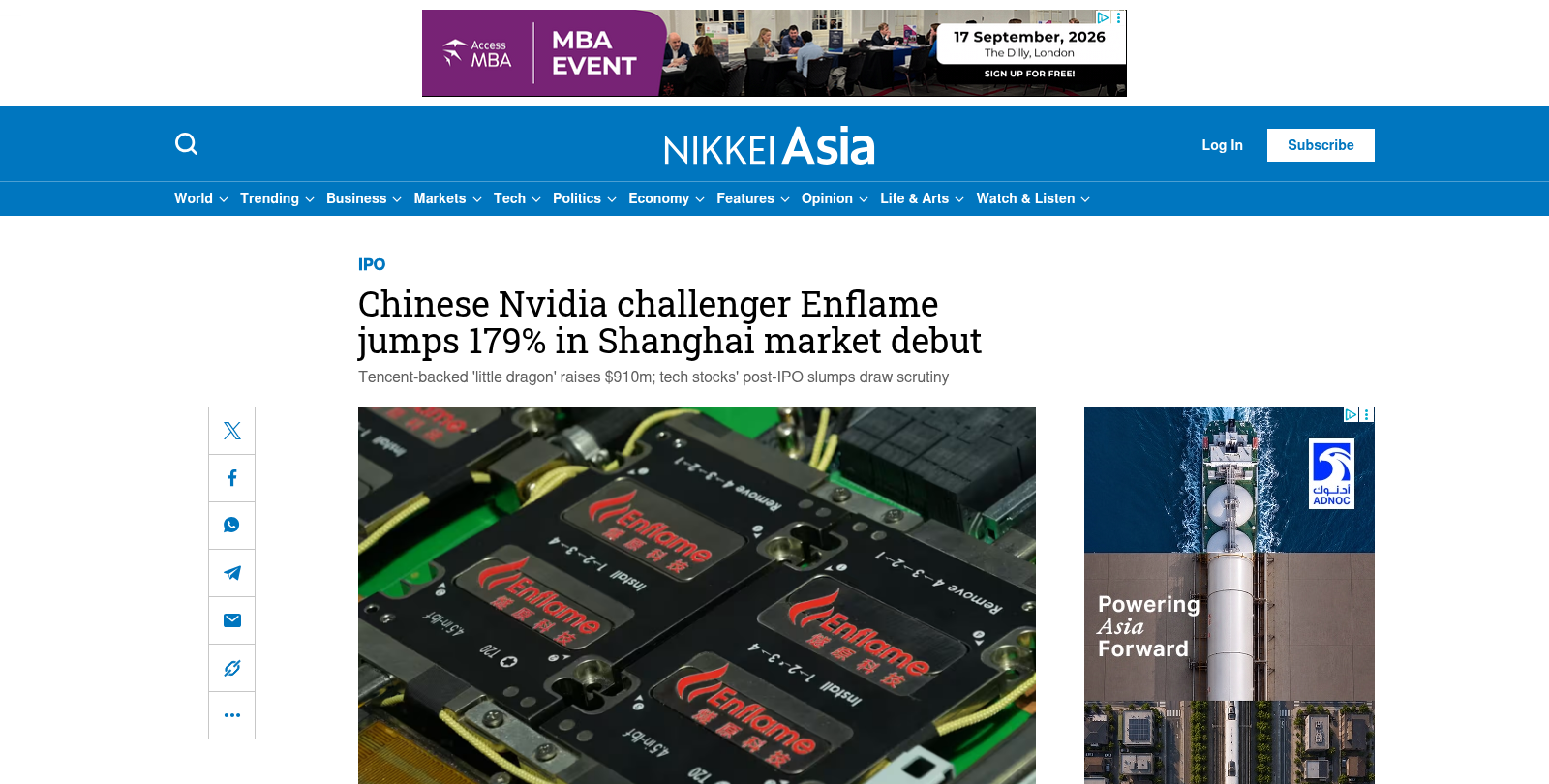
Tencent holds a special place in this story. According to IBTimes, the tech giant remains the company’s largest shareholder with 17.95% of the capital after the IPO. It’s also Enflame’s biggest customer. Tencent-related sales accounted for 83.79% of the company’s revenue in 2025.
On the financial side, according to CNBC, revenue jumped 37% in 2025 to 990 million yuan ($147 million), up from 722 million a year earlier. Net loss narrowed to 1.16 billion yuan from 1.51 billion in 2024. The company is still unprofitable, but it expects revenue for the first nine months of 2026 to reach between 2.3 and 3 billion yuan, annual growth of 326% to 455%, with net loss narrowing to between 700 and 860 million yuan.
The Last of the Four Little Dragons to Go Public
In China, Enflame and its peers are nicknamed the « four little dragons » of AI chips. Moore Threads and MetaX made their debuts on the Shanghai stock exchange, while Biren Technology chose Hong Kong. All three had already seen spectacular surges before Enflame’s turn came.
MetaX jumped nearly 700% on its debut in December, CNBC notes. Moore Threads gained more than 400% on its listing day. Biren, for its part, rose 76% during its January IPO.
The trend goes beyond this quartet. In July, memory chip maker CXMT jumped nearly 466% on its STAR Market debut, briefly becoming China’s most valuable listed company.
Why Beijing Is Betting So Heavily on Its Own Chips
The bet makes sense in light of the market share numbers. According to IDC data cited in Enflame’s prospectus and reported by CNBC, international manufacturers led by Nvidia still accounted for nearly 60% of the Chinese AI accelerator market in 2025. IBTimes, which also cites IDC but on a narrower scope, that of AI acceleration servers, puts Nvidia’s share at 55% and that of Chinese suppliers combined at 41%.
Washington has piled on export restrictions covering the most advanced chips and manufacturing equipment. These are the U.S. chip sanctions, measures that limit China’s access to the highest performing components for computing and artificial intelligence. Beijing, for its part, shows little eagerness to import advanced chips, pressing on with its quest for technological self reliance. A Goldman Sachs report published in August forecasts that Chinese capital spending on semiconductors will reach $82 billion by 2030.
Chinese AI models are advancing at the same pace as the hardware that runs them. Moonshot AI’s Kimi K3 has closed the gap with leading American models, and Z.ai announced in August that its GLM-5.3-Flash model runs entirely on chips made in China, likely a mix of Huawei, Enflame, and other local manufacturers’ components, according to analysts cited by CNBC. Alibaba, for its part, is developing its own AI chips and the software that goes with them.
What This Wave Changes for Nvidia, and for You
This IPO adds to a series of signals complicating Nvidia’s position. In Taiwan, its supplier Unimicron was raided this summer. In the United States, the platform Hugging Face rejected a $12.9 billion buyout offer from Nvidia. And on the chip front itself, OpenAI’s Jalapeño chip reportedly already outperforms Nvidia under certain conditions.
For the gamer buying a graphics card, the direct impact stays limited, at least based on what the available sources document. The U.S. restrictions and the Chinese manufacturer’s breakthrough concern the data center computing market, the one that trains and runs AI models in China, not the consumer graphics cards sold in stores.
Still, Nvidia is losing ground in its most promising long term market. For the first nine months of 2026, Enflame alone forecasts year over year revenue growth of between 326% and 455%.






0 Commentaires
Aucun commentaire pour le moment. Soyez le premier à commenter !