
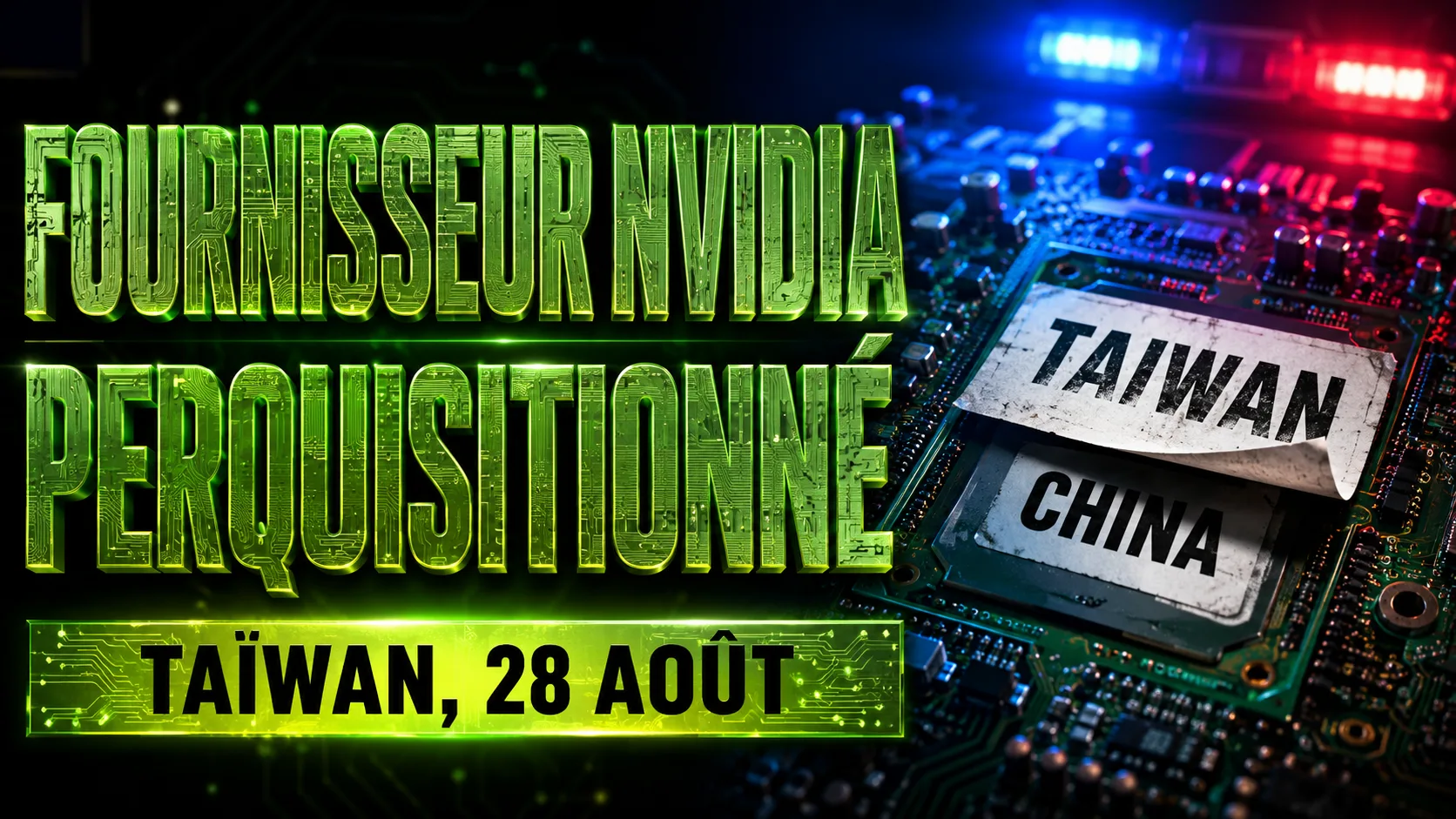
Early Friday, August 28, 2026, investigators from the Taoyuan District Prosecutors Office showed up at Unimicron’s headquarters in the Guishan district of Taiwan. A second team headed to the group’s factory in Zhongli. Over the course of the day, fourteen executives and employees were questioned as suspects.
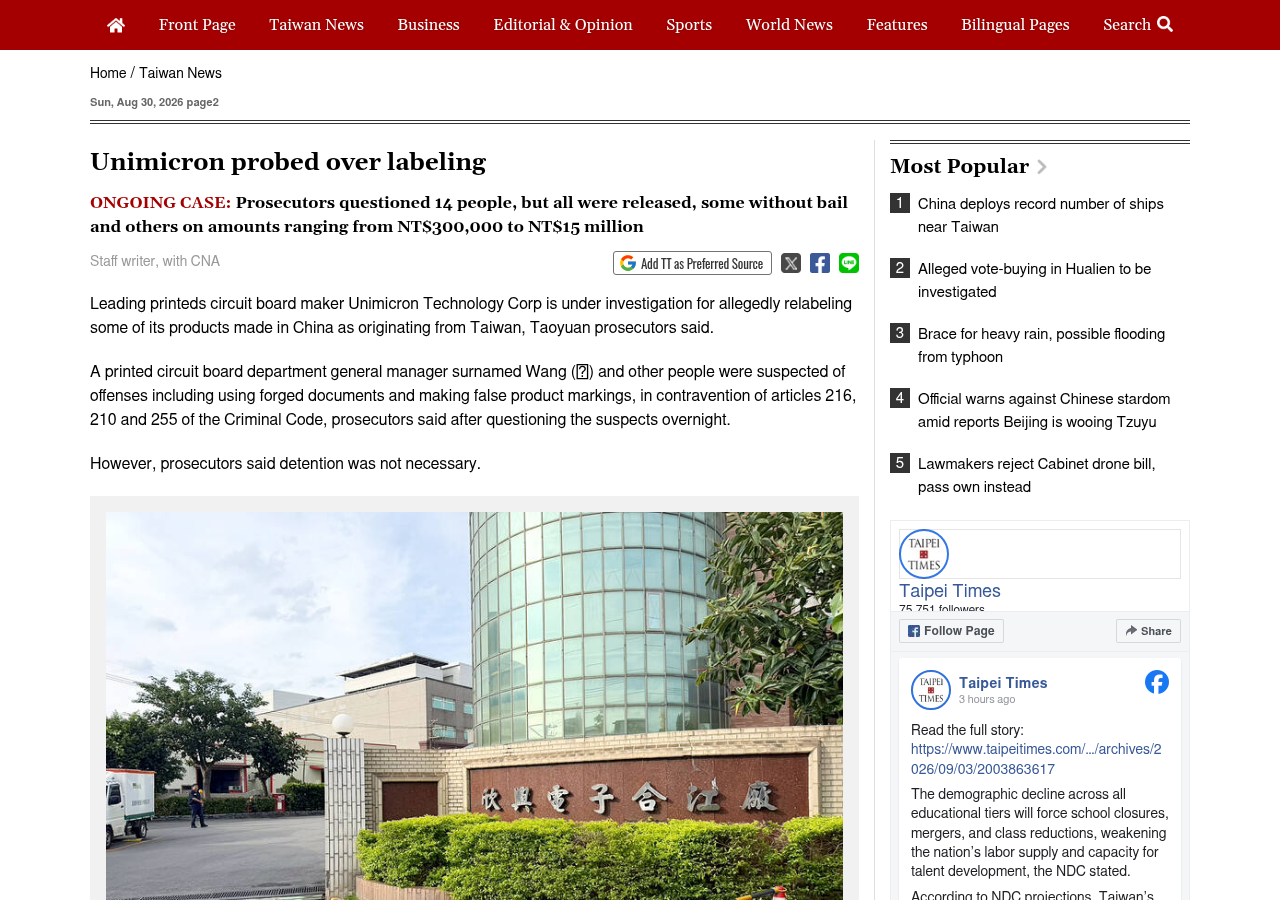
The general manager of the PCB division, known as Wang, and his deputy, known as Wu, were among those questioned. Both were released on bail, Wang for NT$15 million (about US$474,000), Wu for NT$12 million. Three other suspects paid between NT$300,000 and NT$5 million, and nine were released without bail.
Unimicron n’est pas un sous-traitant de second rang. L’entreprise compte parmi les plus gros fabricants mondiaux de circuits imprimés et de substrats avancés, les pièces qui permettent d’assembler les puces les plus puissantes du marché. Nvidia, Intel, Google et Amazon comptent parmi ses clients.
What the investigation into Unimicron targets
The suspicion centers on printed circuit boards made in China and falsely presented as made in Taiwan before being sold to customers. Investigators are citing three articles of Taiwan’s Criminal Code: Article 216 on the use of forged private documents, and Articles 210 and 255 on falsifying origin marks. No formal indictment has been filed so far, and the investigation continues on that basis.
Raiding two sites, the administrative headquarters and a factory, shows where investigators are looking: the offices where labeling decisions get made, and the line where they get carried out.
The Taipei Times, citing a dispatch from Taiwan’s CNA news agency on August 30, places the raid at the Guishan headquarters and the Zhongli factory on the same day. The next day, TechSpot, in a piece by Skye Jacobs, detailed the exact bail amounts paid by the fourteen suspects.
Unimicron spokesperson Chung Ming-feng says the company is “fully cooperating” with the investigation. In a filing to the Taiwan Stock Exchange, the group said it does not expect a material impact on its operations. The market moved faster than that: the stock dropped 10% in the aftermath, according to Nikkei Asia (Cheng Ting-Fang, August 31, 2026).
A quiet link in the processor supply chain
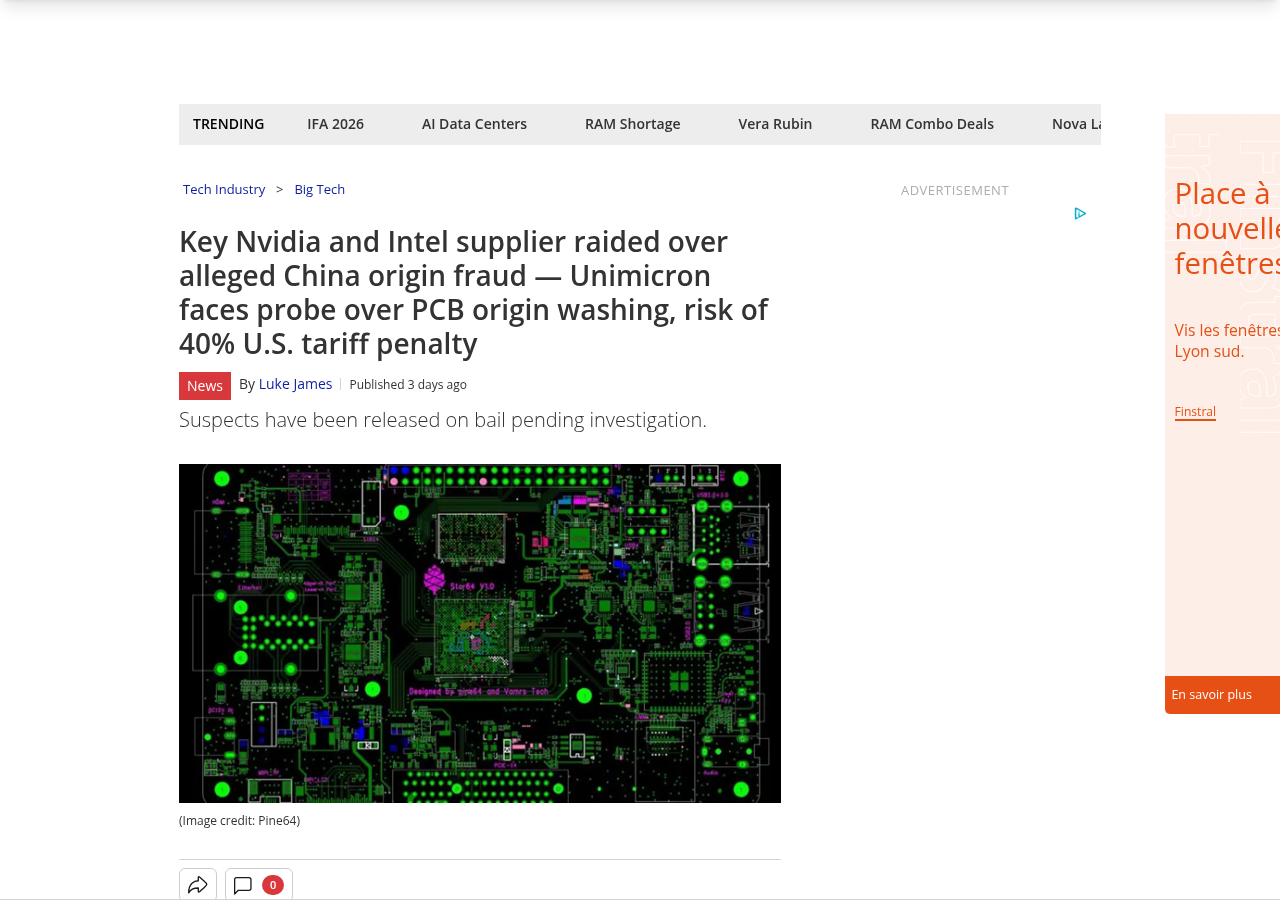
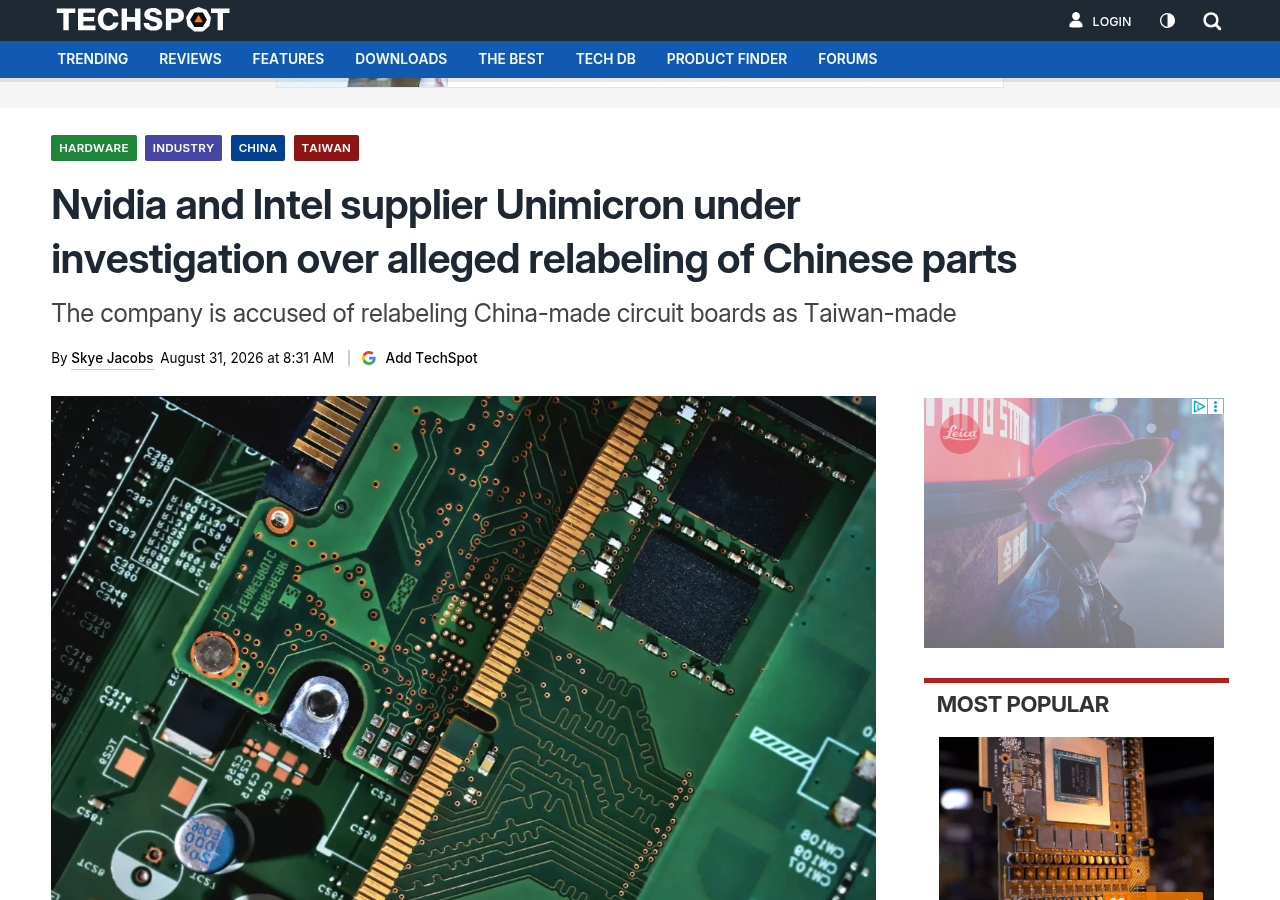
A printed circuit board, or PCB, is the green plate that carries and connects the electronic components of a graphics card, a motherboard, or a smartphone. On the most advanced chips, a substrate is added on top: an intermediate layer of ABF resin (Ajinomoto Build-up Film) that bridges the silicon and the PCB. It is the trickiest part to manufacture, the one where a microscopic etching error can render an entire chip useless.
Unimicron makes both. The company ranks among the world’s largest producers of printed circuit boards and advanced substrates, a position that makes it a supplier without which nothing ships for high-performance computing and AI chips. Nvidia and Intel are among its direct customers, alongside Google and Amazon for their own in-house processors.
Manufacturing an advanced substrate takes several weeks and requires costly equipment, which explains why only a handful of companies worldwide master the process at this scale. A disruption at one of these rare suppliers ripples through delivery times across the whole industry almost immediately, from consumer graphics cards to the AI servers running in cloud giants’ data centers.
That dependency explains why a judicial investigation into a seemingly peripheral manufacturer reaches all the way up to Nvidia, a company that buys up everything it can, including a bid to acquire Hugging Face, yet owns neither its chip factories nor its substrate suppliers.
Why a country-of-origin label is worth a 40% tariff
The United States applies a 40% tariff penalty on transshipped goods, meaning items made in a country subject to steep tariffs and then re-exported under a different origin to dodge the tax. That risk, far more than the Taiwanese investigation itself, is what worries its US customers, according to Tom’s Hardware.
The US rule doesn’t target where the raw material comes from, but where the product takes its final form. A board assembled in China and then simply repackaged elsewhere before entering the United States doesn’t change its customs origin in the eyes of US authorities, even if the label does.
If the allegations hold up, every board sold as Taiwanese while actually coming from China could be reclassified at the US border, with retroactive effect on shipments already delivered to Nvidia, Intel, or their assembly subcontractors. Taiwanese financial media have already named rivals Kinsus and Nan Ya PCB as potential beneficiaries of an order shift, a sign the industry is taking the case seriously even before the investigation concludes.
The case lands at a bad time. The semiconductor supply chain is already going through a memory shortage that has pushed console prices up, and a new bottleneck on printed circuit boards wouldn’t help.
What this means for PC gamers
For a gamer buying a graphics card, this case is still, for now, a distant legal matter. But it adds to an already long list of strains on the graphics card supply chain. The RTX 5090 jumped from $1,999 to $4,930 as the memory shortage bit, and every newly weakened link, whether it’s memory chips or the PCBs carrying the GPU, eventually shows up on the price tag.
Memory makers have already cut back production of standard DRAM chips to prioritize modules bound for AI, a shift that has dried up the supply available for consumer graphics cards. A new drag on printed circuit boards, even one limited to a few weeks of legal uncertainty, would pile onto an already long list of bottlenecks.
Unimicron doesn’t make the GPUs themselves, but the boards that carry them and the substrates that connect their chips. A 40% surcharge passed through at this single step alone would be enough to weigh on a card’s final price, in an industry where every component already stacks on top of another.
The group says it is cooperating with authorities and expects no impact on its production. The investigation, meanwhile, continues.









0 Commentaires
Aucun commentaire pour le moment. Soyez le premier à commenter !