

« I do think it gets worse next year in terms of demand and supply. » Michael Dell said this on Tuesday, October 13, 2026, to CNBC’s David Faber. The head of Dell Technologies was talking about the memory shortage, and he added that it could last four years. Two months after our article on console prices, the question gets very concrete: what does this change for anyone building a PC or buying a gaming machine?
What Michael Dell said, and what he did not say
The direct quotes come from Benzinga, republished by Yahoo Finance (Daragh Thomas, October 16). Asked about memory, Dell answers: « Maybe it’s a four-year problem because there’s just not enough supply. » The « maybe » matters: it is a hypothesis, not a schedule.
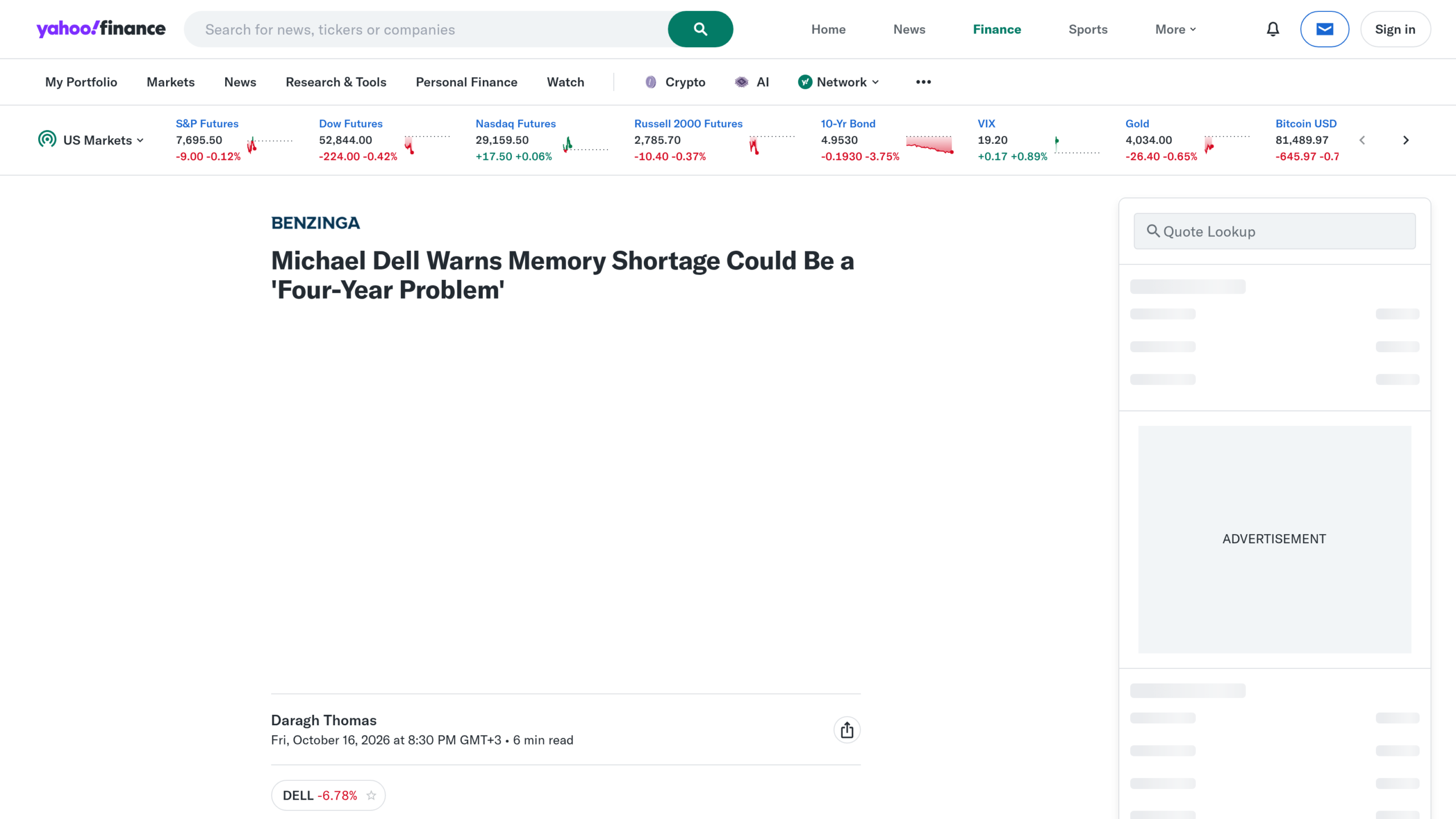
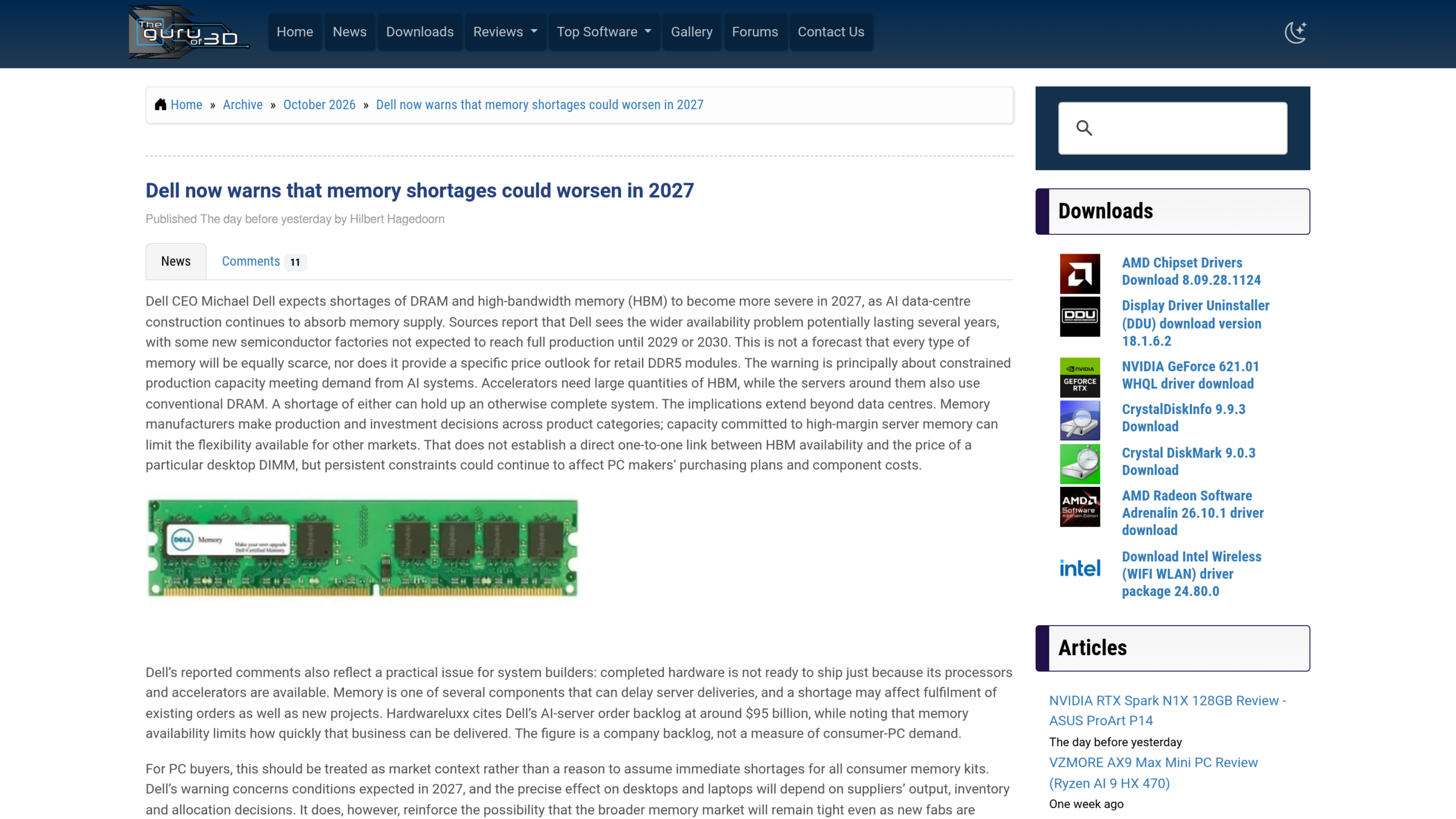
His reasoning on the memory shortage comes down to factories. According to the same article, a new fab (chip factory) takes about four years to build: the ones planned today would only produce in 2029 or 2030. Guru3D (Hilbert Hagedoorn, October 20) gives the same timeline, citing the Wall Street Journal, and sets a useful limit: the warning is about production capacity facing AI demand, and it contains « no specific price outlook for retail DDR5 modules ». We could not read the Wall Street Journal interview itself: this point rests on Guru3D.
$95 billion of orders waiting for memory
Dell is not a neutral observer. Benzinga notes that the company reported $16.4 billion in AI server revenue for the quarter and a record $95 billion backlog in September. These servers combine Nvidia chips, DRAM and HBM (high-bandwidth memory). Guru3D specifies that this figure is a company order backlog, not a measure of consumer demand.
The market reacted with nuance. On Wednesday, October 14, Barclays downgraded Dell from « Overweight » to « Equal-Weight », and the stock was down about 8% in morning trading, according to Benzinga. Analyst Tim Long sees operating margins around 5% on AI servers, so little room to absorb pricier components. ASML, the maker of the machines that etch chips, said the same day that its supply would fall short of customer demand in 2027 and 2028.
What TrendForce puts a number on for the end of the year
For price figures, the best anchor is a press release from TrendForce dated September 30, 2026. The market research firm forecasts a 10 to 15% rise in conventional DRAM contract prices for the fourth quarter, and 15 to 20% for NAND (flash storage chips). Contract prices are what computer makers pay, not what shelves show. TrendForce also notes that the pace of increases is slowing: prices still climb, just more slowly.
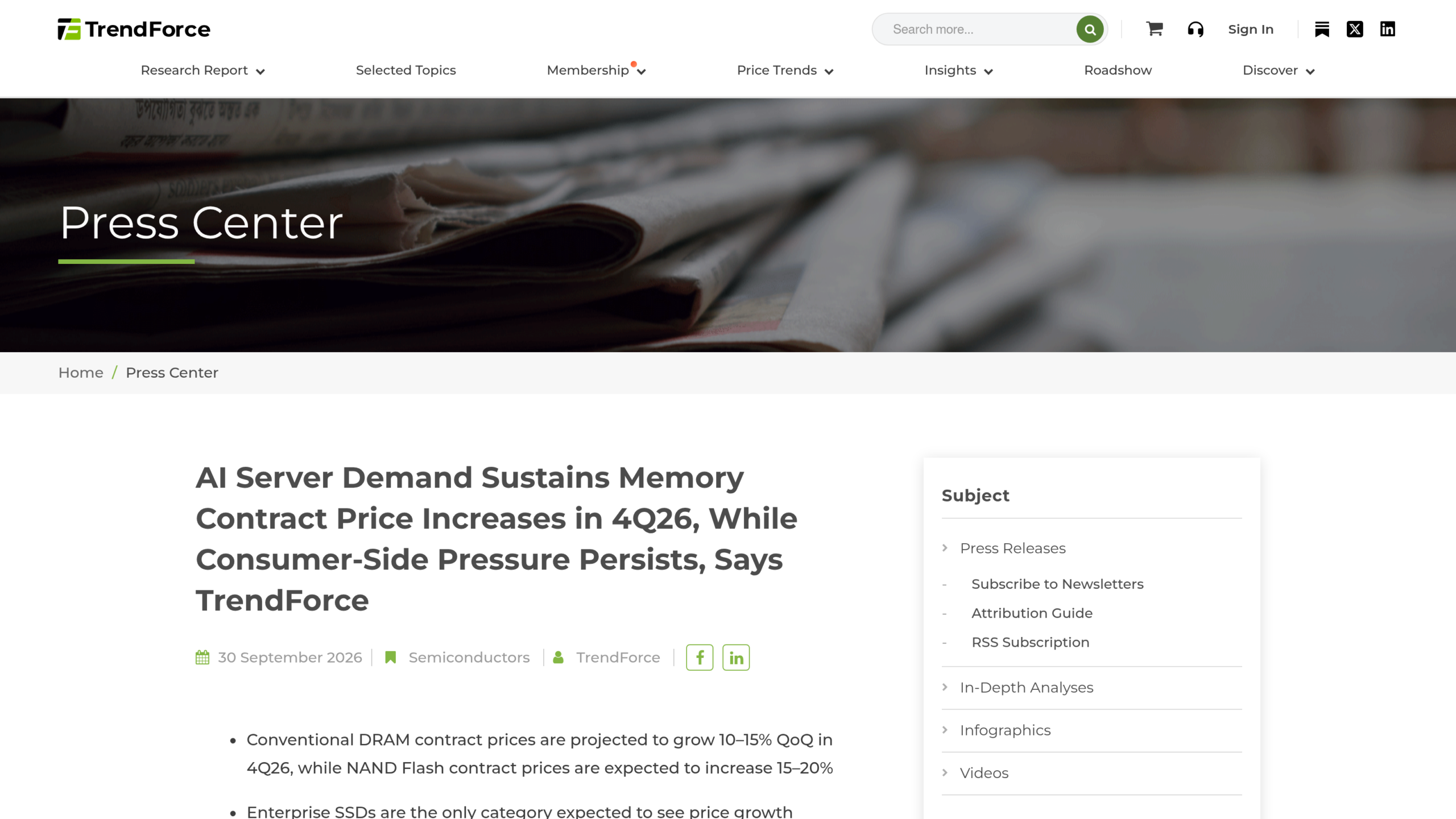
The same text agrees with Michael Dell on 2027: the memory shortage does not ease next year. TrendForce writes that PC makers are still buying « aggressively » while expecting tight DRAM supply next year, and that « the PC DRAM supply could decline in 2027 as more capacity shifts to server applications ».
What the memory shortage changes for a gamer
On the PC side, TrendForce notes that laptop inventories already reflect pricier components, which weighs on sales, and that some brands are cutting the storage capacity of mainstream models to hold down cost. A machine can therefore cost the same and offer less. For graphics cards, the release describes suppliers scaling back GDDR6 production (the memory of many cards) and gradually exiting the market, while GDDR7 stays limited, with advanced capacity going to servers. TrendForce concludes that graphics memory prices should keep rising.
We had already tracked the effects on shelves: the RTX 5090 is above $5,000 in most regions according to Wccftech, for a list price of $1,999. On consoles, our article on console prices covered the Switch 2 going from $449.99 to $499.99 on September 1. Microsoft, for its part, wrote that « console storage and memory prices have increased by more than 2.5x and we expect another doubling by the fall of 2027 ». That 2026 sentence sounds a lot like what Dell says in October.
What nobody puts a number on yet
No source we consulted gives a DDR5 price for 2027, or a date when the increases would stop. Michael Dell makes a forecast, with a « maybe », and he sells servers that depend on this memory. Our reading, which follows from the facts rather than extending them: the memory shortage is decided in AI servers, and gamers sit at the end of the line. For 2027, keep what is dated: TrendForce sees PC supply declining, and Dell places the arrival of new factories in 2029 or 2030.








0 Commentaires
Aucun commentaire pour le moment. Soyez le premier à commenter !