

Amazon has quietly raised Amazon prices on several of its flagship devices. No press release, no banner on the site: the price tags changed overnight, with no warning to customers. Fortune broke the story on August 21, 2026, in an exclusive piece by tech correspondent Sebastian Herrera.
The rise in Amazon prices hits four product families: Echo speakers, Fire TV boxes and sticks, Kindle e-readers (the dedicated e-ink screen for reading), and eero mesh routers (a Wi-Fi unit that covers the whole house by combining with other units). Depending on the model, the bill climbs by as much as 60% or up to $100 more than before.
Amazon offers a precise explanation for this rise in Amazon prices: the cost of memory components (DRAM and flash, the chips that store data and run the device). And the timing lines up with another figure, revealed in late July by the company’s CEO in front of investors.
A price hike revealed by Fortune, without a word from Amazon
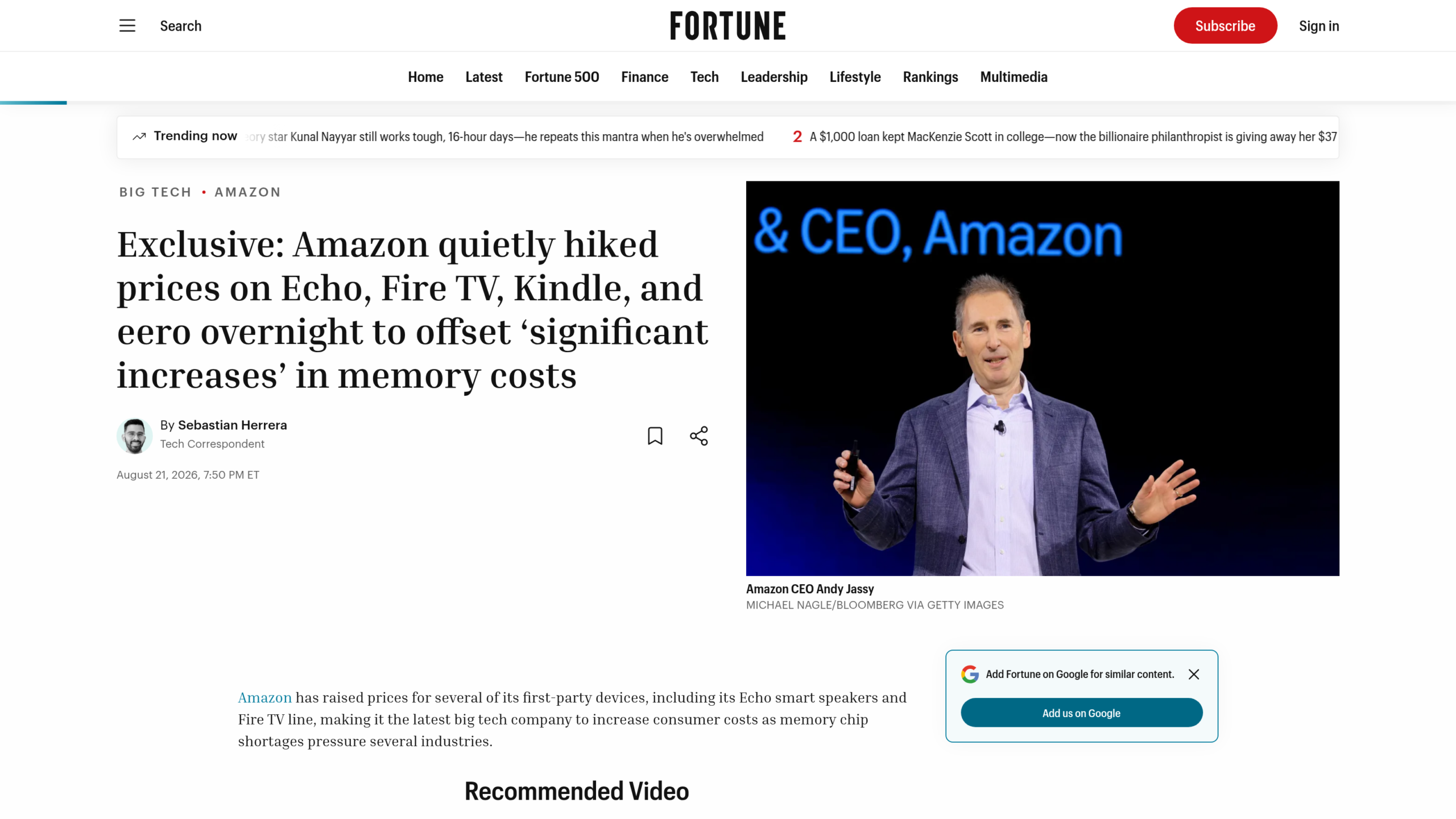
Sebastian Herrera documents the move in his August 21 article: Amazon raised its prices with no announcement or public justification, across its entire consumer lineup. No email to customers, no line on the product pages explaining the change. The rise in Amazon prices only became visible because a media outlet went and checked the product pages.
Amazon doesn’t spell out what’s happening to eero routers in this wave either: Fortune lists the lineup among the affected products, without giving a precise figure model by model. So there’s no way to know whether an eero router is climbing 10% or 40%, only that the product family is indeed part of the price hike.
Amazon prices, lineup by lineup
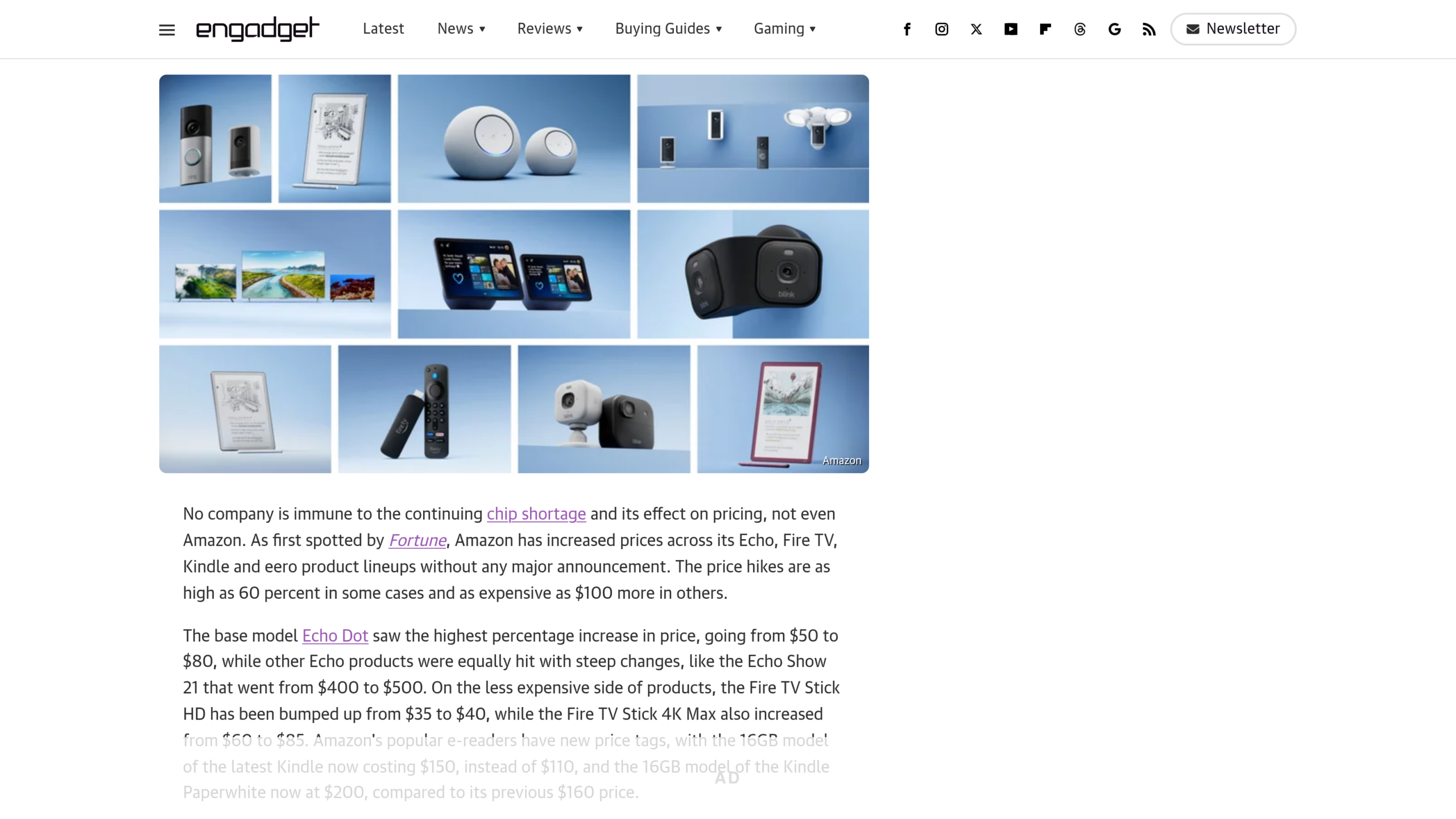
Engadget tracked Amazon prices before and after, device by device. These figures are for the U.S. market: no source consulted gives French or European pricing.
| Device | Before | After | Increase |
|---|---|---|---|
| Echo Dot (base model) | $50 | $80 | +60% |
| Echo Show 21 | $400 | $500 | +25% |
| Fire TV Stick HD | $35 | $40 | +14% |
| Fire TV Stick 4K Max | $60 | $85 | +42% |
| Kindle 16GB | $110 | $150 | +36% |
| Kindle Paperwhite 16GB | $160 | $200 | +25% |
The pattern is clear: it’s the cheapest devices that take the biggest percentage jump. The Echo Dot, the entry-level speaker at $50, climbs 60%, the steepest increase in the table. A memory component that costs a few dollars more weighs far heavier on a $50 device than on a $500 model.
Why memory is blowing up the bill
Amazon told Fortune that the cause lies in significant increases in the cost of memory and storage components. The company says it absorbed these costs for as long as possible before passing them on to the listed Amazon prices.
In late July 2026, CEO Andy Jassy told investors that Amazon would spend $220 billion in investments this year, up from the $200 billion originally planned. Most of that increase goes toward building and equipping data centers (the massive server rooms that run online services and artificial intelligence). The higher cost of memory is cited as one of the reasons for this upward revision.
Demand for AI memory isn’t slowing down. Chipmakers report order books filled far in advance, reserved first for cloud and generative AI giants. Everyday consumers wait further back in line, and that shows up directly on the price tag of a $50 speaker.
Engadget sums up the situation in one line: no company is safe from the ongoing chip shortage, and its effect on prices, not even Amazon. The site had already reported how this same memory shortage is driving up the price of game consoles; Amazon prices are the consumer version of it, sitting in the living room rather than plugged in under the TV.
The end of at-cost Amazon hardware
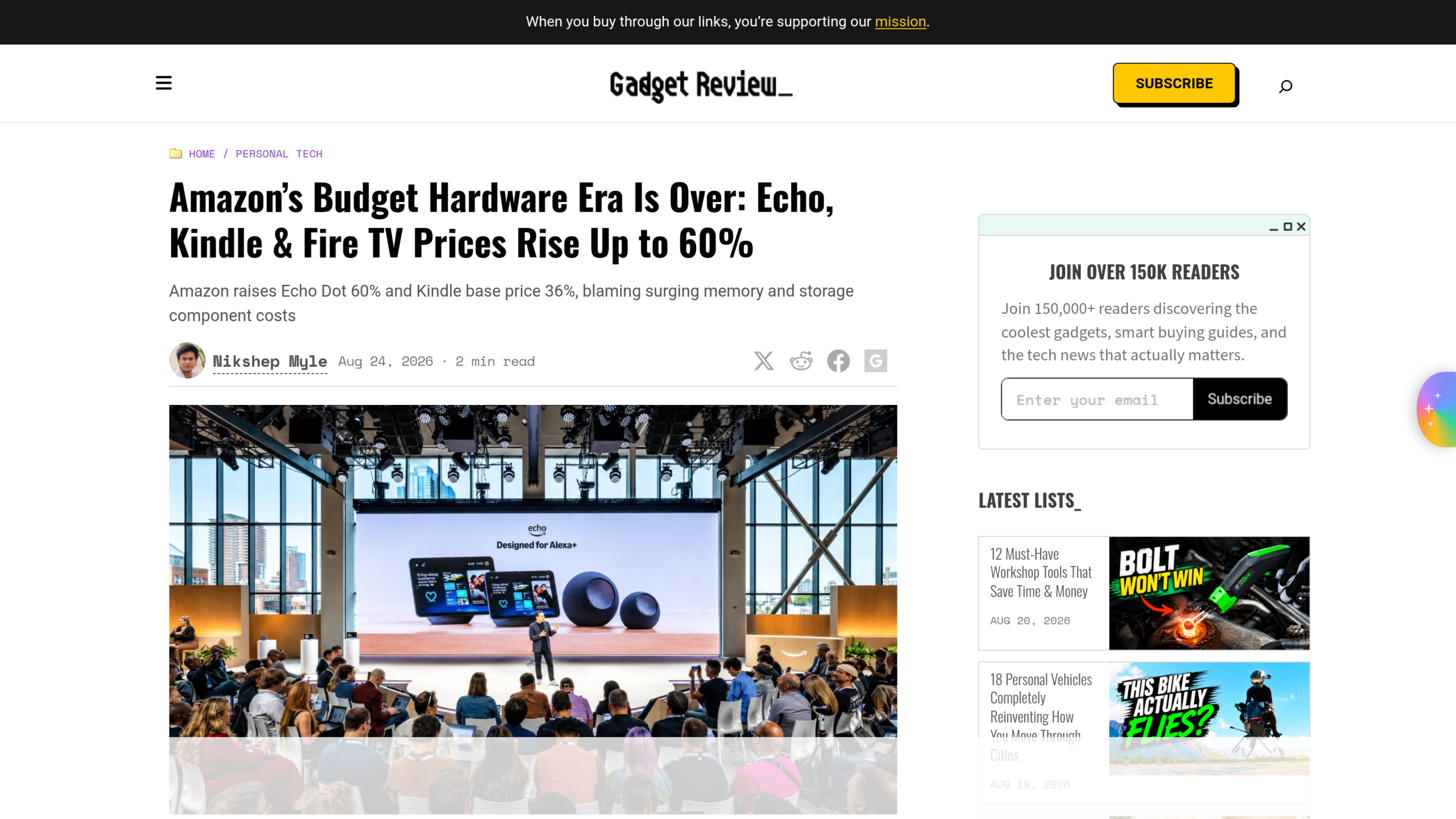
Gadget Review, on August 24, 2026, written by Nikshep Myle, lays out the real stakes: Amazon used to sell some of its hardware at cost (no margin, sometimes even at a loss), betting on the subscriptions, purchases, and content sold afterward. That math relied on cheap components. Today’s rising Amazon prices show that bet no longer holds.
It’s hard to say how long these Amazon prices will hold, whether they keep rising or eventually fall. If component costs come back down someday, nothing guarantees Amazon will lower its price tags again as quietly as it raised them this summer. For now, the brand hasn’t published any date or commitment to that effect, and keeps selling its devices without mentioning the change.
This memory shortage goes far beyond Amazon. It has already driven up the price of DDR5 RAM for PCs, and it’s weighing on entire machines like the compact Nvidia RTX Spark PC. Part of the missing money goes straight toward funding chips dedicated to artificial intelligence, like the ones designed by Etched.
One thing to keep in mind: every Amazon price cited here is the price charged in the United States. No source consulted gives a figure for France or the rest of Europe, and nothing suggests the same increase will apply there in the same proportions.








0 Commentaires
Aucun commentaire pour le moment. Soyez le premier à commenter !