
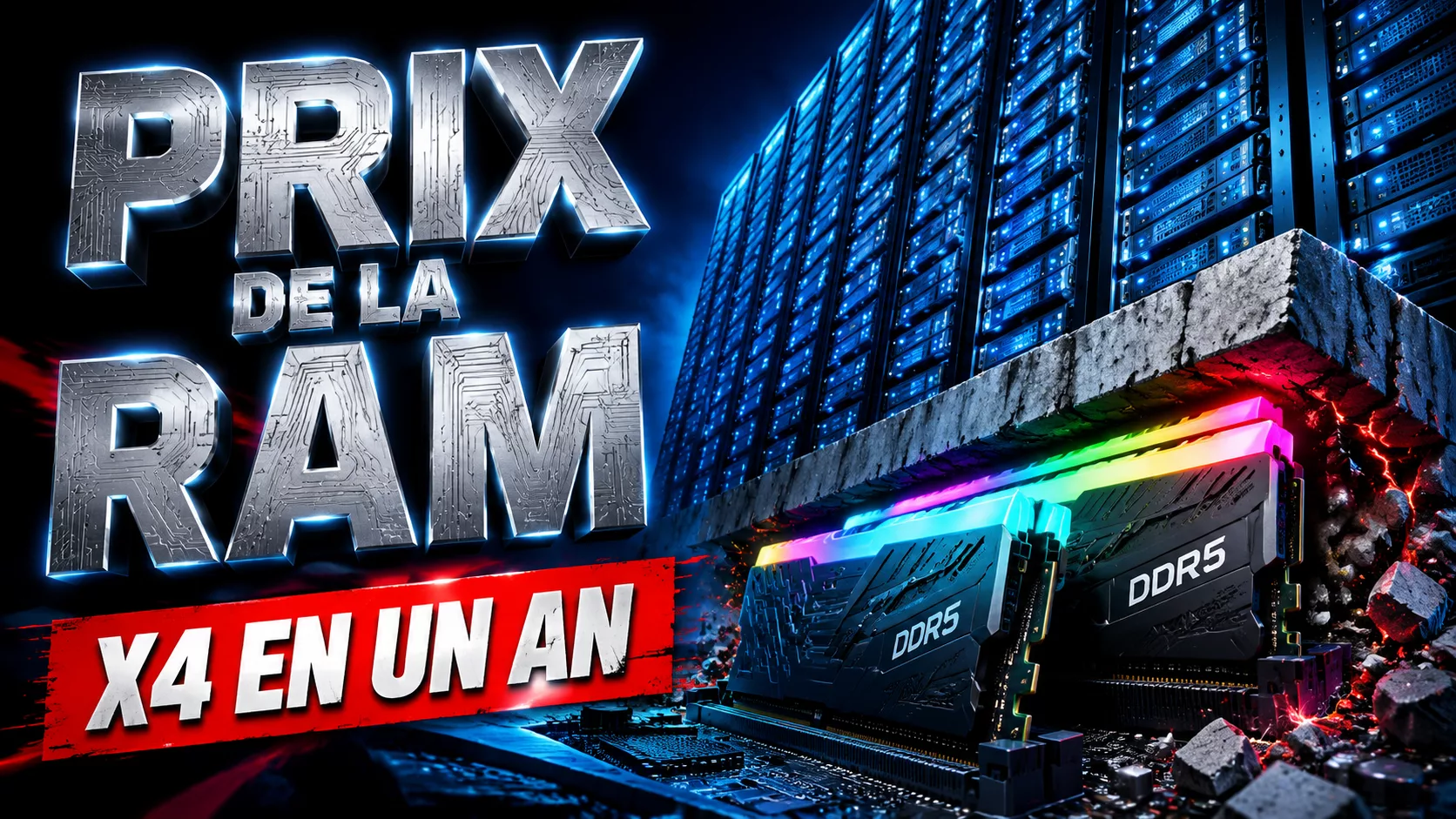
RAM prices have quadrupled in under a year. A 32GB DDR5 kit that cost around $100 in September 2025 now costs more than $400. The cause fits in three letters: manufacturers redirected their factories toward memory for AI accelerators, which sells for far more. And a return to normal isn’t expected before 2028.
RAM prices today, by the numbers
A 32GB DDR5 kit (Double Data Rate 5, the memory generation used in recent PCs) no longer sells for under $375. In a market snapshot from August 14, 2026, prices range from $380 to $589, or roughly $11.88 to $18.41 per gigabyte.
Higher capacities follow the same curve. A 64GB kit lists at $679.99, while another DDR5-6000 model climbs to $849. A 96GB kit sells for $1,799. The high end, a 128GB DDR5-6400 kit, reaches $3,399. Graphics cards face the same logic: the RTX 5090, which went from $1,999 to $4,930, owes much of its price surge to this same memory shortage.
This surge isn’t new. On November 6, 2025, TechPowerUp already reported a 171.8% year-over-year increase (comparing prices a year apart) in DRAM (Dynamic RAM, system memory itself, DDR4 as well as DDR5) prices, according to a report from research firm CTEE. At the time, a G.Skill Trident Z5 Neo RGB 32GB kit in DDR5-6000 CL30, which sold for around $106 a few months earlier, was listed at $239 on Newegg. Module makers like Kingston and ADATA were then paying $13 for 16GB DDR5 chips that had cost them $7 six weeks earlier.
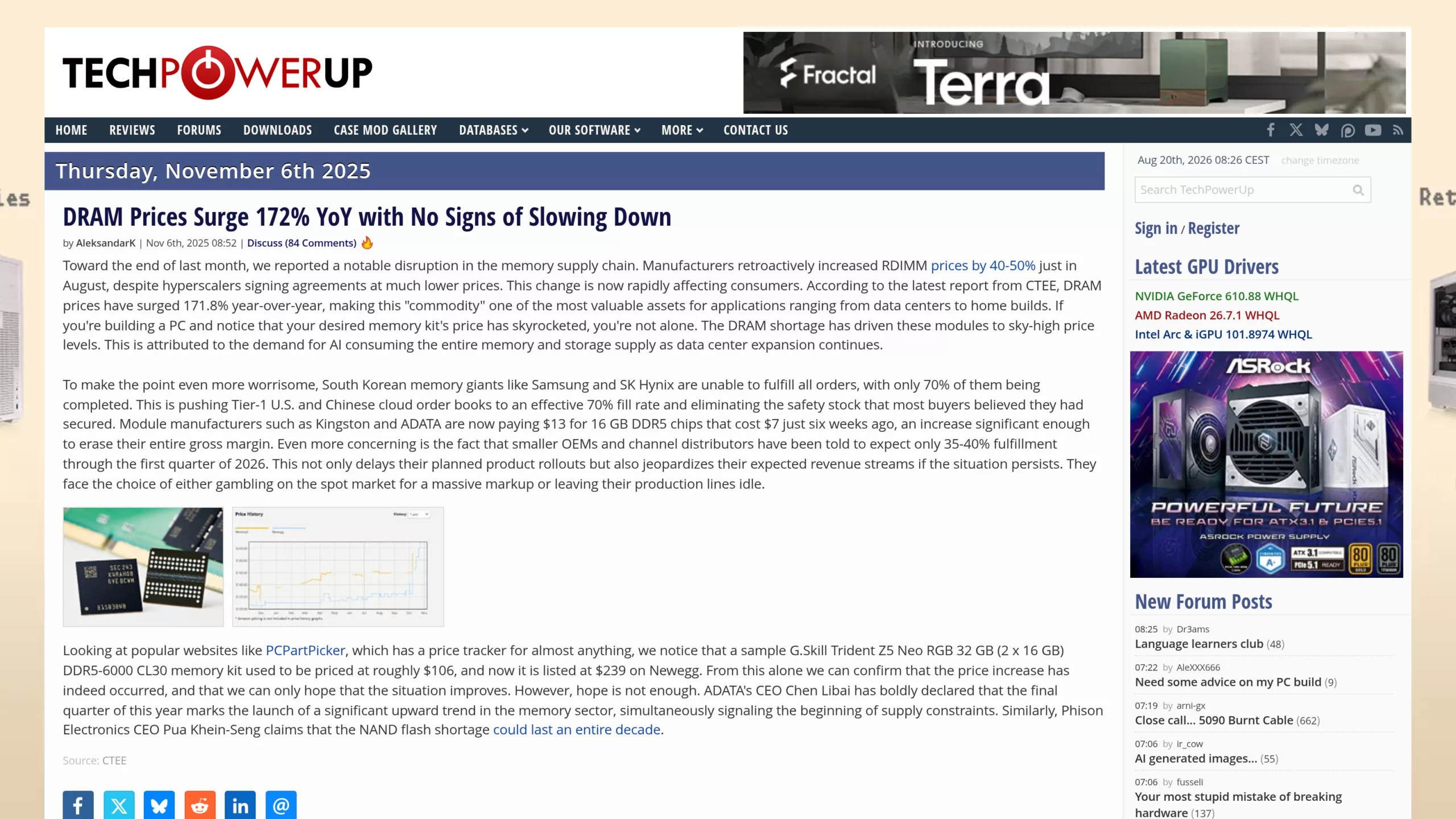
The cheapest component in a gaming PC, long overshadowed by the processor and graphics card, has become one of the most expensive in just a few months.
Why AI ate up the production
Samsung, SK Hynix and Micron redirected a large share of their production capacity toward HBM (High Bandwidth Memory, the very high-speed memory used in AI accelerators), at the expense of consumer DDR5 and NAND flash memory (the component that stores data in SSDs). That capacity goes to Nvidia and other AI chip makers, who pay far more than a PC module manufacturer would. A fab that produces HBM for a data center doesn’t produce DDR5 for your motherboard, and this shift in production is what’s driving RAM prices up across every consumer tier.
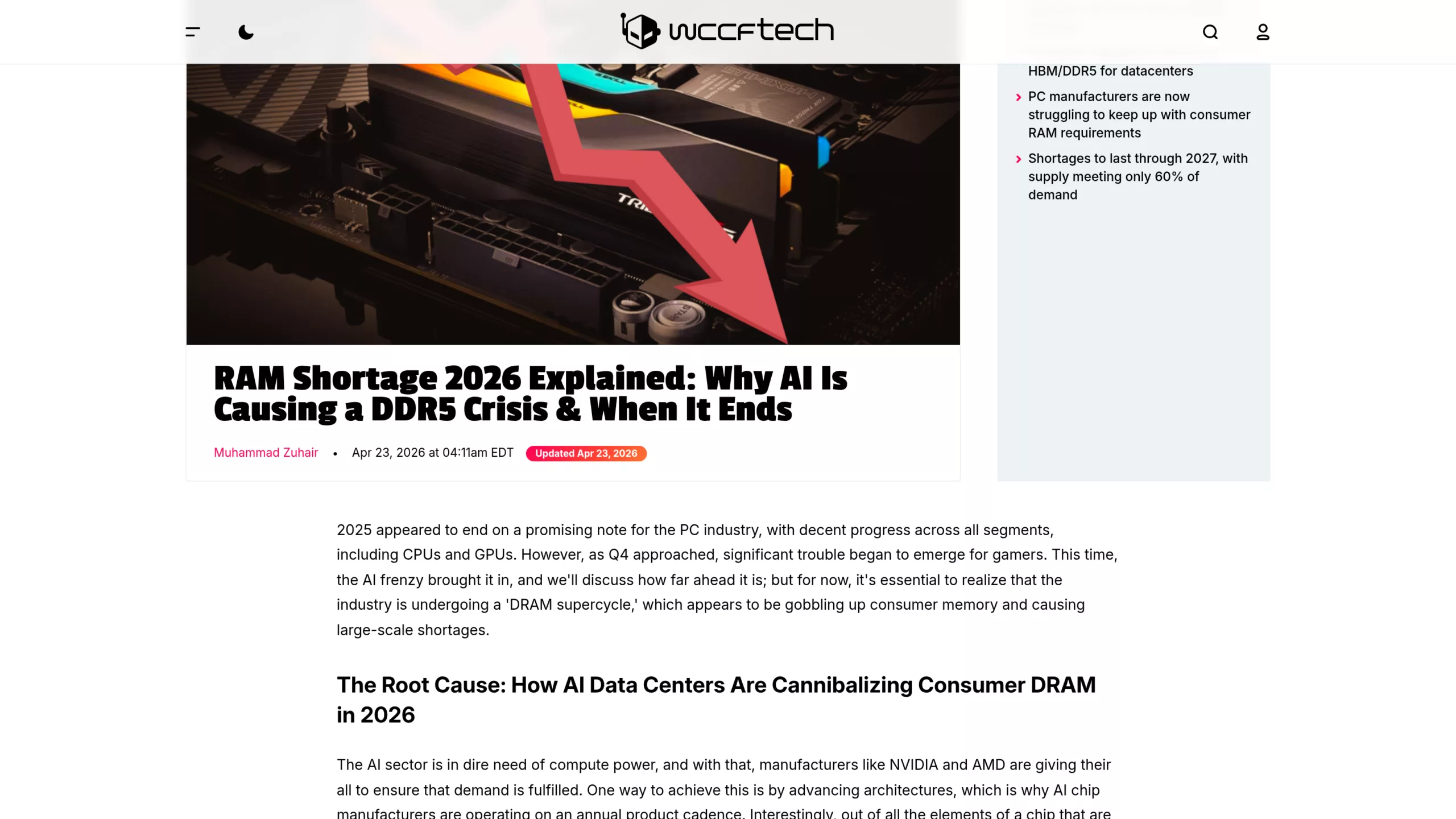
Analysts call this phenomenon the « DRAM supercycle, » a phase where consumer memory gets absorbed by industrial demand to the point of causing large-scale shortages. According to Wccftech’s report on the crisis, current supply covers only 60% of demand, and shortages are expected to continue through 2027.
Graphics card production follows the same logic: factories prioritize data centers, leaving little volume for the consumer market. Nvidia’s RTX 5080 Super launch was in fact delayed partly because the cost of GDDR7 memory roughly tripled. Nvidia and AMD have raised their prices this year, with an increase of around 22% recorded in the Chinese market.
A milestone from November 2025 shows the scale of the shift. At the time, Samsung and SK Hynix could only fulfill 70% of the orders they received. Smaller manufacturers and distributors were promised a fill rate (the share of orders actually delivered) of just 35 to 40% for the first quarter of 2026. Their only alternative: buy at a premium on the spot market, meaning one-off purchases outside annual contracts, billed at the going rate, or leave their production lines idle.
The timeline for a return to normal has stretched considerably since then. Intel now points to 2028 before things settle down. Silicon Motion warns for its part that the shortage in DRAM, NAND and HBM will continue through 2028. Forecasts have thus gone from a few quarters to several years, in an industry channeling its resources toward the billions invested in AI infrastructure rather than consumer memory.
What this means for a gaming build
The extra cost on RAM alone runs between $280 and $490 compared to last year. Anyone weighing several kits can compare options in our roundup of seven DDR5 kits.
At higher capacities, the tab climbs fast: around $680 for 64GB, $1,799 for 96GB, and nearly $3,399 for a 128GB DDR5-6400 kit. Research firm IDC forecasts a 4 to 8% increase in average PC prices in 2026, driven by memory and storage shortages. Some system builders now sell prebuilt PCs without RAM, leaving buyers to supply the component themselves.
Building a PC today structurally costs more than it did a year ago, for the same performance. Switching to an older DDR4 platform doesn’t help either: that memory is affected too. Processors and storage are also under pressure, but nothing as severe as system memory. The launch timeline for Valve’s Steam Machine and its Steam Frame headset, both expected in 2026, hinges on this same market.
Back in March, the question was whether prices were falling
On March 31, 2026, we published an article titled « Prix de la RAM en 2026 : OpenAI Recule, les Tarifs Commencent-ils Vraiment à Baisser ? » (RAM Prices in 2026: OpenAI Pulls Back, Are Prices Really Starting to Drop?). That day, we were asking whether RAM prices were starting to ease, right as OpenAI had just pulled back on part of its component orders.
Five months later, the answer is in, and it points the other way. The $400 threshold has been passed on part of the lineup, and IDC still expects a 4 to 8% rise in the average PC price this year.
The signs of relief seen in recent months almost always came from parties with an interest in reassuring the market: a renegotiated contract, a client scaling back orders. Prices on the shelf, meanwhile, kept climbing over the same period. When a forecast contradicts an actual price, the price wins.
Current estimates point to a return to normal around 2027 in the most optimistic case. Intel and Silicon Motion, for their part, are talking about 2028.







0 Commentaires
Aucun commentaire pour le moment. Soyez le premier à commenter !