
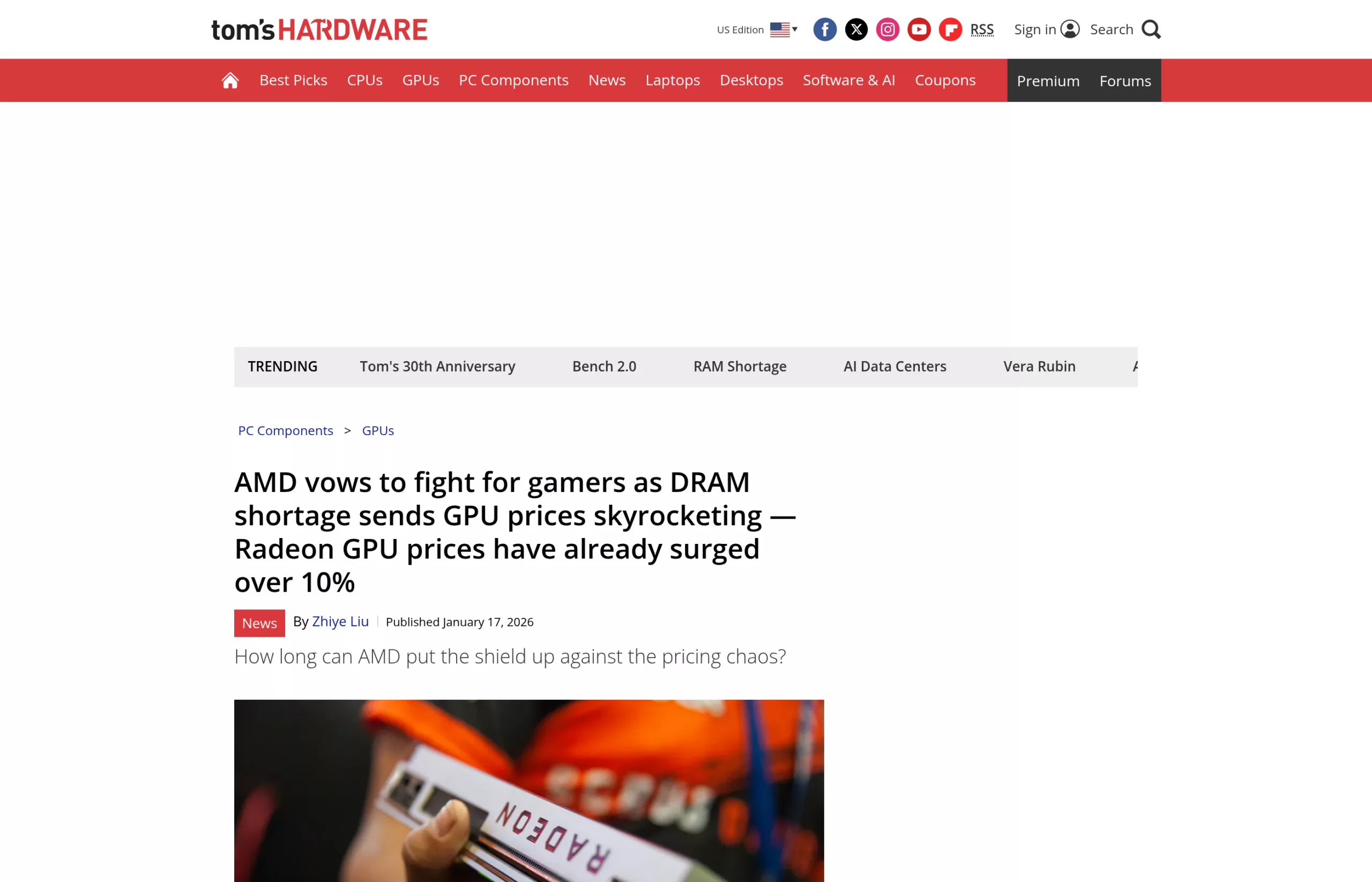
Nvidia’s official store now lists the RTX 5090 (the company’s flagship graphics card, the chip that renders the images in games and applications) at $4,929.99. In January 2025, its launch MSRP (the price recommended by Nvidia itself, often well below what you actually pay in stores) was $1,999. The RTX 5090 price has more than doubled in a year and a half.
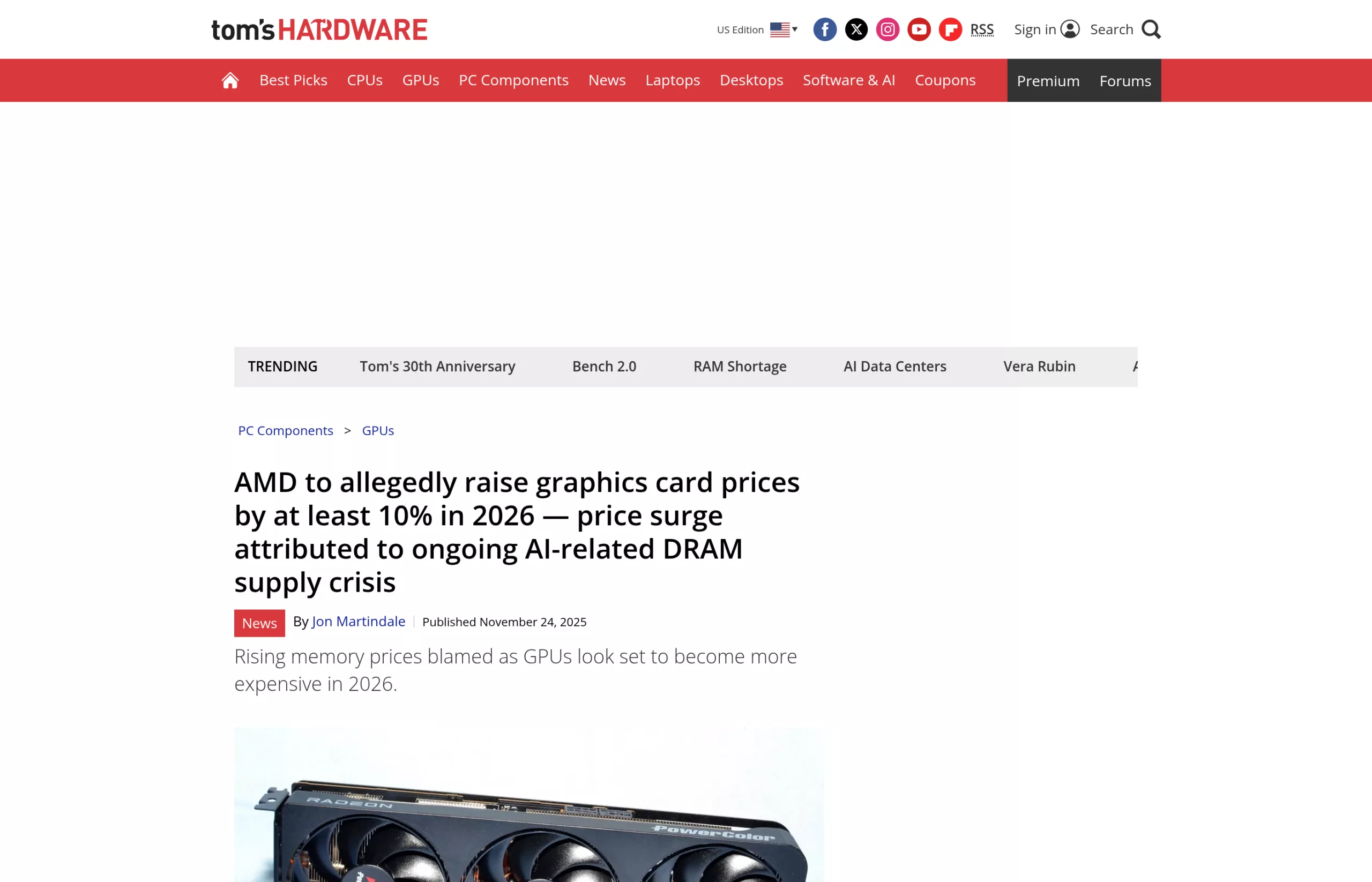
This isn’t an isolated Nvidia incident. AMD has confirmed a price increase of at least 10% on its Radeon cards this August 2026. MSI has warned its investors of increases between 15% and 30% on all its gaming hardware throughout 2026. All three manufacturers point to the same cause. It has nothing to do with video games.
$1,999 in January 2025, $4,930 Today
The RTX 5090 shows just how far prices have spiraled. A gamer who wanted the card at launch paid the MSRP, $1,999. A gamer who orders it today on Nvidia’s website pays $4,929.99. No discount, no one-off stock shortage can explain a gap this wide. It’s the price displayed, continuously, on the manufacturer’s own store.
AMD is following a similar path, at a different scale. The manufacturer has confirmed a price increase of at least 10% across its entire Radeon lineup, effective this month. MSI, for its part, is speaking directly to its shareholders. The company is announcing increases of 15-30% on its gaming hardware for 2026, citing two precise figures to justify the decision: a supply shortfall of around 20% on Nvidia GPUs, and a memory shortage it describes as severe.
Three manufacturers, three separate announcements, one common denominator. Here’s what each one said.
| Manufacturer | What Was Announced |
|---|---|
| Nvidia | RTX 5090 listed at $4,929.99, versus an MSRP of $1,999 at launch in January 2025 |
| AMD | Confirmed increase of at least 10% across all Radeon cards, effective August 2026 |
| MSI | Increases of 15-30% announced to investors for 2026, across all gaming hardware, including graphics cards |
The Memory Went to Data Centers
The cause cited by Nvidia, AMD, and MSI is the same. Data centers dedicated to artificial intelligence are outbidding everyone for memory. Every AI chip needs massive amounts of HBM (a memory stacked in layers, much faster than standard memory, installed directly next to AI accelerators). Memory manufacturers are redirecting their factories toward this product because it is, today, the most profitable in the sector.
This shift is draining the production lines dedicated to DRAM (the standard memory used in computers and consoles), the same memory found in graphics cards and gaming PC RAM modules. Less DRAM available for the general public means more GPUs competing for what remains. The result shows up directly on the price tag of graphics cards. Our article on the global RAM crisis breaks down how this shift is already affecting electronic devices across the board, far beyond graphics cards alone.
The gamer buying a graphics card carries no weight in this trade-off. Their purchase simply ends up in direct competition with that of a data center operator, who can afford to pay far more to secure its supply.
No One Is Promising a Return to Normal Before 2028
Industry players speaking on the subject converge on the same timeline. Intel points to 2028 before memory markets return to normal. Silicon Motion, a manufacturer specializing in memory controllers, agrees. The company expects the shortage affecting DRAM, NAND (another memory family, used notably in storage drives), and HBM alike to last until 2028.
Financial analyses tracking the GPU and memory sector reach a similar conclusion. Prices aren’t expected to come back down before at least the end of 2027. Some projections recently floated around RAM price trends remain even more cautious, as we reported in our article on RAM prices in 2026. For now, no manufacturer is setting a date earlier than this 2027-2028 window.
Gamers waiting for a lull before upgrading their graphics card will have to be patient for several more seasons. The current price surge isn’t a temporary spike tied to a stock shortage. It’s the result of an industrial trade-off between two markets, gaming and artificial intelligence, and for now, the latter is winning across the board.







0 Commentaires
Aucun commentaire pour le moment. Soyez le premier à commenter !