
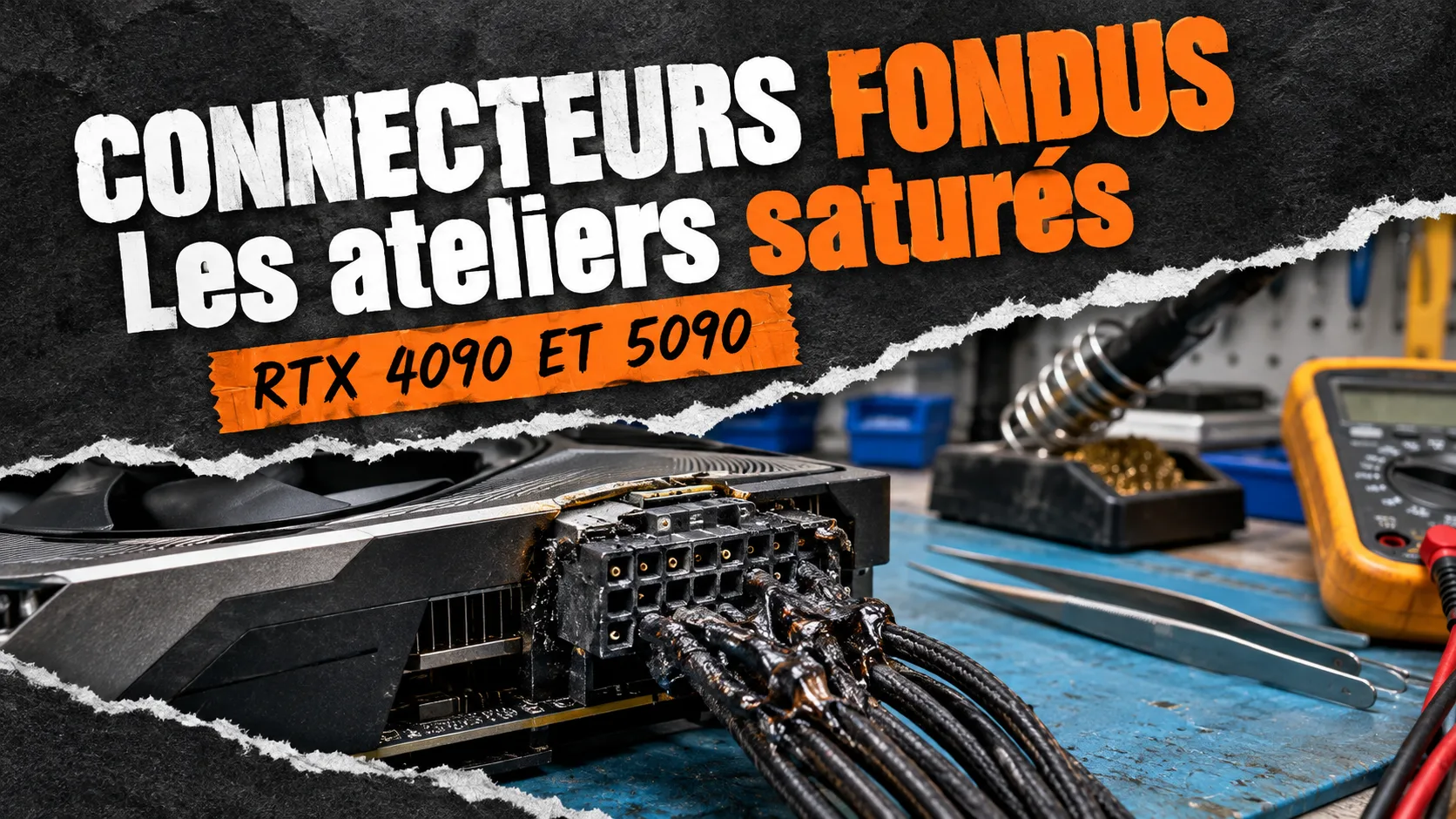
Seven cards in two days at a Chinese workshop, ten in two days according to another report: melted connectors on high-end RTX cards are no longer the isolated cases you read about on forums. PC Gamer (Dave James, October 21, 2026) reports the seven cards received by the repair channel « 修电脑的张哥 » (Zhang the Computer Repairman), and Tech4Gamers (Sajjad Hussain, October 25) counts ten, mostly RTX 4090s. What stands out: these melted connectors hit several brands and the previous generation.
Seven, eight or ten cards: why the counts differ
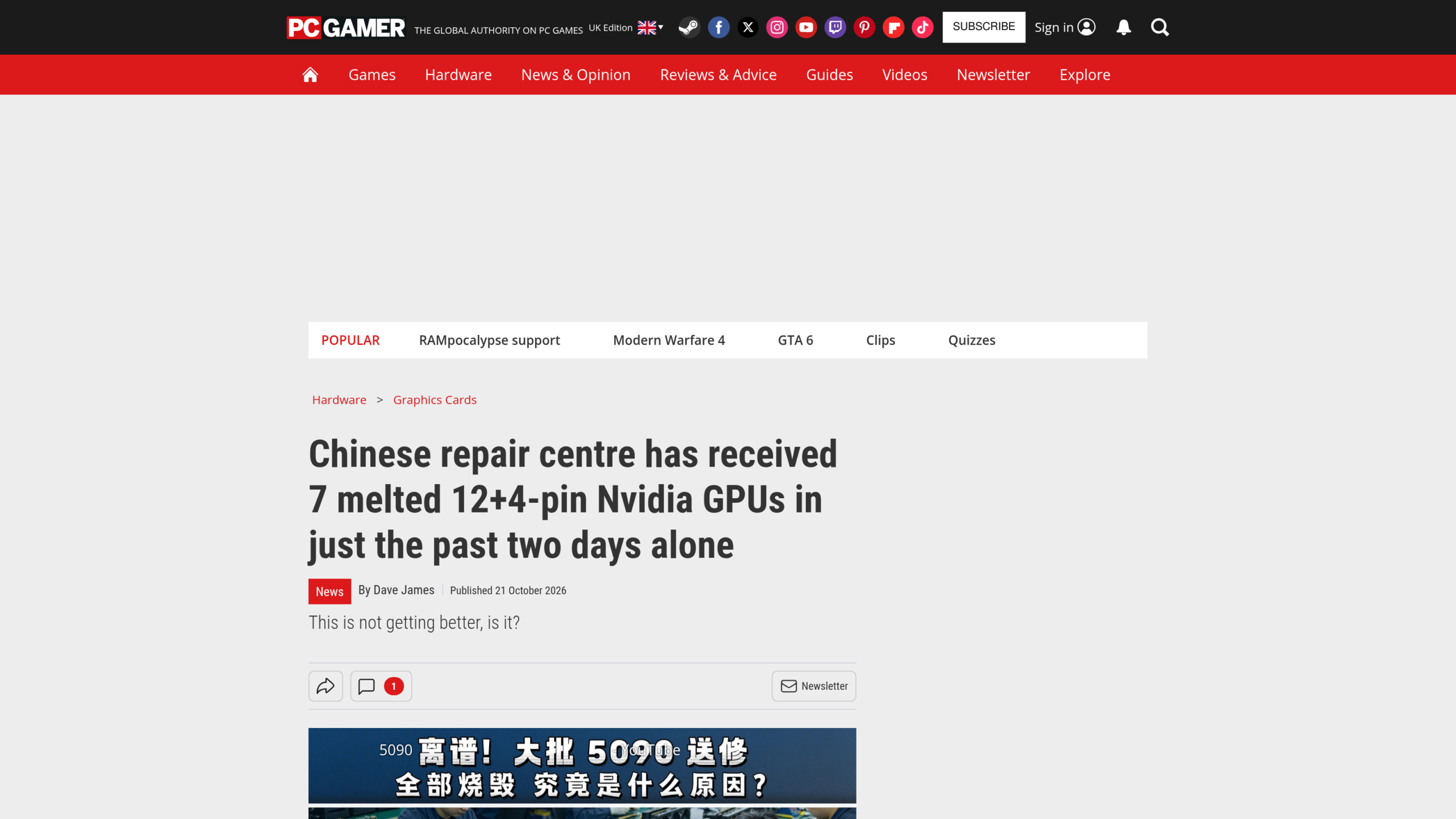
Three figures are circulating, and it is better to set them side by side than to pick one. PC Gamer reports seven cards, « mostly RTX 5090s », with Asus and MSI RTX 4090s, a Gainward and an RTX 5090 Founders Edition in the batch. The outlet draws on the repairer’s video via the Uniko’s Hardware account. Tech4Gamers, four days later, writes ten cards in two days: eight RTX 4090s and two RTX 5090s, from MSI, ASUS and Gainward, crediting Wccftech for the report.
The headline of an article from VideoCardz announces eight RTX 5090 and 4090 cards in two days. That page refused us access, so we cannot read the details. The three totals do not necessarily contradict each other: the two-day windows are not the same, and the split between 4090 and 5090 changes from one report to another. We could not re-watch the original video, and none of the sources says whether Tech4Gamers’ ten cards include PC Gamer’s seven. Keep the order of magnitude in mind: several cards a day in a single workshop.
Melted connectors on every brand, and on the 4090
In PC Gamer’s images, either the card’s socket is burned and sometimes blackens the circuit board, or the cable’s connector has melted into the socket, to the point where the owner had to cut the cable to ship the card. The repairer removes the interface, cleans the contacts and solders on a new 12+4-pin socket (the power connector of these cards, also called 12V-2×6), then tests each card in 3DMark. According to the outlet, some still run a little hot, cable at the power supply included, with nothing worrying.
Another point the outlet notes: users did not necessarily have a weak power supply, and some PCs came from laboratories. For Dave James, the problem therefore does not come only from cheap adapters, old power supplies or misaligned cables. The power drawn by these cards puts cables and sockets under heavy strain. Tech4Gamers goes the same way: despite the redesign of 12VHPWR into 12V-2×6, RTX 4090 and 5090 cards keep burning their connector.
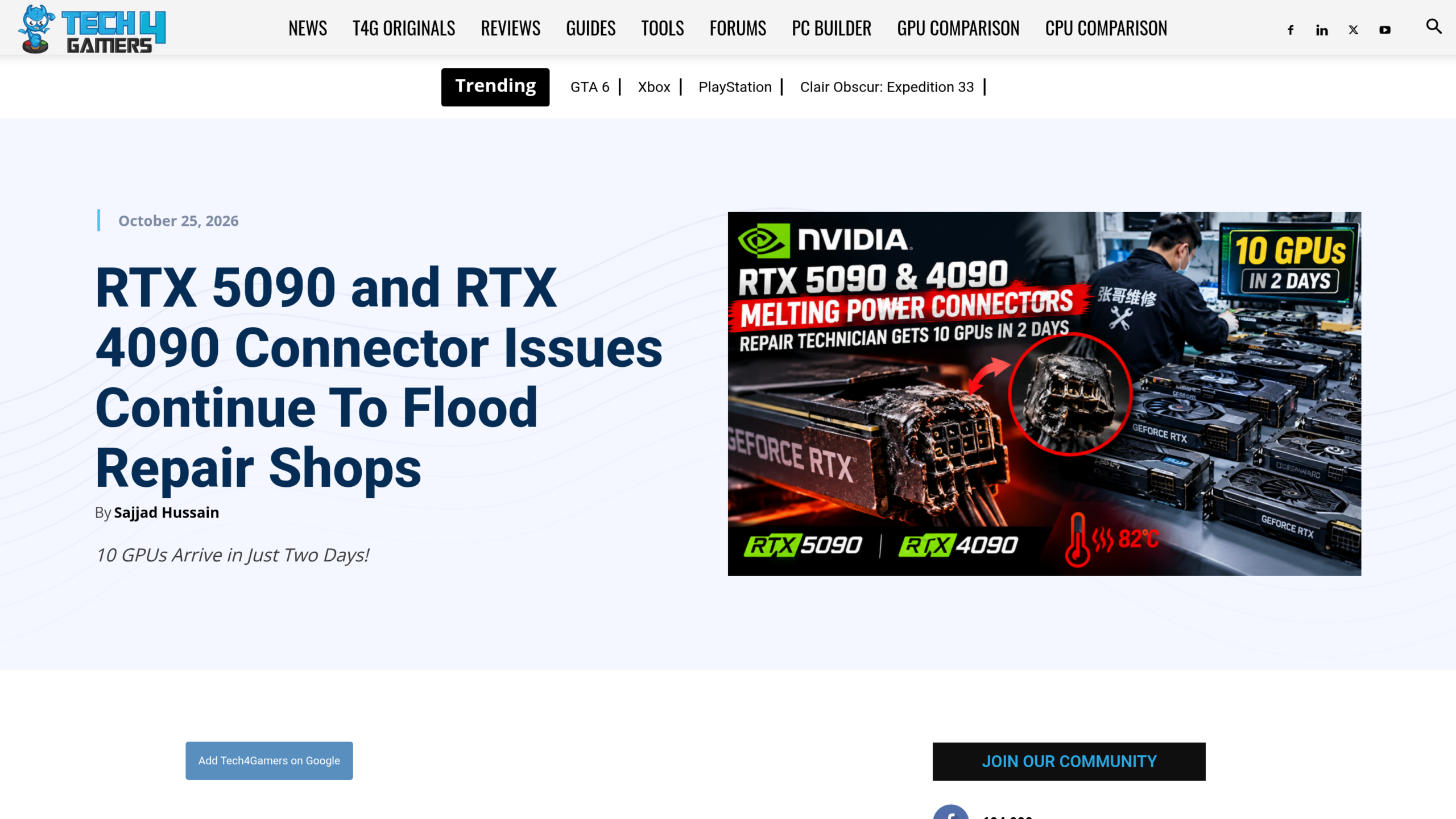
One concrete case: a Gainward RTX 5090 whose connector had melted and fused to the cable. After repair, the technician measured about 82 °C on the connector of an RTX 5090, which Tech4Gamers considers abnormal for a new socket. That figure comes from a single test, with no published protocol.
Warranty and adapters: the workshop becomes the last resort
Why do these cards end up at an independent repairer? Tech4Gamers argues that replacement units are not always available, and that « several manufacturers have refused warranty repairs when consumers used unapproved connections or adapters ». The site names no manufacturer and no specific case.
It is the same mechanism we noted when PNY refused the warranty on a melted RTX 5090 because of the power cable. And an original cable does not protect for sure: the MSI RTX 5090 Vanguard melted with its original cable is the most recent example. When the warranty closes, the independent workshop remains an option for owners of melted connectors.
Monitoring your connector: what the workshops say
The repairer gives two simple checks, reported by PC Gamer. First the finger: during use, the back of the hand placed on the cable a few centimetres from the card should feel moderate warmth, and a cable too hot to touch signals a problem. Then GPU-Z, which shows the voltage of the 12+4-pin connector: on failing cards it drops well below 12 V, to around 11.3 or 11.4 V, and you should then check the temperature by hand.
Accessories exist too. Tech4Gamers cites Thermal Grizzly’s WireView Pro II, which triggers alarms and can shut the PC down in an emergency, and PC Gamer mentions an overcurrent protection dongle from Super Flower. Tech4Gamers warns that these tools treat the symptom, not the cause. As for plugging in, GameGPU noted in the Vanguard case that a poorly seated plug or mechanical stress can increase contact resistance: push the connector in fully and avoid bending the cable right against the card, even though the sources for this article do not establish it as a cause.
One bias remains that PC Gamer admits itself: this channel is widely followed on Bilibili and YouTube, and may receive more cards than an ordinary workshop. We had already seen a RTX 5090 cable melt during a DLSS 5 test : here, the volume changes the reading.






0 Commentaires
Aucun commentaire pour le moment. Soyez le premier à commenter !