Blizzard has just put an end to the uncertainty surrounding restrictions on WoW Forever addons. According to the analysis MysticalOS WoW dedicates to the topic in a recent video, these restrictions will be strictly identical to those already in force on retail, in other words on the content of the Midnight expansion. No lightweight version for a server otherwise designed as a space of total freedom in class composition.
The topic goes beyond a simple question of technical compatibility. It touches on how people will actually be able to play on Forever: which tools will remain available to track a fight, which calculations WoW Forever addons will still be allowed to make on the player’s behalf, and what Blizzard is about to shut down in the coming months. This article goes through the video’s analysis point by point, from Blizzard’s overall philosophy to the prediction about the next big restriction to come.
Two announcements that redraw the rules for WoW Forever addons
Blizzard has just settled a question that has been stirring the community for months. WoW Forever addons will face exactly the same restrictions as the current retail content, that of the Midnight expansion. No exception, no lightweight version for the classless server.
Confirmation came from an interview given to Warcraft Tavern on September 14, 2026. Ion Hazzikostas and Holly Longdale go back over the alignment between Forever and Midnight on this exact topic, add-ons included.
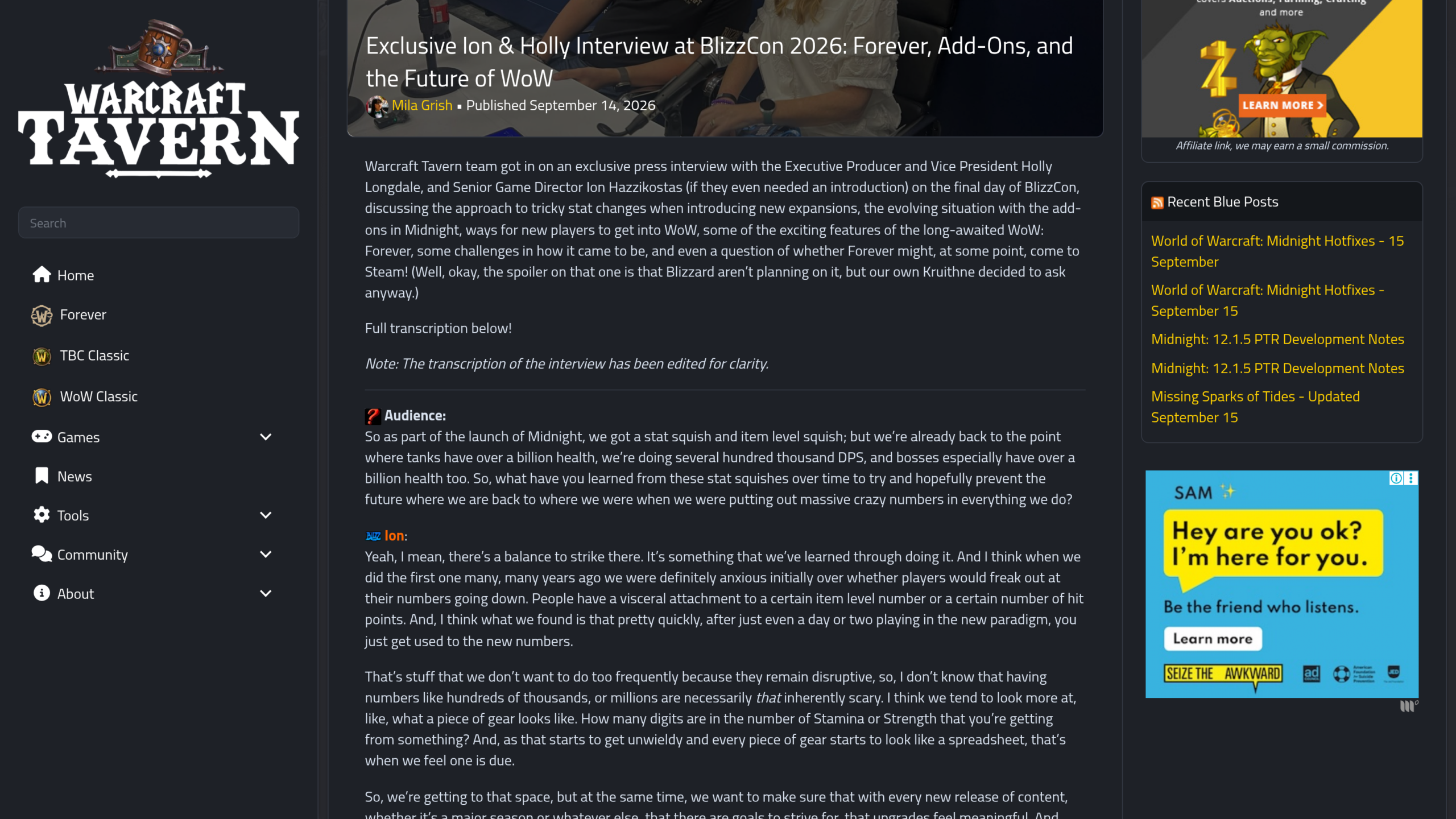
The real change lies in the promise of synchronization between the two games. A restriction added on retail will be carried over to Forever as of the following patch, and vice versa. Blizzard is working from the assumption that Forever players, with their total freedom in class composition, will invent add-on uses that retail has never seen. Fixes found on Forever will then flow back up to the main game.
In practice, the two versions will now move forward hand in hand on this front, with constant back-and-forth between the teams managing each game.
What the restrictions look like on the current game
MysticalOS starts by looking at what WoW Forever addons already face today, from a concrete example: a classic raid fight on the current retail game. It’s the baseline for understanding what the restricted API already allows today, even before talking about Forever.
Despite the limitations imposed on addons, this raid keeps the functions that actually matter in-game. Boss timers (the well-known ability timers that show the countdown before a mechanic) remain available. And above all, patch 12.1 introduces a new aura container that transforms how buffs and debuffs are displayed.
This container allows full customization. Icon size, spell borders, built-in filters to sort what gets displayed: a player who no longer wants to watch their debuffs at the top of the screen can move them to the center with large, clearly visible icons. All of that remains possible with the restricted API, without any unauthorized third-party addon.
For Forever, MysticalOS makes an important point: the interface will be less cluttered than this retail raid. Fewer boss mechanics, less visual noise, less overall complexity. But the technical foundation stays the same. Forever players will therefore have access to the same level of aura customization, on content designed to be more readable from the start.
What remains unclear: timers and the combat timeline
MysticalOS then tests the encounter to show everything the restricted API still allows through. Sound alerts, text alerts, timers, on-screen renamed abilities. None of that is really missing.
The real question mark hangs over the combat timeline. It’s not yet clear what form it will take on the retail client, or on Forever. But the demo shown at BlizzCon already showed a dedicated boss-warnings interface option. That detail changes a lot of things.
If this API really exists on the Forever side, addons like BigWigs, DBM, or improved combat-timeline versions could keep existing. They would hook into this native timeline and simply change how it’s displayed to make it more readable. That’s exactly the logic behind this kind of addon, and always has been.
Blizzard’s philosophy on addons
These examples outline the broader rule that will also govern WoW Forever addons, one the studio finally put down in black and white. Blizzard draws a clear line between two things that often get confused: displaying a piece of information and being the source of that information. An addon can rearrange a screen, change colors, show a bar in a different spot. That’s presentation, and Blizzard allows it without any issue.
What Blizzard Entertainment refuses is for an addon to become the source of a piece of data the game doesn’t natively provide. The studio wants to remain the sole curator of raw combat information. Addons keep the right to display it differently, never to calculate or guess it on their own.
The official post mentions the notion of a protected value: a piece of data that Blizzard knows, that it chooses to show through an addon, but that the addon can neither read directly nor reconstruct on its own. Combat stays a black box. Addons can redecorate it, not open it.
Why Blizzard leaves a door open for accessibility
This principle also holds up in practice, not just in the official texts. On ENC, the same pattern shows up again. MysticalOS had set up a custom voice alert that calls out « frontal » (a ground mechanic to avoid in front of the boss), and Blizzard lets it through. Not by oversight, but because this feature serves accessibility. Some players need this kind of signal to perceive the danger, not to shave off a few extra milliseconds of reaction time.
This is where Blizzard’s limit becomes clear. Ripping out every advanced feature at once would exclude some of the players who depend on them just to be able to play at all. So the studio keeps some leeway on these specific cases, even when the line with pure performance optimization stays blurry.
Finding the balance after the lessons of a rocky launch
Blizzard is looking for a balance between freedom and restriction, and has been testing this formula on retail since addon restrictions launched, the same formula that will shape WoW Forever addons. That launch was chaotic. Entire addons stopped working, some APIs were missing to reproduce functions the base interface already offered, and players had to wait patch after patch to get basic tools back. The restrictions also affect how efficient certain playstyles are, as shown by the recent brake put on mage AoE farming.
Patch 12.1 marks a real turning point in this story: that same aura container mentioned above now lets you add a sound to any buff or debuff received. In practice, that opens the door to very concrete accessibility uses: a player can trigger a sound signal as soon as they get a proc or take a specific debuff.
Picture it in action: a player hears a sound calling out « bomb » as soon as they receive a time-bomb-type debuff, without having to constantly watch their buff bar. That’s exactly the kind of feature addons used to offer effortlessly, and that Blizzard is now trying to catch up on with its own native tools.
What Blizzard categorically refuses
Blizzard’s blacklist is clear. It doesn’t want addons like WeakAuras solving a mechanic entirely on their own, in the player’s place. Automatic monster marking, automatic movement instructions: refused. Same thing for detecting who else received a debuff.
The aura container illustrates the principle well. A player can see their own debuff, never that of other players in the raid. The addon itself knows nothing: it simply asks Blizzard to display an icon and play a sound when the debuff lands. It’s Blizzard that carries out the display, not the addon.
Result: it’s impossible to calculate who’s carrying the bomb, where that person is standing, or what to do with that information. The addon never sees this data, so it can never cross-reference it.
The rule fits in one sentence: displaying information is allowed. Telling the player what to do with it is not.
Most non-calculating WoW Forever addons will keep working
MysticalOS hammers this point throughout the whole video. On retail, with the restrictions already active, he runs a fully customized interface from top to bottom. Custom raid frames, party frames, target frame, player frame: everything is modified compared to the base interface. Nothing forces him to play with the vanilla UI.
For his damage meter, he uses Blizzard’s built-in tool, the one already present on both Forever and retail. You can install an addon like Details and customize its display on top of it. The mechanism just changes in nature: Blizzard becomes the mandatory middleman for combat information, rather than an addon fetching the data on its own.
This nuance has a real cost. An addon like Details will keep working, but with fewer features than before, because it only receives what Blizzard agrees to share. And Blizzard shares less detailed information than what an addon used to grab on its own, without a middleman. Some advanced features will therefore disappear, not the tool as a whole.
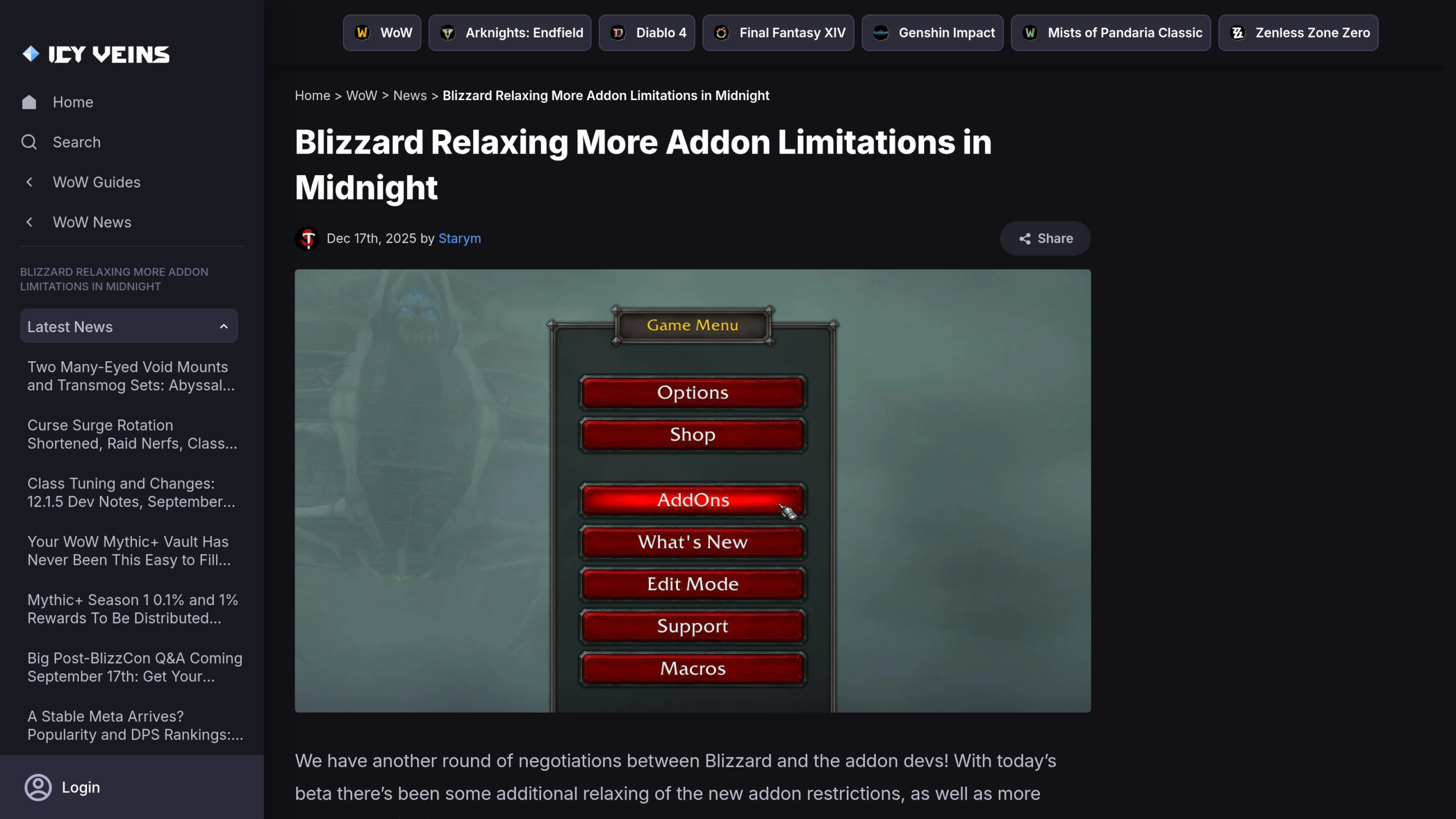
An article from Icy Veins, published last December, shows that Blizzard is indeed moving in this direction. Spells once invisible to addons are now exposed, like the Shaman’s Maelstrom Weapon or the Demon Hunter’s Soul Fragments. The list of restrictions isn’t set in stone. It keeps narrowing as addon developers give feedback.
The takeaway fits in one sentence. Specific features will disappear by the time Forever launches, but no one will be left stuck with a raw vanilla interface and no recourse.
This time, no endless waiting
This continuity also owes a lot to another factor: how fast addon creators will be able to adapt. Forever’s advantage is its API being identical to retail’s, described as a « one-for-one » match. In practice, addon creators won’t need to wait weeks to adapt their tools. MysticalOS explains he already has a reserved spot on the beta access list. As soon as it opens, he plans to import his retail addons as-is and see what needs adjusting.
The technical change is simple to understand. In an addon’s code, a typical condition says « if it’s retail, do this, otherwise if it’s classic, do that. » With Forever, that condition becomes « if it’s retail or Forever, do this, otherwise if it’s classic, do that. » Classic Era, Classic, and The Burning Crusade Anniversary stay on the old, unrestricted API, unchanged.
This closeness also changes the speed of updates. Many retail addons never get ported to Classic, because developers refuse to maintain two separate versions of the same tool. With Forever and Midnight, a single version is enough most of the time, since the features are nearly identical. Only very specific systems, like professions, will be the exception: Forever’s differ too much from retail’s to share the same code.
Expected result for players: unit frames, boss mods, and aura displays should be working from the first or second day of the beta. A much shorter delay than what’s usually seen on Classic.
Still some time before Forever launches
MysticalOS wraps up his point on this topic with a simple reminder: there are still about two months left between the beta and the official launch. During that time, retail and Forever each keep polishing their own game. The game that ships will therefore be more finished than the version tested in the beta.
New restrictions already announced for the current game
MysticalOS moves on to what’s next. The PTR (the public test realm, where Blizzard has players test changes before officially releasing them) for version 12.1.7 should arrive soon on the retail game, followed by 12.2. And an article has already revealed that Blizzard is preparing new addon restrictions, notably on interrupt trackers: those tools that show the cooldown of other players’ interrupt spells, heavily used in PvP and Mythic+ dungeons.
For MysticalOS, the conclusion is clear: this restriction will eventually hit WoW Forever addons too. But it will land on retail first. He has his theories about how Blizzard will handle it technically, but nothing is confirmed until a new PTR comes out.
He also points to a deeper issue: the current API still has open loopholes, capable of allowing certain abuses despite the locks already in place. He announces he’s going to detail one of them later in the video.
What I predict for the next restriction
To understand MysticalOS’s prediction for WoW Forever addons, you first need to look at how things work today on retail. The spell’s ID, its exact name, and its target are secret information. Addons can’t read them directly. But the game still sends events when a spell is cast, like « unit spellcast succeeded » or « unit spellcast start » (internal messages that tell the addon a spell action just happened). These events just say « something is happening, » never exactly what.
The problem, according to MysticalOS, is that addon creators are creative. Very creative. There might only be a handful of people at Blizzard working on this API, while there are thousands of addon authors out there, many of them capable of very sharp reasoning. And sharp reasoning, applied to enough small clues, ends up reconstructing the information that was supposed to stay hidden.
MysticalOS lays out the concrete example. You’re facing the third mob pack of a dungeon, on a well-known standard pull. The community’s routing addon is already installed and knows exactly where the group is on the route. This pull has three monsters, one of which has a different level from the other two. With just that, the addon already knows which of these monsters just cast something. It then cross-references the time elapsed since the fight started. Twelve seconds into combat, for instance, generally matches the moment that monster casts its first ability, one already known from experience. By stacking these clues, the addon guesses the spell without ever having access to its name.
This is what MysticalOS calls disambiguation (resolving an ambiguity by cross-referencing several partial pieces of information to get a precise answer). Each clue on its own means nothing. The current pull, the monster’s level, the fight’s duration, and the position on a known route all stay vague on their own. But added together, these clues point to a single possible answer. MysticalOS compares it to algebra, where you solve for X using several equations. The spell officially stays secret, but every other variable around it isn’t, and that’s enough to figure it out.
MysticalOS draws a precise prediction from this: Blizzard is going to pull the same move it did with auras in the 12.1 update. Back then, the « unit aura » API simply signaled that an update had happened, without saying which one. Addons would then run calculations to compare variables and guess which buff had just appeared or disappeared. Blizzard closed that door by turning the system into a secured container, a kind of sealed box where the addon can now only observe the final result, without ever accessing the raw data that produced it.
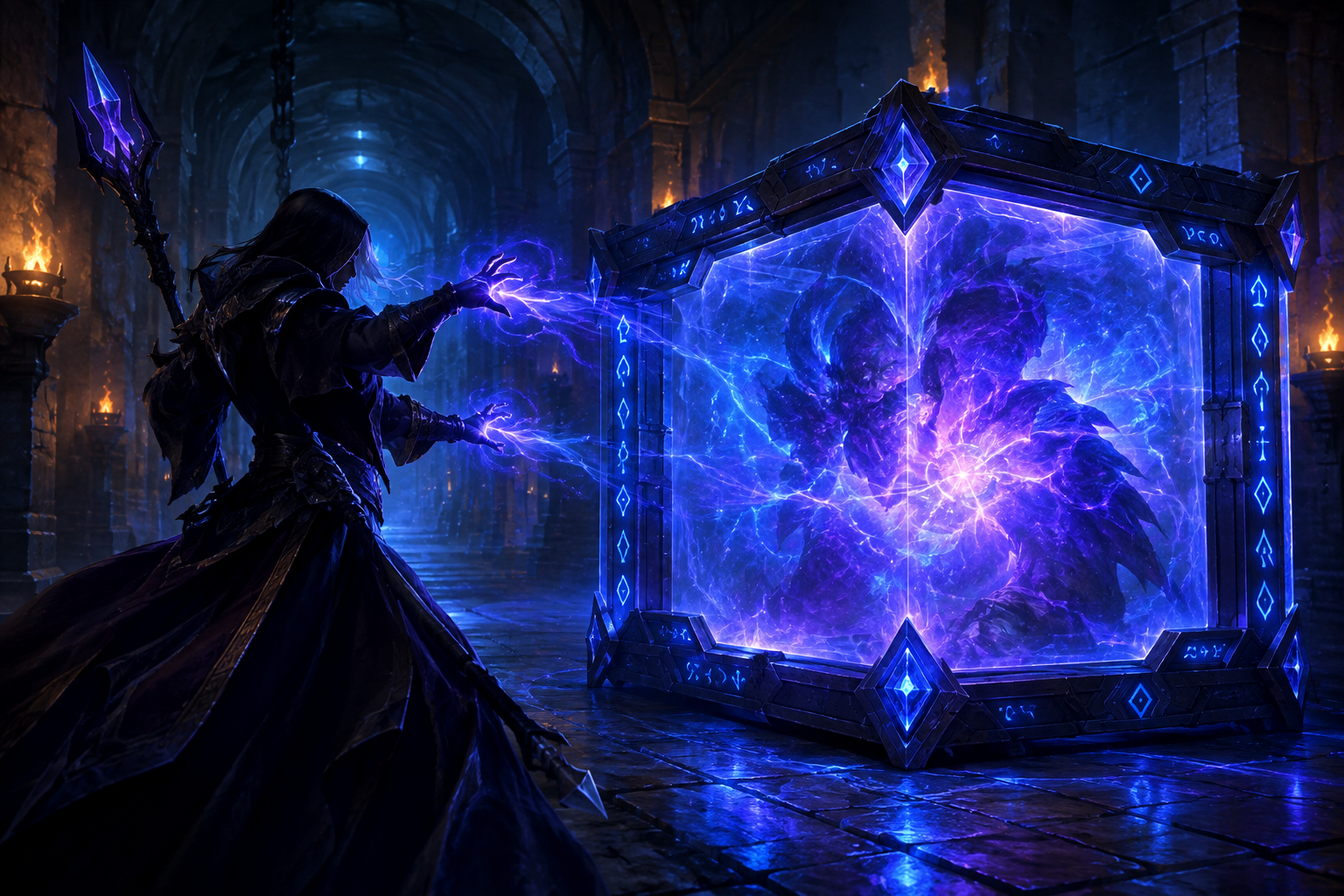
MysticalOS is categorical on this point: the « unit spellcast » events are going away. In their place, Blizzard would create a new secured container, attached directly to the monster’s or player’s nameplate (the floating info bar above a character). This container would itself display the caster, the target, and the spell’s name, without ever telling the addon that a spell had been cast. The addon would no longer receive any signal to interpret. It could only look at what Blizzard chooses to display in the box, without touching it or triggering it itself.
The practical consequence would be heavy for a whole family of addons. Interrupt trackers (addons that follow enemy interrupt cooldowns) and Mythic+ dungeon mods like BigWigs or DBM, which display spell timers even for trash mobs, rely precisely on this cast signal to work. Without it, there would be no way to know a spell has started, let alone which one. Addons could still try to approximate it with scheduling (guessing in advance when a spell should land, without confirmation from the game), but it would increasingly be a guess rather than a certainty. And for other players, it would be even worse: without a spell-cast event, tracking enemy interrupt cooldowns would become almost impossible.
For MysticalOS, this is the logical continuation of what he calls an arms race between Blizzard and addon creators. He places this restriction on retail’s version 12.2, before it inevitably lands on WoW Forever one day. After the aura container, this would be the next big lock in this technical battle, and not the last.
Answers to the expected questions on WoW Forever addons: WeakAuras, quest helpers, maps
Quest helpers aren’t affected
MysticalOS already anticipates the question and answers before it’s even asked. Blizzard is targeting calculation addons used during combat. Anything that helps with exploration stays untouched. Arrows pointing to an objective, useful notes like HandyNotes, outdoor directions: none of that is affected.
A small technical update will probably be needed. Forever’s interface changes in places, so some addons’ code will need to adjust. But that has nothing to do with the restrictions. It’s just ordinary compatibility work. The real restrictions only affect combat: PvP, dungeons, and raids. The rest of the game keeps its tools intact.
WeakAuras loses its calculation part
Here, the answer is harder to hear. WeakAuras as we know it is going away, at least for its calculation side. No more « if my health drops below 20%, trigger this alert » or « if my mana is low, show this. » The aura container can still show a piece of information and play a sound, but it will no longer be able to read that information to reason about it. Health, names, and creature IDs become secret data, invisible to the code.
A configuration interface might survive despite all this. You’d manually enter a spell ID and a sound file to play when a given proc or debuff appears. But it will be up to some other tool to carry that, or to community forks of WeakAuras that already exist and offer similar features. WeakAuras in its current form, the version that calculates and decides on its own, is over.
The fate of Classic-exclusive addons
Last question, and a quicker one. What happens to addons that only exist for Classic, with no retail equivalent? MysticalOS thinks many will choose to disappear rather than adapt. That’s exactly what happened on retail when similar restrictions arrived.
These addons would then remain accessible only on Classic Era and on The Burning Crusade Anniversary realms, the only places where the old ruleset will keep existing. For Forever, they’ll have to evolve or get left behind.
Following what comes next
WoW Forever’s beta is set to open in the days following this video, with a possible update the following Thursday. That’s the moment that really matters. Until someone gets their hands on the client, hypotheses about this restricted API remain just hypotheses. Once the beta launches, it will be possible to test under real conditions: which calls go through, which displays persist, and exactly where the line sits between tolerated information and blocked information.
The underlying question raised by this whole story remains: will retail follow the same path as WoW Forever addons? Upcoming PTRs on the main game will give a real answer, far from any extrapolation. In the meantime, the only certainty is that addon design already needs to factor in the idea of tighter access to game data than today.







0 Commentaires
Aucun commentaire pour le moment. Soyez le premier à commenter !