
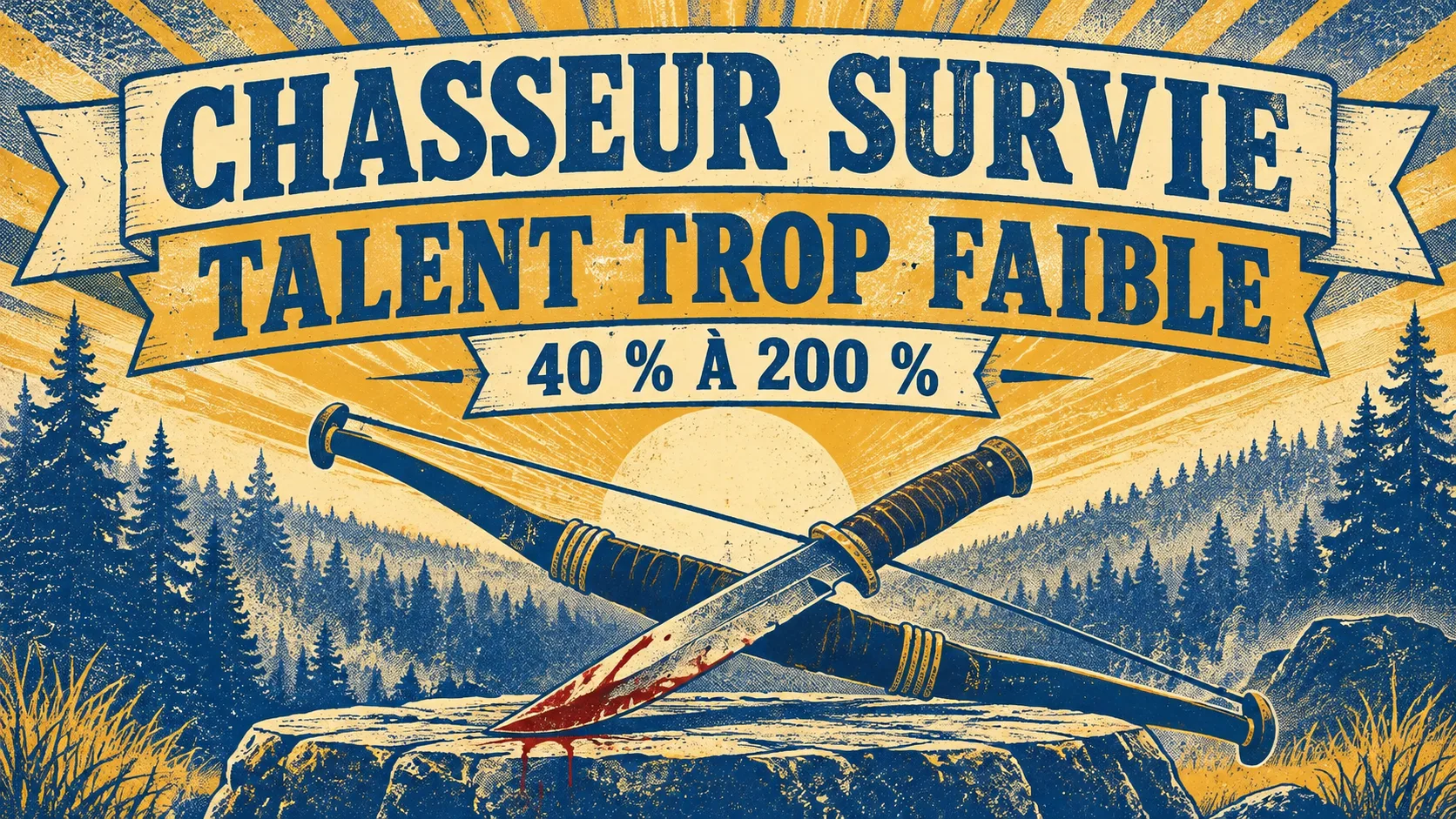
Lacerating Strikes, the capstone talent of the Survival tree, makes the target bleed for 40% of the damage of a Mongoose Bite, spread over 21 seconds. A Blizzard designer thinks it should go above 100% and does not rule out 200%. For a Survival Hunter, that means multiplying this bleed by at least two and a half, and up to five.
The admission comes in episode 8 of the official WoW Forever podcast, “Catching Up On Classes”, posted on November 19, 2026 on the World of Warcraft YouTube channel. Host Josh Corbett is joined by Aidan Moon (Senior Game Designer) and Kris Zierhut (Principal Designer). The Arms Warrior chapter runs from 53:31 to 59:55, and the Hunters chapter from 1:04:42 to 1:07:19. A podcast is not a patch note: no hotfix date is given, and each point below is classed as already in the game, considered, refused or pending.
Survival Hunter: a capstone talent tuned too low
Josh Corbett opens the topic by relaying player feedback: since seeing this capstone talent, Hunters have been wondering whether they are missing something (1:04:48). In the client, the text reads: “Your Mongoose Bite also causes the target to Bleed for damage equal to 40% of the damage done by Mongoose Bite over 21 sec.” The talent sits on row 7 of the tree, with a single rank.
Kris Zierhut explains where the idea came from. In early 2005, before the Hunter talent rework, the 31-point talent of the Survival branch was Lacerate, a copy of Rend that cost mana instead of rage, and that players found weak. The team wanted to bring it back for a more melee-oriented Survival. The first version, more powerful, seemed to add too many buttons, so the bleed became an effect of Mongoose Bite. Kris Zierhut’s verdict fits in one sentence: “we just got the tuning wrong on this.”
| Point | Today (client text) | What Blizzard suggests | Status |
|---|---|---|---|
| Bleed damage | 40% of Mongoose Bite’s damage, over 21 sec | More than 100%, perhaps up to 200% | Considered, no value set |
| Successive applications | The client text does not mention it | Should stack, like Deep Wounds and Ignite (the burn that builds up on Fire Mages), instead of overwriting each other | Considered |
| Timing of the change | None | After the raid data | No date |
Stacking is half of the change. Kris Zierhut wants two Mongoose Bites in quick succession to stack their bleeds, like Deep Wounds and Ignite, the two examples given. The value, though, remains a range: “Maybe even as high as 200%.” At 100%, the bleed would already be worth two and a half times its current value. Our Survival Hunter build and its leveling counterpart already take this talent; nothing requires changing them until a number is published.

Strider Kick and raid data: what will decide the tuning
Two designers agree on the diagnosis: the Survival Hunter capstone talent is too weak today. They announce a retuning but make it depend on raid results: “if survival is too low, it’s absolutely where they’re going to get buffed.” If it is not, Blizzard will rather look to take power away elsewhere and move it onto this talent.
At 1:06:27, one of the two developers floats the idea of swapping this capstone talent with Strider Kick, then sets it aside: players have already seen the tree, and removing a talent people like is hard. No swap is announced.
Arms Warrior: no idea safe enough to act on
Same question on the Warrior side. Josh Corbett relays player feedback: Protection and Fury are happy, but Arms feels “same same as usual.” Where is the wow factor? Aidan Moon answers that it is a good tree for what it already does, with bleeds already in place: Rend, Overpower triggered by Rend, and Deep Wounds. Then the designer is blunt: “I think bleeds are just not very interesting.”
Finding something better is the hard part, and that is where it stops. Aidan Moon cites a personal idea, a Whirlwind you hold down that drains rage every second, then admits that no idea is safe enough for the Arms tree. Arms Warrior is already very strong in PvP, with the game’s only Mortal Strike, apart from a partial exception for the Hunter pet and Wound Poison. In PvE (player versus environment), its damage is “mildly competitive,” which is where Blizzard wants it. A botched change would be hard to take back: one good change beats several small tweaks.
| Lead | What is said | Status |
|---|---|---|
| Held Whirlwind that drains rage | The designer’s personal idea, thrown out to see where it would go | No plan |
| A talent unique to Arms | No idea judged right for now | Pending |
| More mobility | The designer’s firm position: no more mobility, at least in the Arms tree. A personal opinion, as the episode makes clear | Refused |
| Slowing or immobilizing | Improved Hamstring and Spearing Strike (which dismounts) serve as examples | Already in the game, nothing new announced |
Refusing mobility has its logic: keeping a Warrior at range should stay rewarding, otherwise everyone ends up chasing everyone. For anyone playing Arms or Survival Hunter, nothing changes in the short term: see our PvE and PvP builds.
What cannot be taken back
Kris Zierhut widens the point: before launch, the team went through the risky abilities, the ones that could never be removed. That explains why Wild Growth has a cast time and why Riptide has no initial heal. The team’s rule: “once they’re in the game we can’t take them back.” Adding later is always possible. Older class announcements are in our article on episode 2 of the podcast.






0 Commentaires
Aucun commentaire pour le moment. Soyez le premier à commenter !