In July 2021, the State of California sued Activision Blizzard. The complaint described a toxic internal culture, harassment, and pay inequality. Everyone remembers what followed: a walkout outside the Irvine headquarters, a Blizzard president stepping down, developers fired, and names erased from World of Warcraft.
Five years later, the case resurfaced. A federal indictment against a former aide to California’s governor’s office mentions Activision Blizzard, and a sentence buried in the 2023 settlement documents has been circulating everywhere. It states that no independent investigation corroborated the existence of systemic harassment. Many drew a simple conclusion from it: it was all fake.
The documents say something else, and they are publicly available. This report goes back to every source document: the original complaint, the three settlements signed with three different regulators, the official texts, the dates. You’ll find what is established, what got dropped along the way, and what no one can claim today, in either direction.
Table of contents
- Why this case is back in 2026A federal indictment, a viral article, and a mixed-up topic
- What the 2021 complaint actually allegedThe exact content of the document, and how to read a legal complaint
- The breast milk storyThe most-cited allegation doesn’t come from the complaint
- The most serious case was never triedThe 2017 suicide and the complaint the family withdrew
- What regulators put in writing$18M, $35M, and $54.9M, and the sentence everyone quotes
- The war between the two agenciesA firing, a resignation, and claims of interference back in 2022
- The price paidCareers, games rewritten, players who left, then the Microsoft buyout
- What can be said, and what can’tThe three-column summary
- The short version, without the jargonThe essentials in 9 points, if the story is new to you
Why this five-year-old case is back in 2026
On November 12, 2025, Dana Williamson was arrested in California. A former chief of staff to Governor Gavin Newsom, in office from December 2022 to November 2024, she faces a federal indictment on 23 counts: bank fraud, wire fraud, conspiracy, false tax filings, and lying to the FBI. The case, which at first seems to have nothing to do with video games, contains a section directly tied to Activision Blizzard.
According to the indictment, in spring 2023, while working at the governor’s office, Williamson allegedly passed confidential information to lobbyist Alexis Podesta. She reportedly told Podesta she had asked a senior government lawyer to move the Activision Blizzard case to another part of the state administration and get it settled. Activision Blizzard had been a client of Williamson’s before she joined the governor’s office. The company later became a client of Podesta’s. None of this has been tried in court: an indictment remains an accusation, not a conviction.
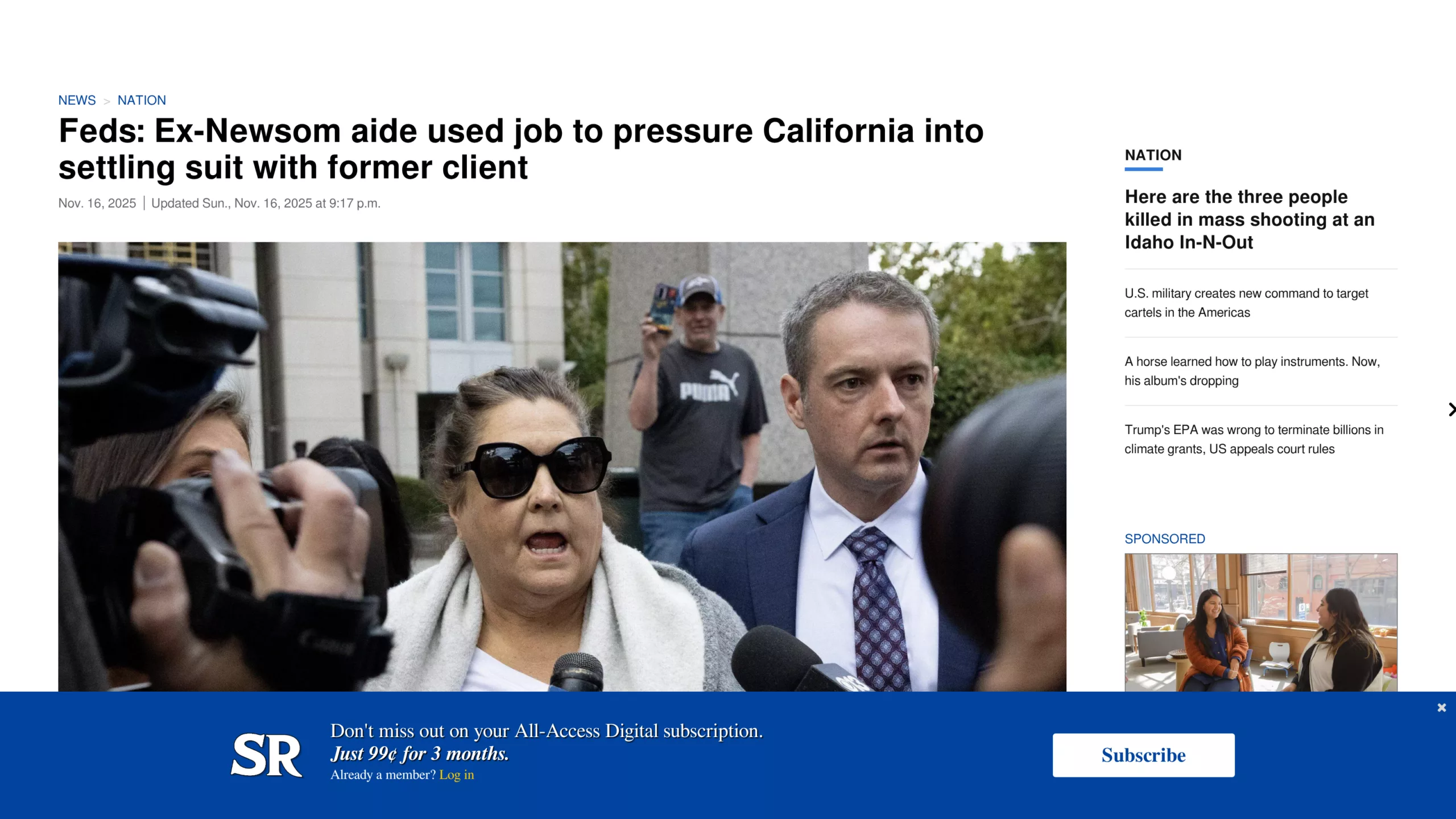
The settlement between the State of California and Activision Blizzard was signed in December 2023, a few months after the events described in the indictment. Asked about this, Governor Newsom’s office said he expects all public servants to uphold the highest standards of integrity.
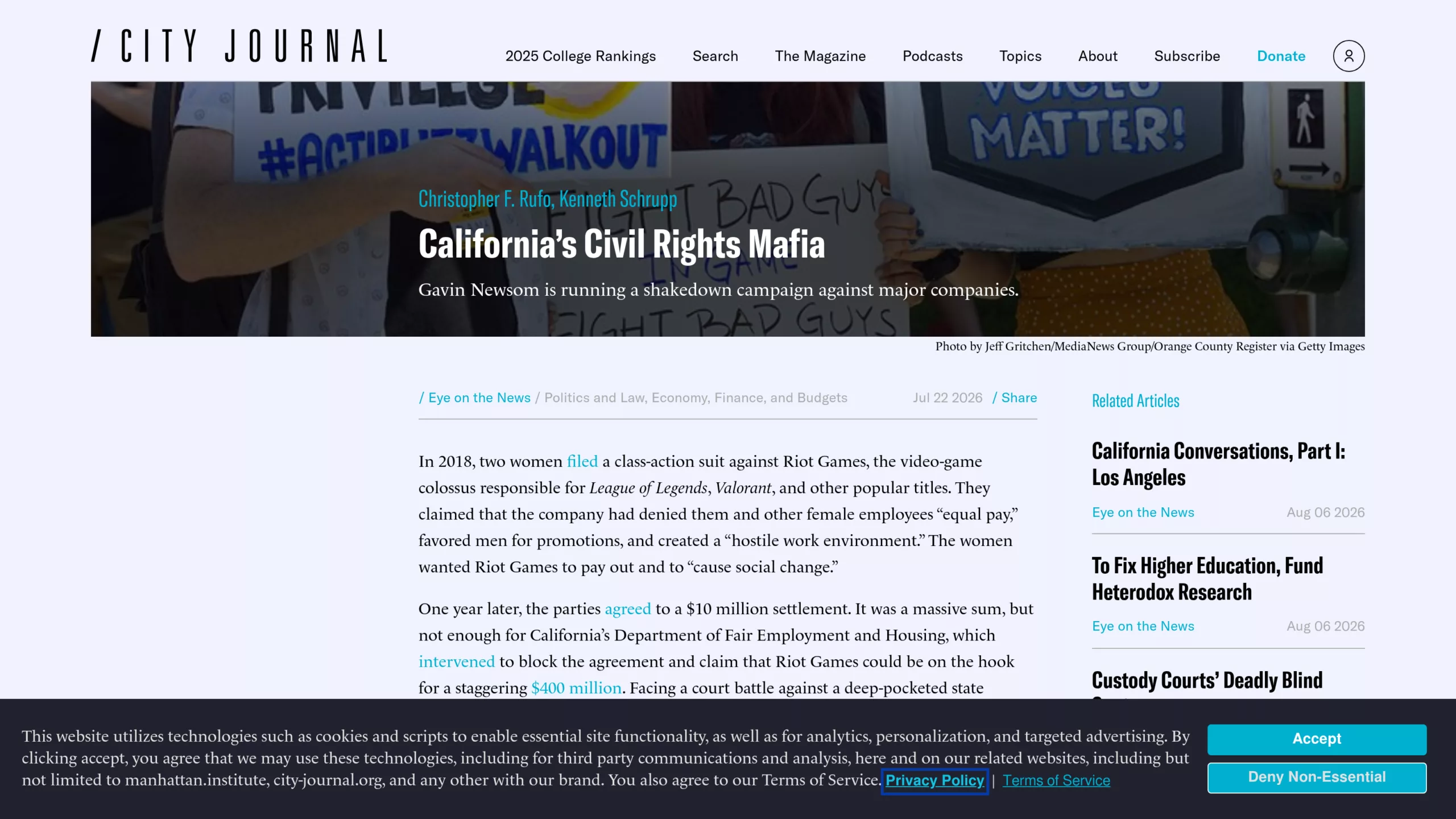
On July 22, 2026, City Journal published an article titled ‘California’s Civil Rights Mafia,’ written by Christopher F. Rufo and Kenneth Schrupp. The piece, published by the conservative think tank Manhattan Institute, revisits the case built against California’s civil rights agency. It is an opinion source with a clear stance, to be read as such, not as a neutral judicial account. In early August 2026, reposts of this article spread widely on social media and among some commentators, who claim that ‘it was all fake.’ That phrase overstates what the documents actually say.
One distinction matters before going further. What’s new in 2025 and 2026 isn’t fresh evidence about the harassment itself. It’s about whether the process that led to the settlement reached in late 2023 was handled properly. The conduct alleged against Activision Blizzard and how the case was handled by California’s administration are two separate questions. This report goes through every piece of the record, one by one.
July 2021: what the California complaint actually alleged
On July 20, 2021, the California Department of Fair Employment and Housing (DFEH), since renamed the Civil Rights Department (CRD), filed a civil complaint in Los Angeles County Superior Court. Three entities were named: Activision Blizzard, Blizzard Entertainment, and Activision Publishing. The agency made its official announcement public the next day, July 21, 2021, saying it was closing an investigation that had lasted more than two years.
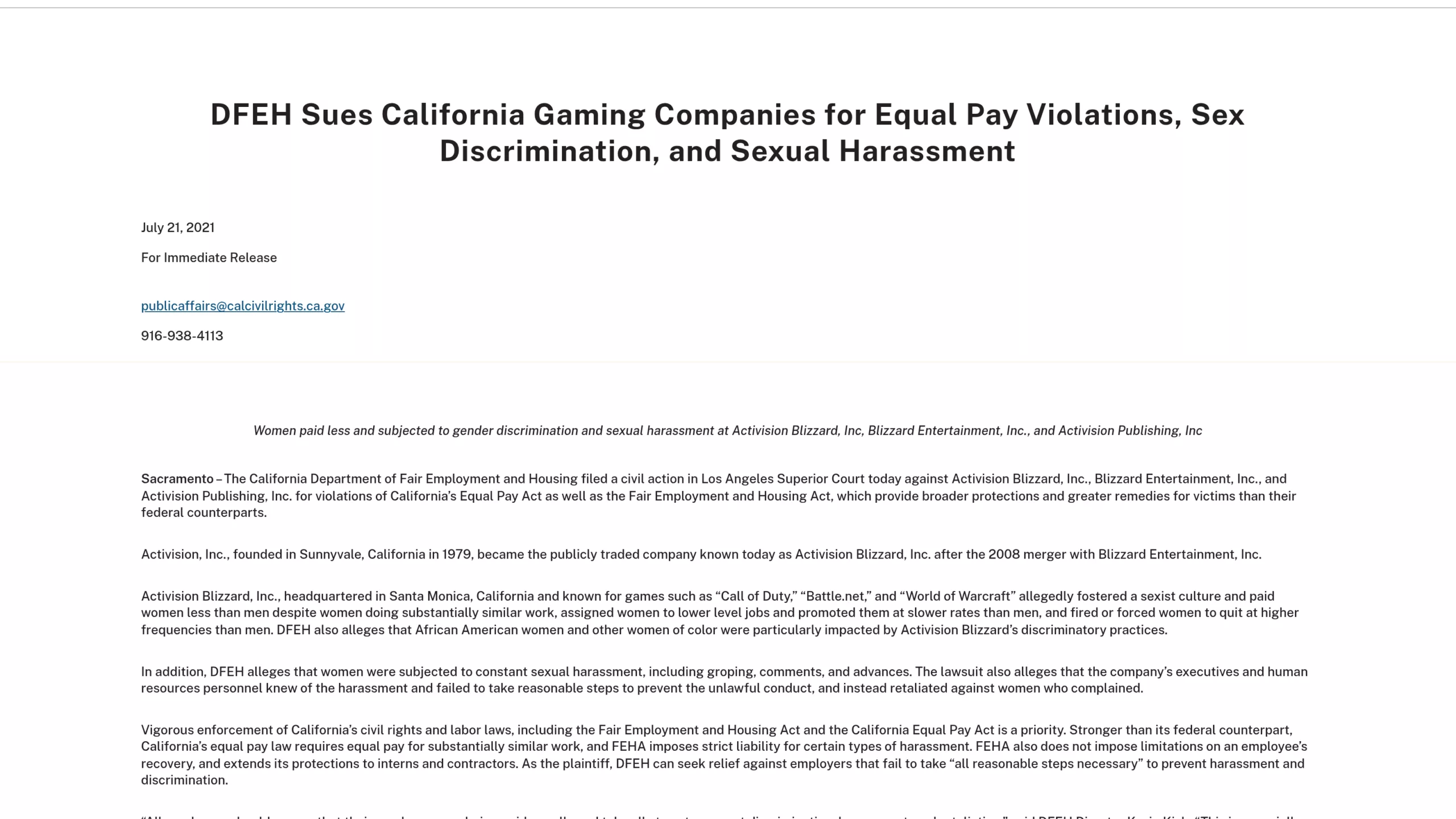
The complaint relies on two California state laws: the California Equal Pay Act, which governs pay equity, and the Fair Employment and Housing Act, which covers workplace discrimination and harassment. Based on those laws, the document describes a set of behaviors and practices that the DFEH attributes to the company. According to the filing, several elements come up repeatedly.
- A culture the complaint calls ‘frat boy,’ a reference to American college fraternity culture, where male employees ‘openly joke about their sexual encounters, talk openly about their coworkers’ bodies, and joke about rape.’ The document frames this atmosphere as fertile ground for harassment and discrimination against women.
- ‘Cube crawls,’ office tours where male employees drank heavily while moving between cubicles, with behavior described as inappropriate toward the women present.
- A hotel room kept during BlizzCon 2013 by game director Alex Afrasiabi, nicknamed internally the ‘Cosby Suite’ after Bill Cosby. Photos showing employees posing with a framed portrait of Cosby were published by Kotaku on July 20, 2021. Afrasiabi is alleged to have hit on female employees at conventions, told them he wanted to marry them, and tried to kiss and hug them.
- Women described in the complaint as ‘universally paid less,’ receiving fewer stock grants and bonuses than their male colleagues, promoted more slowly, and laid off more quickly.
- Sexual harassment described as constant, including groping, remarks, and advances. The complaint claims that managers and human resources were aware and failed to take reasonable action, and that women who complained faced retaliation.
- A note stating that Black women and other women of color were particularly affected by these practices.
Activision Blizzard responded on July 21, 2021, the same day. The company called the complaint distorted and, in many cases, false. It also accused the agency, in its words, of dragging the tragic suicide of an employee into the complaint, a death it said had absolutely no connection to the case.
One point needs to be made before going further. A complaint is a document written by one party, here a state agency acting as prosecutor. It is neither a ruling nor the outcome of an adversarial investigation in which the defense has already answered point by point before a judge. Every element it contains remains an allegation until a court has examined and ruled on it. This California case was never tried on the merits: it ended in settlement agreements, a distinction that matters for understanding what came next. The same caution applies to other heavily discussed lawsuits in the video game industry, where a filed document is often read as a verdict.
This complaint didn’t land in a neutral climate among players. Warcraft III Reforged, released in January 2020, has held a user score of about 0.5 out of 10 on Metacritic ever since, the worst ever recorded on the platform. World of Warcraft Shadowlands got a split reception depending on the audience: critics rated it around 80 out of 100 on OpenCritic, while players scored it around 4.7 out of 10 on Metacritic. So by summer 2021, Blizzard was already facing a community trust crisis even before the DFEH complaint was filed.
Breast milk: the most repeated allegation isn’t in the complaint
Among all the details cited in online summaries of the Blizzard case, this one comes up almost every time: employees reportedly had their breast milk go missing from the company’s refrigerators. The anecdote is often used, depending on who’s telling it, to illustrate either the severity of the internal climate or, conversely, the supposed exaggeration of the case. It’s almost always attributed to the complaint the California agency filed in July 2021.
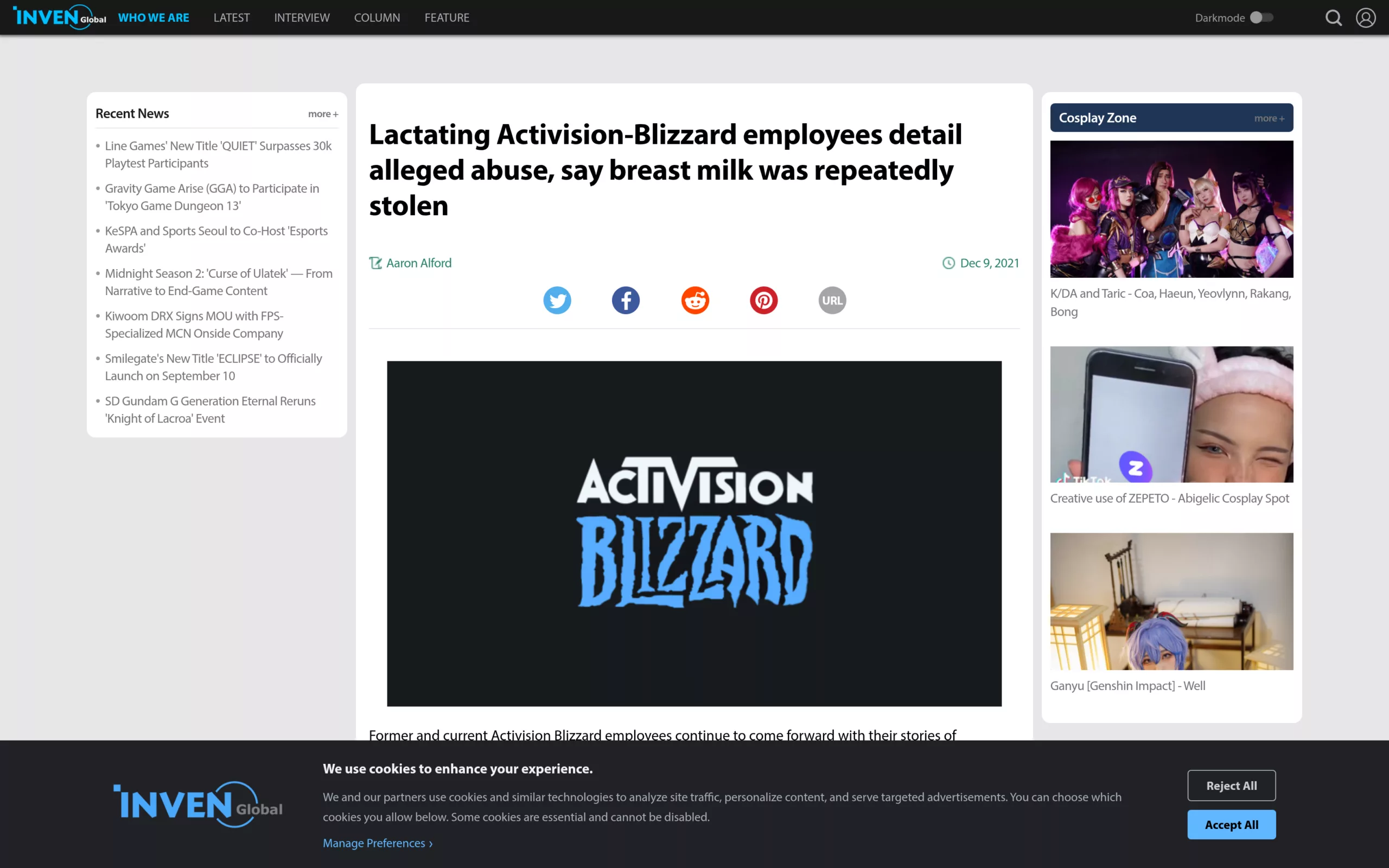
That allegation, however, doesn’t appear in it. It comes from a separate episode, five months later. On December 8 and 9, 2021, employee Jessica Gonzalez posted a Twitter thread of testimonies from a private Discord server called ‘Blizzard Women.’ Several employees described poor conditions for breastfeeding at work: no proper furniture, having to sit on the floor to pump, electrical outlets considered unsafe, and breast milk disappearing from refrigerators that were supposed to be locked.
The most widely shared testimony is from former producer Stephanie Krutsick. She places the events in 2008. At the time, the lactation room had no refrigerator, so she stored her labeled milk in the fridge in the shared break room. As the only breastfeeding employee in the building, she says she once found her entire supply gone.
Journalist Aaron Alford documented these accounts on December 9, 2021 in an article for Inven Global. The topic stayed in the news for months: on May 24, 2022, Kotaku covered it again, in a piece by Ethan Gach about calls for better protections for breastfeeding employees. Activision Blizzard, for its part, says it has since installed properly equipped rooms, added access codes to its ‘Quiet Rooms,’ and put locks on the refrigerators in question.
These accounts were never the subject of any legal proceeding or published independent investigation that formally confirmed or refuted them. They remain what they are: accounts from employees, some named, made public in December 2021, separate from the case brought before California courts five months earlier.
This is where the confusion cuts both ways. Pointing out that the breast milk story does not appear in the complaint is correct about the source, but it says nothing about what that complaint actually contained, which rests on other elements. Conversely, presenting these accounts as part of the court case gives them a status they never had. Both readings start from the same dating error. The useful reflex is the same one to apply to any rumor circulating about Blizzard: trace it back to the source before drawing conclusions.
The most serious case was never tried
Among the elements in the July 2021 California complaint, one passage stands out for its gravity. The document refers to the suicide of an employee during a business trip in 2017. She isn’t named. According to the complaint, she had been harassed by a supervisor she was in a relationship with, and a photo of her had reportedly circulated at a company party. These are allegations made in a legal filing, not facts established by a completed judicial investigation.
Activision Blizzard responded on July 21, 2021, the same day the statement was published. The company accused the California agency of ‘dragging the tragic suicide of an employee, whose death has absolutely no connection to this matter, into the complaint.’ The victim was later publicly identified as Kerri Moynihan, 32, a finance manager at Activision, found dead in her hotel room during a business trip in 2017.
In March 2022, her parents, Paul and Janet Moynihan, took the case further. They filed a separate civil wrongful death complaint in Los Angeles Superior Court, a fifty-page document. In it, they alleged that gender-based harassment at Activision Blizzard was ‘a substantial factor’ in their daughter’s suicide, and that her supervisor had concealed the relationship from police investigators. They sought at least one million dollars. The Washington Post reported on it on March 4, 2022.
On May 6, 2022, two months after filing, the parents asked to withdraw their complaint. They did so ‘with prejudice,’ a legal term that bars them from bringing a similar claim over the same facts again. No public reason was given for the decision. The case ended there, without a court ever getting the chance to examine it.
This withdrawal doesn’t allow for any definitive conclusion, either way. Kerri Moynihan’s death is an established and tragic fact. The link between that death and workplace harassment was alleged in two separate legal documents, filed by two different parties, at different times. That link was never examined on the merits by a court. No one can say today, publicly, that it’s proven, nor that it’s ruled out.
What ‘withdrawn’ means legally. A withdrawn complaint wasn’t lost by the party who filed it, nor won by the party it targeted. It simply was never examined. No evidence was presented, no witness was heard, no ruling was made. The case ends there, and the public debate is left without a referee.
What regulators ultimately put in writing
Between 2022 and 2024, three separate proceedings involving Activision Blizzard were closed out. Three different agencies, three different legal texts, three different amounts. None of these three settlements say exactly the same thing. That difference is precisely what matters. The sections below cover each text as it was signed, without rewording what it doesn’t say.
The federal settlement with the EEOC, March 2022
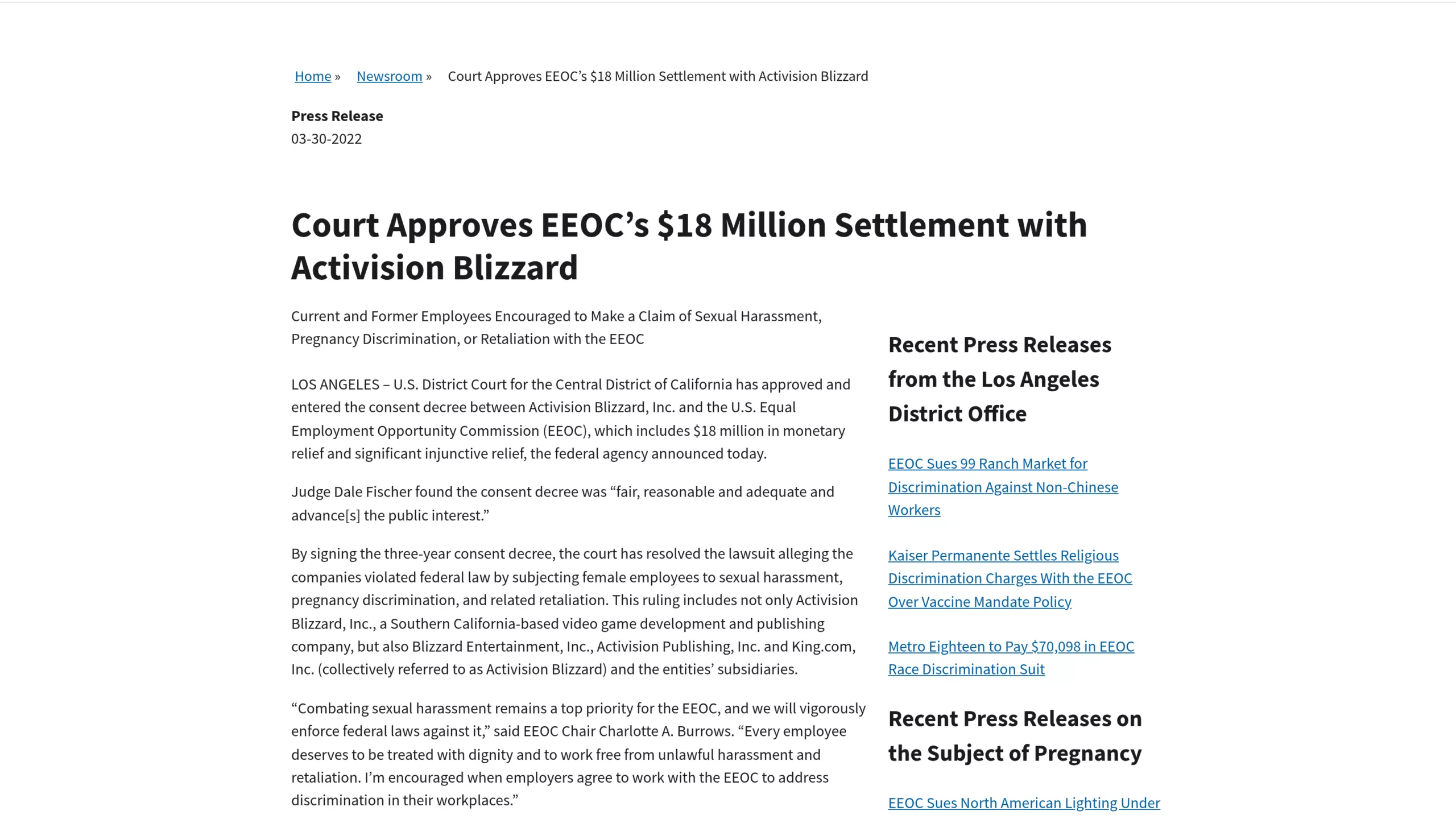
The first proceeding came directly from the federal government. The EEOC, the U.S. agency responsible for enforcing workplace equality, filed its own complaint on September 27, 2021, for violating Title VII of the Civil Rights Act of 1964. The resulting agreement took the form of a consent decree, a text approved by a judge that carries the force of a court order for three years. It covers $18 million. Federal judge Dale Fischer approved it on March 30, 2022, calling it fair, reasonable, and adequate, and finding that it served the public interest.
The agreement covers more than just a payout. It sets up a compensation fund, a neutral third-party consultant overseen by the EEOC, surprise audits of how harassment complaints are handled, an overhaul of HR training, and a review of disciplinary procedures. The text also states that Activision Blizzard admits no wrongdoing, and that it ‘expressly and unequivocally denies’ having engaged in gender-based harassment, retaliation, or discrimination. The California agency, for its part, publicly opposed this federal settlement, calling it mere pennies for the victims, reached without any discovery process or trial.
The settlement with the SEC, February 2023
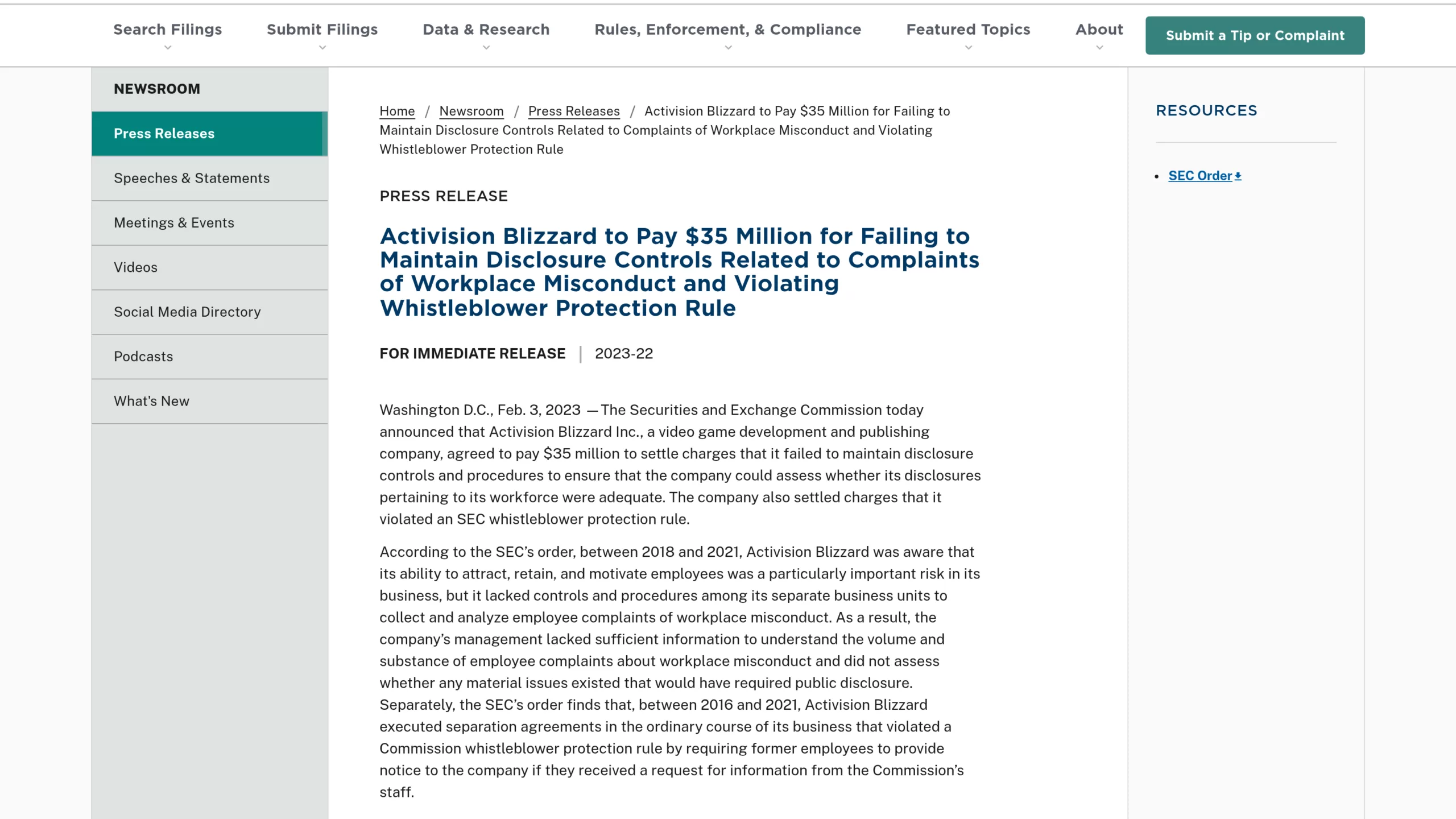
The second case comes from a different kind of regulator. The SEC, the U.S. stock market watchdog, announced a $35 million settlement on February 3, 2023, based on two separate findings. First, between 2018 and 2021, the company lacked the internal controls needed to collect and analyze workplace misconduct complaints. According to the SEC, management therefore didn’t have enough information to understand the volume or substance of those complaints. Second, between 2016 and 2021, certain severance agreements required former employees to notify the company if a regulator contacted them, which violates a federal whistleblower protection rule. Again, no admission and no denial of wrongdoing.
One point deserves to be stated clearly, because it often gets lost in quick summaries. The SEC does not conclude that harassment took place. It penalizes the fact that the company’s own lack of internal controls left it unable to know what was actually happening. This is a fundamentally different kind of finding from the EEOC’s: a securities regulator doesn’t rule on harassment, it rules on the soundness of a public company’s internal processes.
California’s settlement with the CRD, December 2023
The third case, in California, came after the first two and closed out a separate dispute originally brought by the former DFEH. The California Civil Rights Department announced a settlement worth roughly $54.875 million on December 15, 2023, with nearly $45.75 million going to a compensation fund. It covers women employed or contracted in California between October 12, 2015 and December 31, 2020. The proposed consent decree was filed on December 21, 2023, then approved by the court on January 17, 2024. CRD Director Kevin Kish summed up the agency’s position this way: ‘California remains deeply committed to promoting and protecting the civil rights of women in the workplace.’
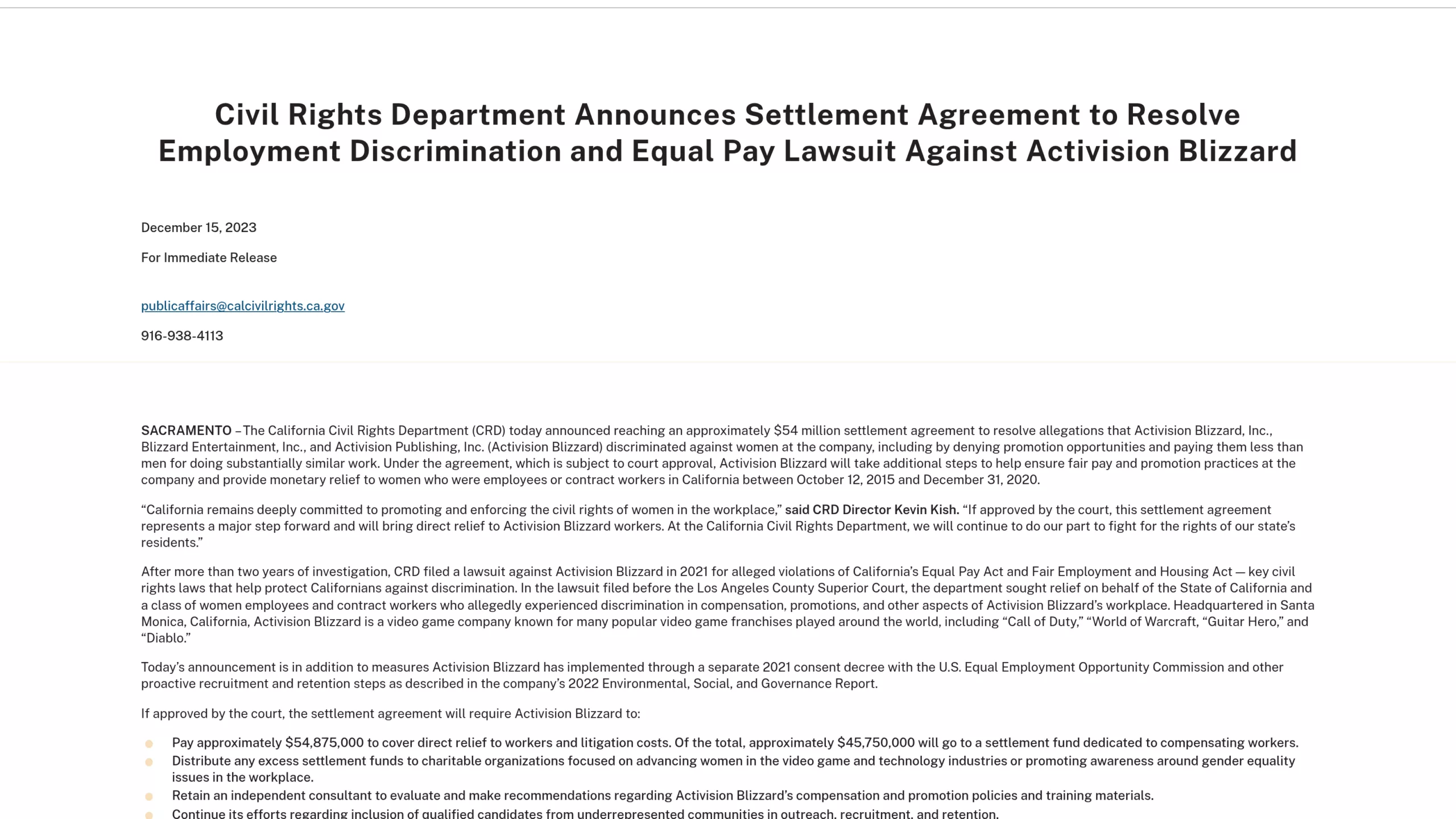
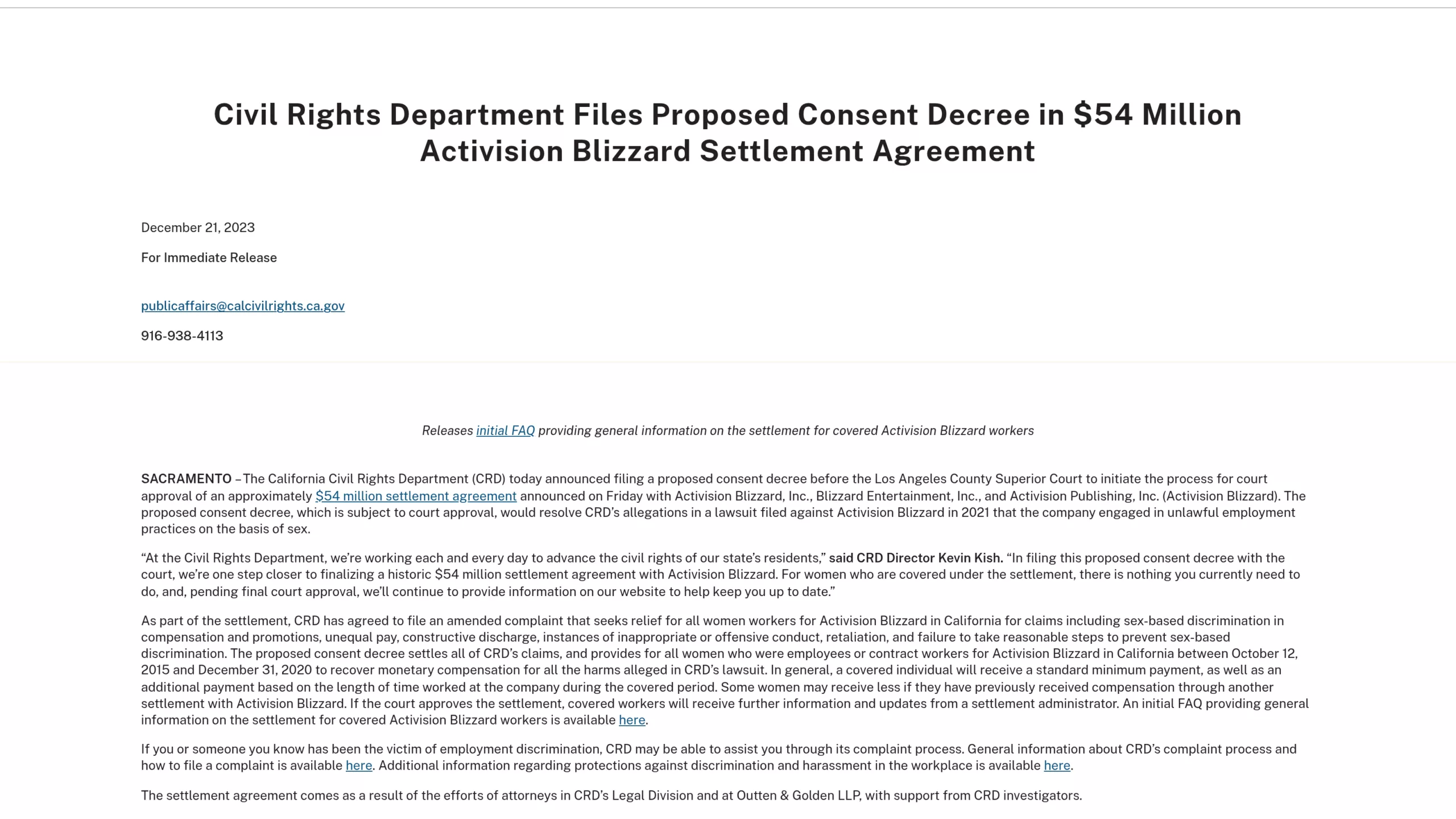
This is the most debated element of the entire case. As part of the settlement, the CRD agreed to file an amended complaint, different from its original version. The claims that ultimately remained cover sex-based discrimination in pay and promotions, wage inequality, constructive discharge, ‘instances of inappropriate or offensive conduct,’ retaliation, and failure to take reasonable steps to prevent sex-based discrimination. The claim specifically covering sexual harassment, however, is dropped from this final list.
The settlement documents contain a sentence that most of the commentary published in 2026 seizes on. It’s a concession from the California agency itself, spelled out in the text of the consent decree.
Excerpt from the California settlement documents, December 2023
‘No court or independent investigation has substantiated any allegation that there was systemic or widespread sexual harassment at Activision Blizzard, that Activision’s executive leadership ignored, condoned, or tolerated a culture of systemic harassment, retaliation, or discrimination, or that Activision’s board of directors, including CEO Robert Kotick, acted inappropriately in responding to any instance of workplace misconduct.’
This sentence is a concession from the California agency itself, written into the settlement documents. It’s the one most of the 2026 commentary cites.
This sentence deserves a careful reading, because it covers exactly three things, and nothing else. It covers whether the harassment was systemic or widespread. It covers whether executive leadership ignored, condoned, or tolerated such a culture. And it covers how the board of directors, Robert Kotick included, handled misconduct cases. It does not say that no harassment took place at Activision Blizzard. Nor does it say that the 2021 complainants lied. Those are two claims the text never makes.
‘Not corroborated’ is not the same as ‘false.’ In a case settled out of court, like this one, there was never a full discovery process or a trial to rule on each fact one by one. The absence of judicial corroboration doesn’t amount to a denial of the underlying facts. On the other hand, across the three settlements, the company paid out more than $100 million. No company signs a check like that out of charity. Both facts stand at once, and that’s exactly what readers should take away: neither full exoneration, nor full confirmation.
Combining the EEOC’s $18 million, the SEC’s $35 million, and the CRD’s $54.875 million, the three settlements total roughly $108 million. An internal review commissioned by Activision itself, led by Gilbert Casellas, a former EEOC chair, separately concluded that there was no widespread harassment or recurring pattern of gender-based harassment. That review, though, remains a piece of work commissioned and paid for by the company under scrutiny, an origin worth keeping in mind when citing it.
| Proceeding | Date | Amount | What it establishes |
|---|---|---|---|
| EEOC (federal) | March 2022 | $18M | Court-approved settlement, no admission of wrongdoing |
| SEC (securities) | February 2023 | $35M | Failure of internal controls over complaints, not a harassment finding |
| California CRD | December 2023 | ~$54.9M | Discrimination and pay inequality, the sexual harassment claim dropped |
The war between the two agencies, and the resignations that followed
Two agencies were pursuing Activision Blizzard at the same time, without ever really working together. On one side, the EEOC, the federal agency that enforces employment discrimination law. On the other, the DFEH, its California counterpart. In September and then October 2021, the EEOC filed its federal complaint and negotiated its own settlement with the company. The DFEH objected immediately. In its view, that settlement would deprive employees of the stronger protections offered by California law, and would erase evidence its own case needed.
The EEOC did not let the objection slide. In October 2021, it accused two DFEH attorneys of a conflict of interest, claiming they had worked on the Activision Blizzard case while still employed by the EEOC, before joining the California agency, a situation the EEOC considered a breach of California’s professional conduct rules. The argument served to discredit the DFEH’s objection. In December 2021, the federal court ruled in the EEOC’s favor and rejected the DFEH’s attempt to block the settlement, which proceeded as planned.
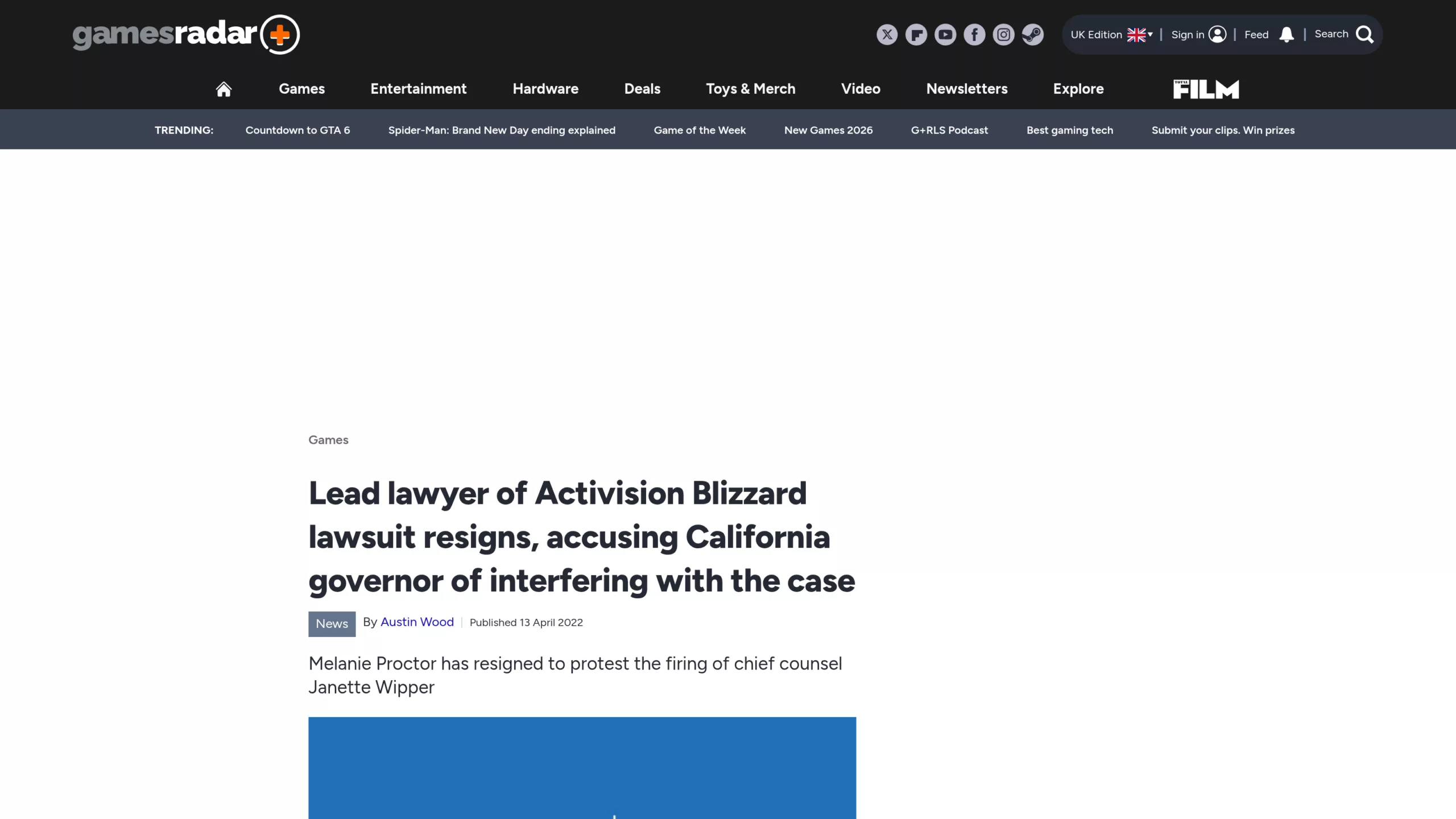
The institutional conflict did not stop there. In late March or early April 2022, Janette Wipper, the DFEH’s chief counsel for the past four years, was fired by Governor Gavin Newsom’s office. The timing raised questions. She had just been reappointed to her position four months earlier.
On April 12, 2022, Melanie Proctor, her deputy, resigned in turn, in protest. In an internal email, she claimed the governor’s office had « repeatedly demanded advance notice of litigation strategy and next steps in the case. » According to Proctor, this pressure intensified « as we continued to win in state courts, » and it « reflected the interests of Activision’s counsel. »
Newsom’s office denied the accusations and called them « categorically false. » No public investigation ever settled the matter between the two versions. To this day, the episode remains an accusation on one side and a denial on the other. It was covered by several specialized and mainstream outlets, including GamesRadar on April 13, 2022 by Austin Wood, as well as Game Informer, Courthouse News, and CBS News.
This point deserves to be placed in context. Proctor’s accusations date back to 2022, long before the federal indictment of November 2025 mentioned at the start of this piece. The suspicion of political interference in this case is therefore not a theory that appeared after the fact to suit one side. It has been documented since 2022, and it was raised by a senior official who resigned specifically over this issue. That said, it does not amount to proof. Proctor’s accusations were never settled by an independent body, and the governor’s office firmly denied them.
The price paid: careers, rewritten games, players gone
The legal proceedings closed one after another, with financial settlements rather than verdicts of guilt. But between July 2021 and today, something tangible happened anyway. Executives and developers left the company. Entire zones of World of Warcraft were renamed. Millions of players closed their client. These are facts that don’t depend on any court.
The Departures
On July 28, 2021, employees at the Irvine headquarters walked out from 10 a.m. to 2 p.m. The exact number of participants varies by source, between roughly 200 and several hundred people. An open letter circulated at the same time and gathered, depending on when it was counted, between 2,600 and 3,100 signatures. The demands were specific: an end to forced arbitration for harassment complaints, new hiring and promotion policies, publication of compensation data, and an independent audit of the company.
The first effects were felt almost immediately. On August 3, 2021, J. Allen Brack stepped down as president of Blizzard Entertainment, a position he had held after more than fifteen years at the company. He was replaced by a co-leadership of Jen Oneal and Mike Ybarra. On August 3 or 4, depending on the source, Jesse Meschuk, head of human resources, also left.
On August 11 and 12, 2021, three developers were fired. Luis Barriga, game director on Diablo IV, at Blizzard since around 2005. Jesse McCree, lead level designer on the same project. Jonathan LeCraft, a designer on World of Warcraft. McCree and LeCraft both appeared in the photos taken in the « Cosby Suite. » Several outlets noted that no official reason was ever communicated internally for these firings. The link to the allegations in the complaint remains a journalistic inference, not a confirmation from the company.
These three high-profile departures were only the visible part of a broader movement. In January 2022, an Activision Blizzard spokesperson confirmed that 37 employees had left the company since July 2021 as part of internal investigations, and that 44 others had faced disciplinary action. The figure put a scale on what had until then looked like a series of individual cases.
What Was Erased From the Games
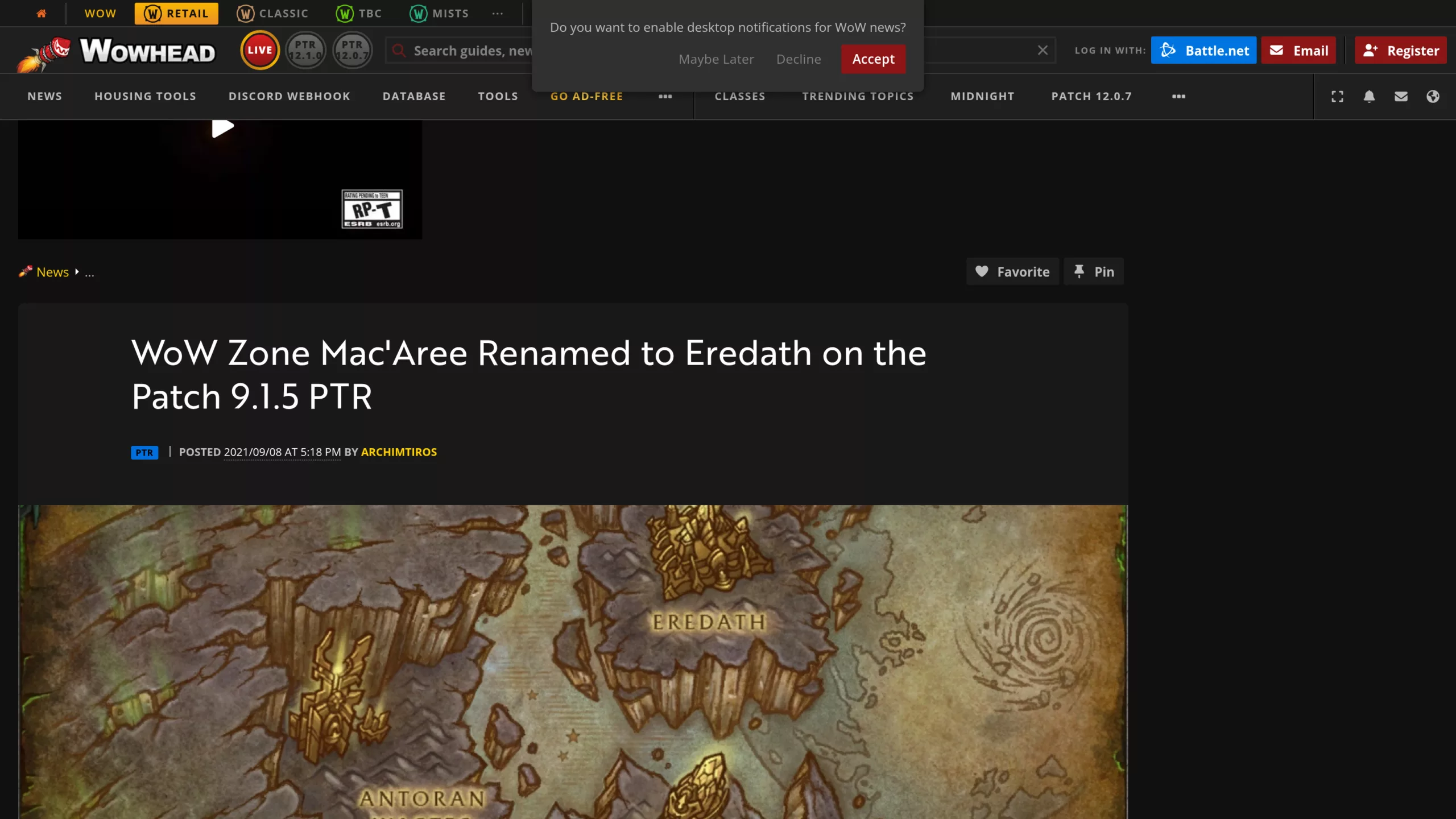
As early as July 27, 2021, the World of Warcraft team announced on its official account that it wanted to remove « references that are not appropriate for our world, » without specifying which ones at that stage. The concrete response came with patch 9.1.5, announced on August 19, detailed on October 6, and released on November 2, 2021. It removed all direct references to the three fired developers, McCree, Barriga, and LeCraft.
The most documented case involves the zone « Mac’Aree » on Argus, which had paid tribute to Jesse McCree since the The Burning Crusade expansion. It was renamed « Eredath. » One detail is worth noting: well before the case became public, quest designer Jennifer Klasing, uncomfortable with the reference, had already asked voice actors internally to pronounce the name « Muh-KAH-Ree » to blur the resemblance. The unease existed internally even before the DFEH complaint.
Other changes followed the same pattern, on items or quests considered to carry a double meaning:
- The mount « Big Love Rocket » becomes « X-45 Heartbreaker. »
- The quest « Blowing Hodir’s Horn » becomes « Hodir’s Call. »
- Several dozen lines of dialogue from non-player characters, considered to carry suggestive connotations, are removed or rewritten.
- On Overwatch, the hero « McCree, » named after the fired developer, becomes « Cole Cassidy. » The announcement comes on October 22, 2021, and the change takes effect in-game on October 26.
One case deserves more careful treatment than the others, because it is often presented as settled fact when it is not. Alexstrasza’s redesign in Dragonflight, released on November 28, 2022, is widely linked to the case in community discussions. The verifiable fact is that her model was indeed reworked, with more covering armor, a change documented by Wowhead as early as July 14, 2022. What is not verifiable is the connection to the Activision Blizzard controversy. No official statement from Blizzard has ever tied this redesign to the case. The company never confirmed it, but it never denied it either. The association remains a community interpretation, widely repeated to the point of sometimes passing for an established fact, which it is not.
A later episode, however, shows an explicit official reaction, this time directly tied to Alexstrasza. In June 2023, on the patch 10.1.5 test server, a quest named « A Missing Soul » asked players to travel back in time to make sure Alexstrasza remained captive of the Dragonmaw clan. Facing negative reactions, community manager Liam Knapp stated that the team had seen the comments, understood the concerns, and was adjusting the content accordingly. The quest was removed before the patch shipped. Here, unlike the 2022 redesign, the link between Blizzard’s reaction and the sensitivity of the topic is confirmed in the company’s own words.
The Players Who Left
Over the course of 2021, Blizzard reportedly lost around 5 million monthly active players. The trend did not stop with the new year. In the first quarter of 2022, the company lost another 2 million in that quarter alone. In the second quarter of 2022, another 2 million. Blizzard’s revenue for that quarter dropped to 401 million dollars, down from 433 million a year earlier.
Part of this narrative, widely repeated in gaming press and in the community, deserves some nuance. Many players who left World of Warcraft supposedly migrated to Final Fantasy XIV. Yet Square Enix suspended sales of the game twice in 2021, in July and then on December 16, the day the Endwalker expansion launched, officially citing server congestion, not an influx from a rival game. The game’s director, Naoki Yoshida, explicitly rejected this narrative on July 20 and 21, 2021, saying he was annoyed that Final Fantasy XIV’s growth was being attributed to players fleeing World of Warcraft. Square Enix never claimed this migration as a fact. It remains a media and community narrative, not data confirmed by the publisher in question.
The departure of these players fed a deeper trend that Blizzard is still fighting today, particularly on the battleground of private servers. It forms the backdrop for the legal actions the company has since launched, such as its federal lawsuit against Project Ascension in June 2026.
And Then Microsoft
On January 18, 2022, Microsoft announced the acquisition of Activision Blizzard for 68.7 billion dollars. The deal, examined at length by antitrust authorities in several countries, was finalized on October 13, 2023. The harassment case was not the cause of the acquisition, but it formed its immediate backdrop, that of a company weakened internally and publicly exposed.
What followed hit Blizzard’s teams directly. On January 25, 2024, Microsoft cut 1,900 positions across its gaming divisions, around 8.6% of the workforce. Mike Ybarra, Blizzard’s president since Brack’s departure, and Allen Adham, head of design, left the company as part of this round. The survival game in development, known internally under the code name Odyssey, was canceled. On February 5, 2024, Johanna Faries, former general manager of the Call of Duty franchise, became president of Blizzard Entertainment. Three years after the Irvine walkout, the studio’s leadership had nothing left in common with that of 2021. This cycle of layoffs and closures has fed, well beyond Blizzard, the crisis of trust running through the entire video game industry.
What can be said, and what can’t
This piece began with a complaint filed in 2021. It ends with court documents, figures paid out to three different agencies, and a federal indictment in 2025 that no one could have predicted at the start. Between these two points, many facts were established, many others remain unresolved, and a handful of conclusions keep circulating without ever having been proven by anyone.
Sorting these three categories is not an exercise in surface-level neutrality. It’s the only way to read this case without falling into either of the two shortcuts that have followed it from the start. The first claims everything was made up because one charge disappeared and a settlement clause mentions uncorroborated facts. The second claims nothing changed because a check was signed. The public record supports neither one.
Established and Documented
- The California complaint of July 20, 2021 followed an investigation described as lasting more than two years.
- About 108 million dollars were paid out across three separate cases: 18 million to the EEOC, 35 million to the SEC, and nearly 54.9 million to California.
- The SEC found, in an official order, a real lack of internal controls between 2018 and 2021, and a clause that violated whistleblower protections between 2016 and 2021.
- Activision Blizzard itself announced, in January 2022, 37 departures and 44 disciplinary actions decided as part of internal investigations, with executives and developers pushed out as early as summer 2021.
- A former senior official from the California governor’s office was federally indicted in November 2025, in an indictment that mentions this case.
Never Settled by a Court
- The truth of the alleged individual harassment claims was never examined by a court, and was neither confirmed nor disproven.
- The link between Kerri Moynihan’s suicide and workplace harassment was never resolved, as her family’s lawsuit was withdrawn before any examination.
- The political interference accusations made by Melanie Proctor in 2022 were denied by the governor’s office, without a judge ever ruling on the matter.
- The charges against Dana Williamson in 2025 remain, at this stage, accusations, not facts ruled on by a court.
- The charge specifically covering sexual harassment disappeared from the amended December 2023 complaint, with no public decision explaining why.
What the Documents Don’t Allow Us to Conclude
- An « uncorroborated » fact is not a false fact. It’s a fact whose truth no one established, for lack of a trial that would have produced the evidence.
- The sentence in the California settlement covers three specific points: the systemic nature of the conduct, the behavior of executives, and that of the board. It does not cover each individual situation experienced by an employee.
- Paying out 108 million dollars is not an admission of guilt. Activision Blizzard explicitly denied any wrongdoing in the text of the federal settlement, and a settlement also serves to end a media crisis and secure a 68.7 billion dollar acquisition.
- The fact that some of the most dramatic accusations rest on shaky sources says nothing about the validity of the others. Each element of this case must be judged on its own, not as a whole.
What these three lists show, taken together, is that a case can be both real in its consequences and uncertain in part of its content. People lost their jobs. A company paid considerable sums and corrected internal practices documented in black and white by a federal regulator. And at the same time, none of these remedies say who was right about each specific allegation, because that isn’t the question a settlement answers.
The real cost of this case may lie less in its outcome than in what it made harder afterward. When a public case ends without a verdict, each side can pick out whatever confirms what it already believed before even opening the file. A sentence from a settlement becomes proof of innocence for some, a dollar figure becomes proof of guilt for others, and both readings rely on the same documents without ever answering each other.
People who had real things to report, at Blizzard or elsewhere, come out of this kind of case less equipped, not better protected. A future report now runs into a precedent where individual truth got diluted in a battle of press releases. Companies, for their part, mostly take away the easiest lesson to apply: managing a media crisis better costs less and takes less time than treating employees better in the first place.
This case does not close on a verdict, then. It closes on a list of established facts, a list of questions left open, and a warning against the two easy answers most often heard about it.
The short version, without the jargon
If you are new to this story, here is what matters, in a few lines.
- In 2021, the state of California publicly accused Blizzard of mistreating its female employees. The filing was heavy: harassment, lower pay, and a drinking culture in the office.
- An official accusation is not proof. A judge decides whether it holds up. Here, no judge ever had to.
- Why? Because Blizzard chose to pay to make it stop. That is called a settlement. It ends the case without a trial, so without any examination of the evidence.
- Roughly 108 million dollars were paid out to three American agencies between 2022 and 2023. Each time, the company refused to admit any wrongdoing.
- Only one thing was formally established by a regulator: Blizzard had no internal system to track and handle employee complaints. In other words, management had put itself in a position where it could not know what was being reported.
- In the final December 2023 agreement, California wrote that no investigation had proven that harassment was widespread, or that executives had looked the other way. That is the sentence circulating everywhere today.
- Watch the trap: « not proven » does not mean « it never happened. » It means nobody carried the verification through to the end, because there was no trial. Those are two different things.
- Meanwhile, the consequences were very real. Employees lost their jobs, developer names were scrubbed from World of Warcraft, millions of players left, and Microsoft bought the company.
- Since November 2025, a new case has opened. It is not about harassment, but about how the 2023 settlement was allegedly negotiated behind the scenes. There too, nothing has been decided yet.
Where things stand today. Nobody has ruled, in either direction. Those who claim it was all made up go further than the documents allow. So do those who claim everything is proven. The only position the texts support is to state what is established, state what is not, and stop there.
Primary Sources and Documents Cited
- California DFEH, communiqué du 21 juillet 2021: filing of the initial complaint.
- EEOC, communiqué du 30 mars 2022: court approval of the 18 million dollar settlement.
- SEC, communiqué du 3 février 2023: 35 million dollars, internal controls and whistleblower protection.
- California CRD, communiqué du 15 décembre 2023: announcement of the roughly 54 million dollar settlement.
- California CRD, communiqué du 21 décembre 2023: filing of the consent decree and the list of charges ultimately retained.
- Inven Global, Aaron Alford, 9 décembre 2021: origin of the testimonies about breastfeeding.
- Washington Post, 4 mars 2022: the wrongful death lawsuit filed by the Moynihan family.
- GamesRadar, Austin Wood, 13 avril 2022: the resignation of Melanie Proctor.
- Wowhead, 8 septembre 2021: the renaming of the Mac’Aree zone to Eredath.
- The Spokesman-Review, 16 novembre 2025: the federal indictment of Dana Williamson.
- City Journal, 22 juillet 2026: the article that reignited the debate. An opinion source.







0 Commentaires
Aucun commentaire pour le moment. Soyez le premier à commenter !