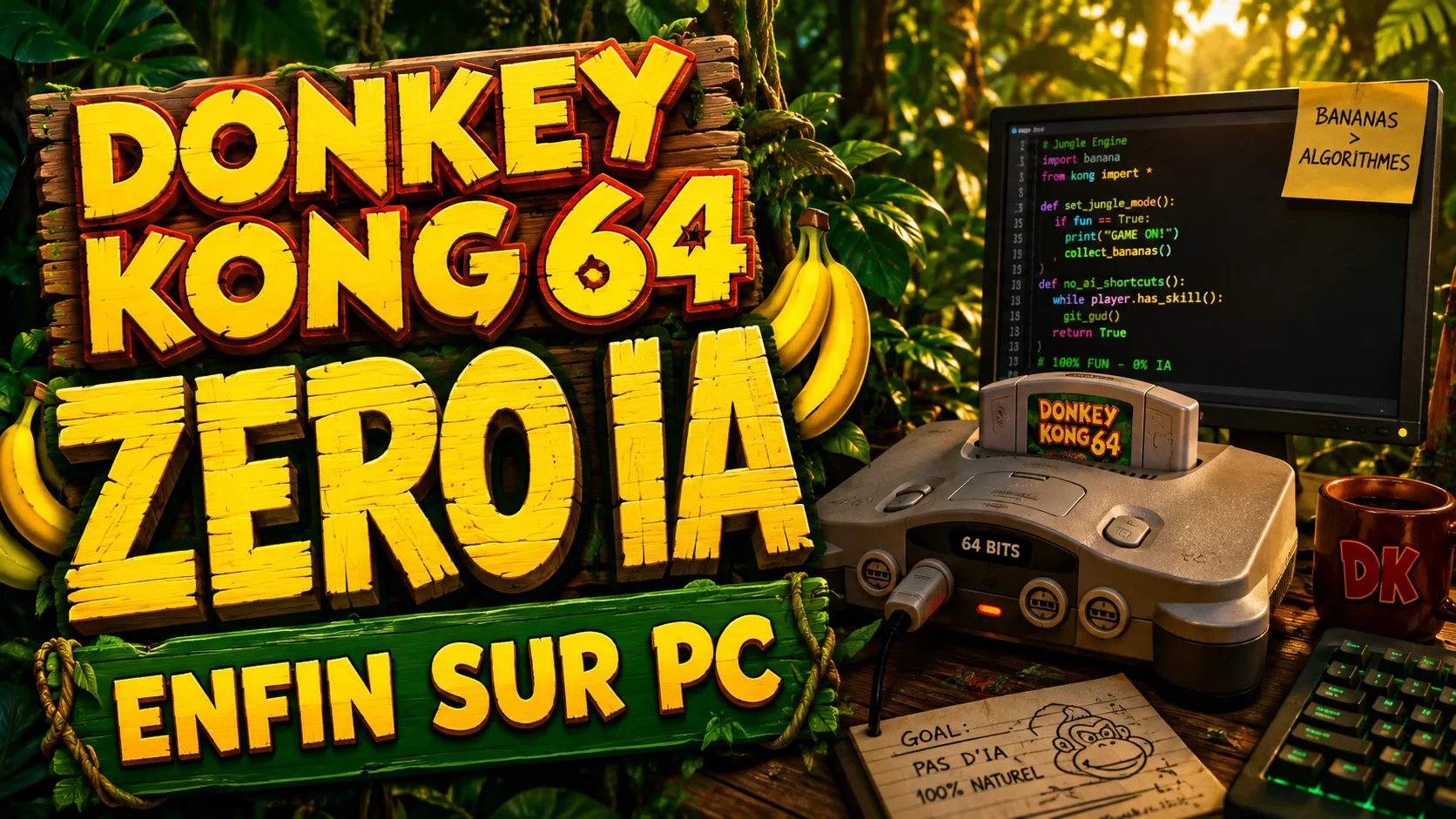
A 1999 game running in 4K on PC is news enough. That its creators bother to point out that no artificial intelligence was used to make it happen is another story entirely.
A recompilation, not an emulation
You can now launch Donkey Kong 64 on your PC, with mouse controls, high-resolution graphics, and a high frame rate. The port is called DK64 Rekongpiled, and it released on August 29, 2026. You need an original ROM of the game, the file extracted from the Nintendo 64 cartridge, to run it.
Emulation runs a program that imitates the original console, with the performance limits that entails. DK64 Rekongpiled takes a different route: it translates the game’s code directly to run on modern hardware, with no middleman. This method has a name, recompilation. It allows for far better performance and the addition of features absent at the time, like mouse control.
Journalist Tyler Colp, writing for PC Gamer, detailed on August 29, 2026 this work carried out by a team that claims not to have used any generative artificial intelligence at any stage. The original game stays intact: its era-appropriate, slightly blurry 3D graphics, its soundtrack, and everything that made Donkey Kong 64 a game both groundbreaking and, at times, maddening.
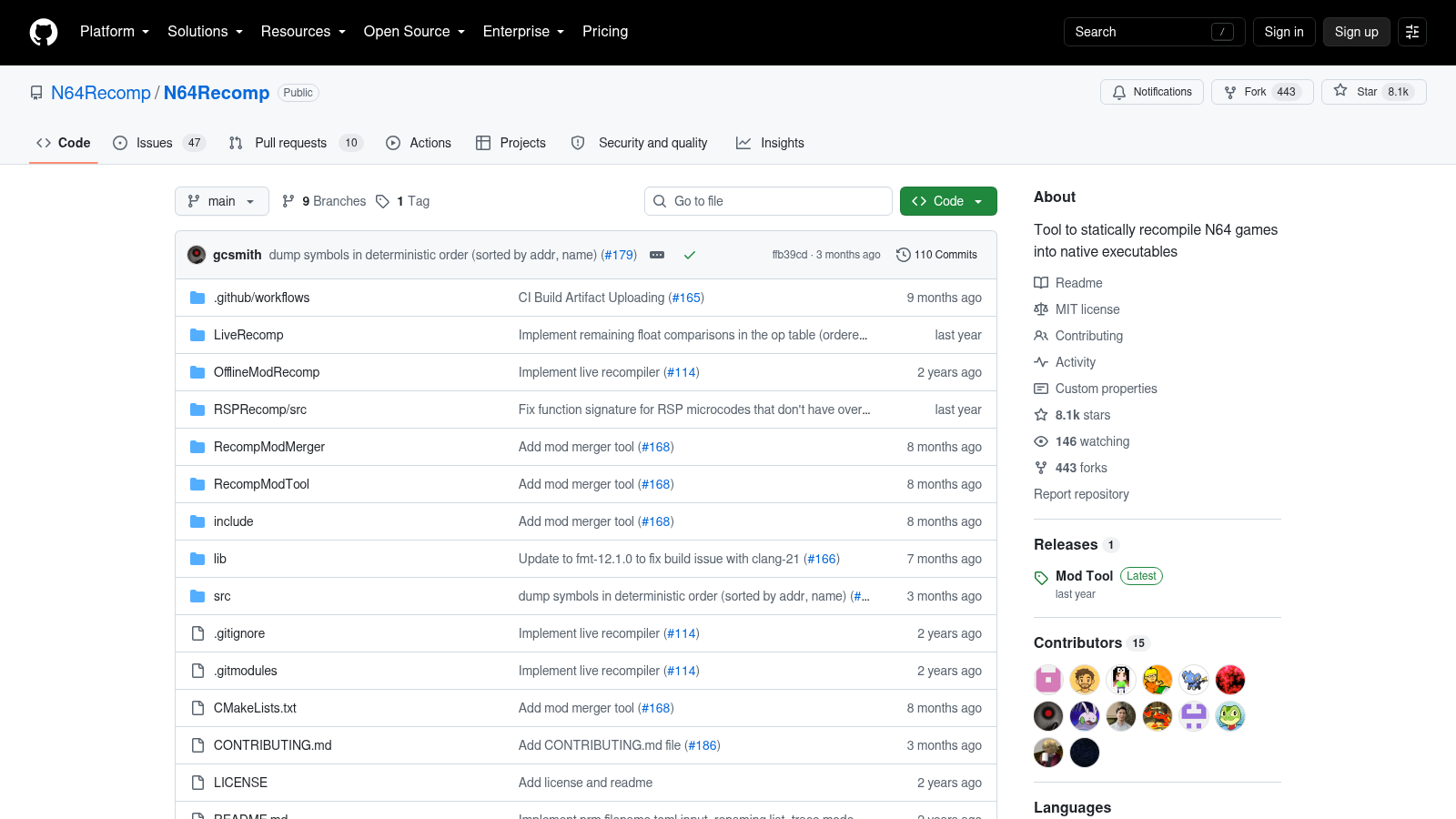
This kind of port relies on N64Recomp, a tool that statically recompiles Nintendo 64 games into native executables. Its public repository shows 8,100 stars, 443 forks, copies of the project that other developers evolve on their own, and 15 contributors, under an MIT license, a highly permissive open-source license. Some contributors had already worked on the DK64 Randomizer, a tool that randomly shuffles the game’s content.
Zero generative AI, and it’s spelled out in black and white
In a message posted on Bluesky, later reused in the release trailer, a project contributor known by the handle 2dos wrote: « no generative AI [was] used at any point in the process. » The phrase takes aim at « vibe coding, » a recently popularized practice where an AI writes code that nobody necessarily rereads or fully understands. For the team, that refusal goes beyond a footnote: it becomes the port’s selling point. The question runs through the whole industry, from the studio accused of replacing its writer with an AI to music, where Apple Music now labels AI-generated tracks.

PC Gamer, August 29, 2026, article by Tyler Colp. The headline echoes the team’s claim: « no generative AI [was] used at any point in the process. »
The timeline clarifies the stance. DK64 Rekongpiled shipped just two months after a group of programmers took over the project themselves, in response to another group leaning heavily on vibe coding. On the N64 Recomp Discord server, 2dos had explained at the time that this practice would « make it progressively harder to manage as time goes on. » The argument is about technical debt, not a moral stance: code generated without real understanding gets expensive to maintain, month after month.
2dos countered with knowledge built up over years on this exact game: « Our DK64 recompilation project is backed by folks who have worked on and tinkered with the backend of the DK64 code for well over a decade, and do not rely on vibe coding to make code changes. » Two teams, two methods, the same game as the target. The one that turned down AI shipped in two months.
A trailer where King K. Rool admits defeat
DK64 Rekongpiled’s trailer tells a story of revenge, played for deliberate laughs. The scene is short, absurd, and oddly endearing for what is, after all, just a technical port trailer.
It features King K. Rool, Donkey Kong’s longtime sworn enemy. He realizes, live, that his plan to keep players from accessing Donkey Kong 64 on PC just failed. A band of stubborn programmers got the better of him. The character’s voice is performed by 2dos, who also voices the villain’s henchman.
That second character steals the scene. He discovers the game runs in 4K at 200 frames per second and can’t believe it. He ditches his boss on the spot to go play it himself. The joke lands because the number is real: a 1999 game running that smoothly, with mouse controls on top, the contrast speaks for itself.
Tyler Colp closes his article with a personal opinion: in his view, no generative artificial intelligence could produce a scene this convincing. The wink isn’t incidental. A team that refuses AI for its code also chooses to voice its own characters, with its own voices and its own sense of comic timing. The care put into the game’s engine and the care put into its trailer come from the same hands.
What this Donkey Kong 64 port says about the moment
Donkey Kong 64 dates back to 1999. Nintendo offers no official PC version, and nothing suggests that will change. So this game’s preservation doesn’t come from the publisher. It comes from a handful of volunteers coding in their spare time, around a tool released under an open-source license and maintained by about fifteen contributors. Nintendo has every right not to re-release its back catalog. When it doesn’t, others step in, with no mandate and no budget. Other publishers make the opposite call, like Konami, which just brought MGS4 off the PS3 after years of waiting.
Three years ago, nobody would have thought to specify that a port was hand-coded. That « zero AI » has become a selling point says something about the moment the romhacking scene, the practice of modifying an old game’s code, is going through. Generative AI tools, Claude included, can now put together a project like this in a fraction of the usual time. The DK64 Rekongpiled team watched a rival project of that kind emerge in parallel, and beat it by two months.
One point shouldn’t get twisted. The team’s argument is technical, not ideological: code generated without real understanding gets harder to maintain over time. A tool that writes code nobody understands creates debt. Used by someone who reviews and understands what they get, it becomes something else entirely. It all comes down to who stays in control.
On this port as elsewhere, that control made all the difference.









0 Commentaires
Aucun commentaire pour le moment. Soyez le premier à commenter !