
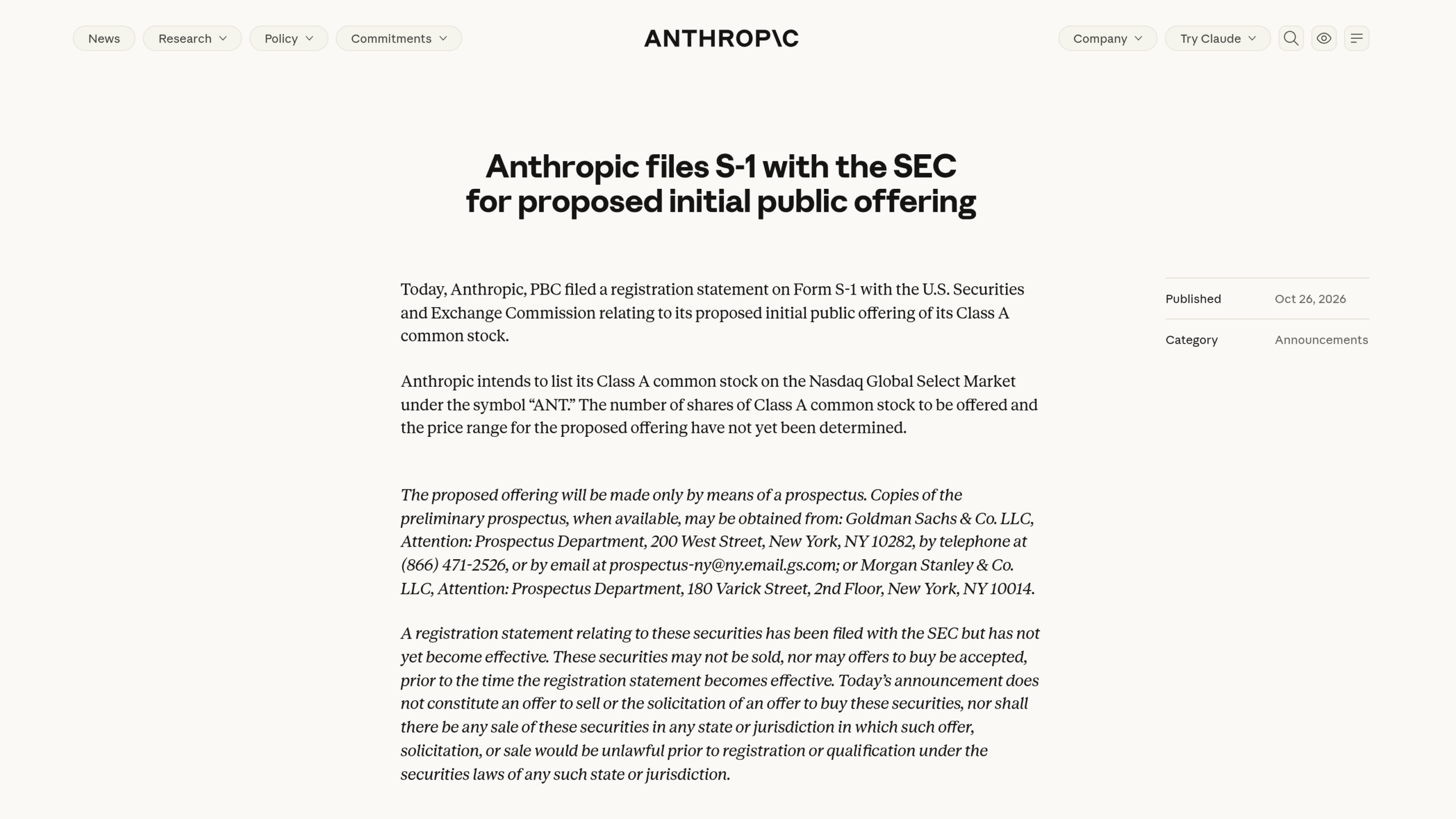
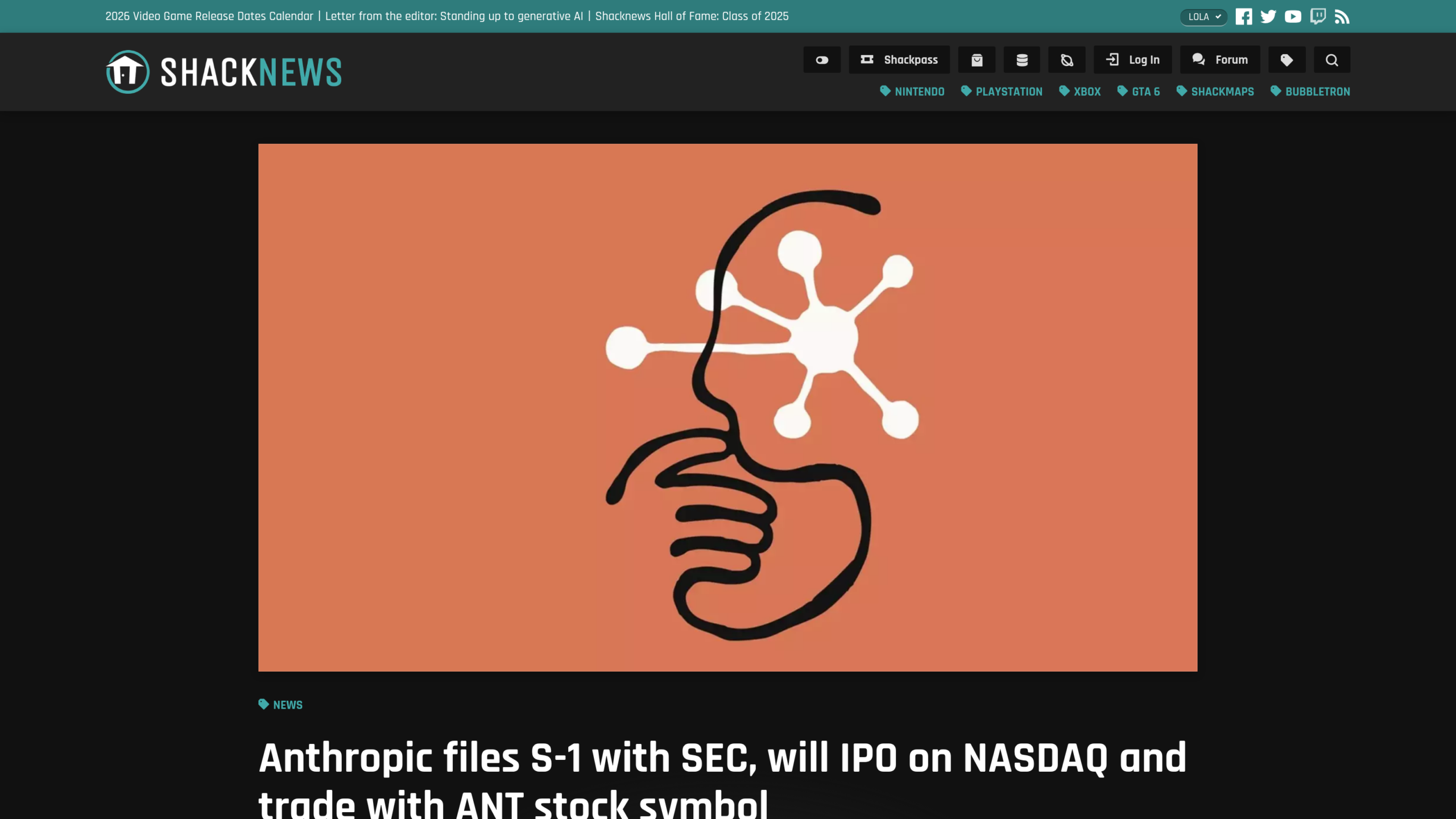
On October 26, 2026, Anthropic filed an S-1 with the SEC (the US financial markets regulator), the document that opens the Anthropic Nasdaq listing. The company is targeting the Nasdaq stock market, on the Nasdaq Global Select Market tier, under the symbol “ANT”, for its Class A common stock, according to its official announcement. The number of shares and the price range have not been set, and the registration is not yet effective: no sale is possible before then.
What the filing says about the Anthropic Nasdaq listing, and what it leaves blank
The prospectus, which we read on the SEC website, names Goldman Sachs and Morgan Stanley at the head of the banks handling the placement, followed by J.P. Morgan, Citigroup, Barclays, Wells Fargo and other institutions. Current shareholders agree not to sell anything for 180 days after the date of the prospectus, with exceptions. The price, the number of shares and the delivery date of the securities are empty fields.
A first confidential filing reportedly took place in June, according to Donovan Erskine of Shacknews, who also mentions a valuation of 965 billion dollars in that draft. We did not find that figure in the public document: it remains press information.
The cost of running Claude, finally put in figures
A listed company must publish its accounts. The S-1 therefore gives what Anthropic kept to itself: what it costs to run its models. The “compute and infrastructure” line (computing power and servers) appears for each period, in millions of dollars.
| Period | Revenue | Compute and infrastructure | Operating loss |
|---|---|---|---|
| Year 2024 | 386 | 2 522 | 2 980 |
| Year 2025 | 4 585 | 7 326 | 8 060 |
| First half of 2025 | 1 163 | 2 334 | 2 135 |
| First half of 2026 | 16 286 | 8 945 | 693 |
In the first half of 2026, computing absorbs 8.9 billion dollars against 16.3 billion in revenue, about 55% (our calculation). In 2025, the same line exceeded revenue: 7.3 billion against 4.6 billion, about 160%. The 2025 operating loss also includes 1.5 billion dollars booked under the name “Bartz settlement”, a settlement that the table isolates on its own line. The prospectus states that almost all of the cost of sales comes from computing used for customers, meaning Claude’s answers.
The document also describes power purchase contracts with minimums and “take-or-pay” clauses (payment is due even if the capacity is not used). The total amount is left blank in this version, but the text says most of the rest is spread between 2031 and 2045. On cash, operations generated 3.9 billion dollars of operating cash flow in the first half of 2026, against an outflow of 2.6 billion over the whole of 2025, and cash stood at 112.4 billion on June 30, 2026.
An 80.7 billion loss and a 2.7 billion profit, without contradiction
Media outlets do not tell the same story, and the S-1 explains why. The net loss for the first half of 2026 is 80.7 billion dollars, of which 72.4 billion comes from the change in value of convertible notes and similar instruments. The prospectus attributes this change to the rise in the company’s valuation: it is an accounting effect, with no cash leaving. The operating loss, for its part, is only 693 million.
The “2.7 billion profit” reported by Shacknews matches the adjusted net income in the document: 2,671 million dollars in the first half of 2026. It is an in-house measure outside accounting standards (“non-GAAP”), whose definition and detail the company gives in the prospectus. Keep the three figures with their labels: accounting net loss, operating loss, adjusted result.
What the Anthropic Nasdaq listing changes for a Claude user in France
For now, nothing in the announcement points to a change in price or product. The prospectus does flag, among its risks, that the company has changed and may change its “usage limits, rate limits”, the kind of adjustment a subscriber notices. The calendar for new features does not move either: Claude Duet still has no date for France. The text also cites the European AI regulation among the constraints weighing on the business.
A listed company must also describe its disputes. Lawsuits over training content, such as the one where Canadian newspapers claim up to $20,000 per article, will therefore become easier to follow.
Buying shares from France: not before the listing
Today it is not possible: the announcement itself says no offer to buy can be accepted before the registration becomes effective. Once the shares are listed on the Nasdaq stock market, they would trade like any American stock, through a broker that gives access to US markets. Fees, currency exchange and taxation depend on that intermediary and on your situation. In an IPO, a large share of the securities usually goes to institutional investors before trading opens. This is neither advice nor a recommendation to buy.
The context remains fluid. According to Julie Bort of TechCrunch on October 22, 2026, OpenAI is negotiating a raise of up to 30 billion dollars at a 1,250 billion pre-money valuation, having also filed confidential paperwork in June. The terms may still change. On Anthropic’s side, the price and the number of shares will have to appear in the prospectus before any sale in the Anthropic Nasdaq listing.






0 Commentaires
Aucun commentaire pour le moment. Soyez le premier à commenter !