

Picture a message at 7 a.m.: three emails to handle, a misplaced meeting, an unpaid invoice, and drafts already waiting without you asking for anything. That is what Claude Duet promises, launched by Anthropic on October 21, 2026. For a reader in France, the rest is less glamorous: you need a US account, a spot on a waitlist, and Anthropic’s help page gives no date.
What Claude Duet does while you are away
In its announcement, Anthropic presents Claude Duet as a « research preview » (an early version open to a limited audience, still being tuned). It is a separate app, on iOS, Android and claude.ai, where Claude acts as a proactive agent: it sends you a short summary each morning of what matters across your connected apps, watches them during the day, and carries out the tasks you hand it, from booking meetings to building a dashboard. It works on its own virtual machine (a remote computer in the cloud), so your phone or laptop does not need to stay on.
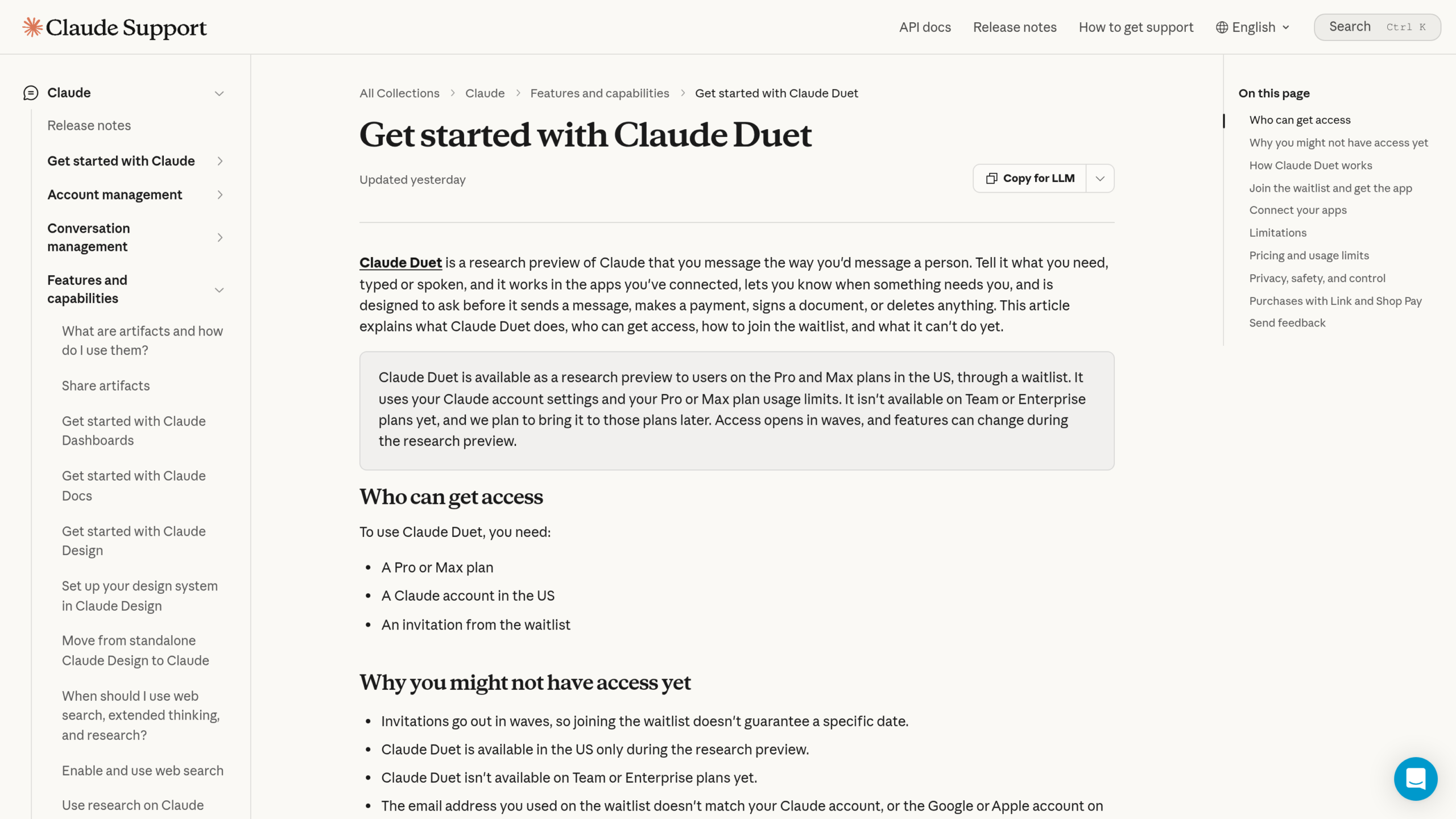
The agent runs on Claude Opus 5.5, which the user cannot change. It checks your accounts every few hours, not continuously: according to the official help page, an urgent message can therefore arrive between two checks. The connectors (the authorized links to your apps) named by the help page are Gmail, Google Calendar, Google Drive, Slack, QuickBooks, HubSpot, Docusign and Calendly. Microsoft 365 is not supported yet.
No announcement for France
To use Claude Duet, Anthropic’s help page requires three things: a Pro or Max plan, a Claude account in the US, and an invitation from the waitlist. Invitations go out « in waves », and signing up guarantees no date. Team and Enterprise plans do not have access for now. We found no date and no mention of any other country: to our knowledge, there is no announcement for France.
Engadget (Igor Bonifacic, October 21) and 9to5Google (Ben Schoon, same day) present it as Anthropic’s answer to Muse, Meta’s agent, and to Dots, OpenAI’s. According to Engadget, OpenAI’s Dots are limited to its most expensive plan, starting at $100 a month, while Anthropic’s $20-a-month Pro plan will get access at general release.
What the only published test says
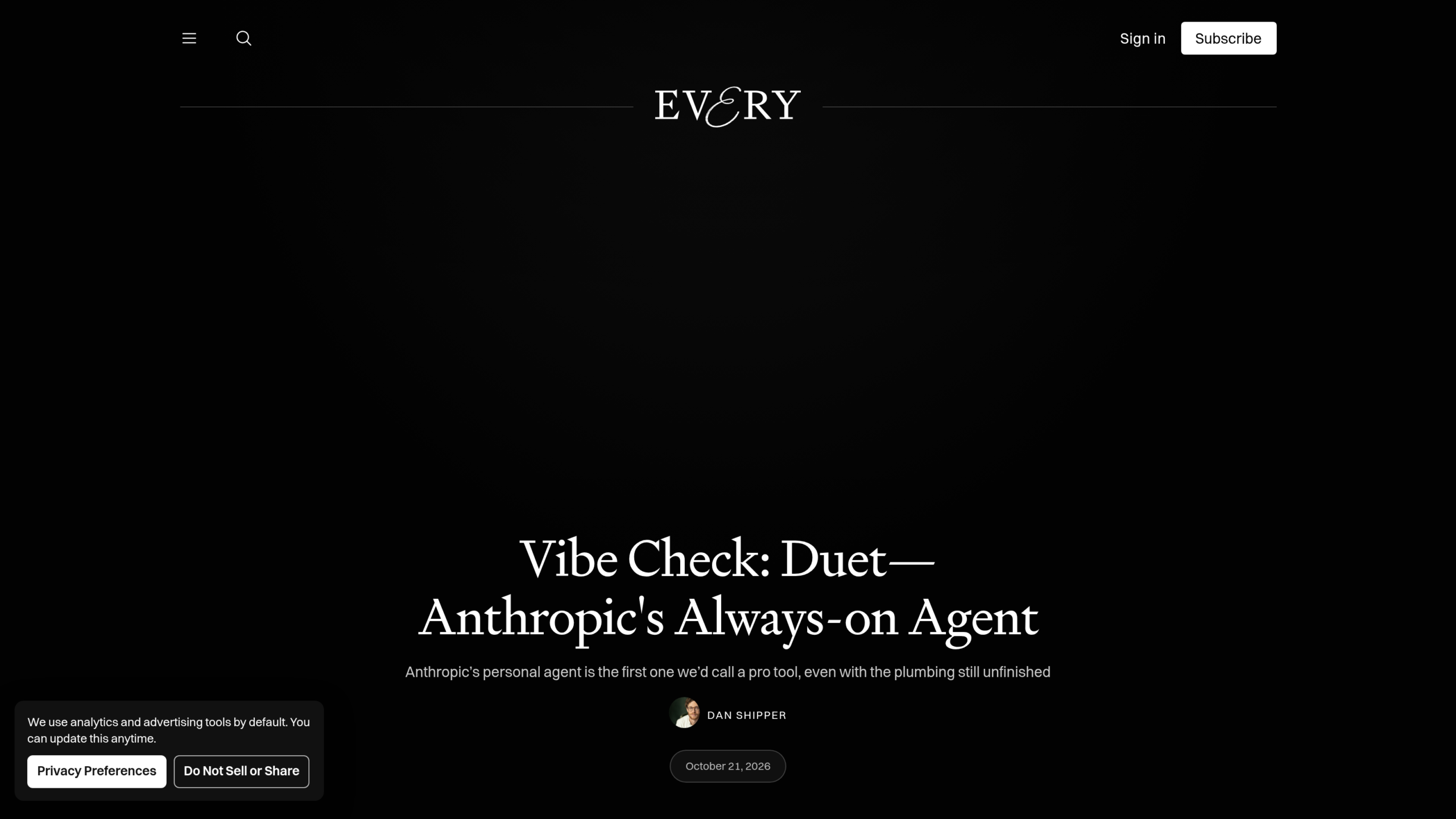
Dan Shipper, head of Every, had early access for two weeks. His verdict, in a « Vibe Check » dated October 21, is favorable: « Claude Duet is the first personal agent I’d call a pro tool. » He also lists the flaws: email drafts are worse than those of Dot, the OpenAI agent he used until then, there is no real voice mode, only transcription, and scheduled tasks do not reach his custom connectors. Every states that Anthropic gave it access with no say over the text. The end of the article is subscribers-only.
What needs your approval, what stays banned
The reference text fits in one sentence, which the help page repeats word for word: the agent is « designed to ask before it sends a message, makes a payment, signs a document, or deletes anything ». It shows what it is about to do and waits for your go-ahead. If you are not available, it finishes the rest and brings the request back later.
- Needs your approval: sending an email, paying, signing a document (through Docusign, for example), deleting.
- Banned even with your approval: buying or selling securities, moving money between accounts, accessing another person’s account.
- Out of reach: it makes no phone calls and sends no text messages to third parties.
- Purchases: the help page describes a confirmation request before each purchase, and a one-time card valid for that purchase only.
Anthropic adds a classifier (a second program that checks every message) meant to refuse to pass on the most sensitive category of information, including credit card numbers and ID documents. Health or personal finance data goes out only if you explicitly asked for it.
The hidden cost: your quota
It is included in Pro and Max at no extra charge, but it draws on the same quota as the rest of Claude, including the five-hour session limits and the weekly limit. The morning summary and the background checks count too, and big jobs (a financial model, a presentation) take more turns. The help page warns that you can therefore hit your limits sooner than with chat alone. Anthropic spaces its checks a few hours apart for that reason. On admission, each user gets one full reset of their limits, valid until November 30, 2026.
An agent that reads your mail also reads the traps
Anthropic’s help page says it plainly: the agent reads content written by others, emails and web pages, and that content can contain instructions meant to mislead it. This is called prompt injection (a hidden instruction in a text the agent reads and mistakes for an order). Anthropic writes that it is built to treat what it reads as information, but that « no defense is perfect », and that this is one reason heavy actions go through your approval.
The risk goes beyond Anthropic. We have reported on two OpenAI agents that switched off a monitoring system, and the Cairn case, where a hacker unleashed AI agents on more than 100 sites: an agent going off script on one side, a hacker using agents as a weapon on the other.
What already applies to the agents available to us
These precautions follow from Anthropic’s safeguards. Our reading, for any agent that reads your mail:
- Connect only the apps the task needs. The help page lets you disconnect any app at any time, but the memory of past exchanges is kept.
- Read the approval screen in full before clicking: recipient, amount, attachment. The help page itself recommends reviewing drafts and requests.
- Refuse to let an agent keep your real card: a one-time card limits the damage.
- Watch consumption: a background agent uses up your quota without you typing a word.
- Treat with suspicion an email or a page that gives orders to « the assistant »: it may be a planted instruction.
For the agent itself, only one thing is certain today: it exists, it is reserved for US accounts, and Anthropic gives no date outside the United States.









0 Commentaires
Aucun commentaire pour le moment. Soyez le premier à commenter !