

A glass sphere resting in a field of flowers, blurred grass in the foreground: the opening image of Genie 4 was not filmed, it is generated on the fly. Google DeepMind introduced this new « world model » (an AI that builds an animated environment live, which you move around in) on October 27, 2026, in a post signed by Raia Hadsell, Diego Rivas and Hang Qi. Access is still limited to testers picked by Google, with no date or price for the general public.
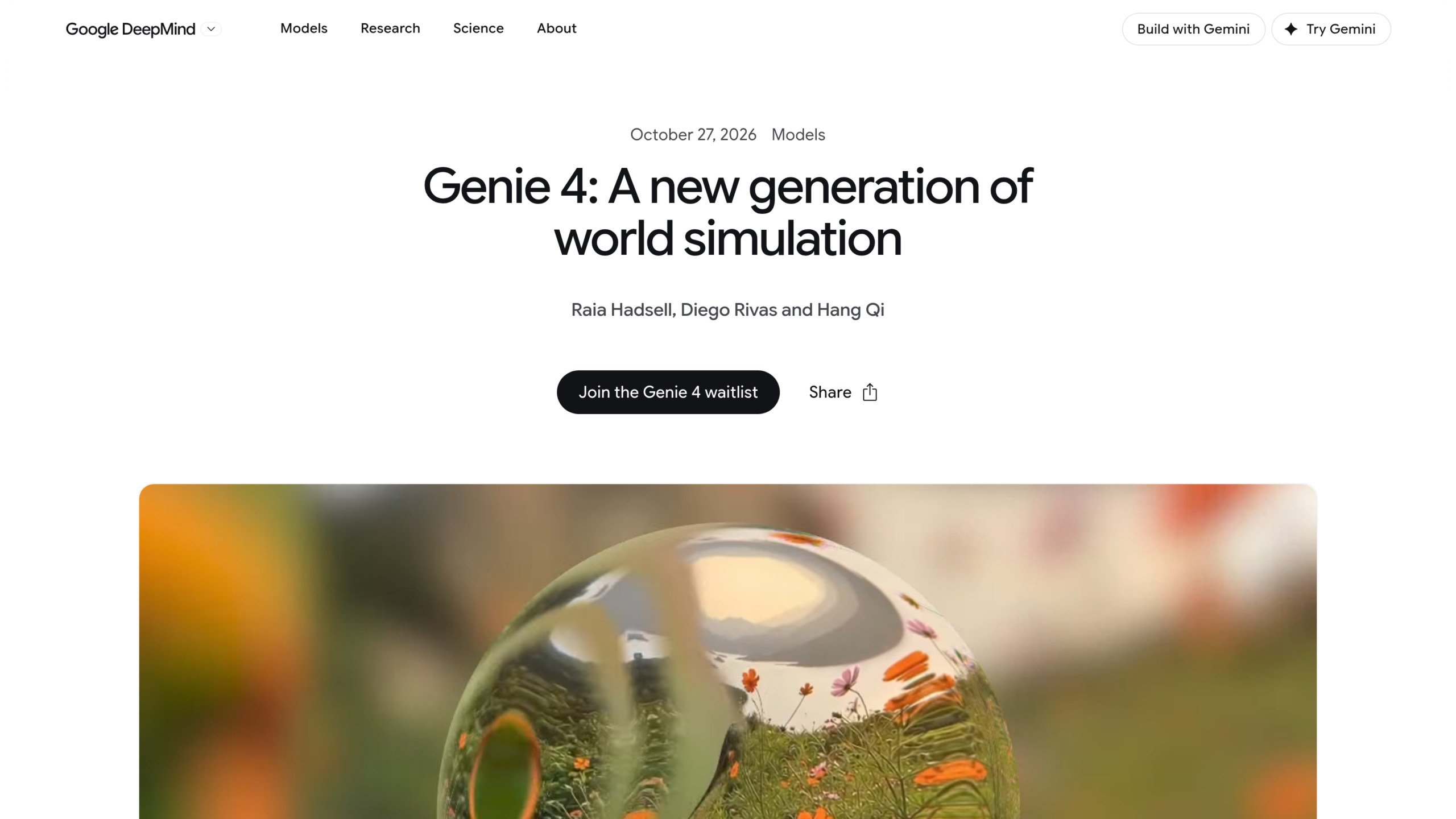
What Genie 4 adds: sound and text commands
The novelty you notice first is something you hear. DeepMind writes “Genie 4 is our first real-time world model to generate audio natively.” Ambient sound, music and dialogue come out of the same model as the picture: wind in the trees, waves on a beach, characters who respond to what you do.
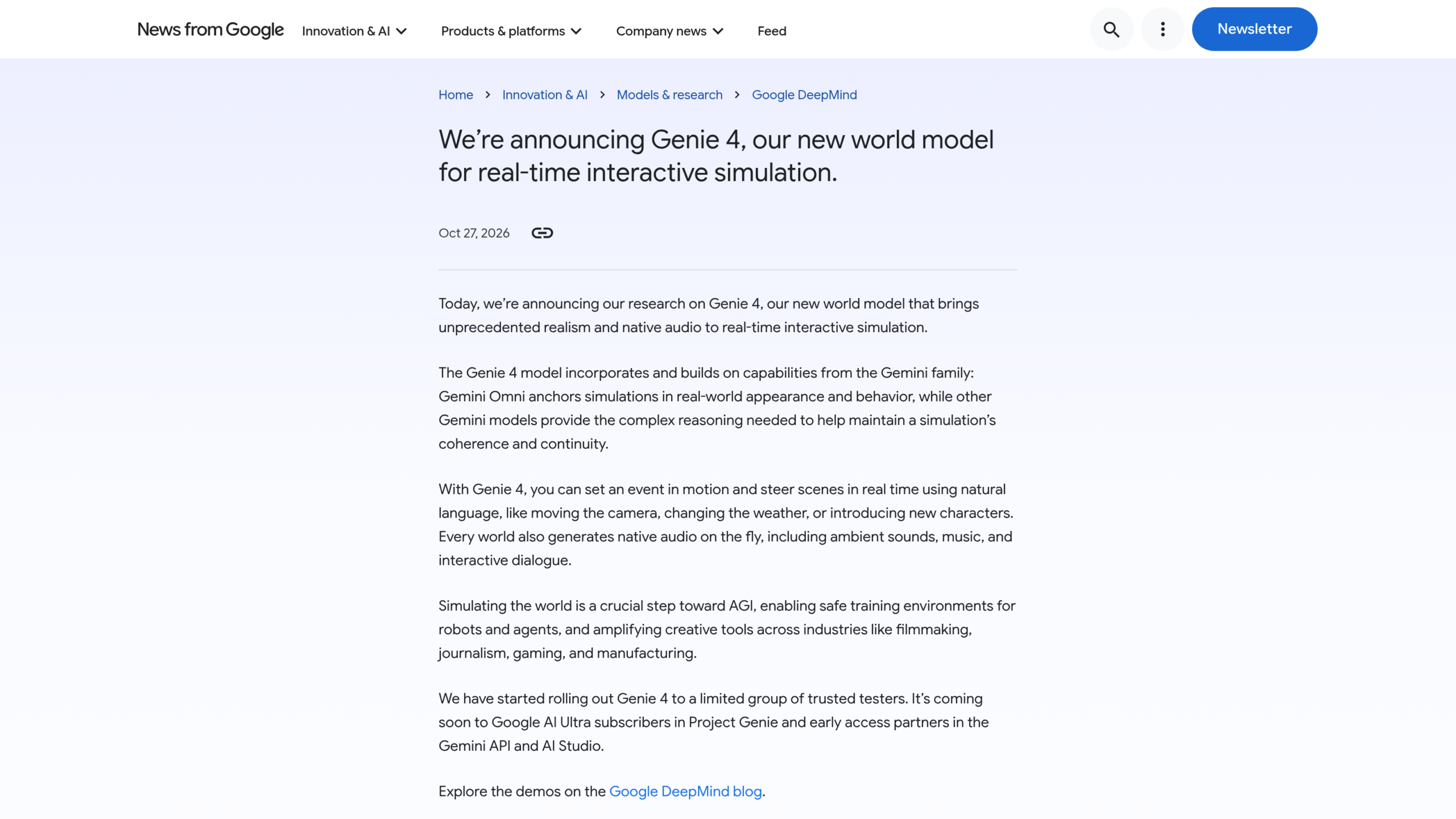
Steering works in two ways. Keyboard keys move the character and the camera, and sentences typed in plain language change the scene as it runs: switch the weather, move the camera, make characters or objects appear. To keep everything consistent, Gemini adapts these instructions to the scene and watches the world between two commands. The model builds on the Gemini family: Gemini Omni anchors the simulation in the look and behavior of the real world, while other Gemini models supply the reasoning that preserves continuity.
On duration, Google gives no figure on its pages. It is TechCrunch, written by Rebecca Bellan that reports coherence held for up to two minutes, twice what Genie 3 managed. That number comes from that outlet alone: it does not appear in the Google posts I read. No resolution or frame rate is published either.
The limits Google admits itself
The post is frank about the state of the product: “Genie 4 remains an early, evolving area of research.” Visual details and object permanence, meaning a tree staying a tree when the camera comes back, can drift, especially in long sessions or after several text edits.
The list of open problems is long: complex physical interactions, real-time audio accuracy, legible text on screen, spatial precision, consistency over time. A player will recognize everything that makes a level hold together, from a readable sign to the exact position of a ledge. TechCrunch adds that Google has solved neither audio accuracy nor legible in-world text.
Google also states that all generated content, video and audio alike, will carry a SynthID watermark (an invisible mark that flags AI-made content).
For gamers: an ideas tool, not a game engine
In the pages I read, nothing describes game rules, saving a session or exporting the world to an engine. Those are absences, not announced bans, but they sketch what the model is for today: a simulation you explore for a few minutes, not a level you replay tomorrow. Video games are on Google’s list of sectors, alongside filmmaking, journalism and manufacturing, and the post mostly stresses training robots and agents.
Diego Rivas, an engineer at DeepMind, sees the value of real time in creative uses like ideation and storyboarding, according to TechCrunch. That is the most plausible reading for a studio: testing a mood, a weather or a setting by typing a sentence, before producing anything. Tejas Kulkarni, a research director at Google, talks about « hybrid world models » to describe the pairing of Gemini and Genie.
The precedent is close. Google Playground already generates games from a prompt, and we noted that it is not available in France. This model sits one floor earlier, at the animated sketch stage.
When you can try it, and where
The post on the Google blog says it plainly: the rollout has started with a limited group of trusted testers, and the model is coming soon to Google AI Ultra subscribers in Project Genie, then to early access partners in the Gemini API and Google AI Studio. TechCrunch speaks of a rollout « in the coming weeks », with no firmer schedule. A waitlist is open on DeepMind’s page.
What nobody has written yet: the price of the subscription or the API for this model, the date, or availability in France. Google names no country on its pages. The pattern resembles Claude Duet, with no date for France, and the caution is the same: until an official page lists the countries, a French player has nothing to plan. The waitlist is the only useful move for now.






0 Commentaires
Aucun commentaire pour le moment. Soyez le premier à commenter !