
Five people at a restaurant, a 187.40 euro bill, two diners who skipped the 8 euro dessert. We asked ChatGPT to solve this end-of-meal problem, without an account, from France, on October 11. Within seconds, Intelligent UI built a real little tool, with fields, buttons and checkboxes. The result was wrong. We tried again: wrong again, in a different way. Free GPT-6 can draw an interface. It does not always check what that interface calculates.
What free GPT-6 brings since October 8
On October 7, OpenAI announced “GPT-6 and Intelligent UI for everyone”. The new model arrived the same day for Plus, Pro, Business and Enterprise subscribers, and the next day for the Free and Go plans. Paying subscribers run on GPT-6 Sol, free accounts on GPT-6 Luna, two versions described as optimized for everyday conversations. OpenAI calls it a global rollout, and France is covered: we got our interactive answers without even logging in.
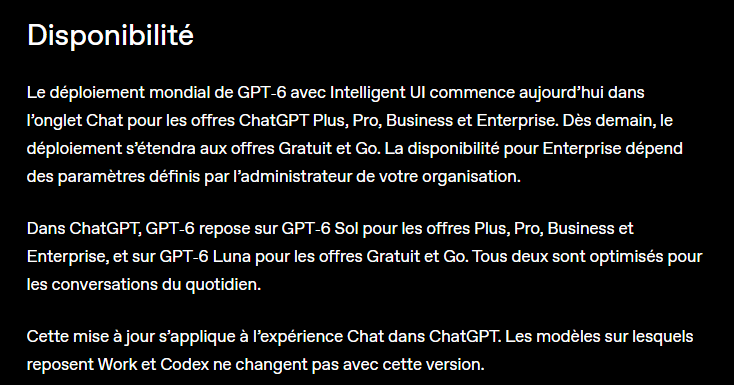
This week, two other AI launches stopped at the French border: Google Playground, which builds games from a prompt, is not available in France, and neither is Apple’s AI-powered Siri.
The real novelty is called Intelligent UI. Instead of a block of text, ChatGPT can answer with a table, a chart, a form or a small tool you use inside the conversation. OpenAI itself gives three examples: a bill splitter, a savings simulator and a retro game. The model picks the format on its own, and falls back to text when that works better. On speed, the company says GPT-6 Instant starts answering web-search questions 44% sooner than GPT-5.6 Instant, a figure from its own tests. The Sol model had made headlines a few days earlier, after Astra 6.1 was dropped.
First attempt: a nice tool, 8 euros too much
We took OpenAI’s own example at its word. ChatGPT answered with a complete bill-splitting module: the 187.40 euro amount prefilled, a diner counter with plus and minus buttons, the dessert price, and a checkbox per person to mark those who skipped it. It looks polished, and it is easy to see why OpenAI uses it as a showcase for Intelligent UI.
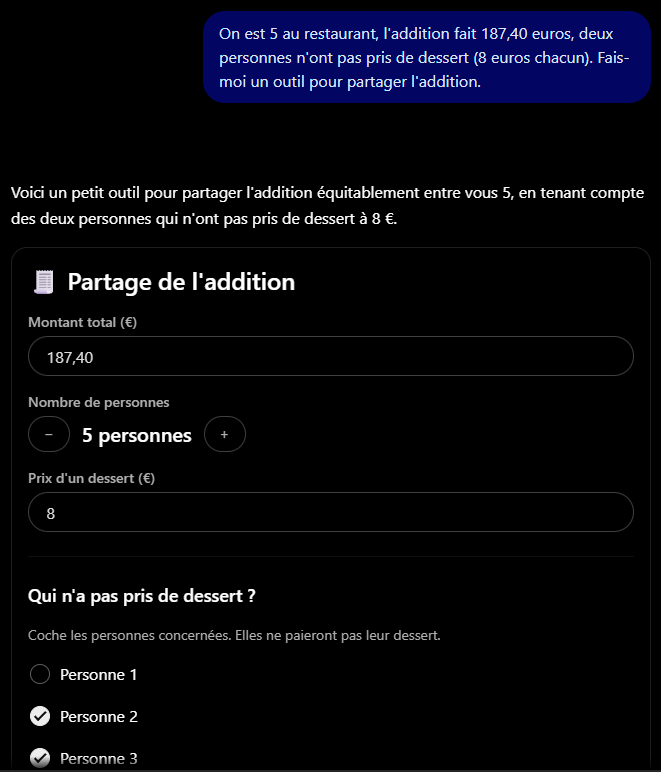
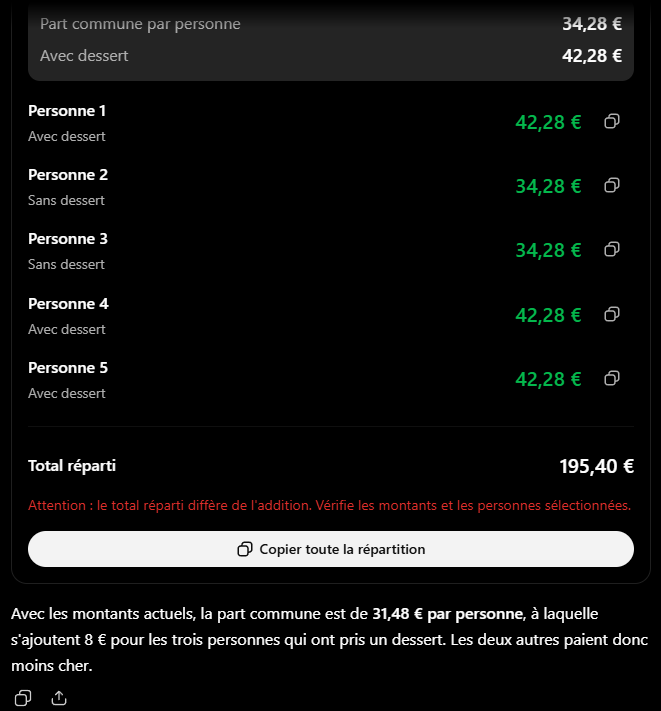
The math does not hold up. The tool charges 42.28 euros to the three people who had dessert and 34.28 euros to the other two. Add it up: 195.40 euros, 8 euros more than the bill. The tool knows it, too. Right under the total, a red line warns, in French, that the split total differs from the bill and asks you to check the amounts and selected people. And below the tool, ChatGPT’s closing sentence announces a shared portion of 31.48 euros, a third figure that matches neither the tool nor reality.
The right answer takes one line. The three desserts eaten cost 24 euros. The rest, 163.40 euros, splits five ways: 32.68 euros each. The three dessert eaters add their 8 euros and pay 40.68 euros. Three times 40.68 plus two times 32.68: 187.40 euros, which checks out.
Second attempt: same question, different mistake
An AI answer varies from one try to the next. So we asked exactly the same question in a new conversation. The new tool is different, with a field for an optional tip, and so is its reasoning: ChatGPT subtracts 16 euros of “uneaten desserts” from the total, then splits the rest equally. Everyone pays 34.28 euros, dessert or not.
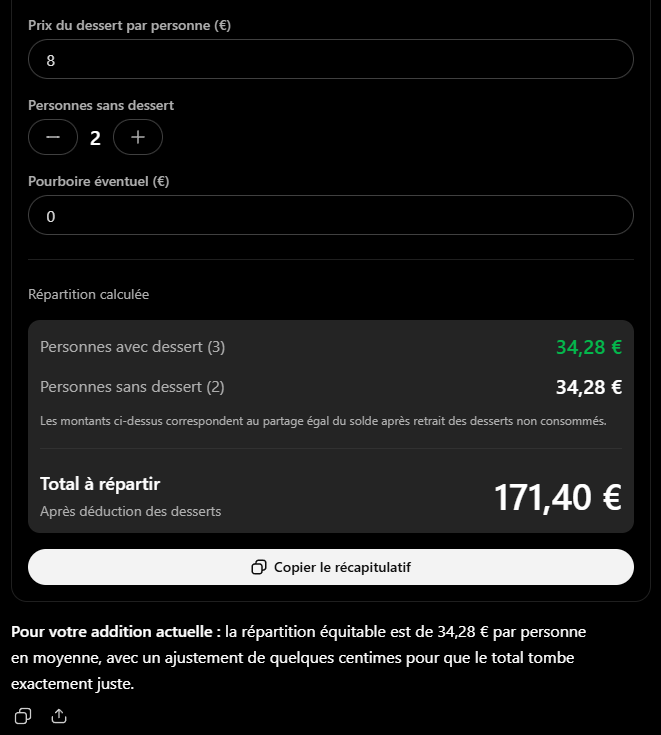
Those 16 euros of desserts that nobody ordered were never on the bill. Five times 34.28 euros is 171.40 euros. The restaurant is 16 euros short, and the people who ate dessert do not pay for it. This time, no red warning. ChatGPT even concludes that “a few cents of adjustment” will make the total “come out exactly right.”
Third attempt: right numbers, misleading chart
To be fair to the model, we asked a question where any mistake shows immediately: a mount has a 1% chance to drop from a boss, what are my odds of getting it in 100 kills? The answer is correct. ChatGPT gives the right formula and the right result, about 63.4%, and points out that each attempt is independent: the game owes you nothing after 100 failures, unless there is a pity mechanic. We recalculated its milestones, a coin flip at 69 bosses, 90% at 230, 99% at 459: all correct.
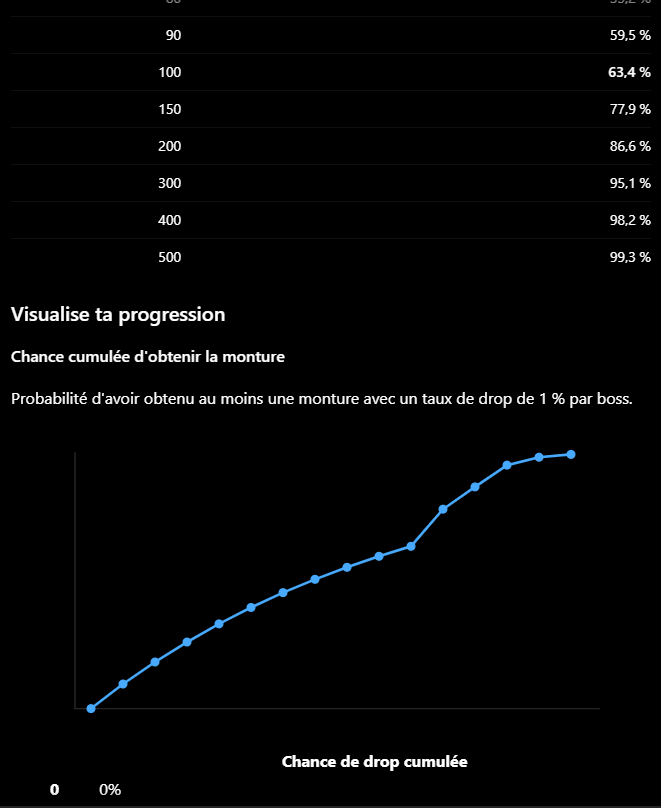
The chart that comes with the answer, however, distorts the curve. The points 100, 150, 200, 300, 400 and 500 are spaced as if they were regular, while the gaps double. The curve, which should bend smoothly, shows a kink that does not exist. And the horizontal axis has no ticks to notice it. A player who only reads the drawing walks away with the wrong intuition.
Our verdict on free GPT-6 and Intelligent UI
Intelligent UI changes how you use ChatGPT, and free GPT-6 is not held back on that front. To explain a concept, compare figures or visualize a probability, the interactive format helps. The text of the mount answer was clear and correct, and the table made it easy to read.
But a tool that calculates inherits the trust we give a calculator, and this one has not earned it yet. In two attempts at a case anyone solves in their head, we got two wrong splits, in opposite directions: 8 euros too much, then 16 euros too little. The first tool even detected its mistake and displayed it, without fixing it. ChatGPT reminds you at the bottom of every answer that it “can make mistakes.” With Intelligent UI, that notice matters more: the mistake now comes dressed in an interface that looks reliable.
The right reflex fits in one sum: before paying, check that the shares add back up to the total.






0 Commentaires
Aucun commentaire pour le moment. Soyez le premier à commenter !