
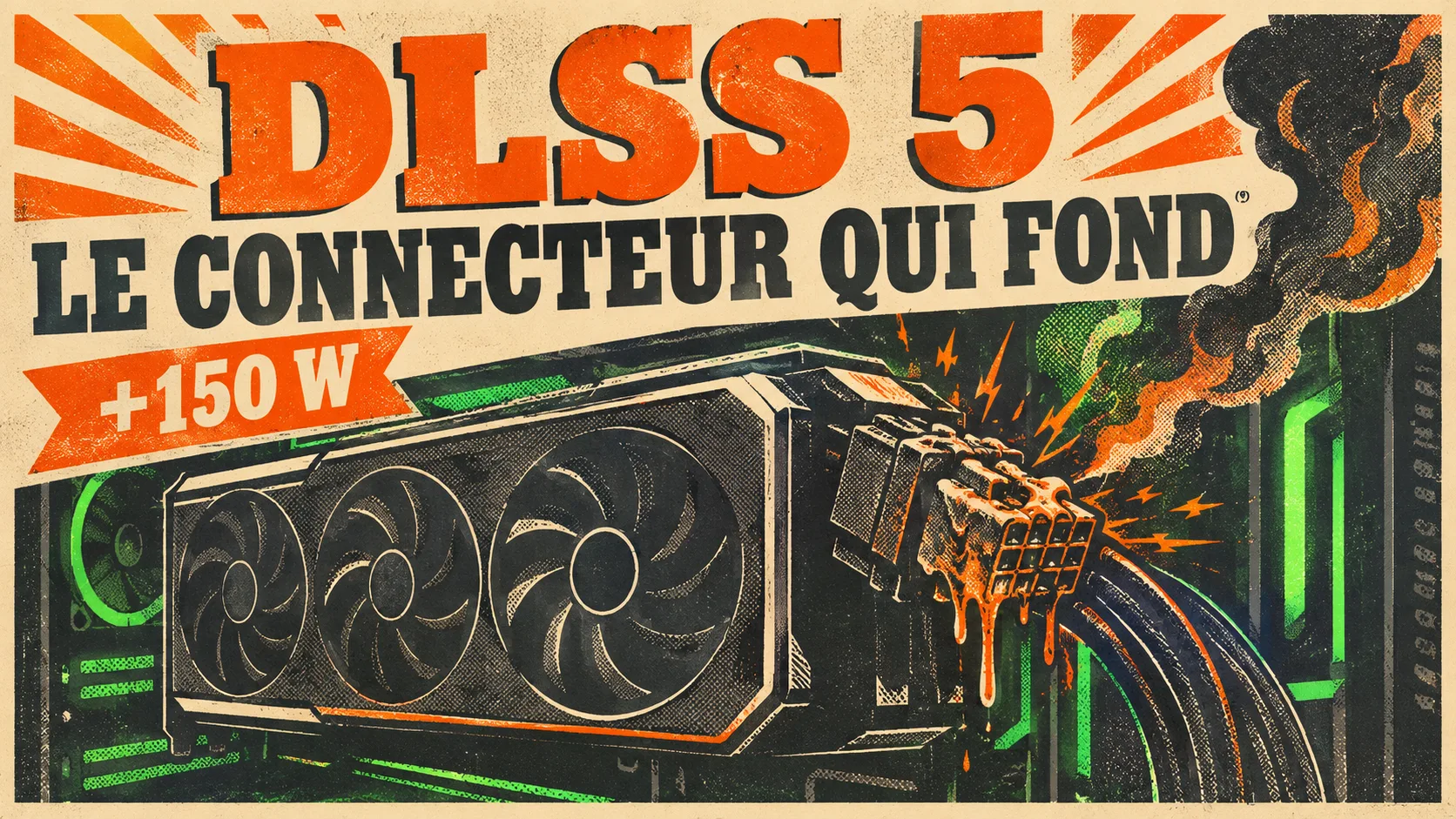
A sixteen-pin power connector, the one RTX 50 cards use to link the case’s power supply to the graphics card and that the industry calls 12V-2×6, showed up charred and melted in a photo shared on September 7, 2026 by Tom’s Hardware, sourced from the HardOCP forum. The player claims he fried his RTX 5090 while testing DLSS 5, Nvidia’s latest neural rendering technique, a process that redraws certain image details using an AI model instead of simply upscaling them. An article published on the site on September 3 already covered what this technique adds to the image. This one is about watts, heat, and a cable that couldn’t take it.
A Melted RTX 5090 Connector, But a Report Worth Qualifying
The report comes from a HardOCP forum member going by Erek, picked up by Tom’s Hardware and TweakTown. His card, an MSI GeForce RTX 5090 Gaming Trio OC with a rated TDP of 575 W, the maximum power draw set by the manufacturer, was pulling around 450 W in regular gameplay. Once the feature was turned on in NBA 2K27, GPU-Z software showed sustained power draw above 610 W. TweakTown notes that the card’s total power, cable included plus the 75 W supplied by the PCIe slot itself, reached as high as 613.5 W.

Shortly after, the card showed signs of instability before shutting down completely. The user noticed a burning smell, then found the connector melted, partly fused to the cable. At least five pins showed burn marks, and the plastic housing of one of them had completely melted away. Tom’s Hardware doesn’t mince words about it: this remains a user report picked up by the press, not a lab measurement, and the exact cause of the failure isn’t confirmed.
Tom’s Hardware’s Measurements, Card by Card
Two days before the incident, Tom’s Hardware had tested DLSS 5 across the entire RTX 50 lineup in NBA 2K27. On the Founders Edition, the reference version sold directly by Nvidia as opposed to cards built by partners like MSI or Asus, power draw climbs from about 465 W without the feature to a maximum of 575 W once it’s turned on. According to TweakTown, the RTX 5080 gains about 100 W and runs into its 360 W limit. The MSI RTX 5090 Lightning Z averages nearly 850 W in 4K, a 48% higher power draw than the Founders Edition for just 22% more performance.

These swings are nothing new for Tom’s Hardware. In tests run before the official launch in NBA 2K27, the same Lightning Z, fitted with two sixteen-pin connectors and a BIOS tuned to handle up to 1,000 W, went from 691 W to 800 W with the feature turned on in Control, and from 480 W to 720 W in Hogwarts Legacy, a 50% jump. The Founders Edition, for its part, went from 417 W to 547 W on that same game, 31% more with a single connector. Even at 1080p, where almost every Blackwell card, the code name for the RTX 50 generation, can run it, the bottleneck shifts: without it, every model from the RTX 5070 up is CPU-bound, not GPU-bound.
Why DLSS 5 Drives Up Power Draw
Tom’s Hardware attributes this to the load placed on the Tensor Cores, the AI-focused compute circuits built into the chip. Generating an image with this technique carries a fixed compute cost per output frame, one that grows with the target resolution. That cost dominates total render time, so turning on Nvidia’s classic upscaling to lower the render resolution no longer recovers performance the way it used to. The card still has to wait for the model’s final generation pass either way.
An article published earlier on the site covered DLSS 4.5 and its ray reconstruction, already available on every RTX card. This fifth version adds a separate compute layer, reserved for now to RTX 50 cards. On his own RTX 5090, Engadget‘s Devindra Hardawar measured power draw climbing from about 400 W to 525 W in 4K once the feature was turned on, with frame rate dropping from 240 to 150 frames per second on the same test.
The 16-Pin Connector, an Already Documented Problem
The sixteen-pin connector didn’t need DLSS 5 to make headlines. TweakTown lists several separate incidents on RTX 50 cards: a melted cable on an RTX 5070, an RTX 5090 and its power supply damaged together at the site Club386, and a hole burned through a card’s circuit board after an attempt to install a second connector. Hassam Nasir of Tom’s Hardware sums it up bluntly: an RTX 5090 giving up the ghost has nearly become a monthly occurrence, usually tied to a cable not fully seated in its connector.

Its rated capacity tops out at 600 W. The motherboard’s PCIe slot supplies another 75 W on top of that. This extra load pushes certain setups right up to that limit, or even past it on unlocked models like the Lightning Z. TweakTown calls Erek’s incident the first known case of a melted cable directly tied to these tests.
What This Means for Your Setup
For now, DLSS 5 officially runs only in NBA 2K27, and only on RTX 50 cards. Nvidia has responded to criticism from its community, reports Engadget, by announcing that the technology will one day come to RTX 40 cards, excluded up to now. Players are already testing it through mods in other games like Control and Cyberpunk 2077, and Capcom, Tencent, and Ubisoft have committed to adding it to future titles, without naming which ones.
Nvidia also sells the RTX Spark, a full ARM-based PC for $2,500. DLSS 5, meanwhile, demands more watts from cards already running at their ceiling. If you already own an RTX 5090 and plan to try it, check your power supply’s headroom and the condition of your cable before launching the game. On Hogwarts Legacy, Tom’s Hardware measured up to 50% more power draw just from turning it on.








0 Commentaires
Aucun commentaire pour le moment. Soyez le premier à commenter !