
The patch notes for Metro 2033 Redux and Metro: Last Light Redux say three words on the subject: “DLSS Support”. Players found more by opening the graphics options: a “Neural Rendering” setting, the name of the headline DLSS 5 feature. Neither 4A Games nor Nvidia has announced DLSS 5 in Metro Redux: the press is relying for now on what players spotted.
What 4A Games states in writing
The “Next Gen” update came out on October 22, 2026 on PC (Steam, Epic, GOG). The notes published by Deep Silver list an uncapped frame rate (depending on your hardware) and support for three upscaling techniques: 4A TSR (4A Games’ in-house technique), Nvidia’s DLSS and AMD’s FSR. They go on with screen-space global illumination, more geometry detail, 4K textures and improved PBR materials. Spatial audio and DualSense adaptive triggers come on top.

Per the notes, 4K requires a 4K monitor, and it mentions neither DLSS 5 nor neural rendering. TBreak writes that the developers indicated ray tracing was not added. We found this detail only at TBreak. Another date to note: the console and Microsoft Store versions are scheduled for October 29, according to TheFPSReview and TBreak. TBreak adds that the update is free for owners of the game.
The setting players found
First to flag it was DSOGaming, on October 22. John Papadopoulos writes that a “Neural Rendering” setting appears when you enable DLSS, then: “Some speculate that this is native support for DLSS 5.” He adds that he is downloading the game to compare. His text stays hedged.

On October 23, TheFPSReview (Peter Brosdahl) goes further: “evidently the devs also added support for DLSS 5”. The outlet relies on a post by player Renan Maniero, who says the DLL in the game folder is the latest version, the same one as in NBA 2K27. It is a clue, not a confirmation: no statement from 4A Games or Nvidia establishes it. If the clue holds, Metro Redux would be the second game to offer the feature after NBA 2K27, which has not been confirmed either.

What DLSS 5 changes on screen in Metro Redux, and for which RTX cards
DLSS 5 does more than raise the resolution. According to TBreak, neural rendering uses artificial intelligence to modify lighting and material appearance based on the image the game renders. It works on GeForce RTX 50 Series cards and RTX Spark systems. Owners of older cards keep the standard DLSS listed in the notes. According to DSOGaming, the setting only shows up once DLSS is enabled. We infer that it does not combine with FSR or TSR, although none of the sources we read says so.
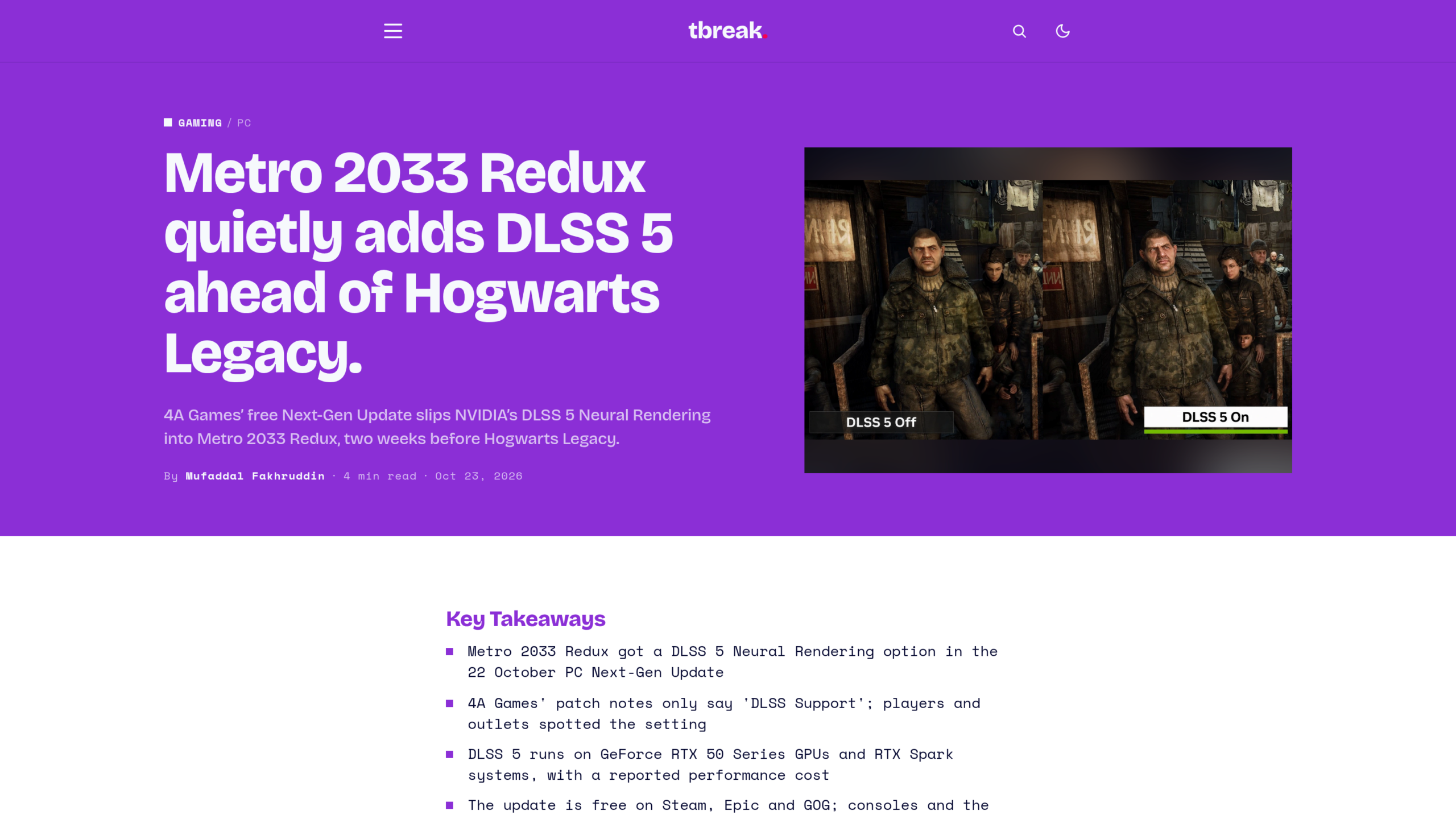
On the look, opinions differ. TBreak reports that DSOGaming’s comparisons show better faces while the environments barely change. The showcase here is the faces. The faces of a game released in 2010, then reissued as Redux, are where age shows most: that is our reading, not TBreak’s. The performance cost circulates as player figures we could not verify, so we do not repeat them. TBreak only notes that a cost exists and depends on the card and the settings.
Our article DLSS 5 makes games prettier, and industry engineers call it an airbrush filter recalls that NBA 2K27 was the showcase, and reports the verdict of a Respawn rendering engineer. A 2010 game works as a full-scale test of that criticism: do faces gain fidelity, or smoothing? We also covered the RTX 5090 cable that melted during a DLSS 5 test.
A schedule that did not include Metro
According to TBreak, Nvidia confirmed DLSS 5 for Hogwarts Legacy on November 5, then for Where Winds Meet in late November. Metro was not in that announcement, which makes this appearance a surprise for people following the program. As for Metro 2039, due February 4, 2027 according to Deep Silver: none of the sources we read says whether it will use the feature.
The “Neural Rendering” setting is in the game. DLSS 5, for now, rests on a DLL and a menu label.





0 Commentaires
Aucun commentaire pour le moment. Soyez le premier à commenter !