
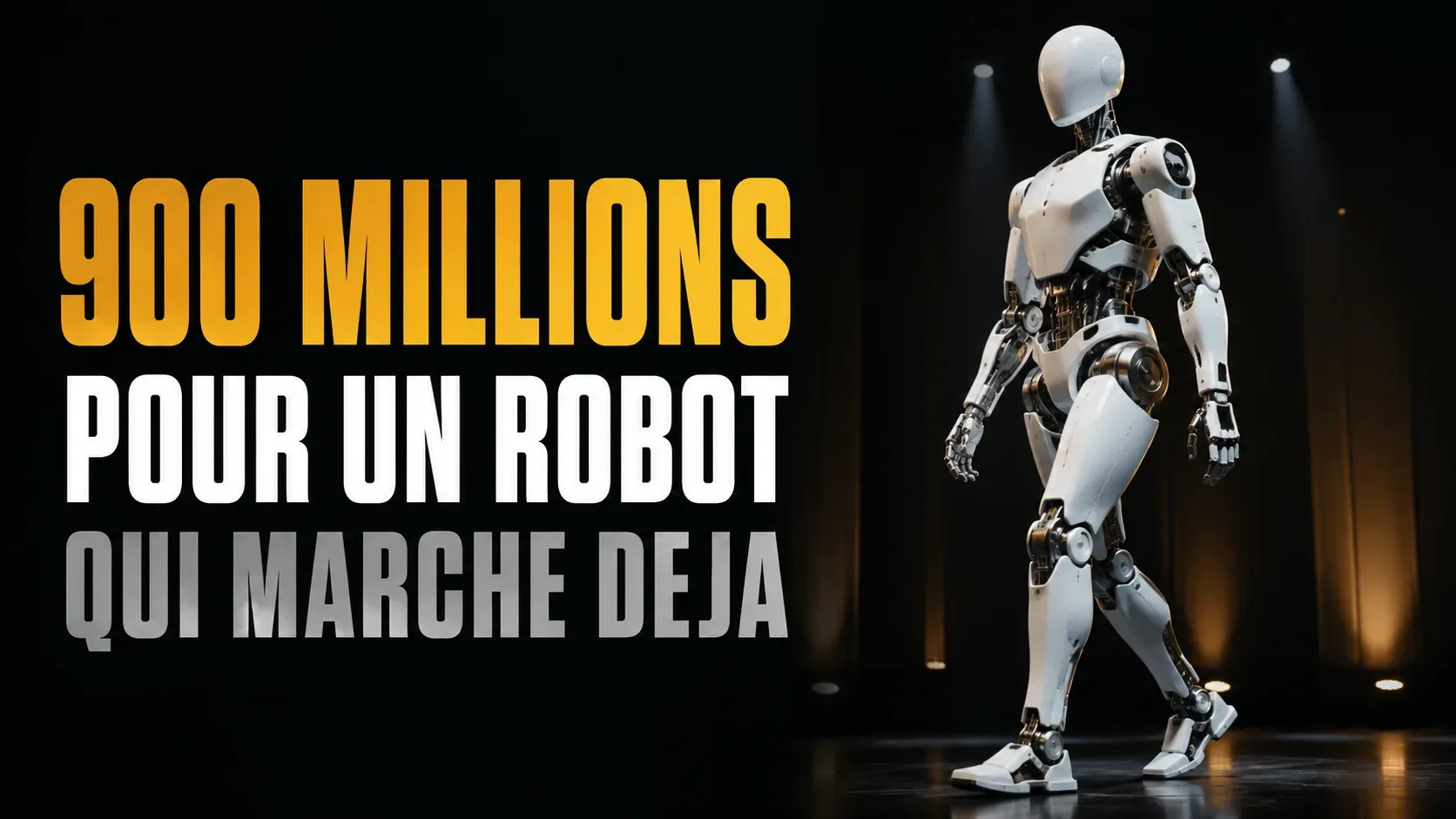
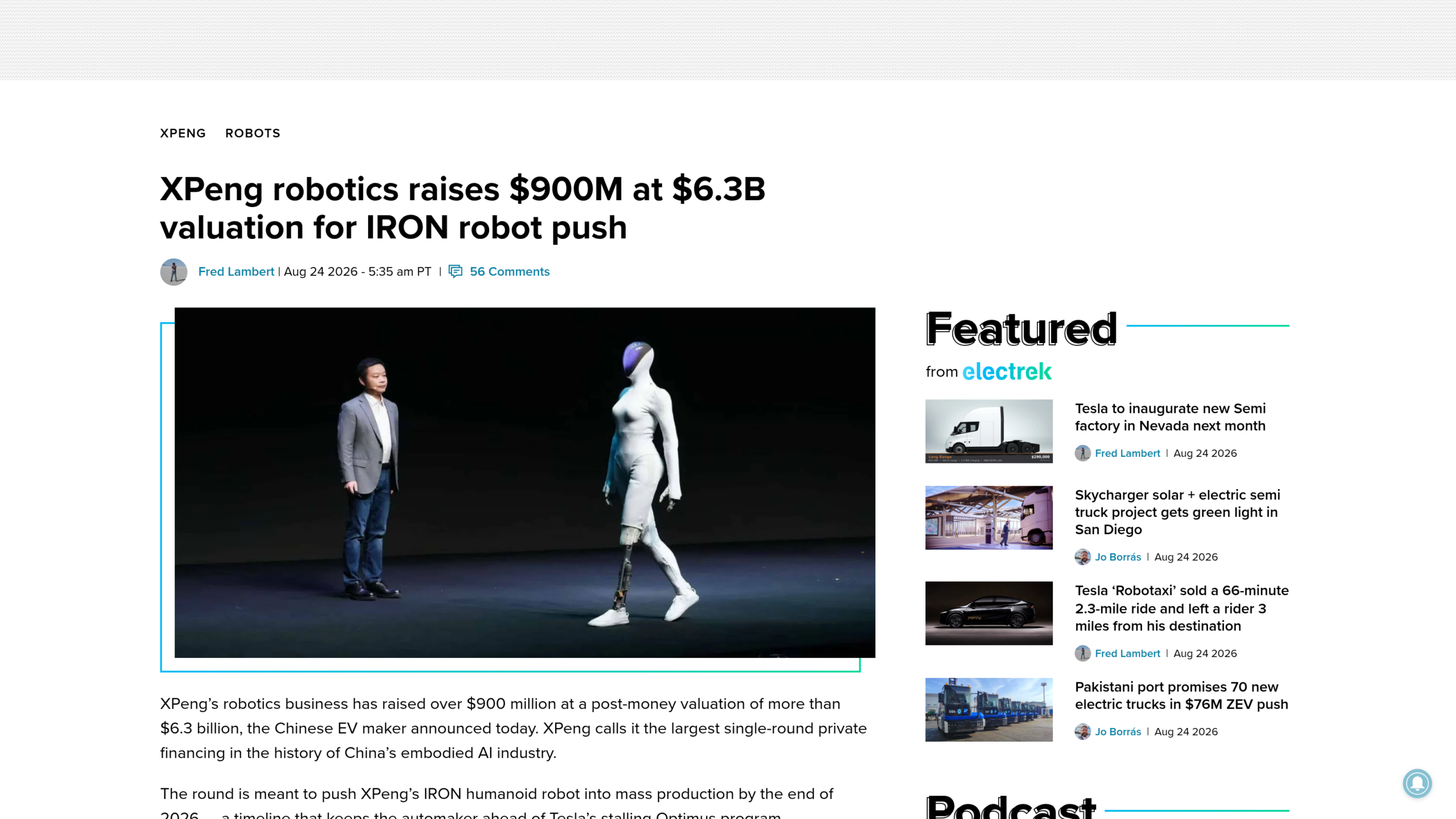
Guangzhou, August 24, 2026. On stage, a robot walks alongside XPeng’s founder, its mechanical leg clearly visible under the spotlights. XPeng IRON is already walking in public, and its maker has just announced one of the biggest funding rounds ever recorded in embodied AI (artificial intelligence built into machines that perceive and act in the physical world, unlike software that stays behind a screen).
XPeng Inc., listed on the NYSE under the ticker XPEV and on the Hong Kong Stock Exchange under 9868, is known first and foremost as a Chinese electric vehicle maker. The company now describes itself as « a global leader in physical AI. » Its robotics division has just signed share purchase agreements with several investors, for an amount exceeding $900 million.
That amount values the subsidiary at over $6.3 billion post-money (the valuation once the fresh cash is factored into the company’s balance sheet). XPeng calls it the largest single private funding round ever raised in China’s embodied AI industry. The question comes down to two points: what this money funds, and what XPeng IRON actually delivers beyond the few steps taken on stage.
XPeng, a car maker betting on embodied AI
An electric vehicle maker branching out into humanoid robots isn’t as strange as it sounds. XPeng already builds batteries that can power a vehicle for hours, precise electric motors, onboard chips, and large-scale automated production lines. Those are exactly the building blocks a machine needs to stand up, walk, and handle objects without draining its battery in a few minutes.
Self-driving technology also provides a direct training ground. XPeng has spent years developing driving systems that perceive the road, anticipate obstacles, and make decisions without human input. Elsewhere in the industry, that same logic is already leaving the lab: in Las Vegas, it’s driverless robotaxis carrying that bet forward. For XPeng, getting a robot to walk means transposing that know-how onto two legs instead of four wheels.
That bet is called XPeng IRON. The company describes it as an advanced humanoid robot, combining a form and movements very close to a human’s with AI-driven intelligence, built to meet the highest safety standards. XPeng has turned it into its all-purpose platform, capable of improving through reinforcement learning (a training method where the machine adjusts its behavior based on its mistakes and successes), this time directly in the real world rather than in simulation.
A historic funding round: over $900 million
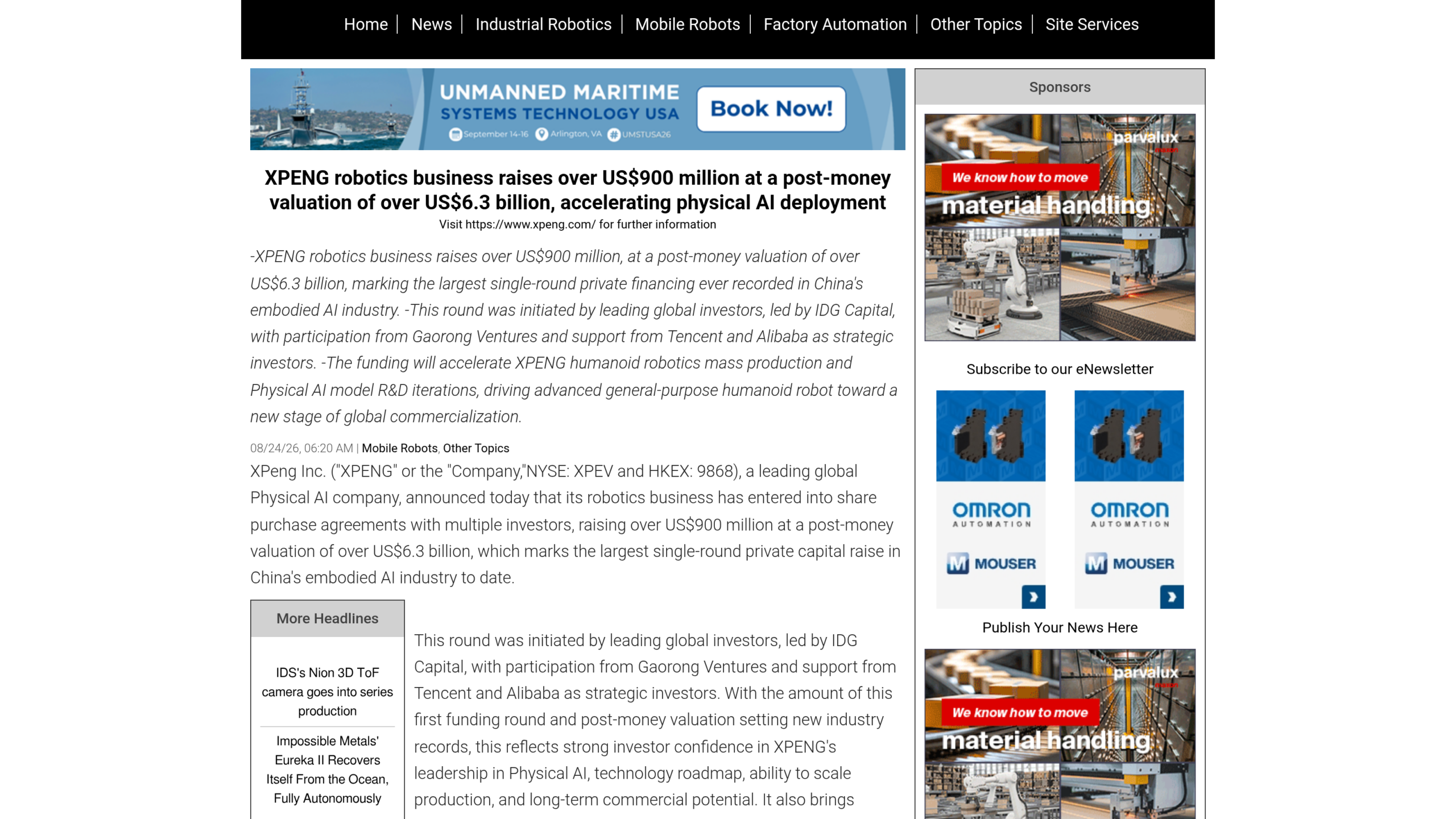
A funding round (a deal where a company sells part of its equity to investors in exchange for cash) rarely brings together this many heavyweight players at once. The one for XPeng’s robotics division was led by IDG Capital, with participation from Gaorong Ventures, and backing from two Chinese tech giants, Tencent and Alibaba, as strategic investors.
In its statement, XPeng says the amount and the valuation set new records for the sector, and reflect investor confidence in its role as a leader in physical AI, its technology roadmap, its ability to industrialize production, and its long-term commercial potential. In other words, this money funds the next phase of the XPeng IRON program directly, from research through to the factory floor.
The scale of the figure deserves some context. A round of over $900 million, for a single division of an already publicly traded company, dwarfs what most robotics start-ups raise over their entire existence. It places XPeng among the best-funded players in a sector where capital is shifting from software toward hardware that moves.
XPeng IRON, the specs of a humanoid robot
The body of XPeng IRON has 76 degrees of freedom (the number of independent movements a joint or set of joints can perform, a standard robotics measure of how flexible a mechanical skeleton is), spread across the entire body. Each hand adds 21 more on its own, enough to handle objects with precision close to that of a human hand rather than simple rigid grippers.
Three in-house chips, called Turing AI, deliver up to 2,250 TOPS of computing power (TOPS, for trillions of operations per second, measures how fast a chip can process the calculations needed for onboard artificial intelligence). That power lets the robot act without being remotely piloted: decisions are made directly onboard, not sent off to a distant server.
| Feature | XPeng IRON |
|---|---|
| Degrees of freedom (full body) | 76 |
| Degrees of freedom (per hand) | 21 |
| Onboard chips | 3 Turing AI chips |
| Computing power | Up to 2,250 TOPS |
| Targeted mass production | Late 2026 |
| Commercial deliveries | China and international, 2027 |
This surge in onboard computing power isn’t unique to XPeng. Elsewhere, money is also moving toward hardware built specifically for AI, as shown by a chip designed solely to run transformer-type models. The common thread: the faster and more independently a machine needs to decide, the more it needs a chip built specifically for that task, rather than a general-purpose processor.
Mass production by late 2026: a promise still to be confirmed
XPeng is targeting mass production (large-scale series manufacturing, rather than a handful of hand-assembled units) of XPeng IRON as early as the end of 2026. The rollout would start in the company’s stores and on its campuses, ahead of commercial deliveries in China and internationally planned for 2027.
The specialist outlet Electrek, written by Fred Lambert, notes that this timeline would put XPeng ahead of Tesla’s Optimus program, which it describes as struggling. That comparison remains Electrek’s own, not a fact established by XPeng or by an independent third party, and it’s worth exactly what any prediction is worth in a sector where announcements move faster than factories.
One caveat is worth stating: no humanoid robot, from any manufacturer, has ever met a mass production deadline announced this early. Between a stage in Guangzhou and an assembly line running at full capacity, there’s still a gap that only the coming months will close. The other half of the AI market keeps growing quietly too: while XPeng IRON is learning to walk, software models like Gemini are crossing the one-billion-user mark, proof that the AI race is now being fought on two fronts, screens and legs.








0 Commentaires
Aucun commentaire pour le moment. Soyez le premier à commenter !