
On August 11, 2026, Sundar Pichai announced on X that the Gemini app had surpassed one billion monthly active users. It’s the fourteenth Google product to cross this threshold, and the fastest in its history to get there.
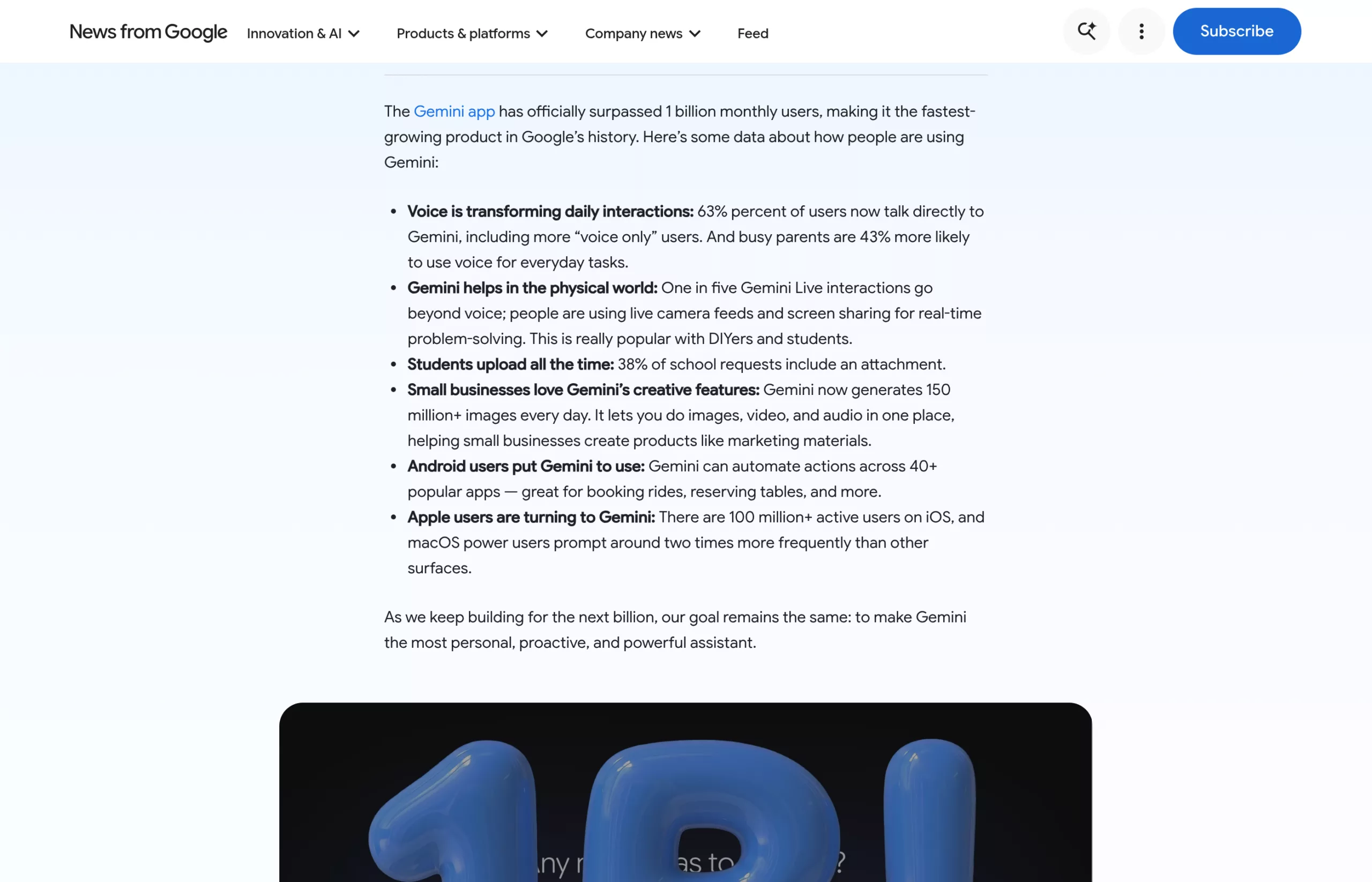
The same day, Google published usage data on its official blog. 63% of users talk directly to the assistant, 150 million images are generated every day, and 100 million active users come from iOS. One figure is missing, the number of paying subscribers to Gemini. Without it, there’s no way to tell whether this billion reflects an audience it won or an audience simply distributed by default.
The fourteenth in-house product to cross the billion mark
Sundar Pichai, CEO of Google, announced on X on August 11, 2026, that Gemini had surpassed one billion monthly active users. He credits this result to Josh Woodward, the vice president who leads Google Labs, the app, and AI Studio (the tool for building with Google’s models). He also praises the whole team behind the product.
A monthly active user is someone who opened the app at least once during the month, not someone who uses it every day. Google calls this figure its fastest growth in its history, a figure published the same day on its official blog, the Keyword.
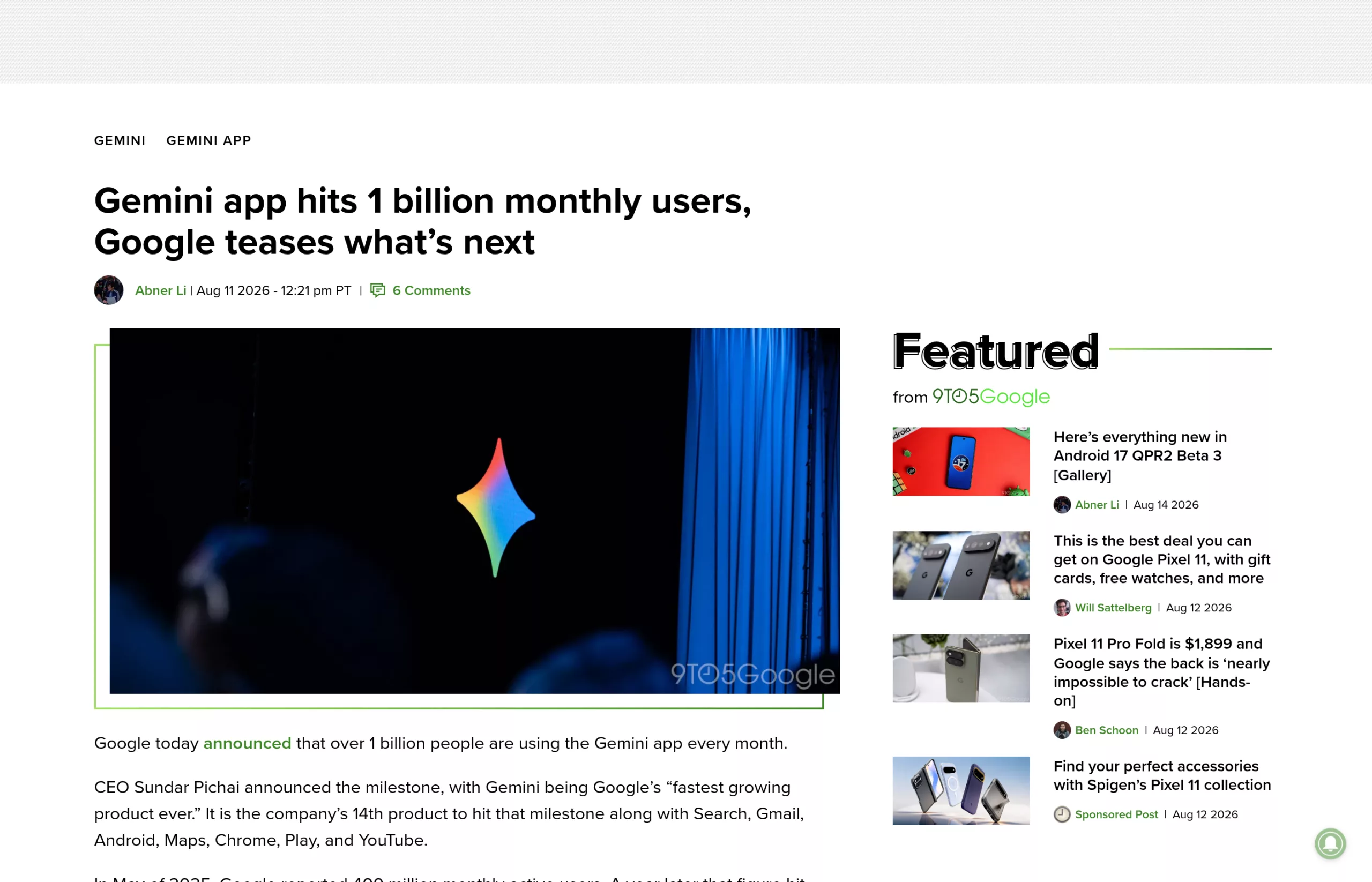
This billion-user mark puts Gemini alongside thirteen other Google products, including Search, Gmail, Android, Maps, Chrome, Play, and YouTube. It’s the fourteenth in-house name to reach it. This club mostly brings together services installed by default on billions of phones and computers.
Joining this list says nothing about how each user discovered the product. The figure measures presence, not preference.
From 400 million to a billion in fifteen months
In May 2025, at its annual Google I/O conference, Google announced that its Gemini AI app had 400 million monthly active users. Five months later, in October 2025, that total passed 650 million.
A year after the first figure, in May 2026, Google returned to the Google I/O stage to announce that the 900 million monthly active users mark had been crossed. Two months later, on July 22, 2026, Alphabet, Google’s parent company, published its second-quarter 2026 earnings. The app was credited with 950 million monthly active users there.
Just twenty days later, on August 11, 2026, Gemini crossed the billion mark. Between these two announcements, the monthly audience gained at least fifty million users in barely three weeks. This pace, more than the round number itself, sets this milestone apart from previous ones. In fifteen months, the app has more than doubled its monthly audience.
ChatGPT, developed by OpenAI, had crossed that same billion monthly active users threshold in June 2026, two months before Gemini. The world’s two most-used AI assistants therefore passed the same mark within a few weeks of each other.
What Google chooses to show
On August 11, 2026, Google published a series of figures on its official blog, the Keyword, to mark Gemini’s billion monthly active users milestone. These figures tell a story of usage, never of revenue or long-term user loyalty.
Here is the data Google highlights, with the exact figures from the post.
- 63% of users now talk directly to the assistant, with a rise in those who use voice only (the microphone, no keyboard).
- Busy parents use voice 43% more often for everyday tasks.
- One in five interactions with Gemini Live, the live conversation mode, goes beyond simple voice: camera feed and screen sharing to solve a problem, a use case popular with DIYers and students.
- 38% of school requests include an attachment, a photo of homework, or a document.
- Gemini generates more than 150 million images a day, a use Google links to small businesses producing their own marketing visuals.
- On Android, the assistant can automate actions across more than 40 popular apps, like booking a ride or a table.
- More than 100 million active users on iOS.
- On macOS, the most dedicated users turn to the assistant about twice as often as on other platforms.
Every line on this list answers a question Google chose to ask. How many speak aloud, how many attach a file, how many generate an image. No line says how many stick around after a month, or how many pay for a subscription. This choice isn’t misleading, a company communicates what serves its case.
The post ends with an avowed promise: « As we keep building for the next billion, our goal remains the same: to make Gemini the most personal, proactive, and powerful assistant. » This sentence states the ambition, the billion users states the scale. One measure is missing between the two, the one that matters most to a company, the money these uses generate.
The figure Gemini didn’t disclose
Neither the announcement on X nor the blog post gives the number of paying subscribers. The trade press flagged this absence within hours.
One figure stands out: more than 100 million active users on iOS. On iPhone, Gemini isn’t installed by default. Users have to open the App Store (Apple’s app marketplace), search for the app, and install it. It’s the only figure in the announcement that measures a deliberate action rather than a presence inherited from the system.
The contrast becomes clear next to Android, where the assistant is built into the system. Google states it can automate actions across more than 40 apps there without the user having installed anything themselves. A monthly active user refers to anyone who opened the app at least once during the month, nothing more. This figure says nothing about how often they return or their loyalty.
One distinction is worth keeping in mind: market share you win isn’t measured the same way as market share you distribute by default. The first case implies a choice, the second only implies already being installed on the device the user owns.
The AI industry is swallowing enormous amounts of capital, which makes the question of profitability more pressing than that of reach. A billion users is impressive. How many of them pay to stay?









0 Commentaires
Aucun commentaire pour le moment. Soyez le premier à commenter !