
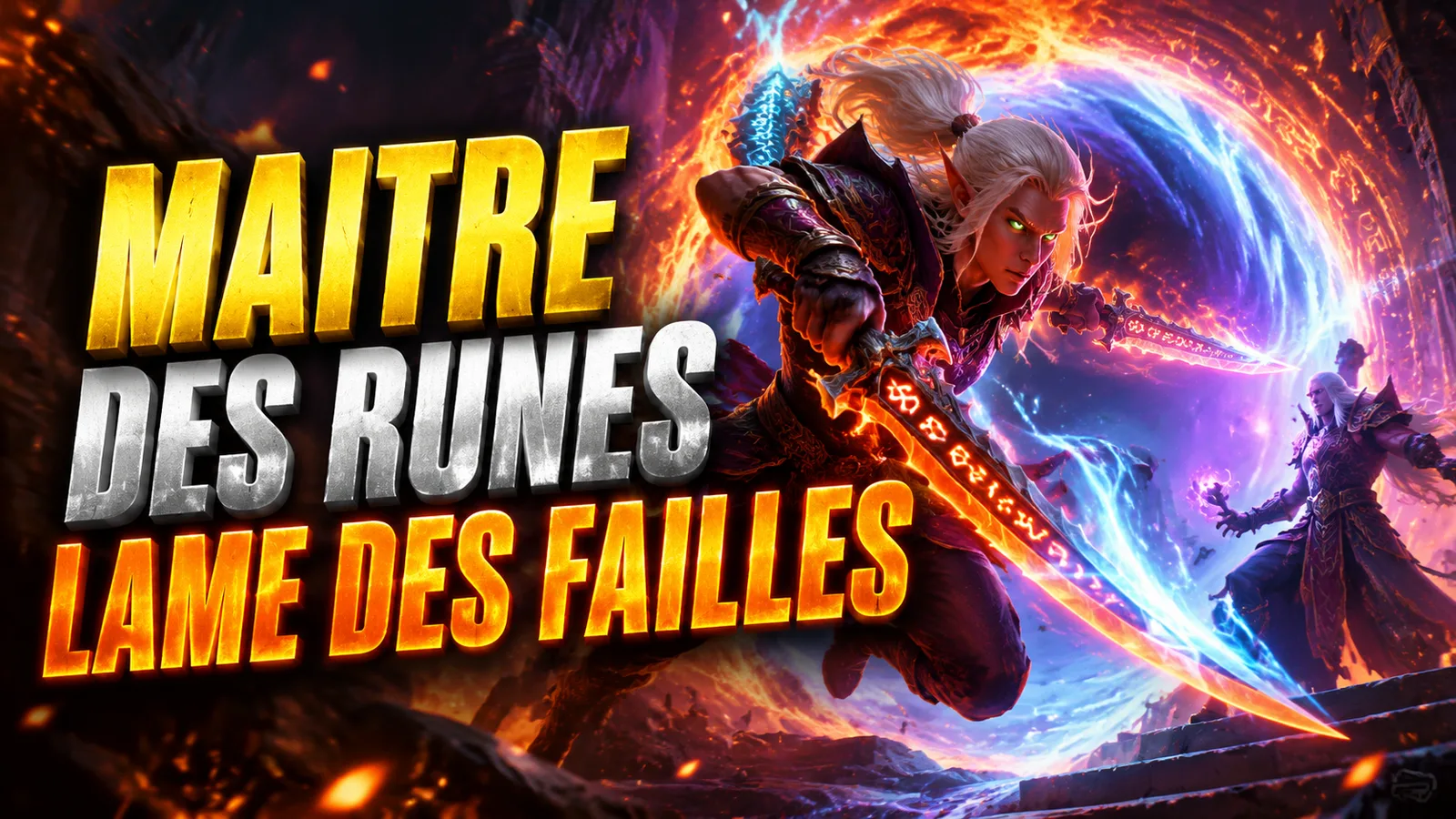
The mage-hunter: a two-handed weapon riding arcane rifts, packing a striking 8 defensive effects — built to close on casters, cut through their spells, and survive the answer.
Reactive, anti-magic melee with off-tank bones.
Your Primordial Blast and Smolder now refresh a charge of Runeblade. In addition, every 3rd Runeblade restores AP mana, boosted by 20% while Runic Tattoos: Water is active.
Plays like an Enhancement Shaman with a dash of Frost DK rune-mechanics: elemental-flavored weapon strikes (Smolder, Fracture, Hoarfrost, Hurricane) feed a proc-chain filler, Runeblade, itself relit by Windsage, Surging Slash and Spellfire Runes resets, while Primordial Blast and Zenith/Primordial Fury act as Lava Burst/Elemental Blast-style burst spenders. It's explicitly not a retail healing-spec analog — nothing like Chain Heal/Riptide anywhere — its 'support' reads closer to Enhancement's utility-bolted-onto-DPS identity (self-dispel via Magebreaker, a hard interrupt via Ley Lock, a Nature AoE zone via Turbulence) than to any dedicated healer profile.
How is this number calculated?
Measured scope: Zul'Gurub, Molten Core, Onyxia's Lair, all difficulties — High Priest Venoxis, High Priestess Jeklik, High Priestess Mar'li, Bloodlord Mandokir, High Priest Thekal, High Priestess Arlokk, Jin'do the Hexxer, Hakkar, Gri'lek, Gahz'ranka, Lucifron, Magmadar, Gehennas, Baron Geddon, Garr, Shazzrah, Golemagg the Incinerator, Sulfuron Harbinger, Majordomo Executus, Ragnaros, Basalthane, Onyxia.
These numbers come from Ascension Logs’ public combat logs, not an in-house guess.
The index compares each spec to the median player — the one sitting exactly in the middle of the ranking — on the same boss and the same group format: 1.00 matches that median player, 1.40 means 40% more damage than them. Only each player’s best fight counts, never their average — otherwise a player posting fifty fights would count as much as fifty different players, and averaging would mostly reward beginners still learning the spec rather than those who’ve mastered it. The comparison always happens on the same boss and the same format: a two-minute fight and a seven-minute one aren’t comparable, and a flex raid doesn’t give the same support as a 25-man.
Tiers (S, A, B…) aren’t picked by hand: the cutoffs are calculated from the real spread of every measured spec. A spec under 15 distinct players or 30 fights isn't ranked at all, rather than given a made-up grade.
How is this number calculated?
Mythic dungeons only — Ascension CoA has no Mythic+ tier yet (220 tracked encounters).
These numbers come from Ascension Logs’ public combat logs, not an in-house guess.
The index compares each spec to the median player — the one sitting exactly in the middle of the ranking — on the same boss: 1.00 matches that median player, 1.40 means 40% more damage than them. Only each player’s best fight counts, never their average — otherwise a player posting fifty fights would count as much as fifty different players, and averaging would mostly reward beginners still learning the spec rather than those who’ve mastered it. The comparison always happens on the same boss: 92.4% of dungeon fights are played in 5-player groups, and splitting by group size as well would discard more usable damage rows (4.5% lost against 1.4% when comparing by boss alone) for zero additional publishable spec — group size is therefore not part of the comparison.
Tiers (S, A, B…) aren’t picked by hand: the cutoffs are calculated from the real spread of every measured Dungeon spec — this column has its own distribution, it doesn’t reuse Raid’s cutoffs. A spec under 15 distinct players or 30 fights isn't ranked at all, rather than given a made-up grade.
Each performance above links to its own real combat report. Ascension Logs, however, doesn’t offer a rankings page covering every Mythic dungeon — unlike Raid, there’s no « View the source rankings » button here.
Ranking updated on August 29, 2026
The tree the best players actually run. Read from the top 10 Riftblade Runemasters in our player rankings for raids, of whom 1 has since switched specialisation and 1 was last recorded in a dungeon and 1 had no usable record, leaving 7. 35 of its 52 talents are identical across all 7, so they agree on the bulk of it and part ways on the rest. This exact tree is run by the 7th and 9th ranked players. Recorded on 16 August 2026.
The 56 points are a fixed budget, so no tree can take everything. The most common picks left out of this one: Prismatic Flow 71 %, Earthen Codex 57 %, Magic Feeder 57 %.
These talents are a PvE configuration. The Arena and Battleground grades shown above rate the specialisation’s PvP potential, not this tree.
See also: all Ascension builds · the talent tree builder
Talent data: ascension.gg
· Spec tiers & analysis: ascensionsidekick.com
Editorial rewrite, interactive talent tree, tooltips and fact-checking: KAMI LABS





4 Commentaires
Riftblade utilise une arme a 2 mains, donc l’intitulé ( doubles dagues ) correspond pas à la spé, les logs utilisés pour montrer le dps n’utilise pas la page de talent présentée. Du coup est ce que le guide est fiable?
Salut Jambonator, tes deux remarques sont fondées et la fiche est corrigée depuis quelques minutes. Sur l’arme d’abord : nos propres données de spé disent « Two-handed », avec la raison en clair, Fracture exige une arme à deux mains. La fiche affichait « Doubles dagues » parce qu’elle avait été rédigée d’après un champ de description inféré au lieu du champ mesuré. J’ai passé les 70 fiches au crible dans la foulée pour voir si d’autres avaient le même défaut : c’était la seule. Ton second point est plus fin. Les trois combats affichés viennent des logs publics d’Ascension Logs : ce sont de vrais joueurs, avec leurs propres arbres. Ils mesurent la performance de la spécialisation, pas celle du build présenté au-dessus. La fiche le disait, mais trop discrètement pour qu’on ne s’y trompe pas. La phrase précise maintenant que ces joueurs ont pu répartir leurs points autrement.
Riftblade n’utilise pas d’arme à une main… Riftblade utilise une arme à deux mains, ce tutoriel n’est PAS du tout correct.
Salut Ulkiorra, c’est corrigé. La fiche annonçait « Doubles dagues » alors que nos propres données de spécialisation disent « Two-handed », avec la justification en clair : Fracture exige une arme à deux mains. L’erreur venait d’un champ de description inféré, utilisé à la place du champ mesuré au moment de la rédaction. Un autre lecteur avait signalé la même chose la veille. Deux remontées indépendantes en deux jours sur le même point, ça ne laisse pas beaucoup de place au doute. J’en ai profité pour auditer les 70 fiches Ascension : aucune autre ne présente ce défaut.