
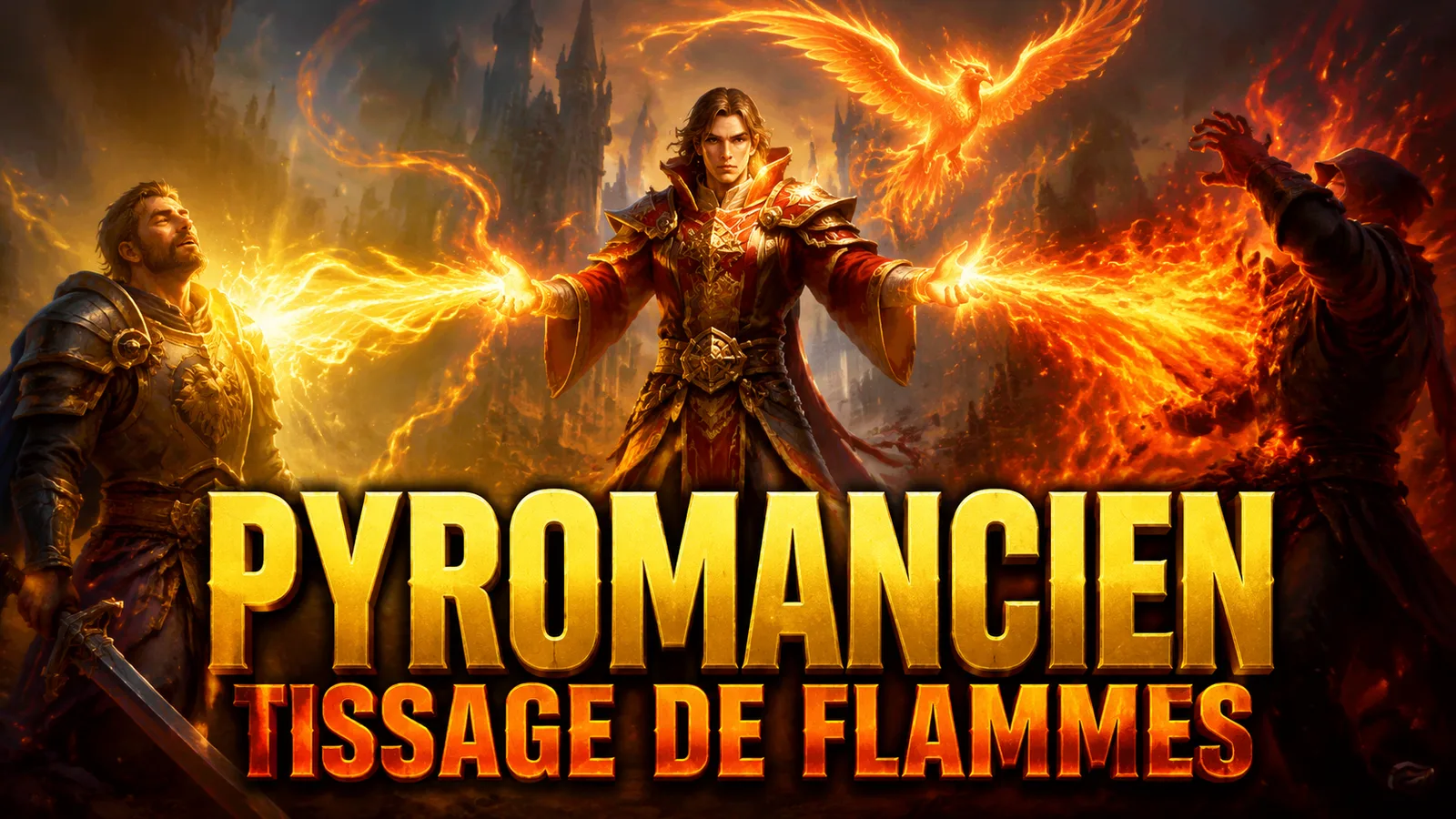
Flameweaving heals and fights off the same button bar: Kindle and Cinderheart are the cast-time heals, Ember Touch is the instant Ember-spender burst heal — no cast time, so it keeps healing right through an interrupt — and Cleansing Flames damages enemies and heals allies at once in the same frontal cone, so 'dealing damage' and 'healing' a group skirmish are often literally the same cast. On the damage side it weaves Flare Bolt (builds Flamecasting stacks toward haste and crit) and Lava Shard, feeding a Heat/Ember economy that funds the Ember-spender heals.
The cooldown layer is defensive and Phoenix-flavored rather than a CC lockdown kit: Inferno Barrier's absorb, Phoenix Dive's dash-and-shield, and the Phoenix Egg / Roaring Pyre / Kael's Command healing zones, backed by a passive death save — Spirit of the Phoenix. The real skill test is positioning: Cleansing Flames only pays off when the cone is lined through allies AND enemies correctly, and the Phoenix zones only heal whoever is actually standing in them.
A hit that would otherwise kill you instead transforms you into the Spirit of the Phoenix for 15 seconds: your spells cost no mana and your Spirit is increased by 100%. You are reborn at the end of the transformation. Can only trigger once every 10 minutes.
The closest retail analog is Preservation Evoker, mechanically more than thematically. Cleansing Flames is a miniature Living Flame / Dream Breath (one cast that heals allies or damages enemies depending who's in front of you), Phoenix Dive is a dash-shield like Rescue/Zephyr repositioning, and Inferno Barrier's absorb echoes Renewing Blaze/Obsidian Scales-style mitigation. The one thing retail Preservation doesn't have that this spec does is a hard cheat death (Spirit of the Phoenix) — closer to the old Priest Spirit of Redemption, layered onto an Evoker-shaped hybrid kit.
How is this number calculated?
Measured scope: Zul'Gurub, Molten Core, Onyxia's Lair, all difficulties — High Priest Venoxis, High Priestess Jeklik, High Priestess Mar'li, Bloodlord Mandokir, High Priest Thekal, High Priestess Arlokk, Jin'do the Hexxer, Hakkar, Gri'lek, Gahz'ranka, Lucifron, Magmadar, Gehennas, Baron Geddon, Garr, Shazzrah, Golemagg the Incinerator, Sulfuron Harbinger, Majordomo Executus, Ragnaros, Basalthane, Onyxia.
These numbers come from Ascension Logs’ public combat logs, not an in-house guess.
The index compares each spec to the median player — the one sitting exactly in the middle of the ranking — on the same boss and the same group format: 1.00 matches that median player, 1.40 means 40% more damage than them. Only each player’s best fight counts, never their average — otherwise a player posting fifty fights would count as much as fifty different players, and averaging would mostly reward beginners still learning the spec rather than those who’ve mastered it. The comparison always happens on the same boss and the same format: a two-minute fight and a seven-minute one aren’t comparable, and a flex raid doesn’t give the same support as a 25-man.
Tiers (S, A, B…) aren’t picked by hand: the cutoffs are calculated from the real spread of every measured spec. A spec under 15 distinct players or 30 fights isn't ranked at all, rather than given a made-up grade. For healing specs, only fights where the player actually healed are counted — several healing specs are often played for damage, and counting those would unfairly drag their score down.
How is this number calculated?
Mythic dungeons only — Ascension CoA has no Mythic+ tier yet (220 tracked encounters).
These numbers come from Ascension Logs’ public combat logs, not an in-house guess.
The index compares each spec to the median player — the one sitting exactly in the middle of the ranking — on the same boss: 1.00 matches that median player, 1.40 means 40% more damage than them. Only each player’s best fight counts, never their average — otherwise a player posting fifty fights would count as much as fifty different players, and averaging would mostly reward beginners still learning the spec rather than those who’ve mastered it. The comparison always happens on the same boss: 92.4% of dungeon fights are played in 5-player groups, and splitting by group size as well would discard more usable damage rows (4.5% lost against 1.4% when comparing by boss alone) for zero additional publishable spec — group size is therefore not part of the comparison.
Tiers (S, A, B…) aren’t picked by hand: the cutoffs are calculated from the real spread of every measured Dungeon spec — this column has its own distribution, it doesn’t reuse Raid’s cutoffs. A spec under 15 distinct players or 30 fights isn't ranked at all, rather than given a made-up grade. For healing specs, only fights where the player actually healed are counted — several healing specs are often played for damage, and counting those would unfairly drag their score down.
Each performance above links to its own real combat report. Ascension Logs, however, doesn’t offer a rankings page covering every Mythic dungeon — unlike Raid, there’s no « View the source rankings » button here.
Ranking updated on August 29, 2026
The tree the best players actually run. Read from the top 10 Flameweaving Pyromancers in our player rankings for raids, of whom 1 was last recorded in a dungeon, leaving 9. 30 of its 50 talents are identical across all 9, so they agree on the bulk of it and part ways on the rest. This exact tree is run by the 8th ranked player. Recorded on 18 August 2026.
The 56 points are a fixed budget, so no tree can take everything. The most common picks left out of this one: Hellscape 78 %, Neltharion’s Resolve 67 %, Invigoration 67 %.
These talents are a PvE configuration. The Arena and Battleground grades shown above rate the specialisation’s PvP potential, not this tree.
See also: all Ascension builds · the talent tree builder
Talent data: ascension.gg
· Spec tiers & analysis: ascensionsidekick.com
Editorial rewrite, interactive talent tree, tooltips and fact-checking: KAMI LABS







0 Commentaires
Aucun commentaire pour le moment. Soyez le premier à commenter !