
This guide to Ascension Season 10 draws on ChoppLock’s video, a well-known voice in the French community, who walks step by step through how to approach this unusual server. Here’s the essential rundown to lay solid foundations before you dive in.
Season 10 just launched, and plenty of players are flocking to Ascension right now. Many arrive with classic World of Warcraft habits in mind, only to realize nothing here works the way they expect. No class to pick, no forced specialization — a mode built entirely around freedom to build your own character. For those also worried about the language barrier, know that playing entirely in French is possible thanks to a translation addon. This article covers character creation, the spell and talent system, the best leveling methods, and prestige, the mechanic that shapes long-term progression.
Ascension Season 10: a classless WoW
Ascension Season 10 launched last week. Tons of new players are arriving right now — some have already finished everything, others are just discovering the server. Many feel lost, and that’s understandable. This mode has nothing in common with classic World of Warcraft.
Ascension runs in classless mode, a WoW with no predefined classes. Nobody picks « warrior » or « mage » when creating a character. Each player picks up spells from every class in the game and combines them into their own build, with its own strengths and weaknesses.
Dark Moon or Wildcard: two ways to build your character
Ascension offers two servers for building your character, each with an opposite philosophy. On Dark Moon, you choose every spell yourself and place talent points according to your own logic. Progression follows your choices, not chance. On Wildcard, allocation relies much more heavily on randomness. Spells and talents drop as you level up, without you directly deciding what you get. Both philosophies lead to the same goal: building a combination of spells that reflects your playstyle.
Progression starts at level 10 in both modes. The acquisition pace then follows a fixed rhythm, whichever option you choose.
- A new talent every 4 levels
- A new spell every 2 levels
The character then takes shape as you play. Dungeons, PvP fights, quests — every bit of content Ascension offers rewards scrolls that let you gradually fine-tune this spell combination as you progress (more on this system a bit further down).
Level scaling and creating a classless character
Before diving into the heart of the matter, a quick stop at character creation is in order. The first thing to turn on is level scaling. This option raises monster levels so they always match yours, instead of staying fixed to their original zone.

Without this option, monsters can outlevel you. As a result, quests turn grey, the color that signals they no longer give any reward. With scaling on, monsters always stay within your range, at least green. So you can go back to zones you’ve long outleveled and keep earning experience there. A valuable option for exploring the world without worrying about the recommended level.
Once that option is checked, it’s time for character creation itself. No class to select here. The character starts out raw, with no specialization, no predefined combat identity. Once in-game, a button appears in the center of the screen. That’s what gives you access to the starter kit.
The starter kit: choose, lock, reroll before level 10
The button from the previous section opens a spell draw. The pool mixes several World of Warcraft classes, with druid spells, paladin spells, summoning spells, and plenty more. Four slots need filling right from level 1. Some of the spells offered are modified versions of their original. A Thunder Clap can deal holy damage instead of the usual physical damage. A warrior spell might end up converted into a frost attack, handy for building a frost-focused character. Holding the Shift key shows extra information on each spell offered, useful for comparing before you decide.

A small padlock appears above each slot. Clicking it locks the spell you want to keep. All the other slots can then be rerolled — that’s the in-game term for drawing a new random spell — without touching the one already locked. This detail changes everything for a beginner. It lets you keep a good spell found by chance, like a holy Thunder Clap, and keep looking for the other three without starting from scratch every attempt. Between level 1 and level 9, these rerolls are unlimited. No reason to settle for the first kit you get.
Level 10 changes everything. Past that point, the four starting spells lock in permanently. There’s no rerolling them once that threshold is crossed. Hence the value of taking your time beforehand, locking in the right spells one by one, and refining the kit until you get a satisfying combination. After level 10, the only way to replace a disappointing spell is through scrolls earned by playing, which can put a specific slot back up for grabs.
Leveling up: quests, battlegrounds, dungeons and Manastorm
This same scroll system, called Scrolls of Fortune, keeps accompanying your progression afterward, whether you’re targeting a specific spell or talent. Once level 10 is reached through classic questing, two major experience routes open up on Ascension Season 10. Battlegrounds suit PvP fans, with balance considered solid. And then there’s the Manastorm, an Ascension specialty found on no other server.
The Manastorm works like a mini dungeon playable solo, in a duo, a trio, or a raid group. Scaling applies between levels 10 and 59, which lets you form a group with friends or strangers of very different levels without penalizing anyone. Each run spawns between 1 and 15 bosses, whether open-world bosses or bosses normally reserved for dungeons. The system runs on tiers, and the higher the tier, the better the rewards and the more experience you earn. It’s the fastest method for gaining levels on this server.
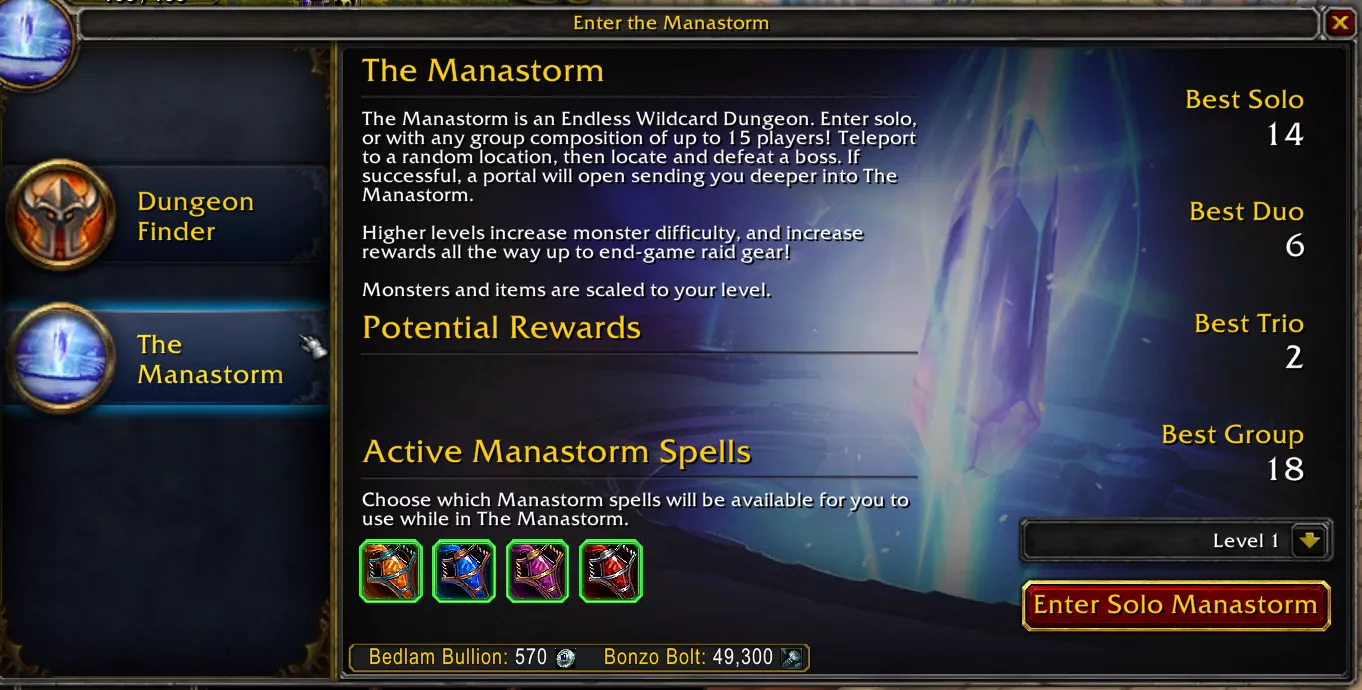
Starting at level 15, classic dungeons join the list of options. Their experience is boosted compared to other versions of Ascension, making them a credible alternative to the Manastorm once you cross that threshold. Between quests, battlegrounds, dungeons and the Manastorm, the choice of leveling method remains entirely up to you.
The experience bonuses that speed up leveling
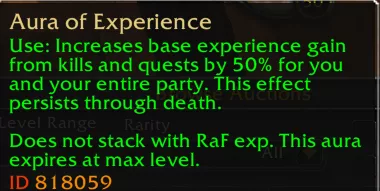
Leveling, the character’s level progression, also depends on a few experience bonuses picked up along the way. Three items display very precise numeric effects in their tooltip, making them easy to spot. Aura of Experience increases base experience earned from kills and quests by 50%. The bonus benefits the wearer and their entire group. It stays active even after the character dies. It doesn’t stack with Recruit a Friend experience, and it stops on its own once the max level is reached.
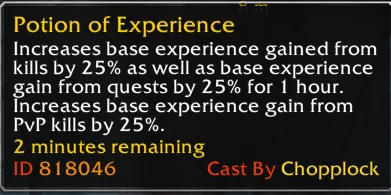
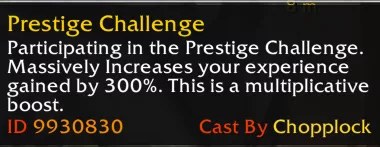
Potion of Experience works on a different principle. It adds 25% experience on kills, 25% on quests for one hour, and 25% on kills scored in PvP — three distinct effects active at the same time. The Prestige Challenge, for its part, promises 300% extra experience to those who take part. Unlike the previous two, this bonus is multiplicative. It multiplies the experience already earned from other sources, instead of simply adding to it as a flat percentage.
Prestige and Mark of Ascension
Once level 60 is reached, prestige becomes available, a new mechanic that redefines progression. The principle is simple. Your character goes back to level 1. It’s still the same character. You keep your professions, and all your level 60 gear goes straight into your bags. You start fresh from a neutral base, but with extra cards in hand.
- What stays the same at prestige: the character, the professions
- What goes into your bags: the level 60 gear
- What starts over: the level, reset to 1
- What gets added: the skill cards earned through scrolls
Prestige is the main method for optimizing a character during the season. It’s also the one that earns you the most Mark of Ascension, a small yellow currency you accumulate as you play. These marks are used to buy scrolls to reroll your spells. Each scroll bought grants a card. Skill cards can be checked at the bottom of the talent tree page.
These cards define your starting point at each new prestige. A rogue player, for example, might start directly with Sinister Strike, then add the warrior’s Whirlwind to their skill base. Over time, the range of available cards expands enormously. After thirteen or fourteen prestiges on a main account, the choice becomes wide.
Your very first character has access to no cards at all. The early game is therefore limited, and feeling useless in combat is common at this stage. That’s normal. The first prestige unlocks the very first cards. It’s the true foundation of the Ascension Season 10 server — without it, no optimization is possible.
Spell modifiers and golden cards: building your build
Building a build on Ascension Season 10 means tuning the spells and talents you have to work together. Many spells exist in several versions. These variants are modifiers — they change the behavior of the original spell, sometimes even its spell school. The mage’s Pyroblast, for instance, has an Arctic version, a spell added to the server. Starfire follows the same logic with its Astral version, which switches its spell school to match other chosen spells. To spot these links, just hold the Shift key over a spell. The game then shows whether it’s a modifier of another one. It’s this bit of theorycrafting — optimizing the character on paper before playing — that pushes you to start from a central spell like Starfire and look for the talents that coordinate with it.
Once that coordination is found, the build comes together with up to three talents placed at the top, rounded out with golden cards. These golden cards can’t be bought directly. You get them by stacking duplicates of normal cards, which turn into packs of golden cards once a certain threshold is reached. They therefore stay rare. You need to already own a substantial collection of normal cards before you can start unlocking them.
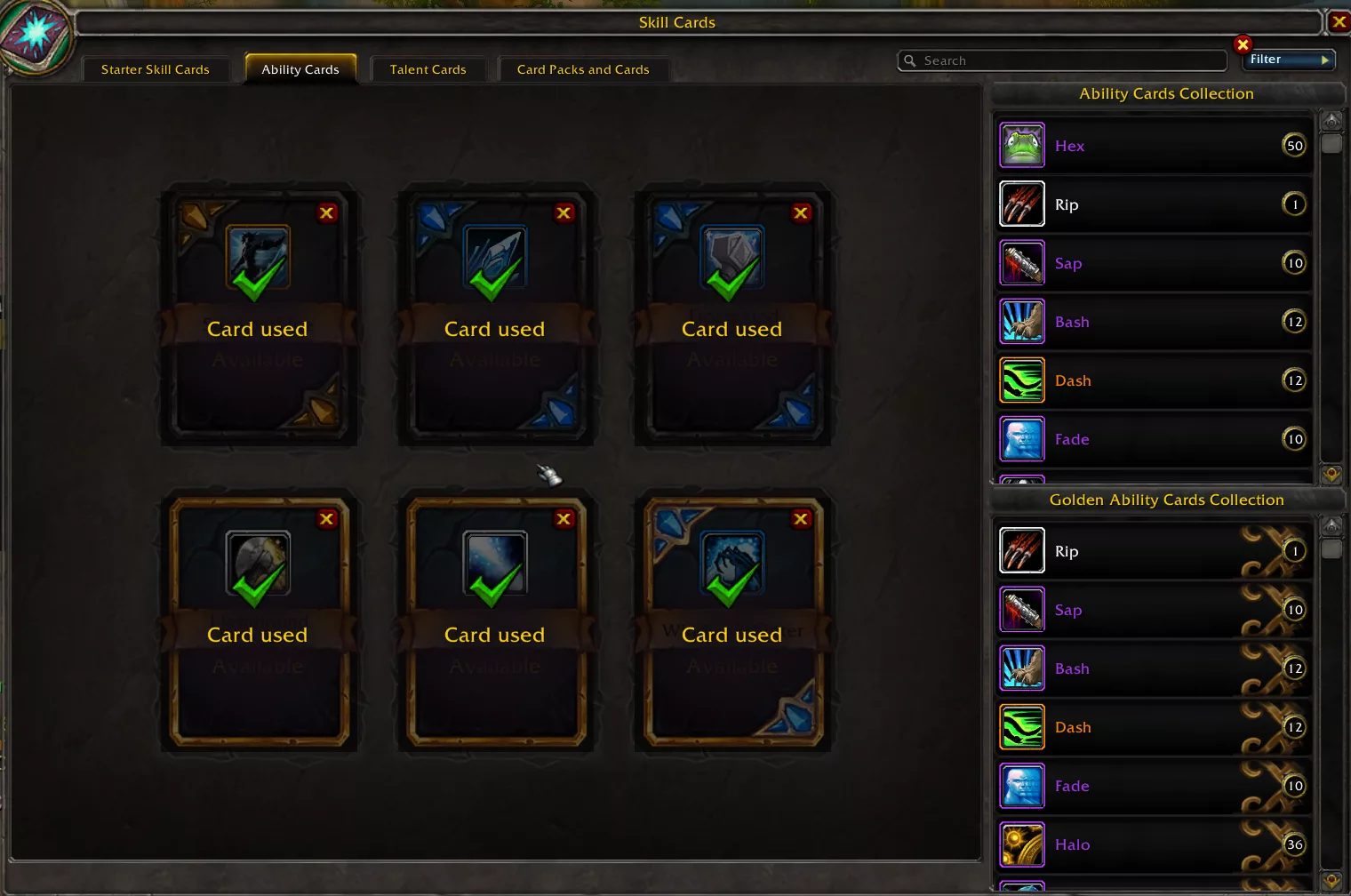
Below each talent or spell is the level at which it unlocks, which lets you plan the build well before you actually have it complete. Once the cards are placed, all that’s left is to resume leveling up to level 60. Along the way, the game’s content hands out scrolls and other refinement items, useful for removing talents you received but that don’t suit the chosen build, and for fine-tuning the character as you progress.








0 Commentaires
Aucun commentaire pour le moment. Soyez le premier à commenter !